論文解説
Projected Neural Additive Models as Universal Approximators
万能近似器としてのProjected Neural Additive Models
- 課題 NAMは解釈しやすい一方で、交差する変数どうしの相互作用を表現できません。MLPは万能近似の性質を持ちますが、透明性は低いです。
- 手法 学習可能な線形投影Tを NAMの前段に置き、投影空間上の単変数MLP基底の和で予測するPNAMを提案します。
- 結果 PNAMは万能近似器であり、Cs関数に対してM^(-s/(N-1))の近似率を持つことが証明されています。結び目分類では、投影数が大きくなるほどNAMより高い精度を示します。
NAMの表現力の限界とPNAMの動機
ニューラルネットワークの解釈可能性を高めるために提案されたニューラル加法モデル(NAM)は、各入力変数の単変数関数をそれぞれ独立したMLPで学習し、その和で予測します。この構造は特徴ごとの解釈を容易にしますが、交差偏導関数が恒等的に0になるため、χ1χ2のような交差変数の相互作用は表現できません。一方、多層パーセプトロンは万能近似の性質を持つものの、予測の構造は不透明です。この論文は、NAMに学習可能な線形変換Tを加えた投影ニューラル加法モデル(PNAM)がこの隔たりを埋められるかを扱っています。入力をz=Tχで投影してから単変数関数の和で予測するため、投影空間では相互作用を捉えつつ、加法構造を保てます。
投影と単変数基底の構成
PNAMは式(2)のように、予測値をζiとMLPiの積の和として書き、各MLPiは投影成分ziについて定義された単変数関数です。この論文では高周波成分を捉えるため、MLPの入力の前にFourier特徴写像γi(zi)=[cos(2πBi zi), sin(2πBi zi)]を置きます。行列Biの要素はN(0, σ²)からサンプリングされ、初期化後は固定されます。正則化項は、重みθに対するℓ1、基底値の大きさに対するℓ2、Tに関するSVDベースの直交性のずれℓ3、そしてTとζに対するL1項ℓ4、ℓ5から構成されます。論文では、ℓ3がTを軸に揃った対角形に近づける構造的な事前分布として働くと説明しており、これは交差結合が経験的損失を十分に減らす場合にのみ導入されるという条件付きで示されています。
万能近似と近似率の結果
理論の中心は多項式表現定理です。論文では、任意の多変数多項式Fが、投影zi=Σj Tij χjと単変数多項式giの和として厳密に表せることを帰納法で示しており、投影数Mは(deg F+1)^(N-1)以下に抑えられます。この結果とStone–Weierstrassの定理を併せると、コンパクトな定義域上でPNAMが任意の連続関数を所望の精度で近似できることが導かれ、これを定理2.1としています。定理2.2は、Cs関数について近似誤差がM^(-s/(N-1))の割合で減少すると主張しており、これはJackson定理と多項式表現の投影数の上限から得られるとされています。これらの結果は条件付きで成り立つ存在の結果であり、学習アルゴリズムがその表現を見つけることを保証するものではありません。
結び目不変量の分類実験
結び目の符号数予測実験は、17個の幾何学的不変量を入力として14クラスに分類します。論文では、Mが大きくなるほど精度が単調に増加すると述べられています。すべてのモデルは2つの隠れ層(64、32ニューロン)を使い、テスト精度は10回の実行の平均と標準偏差で集計されます。この結果は、この実験設定での比較であり、他のタスクやデータセットに一般化できる結論ではありません。
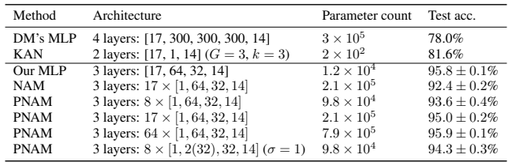
Table 1 : Performance comparison of different neural network architectures for the multi-class classification problem of predicting the signature of mathematical knots. The first two rows are reproduced from Table 3 of Liu et al. [14]; see [14] for definitions of G and k. For the remaining rows, the mean and standard deviation of the test accuracy are computed over 10 runs. The last row incorporates the Fourier feature mapping described in Eq. (4).
出典 · CC BY 4.0 · Nhon N. Phan, Qiang Du, John D. Clayton, WaiChing Sun · Projected Neural Additive Models as Universal Approximators · 論文の図を引用 · 元のPDFの8ページ目から図の部分を抽出しています。寄与度の順位と入力の枝刈り
解釈可能性の実験では、学習したTの列ごとの平均絶対係数を入力の寄与度の代理指標として使います。M=8のPNAMで上位3つの入力のみを残した場合、テスト精度は78.1%でした。この順位では、Re(meridional translation)とlongitudinal translationが複数の実行で上位に現れます。論文は、この順位がℓ2正則化が有効で適切に調整された場合に限られる経験的な性質であり、構造的に保証されるものではないと制限しています。また、順列重要度や勾配感度との順位相関も報告されていますが、これは同じモデルに対する複数の代理指標の比較です。
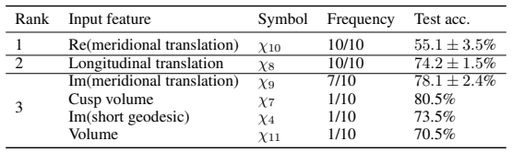
Table 2 : Ranking of important features based on the mean absolute coefficients for the PNAM with M= 8 (without the Fourier feature mapping) in Table 1. The mean and standard deviation of the test accuracy (associated with retaining only the top n features) are computed over the runs in which the topnfeatures appeared.
出典 · CC BY 4.0 · Nhon N. Phan, Qiang Du, John D. Clayton, WaiChing Sun · Projected Neural Additive Models as Universal Approximators · 論文の図を引用 · 元のPDFの9ページ目から図の部分を抽出しています。解釈性と最適化の限界
論文は、PNAMがグローバルな解釈可能性は提供する一方で、個々の入力の局所的な寄与を直接示すものではないと述べています。基底gijは投影変数zjについて定義されるため、元の入力χkが出力に与える影響を単独で読み取ることはできません。また、PNAMは予測モデルであり因果モデルではないため、大きな係数は予測的な影響を意味しますが、因果を意味するものではありません。最適化の面では、万能近似と近似率は存在に関する結果であり、同時最適化問題は非凸で、Mと正則化重みに敏感です。記号回帰は、実験では基底ごとに1分だけ実行されたため、複雑な関数に対しては近似的なものにとどまる可能性があります。
論文情報
- 著者
- Nhon N. Phan, Qiang Du, John D. Clayton, WaiChing Sun
- 学会・ジャーナル
- arXiv · プレプリント
- 公開日
- 2026年11月6日
- 登録日
- 2026年11月10日
- 更新日
- 2026年11月6日
- バージョン
- v1
- arXiv
- 2611.10186
- カテゴリ
- cs.LG
- ライセンス
- CC BY 4.0
- 掲載内容
- 論文情報・解説・論文の図
この解説は、Refivuの韓国語解説をAIで翻訳したものです。不正確な翻訳や誤りが含まれる可能性があります。論文と図の利用条件は各出典に従います。
アブストラクト
Neural additive models (NAMs) offer interpretability but lack expressivity due to their rigid additive structure, whereas multi-layer perceptrons (MLPs) achieve universal approximation at the cost of transparency. We establish the first theoretical foundation for projected neural additive models (PNAMs), which augment NAMs with a learnable linear transformation $\boldsymbol{T}$ to capture cross-variable interactions. While standard NAMs cannot approximate even the simplest interaction term $χ_1 χ_2$ because their cross-derivatives are identically zero, we prove that PNAMs are universal approximators and characterize the minimum number of projections required for exact polynomial representation. Furthermore, we derive an approximation rate of $\mathcal{O}(M^{-s / (N - 1)})$ for $\mathcal{C}^s$ functions (i.e., functions with $s$ continuous derivatives), where $M$ denotes the number of projections and $N$ the input dimension; this rate is known to be optimal for ridge function approximation. To recover interpretability from the projected inputs, we introduce structured sparsity regularizers and post-hoc symbolic regression techniques that enable global input ranking, parameter pruning, and the conversion of learned bases into compact analytical expressions. Experiments on knot theory invariants, MNIST, and phase field fracture mechanics demonstrate that PNAMs match or surpass similar architectures in accuracy while discovering salient features and yielding symbolic models with orders of magnitude fewer parameters.
この論文を引用
Nhon N. Phan, Qiang Du, John D. Clayton, WaiChing Sun (2026). Projected Neural Additive Models as Universal Approximators. arXiv:2611.10186v1. https://arxiv.org/abs/2611.10186v1
BibTeX
@misc{phan2026projected,
  title = {{Projected Neural Additive Models as Universal Approximators}},
  author = {Nhon N. Phan and Qiang Du and John D. Clayton and WaiChing Sun},
  year = {2026},
  eprint = {2611.10186},
  archivePrefix = {arXiv},
  url = {https://arxiv.org/abs/2611.10186v1}
}