論文解説
Science Prediction Universe
科学予測ユニバース
- 課題 実験結果を実験前に予測する能力は科学理論の信頼性を左右しますが、測定によってのみ答えが決まる問題は既存の評価では測りにくいです。
- 手法 測定値を隠した実験候補の順位をエージェントに提出させ、隔離された採点でSpearman相関を計算します。
- 結果 公開課題では最高の課題補正平均が0.478で、非公開16課題では13設定中12設定がランダムより有意に高い結果でした。
実験結果を予測する問題
科学研究では、実験結果を実験の前に予測する能力が、理論の信頼性を測る基準となります。ただし電気化学や酵素工学のように、答えが計算ではなく測定によってのみ決まる問題は、文献検索や計算ツールを備えたエージェントにとっても依然として難しいです。この論文は、この空白を埋めるために、測定値を隠した状態で実験候補の順位を当てるベンチマークを作成しています。各課題では、実験設定、匿名化された実験識別子、比較グループ、測定の定義を与えます。エージェントは、測定値の低い順から高い順に並べた rankings.json を提出します。
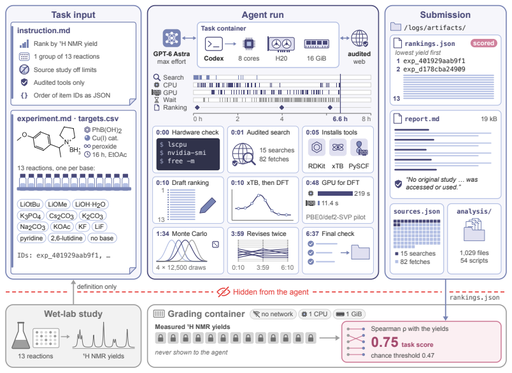
Figure 2 :The SPU setting, shown with one official run.Left, the task: rank 13 copper-catalyzed deaminative arylations of one amine-borane, which differ only in the base additive, by measured 1H NMR yield. Middle, GPT-6 Astra at max reasoning effort worked in Codex for 6.6 of the 8 available hours, reaching the web only through the audited service and revising its ranking twice. Right, the files the run submitted. Bottom, the measured yields stay in a separate grading container and are never shown to the agent; this submission scores 0.75, above the task’s chance threshold of 0.47.
出典 · CC BY 4.0 · 元のPDFの3ページ目から図の部分を抽出しています。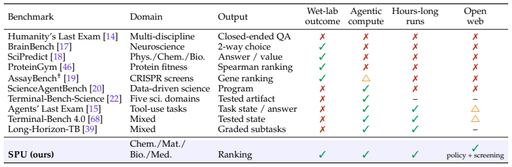
Table 4 :SPU compared with related evaluations.Wet-lab outcome: the target is a measured experimental result.Agentic compute: the model runs code and scientific software of its own choosing. Hours-long runs: a single run may last hours (Terminal-Bench 4.0: 8 h limit).Open web: retrieval is allowed during the run (△: allowed with an instruction not to look up answers, but not audited). ✓ yes, △ partly, ✗ no, – not stated in the release. †AssayBench evaluates agent baselines alongside direct LLM prediction.
出典 · CC BY 4.0 · 元のPDFの36ページ目から図の部分を抽出しています。課題の構成と採点方法
公開課題100個は、2025年以降のNature Portfolio系列の論文85編から作られました。専門家らは再現性の高い研究を選び、単調な傾向しか残らない比較と、測定誤差の範囲内にある比較を除外しました。採点は隔離されたコンテナ内で行われ、各比較グループのSpearman相関をグループの重みで合算したStでスコアが付けられます。ランダムに作られた有効な順位の期待スコアは0です。課題ごとのランダム基準は、4,000個のランダム提出の95パーセンタイルで決められます。非公開課題16個は、未発表のwet-lab実験から得られたものです。
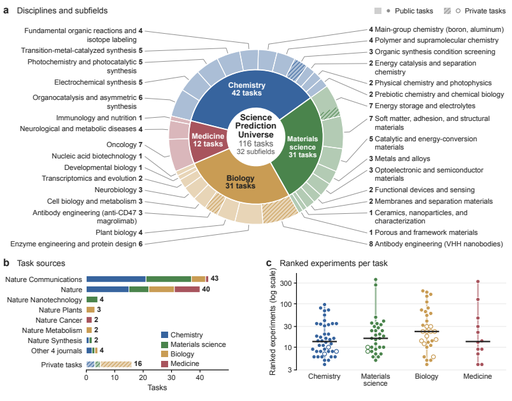
Figure 3 :Coverage of the Science Prediction Universe. a, The 116 tasks by discipline and subfield; sector angles are proportional to task counts, and hatching marks private tasks.b, Sources of the tasks: 85 papers in 11 Nature Portfolio journals, published online between January 2025 and August 2026, for the 100 public tasks, and four series of unpublished wet-lab experiments for the 16 private tasks; journals with one source paper are pooled.c, Number of experiments in each task on a logarithmic scale, with open circles for private tasks and black ticks at discipline medians.
出典 · CC BY 4.0 · 元のPDFの6ページ目から図の部分を抽出しています。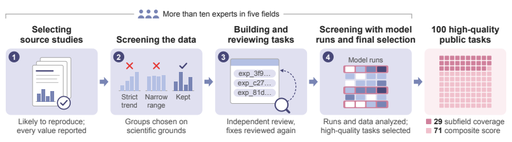
Figure 4 :Public Task Construction.More than ten experts in five fields built the public tasks in four steps. Step 2 avoids two kinds of comparison (crossed charts): orderings that rise or fall strictly with one varied parameter, and values that differ only slightly. In Step 3, each task is reviewed independently, and a task with a blocking issue is fixed and reviewed again (dashed arrow). Step 4 selects tasks by pilot scores, mainly those of GPT-6 Astra; the 100 squares on the right are the public tasks, 29 giving every subfield a task and 71 chosen by composite score.
出典 · CC BY 4.0 · 元のPDFの7ページ目から図の部分を抽出しています。公開課題の結果
公開課題では、最高のタスク補正平均はOpus 5.5の0.478でした。設定は大きく二つの階層に分かれ、上位6設定は0.393から0.478、残りの7設定は0.227から0.315の範囲にありました。採点された課題のうち、ランダム基準を上回った割合は34%から52%の間でした。Astra MediumはAstra Maxより、タスク補正平均が0.022高く、両設定は推論の強度だけが異なります。そのため、実行時間が長くなっても、検出可能な精度向上にはつながりませんでした。
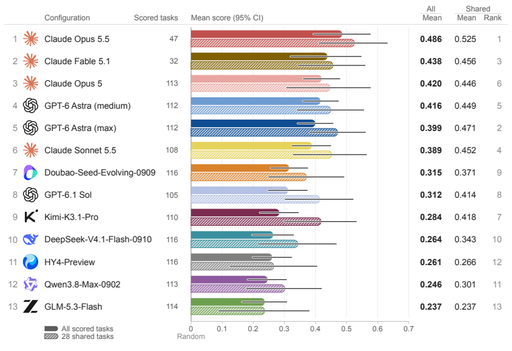
Figure 1 :Configurations ranked by mean score on all scored tasks.Solid bars are means over the tasks, among the 100 public and 16 private tasks, on which the configuration has a scored run (Scored tasks). Hatched bars are means over the 28 shared tasks, the 27 public tasks and one private task on which all thirteen configurations have a scored run; the far-right column ranks the configurations on these tasks. Claude Opus 5.5 and Claude Fable 5.1 ended most of their runs in safety refusals, mainly on chemistry, biology and medicine tasks, so they are scored on fewer tasks and only 28 tasks are shared by all thirteen configurations, against 94 shared by the other eleven. Lines are 95% bootstrap intervals over tasks, with the same resampled tasks for every configuration on the shared tasks. A perfect ranking scores 1, and random rankings average 0. GPT-6 Astra ran in Codex at medium and max reasoning effort, GPT-6.1 Sol in Codex at max effort, and the other models in Claude Code at max effort.
出典 · CC BY 4.0 · 元のPDFの2ページ目から図の部分を抽出しています。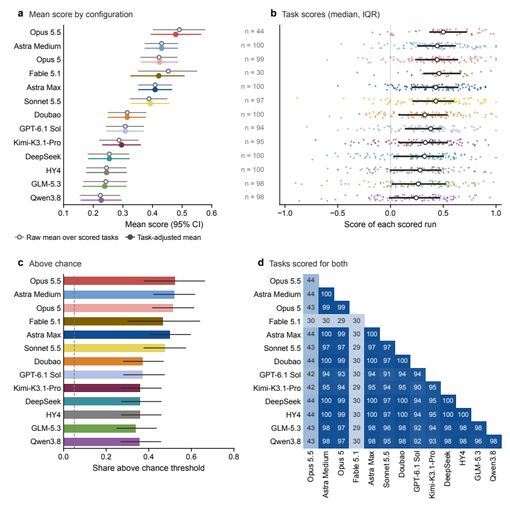
Figure 9 :Coverage and scores on the public tasks. a, Raw mean (open circles) and task-adjusted mean (filled circles), with 95% bootstrap intervals over tasks; n is the number of scored tasks.b, Scores of all scored runs, with medians and interquartile ranges.c, Share of scored tasks whose score exceeds the task’s chance threshold, with Wilson 95% intervals; the dashed line marks the 5% expected from random rankings.d, Number of tasks scored for both configurations of each pair.
出典 · CC BY 4.0 · 元のPDFの13ページ目から図の部分を抽出しています。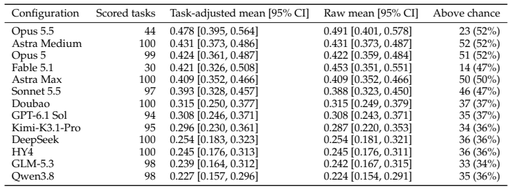
Table 1 :Results on the public tasks.Configurations are ordered by task-adjusted mean, and brackets give 95% bootstrap intervals over tasks. Above chance counts the scored tasks whose score exceeds the task’s chance threshold (Section 2.5).
出典 · CC BY 4.0 · 元のPDFの14ページ目から図の部分を抽出しています。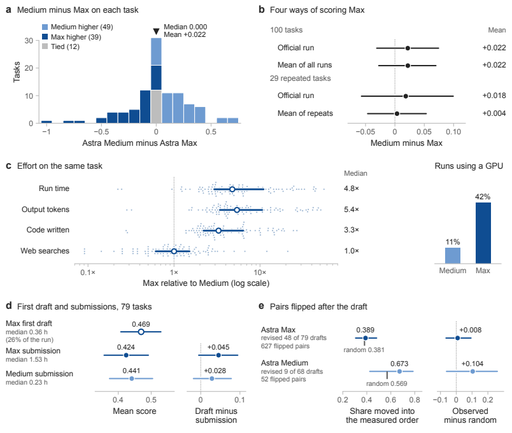
Figure 24 :The same model at two reasoning efforts. a, Difference in score between Astra Medium and Astra Max on each of the 100 public tasks.b, Mean difference under four ways of scoring Max, with 95% bootstrap intervals.c, Ratio of Max to Medium on the same task for run time, output tokens, code written and web searches, and the share of runs that used a GPU.d, Score of Max’s first complete ranking, of its own submission and of Medium’s submission on the tasks where that draft is visible, and the draft minus each submission, with 95% intervals.e, Share of the item pairs flipped after the draft that moved into the measured order, against the share expected from random flips at the same distance in that draft, and the difference, with 95% intervals.
出典 · CC BY 4.0 · 元のPDFの34ページ目から図の部分を抽出しています。非公開課題の結果
非公開の16課題では、13設定のうち12設定が、ランダムな順位よりも有意に高いスコアを得ました。ただし、Opus 5.5とFable 5.1は採点された課題数が少ないため、平均を安定して解釈するのは難しいです。この結果は、公開前のデータが検索や記憶によって露出しない設定でも、一部のエージェントがランダムより優れた順位を作ることの根拠となります。
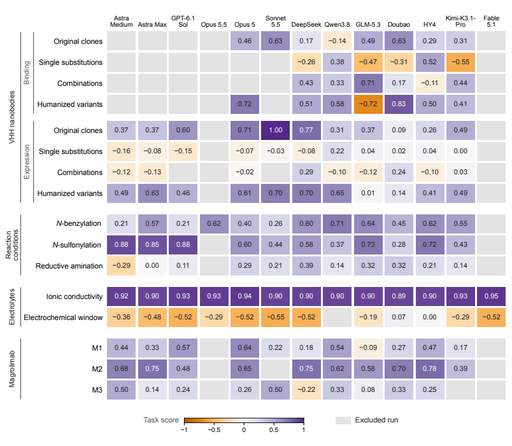
Figure 10 :Scores on the private tasks.Score of each configuration on each private task, grouped into the VHH (eight tasks), reaction-condition (three), electrolyte (two) and Magrolimab (three) series. Gray cells mark excluded runs: refusals, one timeout and one information-policy stop.
出典 · CC BY 4.0 · 元のPDFの15ページ目から図の部分を抽出しています。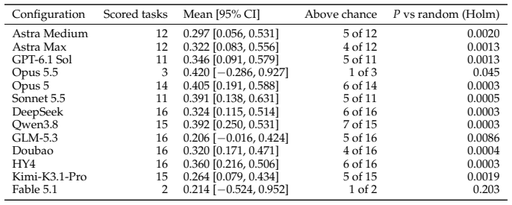
Table 2 :Results on the private tasks.Rows follow the configuration order of Section 3.1, and brackets give 95% bootstrap intervals over tasks, descriptive only for the four configurations scored on fewer than 12 tasks (Opus 5.5, Fable 5.1, GPT-6.1 Sol and Sonnet 5.5). Above chance counts the scored tasks whose score exceeds the task’s chance threshold, as in Table 1; the last column gives the Holm-corrected one-sided P for a mean above that of uniformly random rankings, a different comparison.
出典 · CC BY 4.0 · 元のPDFの16ページ目から図の部分を抽出しています。限界
Opus 5.5とFable 5.1は、安全上の拒否により、多くの化学、生物、医学の課題を完了できませんでした。そのため、この2設定の平均は、完了した課題の部分集合に対する値として解釈すべきです。非公開課題は16個と少ないため、信頼区間は広くなります。また、エージェントは実行時間やツールの使用を自ら決めるため、実行時間とスコアの相関は観察的な結果です。
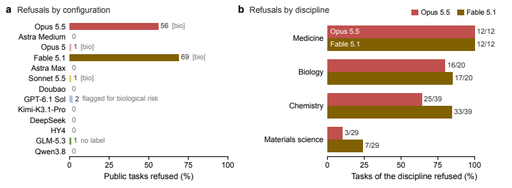
Figure 7 :Refusals in the official runs on the public tasks. a, Share of the 100 public tasks refused by each configuration; every refusal by Opus 5.5, Fable 5.1, Opus 5 and Sonnet 5.5 carries the [bio] label, and GPT-6.1 Sol’s two were flagged by its provider for possible biological risk.b, Share of the tasks in each discipline refused by Opus 5.5 and Fable 5.1.
出典 · CC BY 4.0 · 元のPDFの12ページ目から図の部分を抽出しています。論文情報
- 著者
- Zengji Tu, Xiang Liu, Jiarui Sun, Ruoyu Wu, Zhihui Qi, Chengda Wu, Yutao Zhou, Bo Yang, Ziyan Zhang, Jialong Wu, Liang Chen, Kuan Li, Steven Dillmann, Yuanqi Du, Soojung Yang, Shizhe Diao, Jianjun Wu, Junlang Liu, Xuming Hu, Lin Chang, Baobao Chang, Xiaowen Chu, Philip S. Yu, Tong-Yi Zhang, Hao Cheng, Qin Han, Yanye Feng, Chenru Duan, Chuncheng Liu, Yan Liu, Yuchen Gao, Zhao Li, Ronghua Zhang, Tory Xu, Renjian Song, Yaokai Fu
- 学会・ジャーナル
- arXiv · プレプリント
- 公開日
- 2026年11月11日
- 登録日
- 2026年11月13日
- 更新日
- 2026年11月11日
- バージョン
- v1
- arXiv
- 2611.15049
- カテゴリ
- cs.AI · cs.CL
- ライセンス
- CC BY 4.0
- 掲載内容
- 論文情報・解説・論文の図
この解説は、Refivuの韓国語解説をAIで翻訳したものです。不正確な翻訳や誤りが含まれる可能性があります。論文と図の利用条件は各出典に従います。
アブストラクト
Humanity has long sought to explain natural phenomena. Reliable prediction of experimental outcomes is a central test of our understanding of the processes that produce them. If artificial general intelligence (AGI) is to surpass human scientific capabilities, it must also predict experimental outcomes more reliably than humans. Such capabilities could accelerate scientific discovery across disciplines, help address humanity's most pressing challenges, and improve human well-being. We introduce Science Prediction Universe (SPU), a benchmark of hidden experimental outcomes with 100 public verified tasks from chemistry, materials science, biology and medicine, and 16 private tasks from unpublished wet-lab experiments. Given an experimental setup and candidate conditions, an agent works with any resources it needs to rank the candidates by a measured outcome. We evaluate thirteen agent configurations spanning twelve frontier models across two harnesses (Codex and Claude Code). Current agents remain far from saturating wet-lab outcome prediction, with substantial performance disparities across models: on the public benchmark, configurations separate into two distinct tiers, with task-adjusted Spearman correlations ranging from 0.227 for the lowest-performing configuration to 0.478 for the best. Analysis of 1,155 scored public trajectories (227,103 tool calls) suggests that the bottleneck lies in scientific judgment rather than tool execution: agents rely on shared monotone priors, agreeing far more with one another than with experimental reality (0.52 vs. 0.33), and frequently compute trivial physical or chemical proxies that do not influence the final outcome.
この論文を引用
Zengji Tu, Xiang Liu, Jiarui Sun, Ruoyu Wu, Zhihui Qi, Chengda Wu, Yutao Zhou, Bo Yang, Ziyan Zhang, Jialong Wu, Liang Chen, Kuan Li, Steven Dillmann, Yuanqi Du, Soojung Yang, Shizhe Diao, Jianjun Wu, Junlang Liu, Xuming Hu, Lin Chang et al. (2026). Science Prediction Universe. arXiv:2611.15049v1. https://arxiv.org/abs/2611.15049v1
BibTeX
@misc{tu2026science,
  title = {{Science Prediction Universe}},
  author = {Zengji Tu and Xiang Liu and Jiarui Sun and Ruoyu Wu and Zhihui Qi and Chengda Wu and Yutao Zhou and Bo Yang and Ziyan Zhang and Jialong Wu and Liang Chen and Kuan Li and Steven Dillmann and Yuanqi Du and Soojung Yang and Shizhe Diao and Jianjun Wu and Junlang Liu and Xuming Hu and Lin Chang and Baobao Chang and Xiaowen Chu and Philip S. Yu and Tong-Yi Zhang and Hao Cheng and Qin Han and Yanye Feng and Chenru Duan and Chuncheng Liu and Yan Liu and Yuchen Gao and Zhao Li and Ronghua Zhang and Tory Xu and Renjian Song and Yaokai Fu},
  year = {2026},
  eprint = {2611.15049},
  archivePrefix = {arXiv},
  url = {https://arxiv.org/abs/2611.15049v1}
}