論文解説
The cost of enforcing long-run coverage: a phase transition in online conformal prediction
長期カバレッジ保証を強制するコスト:オンラインコンフォーマル予測における相転移
- 課題 長期の経験的カバレッジを強く保証すると、i.i.d.設定では時点ごとのカバレッジ誤差が大きくなることがあります。そのため、両方の目標を同時に満たす限界を定める必要があります。
- 手法 ベースラインのsplit conformal集合を累積偏差の範囲に合わせて切り詰め、同じ制約のもとでACIの減衰ステップサイズのコストと比較します。
- 結果 最小累積不一致は、β≤1/2では√T、β>1/2ではT^βのオーダーで与えられます。実験では、ACIがtruncated split conformalより速く不一致が増えました。
オンライン予測における長期カバレッジと時点ごとのカバレッジの衝突
オンライン予測では、毎時点で新しい特徴量に対して予測集合を作り、その集合が実際の応答を含むことを求めます。ただし、分布変化や変化点があるとi.i.d.の仮定が崩れ、その場合は長い区間の経験的カバレッジだけを保証する方法が必要になります。問題は、長期カバレッジの制約を強くかけるほど、i.i.d.設定では時点ごとのカバレッジが揺らぎうることです。この論文は、両方の目標を同時に満たすbest-of-both-worldsアルゴリズムがどこまで可能か、そして制約の強さβによってそのコストがどう変わるかを扱っています。
Oracle不一致と位相転移
論文では、アルゴリズムの予測集合とexact oracleの予測集合が同じ応答に対して異なる形で含まれる回数を、累積不一致ℓ_Tとして定義しています。この値は時点ごとの学習条件付きカバレッジ誤差の和Δ^inst_T以上であり、条件付きJensen不等式につながります。制約は|E_T|/T ≤ κT^{-β}で与えられ、累積偏差E_TがκT^{1-β}の範囲を外れるかどうかが鍵になります。著者らは最小不一致の最適オーダーをT^{max{1/2,β}}として示しており、β≤1/2では√T、β>1/2ではT^βになります。この結果は、nonatomicなスコア分布を仮定したi.i.d.法則の集合上で、最小最大レートとして与えられたものです。
切り詰め方法とACIの比較
ベースラインはsplit conformalの予測集合C^CPです。切り詰めアルゴリズムΓ_{κ,β}は、仮想の累積誤差Ēが上限を超えるおそれがあるときにだけ予測集合を全空間𝒴に置き換え、下限を下回るおそれがあるときは空集合に置き換えます。それ以外の場合には、ベースラインの集合をそのまま使います。ベースラインはすべての観測を使い続けるため、切り詰められたラウンドもベースラインの計算に含まれます。κ≥1/2の場合は2つの強制条件が同時に成り立たないため、すべてのデータ列で制約を満たします。比較対象のACIは、固定スコアに対してq_{t+1}=q_t+η_t(e_t−α)で閾値を更新し、η_t=c t^{-(1−β)}のとき最小不一致はT^{(1+β)/2}で与えられます。
このオーダーは、β∈(0,1)ではT^{max{1/2,β}}より大きくなります。このACIの結果は、スコア密度が[0,B]上でλ−とλ+の間にあるという仮定のもとで成り立ちます。
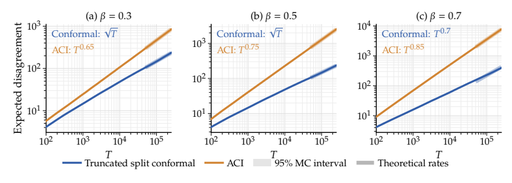
Figure 4 :ACI and truncated split conformal prediction under the same long-run empirical coverage guarantee.Both algorithms use𝛼=0.1 and satisfy the(𝛽,2) constraint. Each panel uses logarithmic axes and shows estimated expected cumulative disagreement with the population oracle over500 paired replications. ACI uses𝑞1 =0.9 and𝜂𝑡 =𝑡 −(1−𝛽). The theoretical rates are proportional to𝑇(1+𝛽)/2 for ACI and𝑇max{1/2,𝛽} for truncated split conformal prediction.
出典 · CC BY 4.0 · Yu Gui, Rina Foygel Barber, Cong Ma · The cost of enforcing long-run coverage: a phase transition in online conformal prediction · 論文の図を引用 · 元のPDFの14ページ目から図の部分を抽出しています。切り詰めとACIの累積不一致の比較
数値実験は、X~Unif[0,1]、f(x)=sin(2πx)、σ(x)=0.2+0.3xの異分散回帰モデルで行いました。固定スコアは[0,1]上の一様分布に従うように構成し、α=0.1に設定しました。切り詰め実験はκ=0.5、500回の独立した反復、T=250,000時点で行い、各経路の累積偏差がすべて長期制約を満たすかを確認しました。β<1/2では基準線と同程度の√Tレートになり、β≥1/2ではT^βのレートと一致しました。ACIとの比較では、q_1=0.9、η_t=t^{-(1−β)}、同じ(β,2)制約を用いました。その結果、ACIの累積不一致は3つのβのいずれでも、truncated split conformalより速く増加しました。
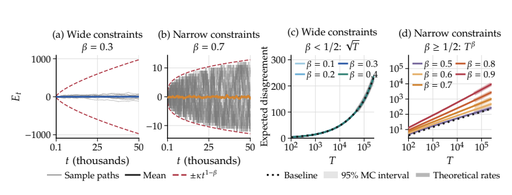
Figure 2 :Long-run empirical coverage and oracle disagreement of truncated split conformal prediction.We use𝛼=0.1and𝜅=0.5. Panels (a)–(b) show the cumulative deviations for𝛽=0.3 and𝛽=0.7 , respectively: the first twelve paths, the mean over500 replications, and the bounds
出典 · CC BY 4.0 · Yu Gui, Rina Foygel Barber, Cong Ma · The cost of enforcing long-run coverage: a phase transition in online conformal prediction · 論文の図を引用 · 元のPDFの12ページ目から図の部分を抽出しています。β>1/2の追加コストと適用条件
β>1/2の制約は、i.i.d.設定でも最適な時点ごとのカバレッジに完全には追従できないという追加コストを生みます。この結果は、nonatomicなスコア分布とexact oracleの定義を前提としています。アトムがある分布では、exact oracleが存在しないことがあるため、relaxed oracleを別に扱っています。ACIの結果はスコア密度の上下限の仮定に依存しており、論文が示した数値実験は、1つの回帰設定と固定されたκ、α、反復回数で得られたものに限られます。
論文情報
- 著者
- Yu Gui, Rina Foygel Barber, Cong Ma
- 学会・ジャーナル
- arXiv · プレプリント
- 公開日
- 2026年11月16日
- 登録日
- 2026年11月18日
- 更新日
- 2026年11月16日
- バージョン
- v1
- arXiv
- 2611.21542
- カテゴリ
- math.ST · cs.LG · stat.ML
- ライセンス
- CC BY 4.0
- 掲載内容
- 論文情報・解説・論文の図
この解説は、Refivuの韓国語解説をAIで翻訳したものです。不正確な翻訳や誤りが含まれる可能性があります。論文と図の利用条件は各出典に従います。
アブストラクト
Consider an online prediction setting, where at each time, we are given a new feature vector and asked to provide a prediction interval or prediction set that will likely contain the corresponding response. In this setting, if the data points are i.i.d. (or more generally, exchangeable), conformal prediction provides a mechanism for building valid prediction sets around the output of any trained model, offering coverage probability $\geq 1-α$ at each time $t$. In practice, however, issues such as distribution drift, changepoints, or other challenges may cause violations of the i.i.d. assumption. In this adversarial setting, online conformal prediction methods can still offer guarantees on long-run empirical coverage. However, there is a trade-off between these two types of goals: enforcing tight constraints on long-run empirical coverage to protect against the adversarial setting can lead to unstable oscillations in the instantaneous training-conditional coverage in the i.i.d. setting. In this work, we seek best-of-both-worlds algorithms that aim to minimize cumulative error in instantaneous training-conditional coverage when in the i.i.d. setting, while also offering long-run empirical coverage guarantees in the adversarial setting. Specifically, consider a condition that requires long-run empirical coverage to deviate from the target level $1-α$ by at most $\mathcal{O}(T^{-β})$, for some $β\in[0,1]$. We prove that this family of conditions can be described with a phase transition. For $β\in[0,\frac{1}{2}]$, it is possible to construct algorithms satisfying such a constraint in the adversarial setting, while offering the same instantaneous coverage performance as split conformal prediction if the data is in fact i.i.d. On the other hand, for $β\in(\frac{1}{2},1]$, this type of condition comes at a cost, and does not achieve best-of-both-worlds behavior.
この論文を引用
Yu Gui, Rina Foygel Barber, Cong Ma (2026). The cost of enforcing long-run coverage: a phase transition in online conformal prediction. arXiv:2611.21542v1. https://arxiv.org/abs/2611.21542v1
BibTeX
@misc{gui2026cost,
  title = {{The cost of enforcing long-run coverage: a phase transition in online conformal prediction}},
  author = {Yu Gui and Rina Foygel Barber and Cong Ma},
  year = {2026},
  eprint = {2611.21542},
  archivePrefix = {arXiv},
  url = {https://arxiv.org/abs/2611.21542v1}
}