論文解説
PLECTA: Overlap-aware instance segmentation of dense strand networks from binary masks
PLECTA:二値マスクから高密度なストランドネットワークを分割する重なり認識インスタンスセグメンテーション
- 課題 重なったストランドのネットワークでは、交差と間隔のせいで個々のストランドの識別情報が混ざってしまうことが難しい問題です。
- 手法 二値軸マスクの交差点ごとに連結候補をコストで評価し、最大重み部分マッチングで連結を選びます。
- 結果 合成シーン128個で平均共通断片ペアF1 0.85を記録し、同じマスク条件での比較では最も高い順位でした。
重なったストランドをマスクだけで分ける問題
CNTシート、コラーゲンネットワーク、紙のように、ストランドが互いに重なり合う材料では、ストランドの配置が物性に影響します。顕微鏡写真からこの配置を測るには、交差点と信号の間隔をまたぎながら個々のストランドを追跡する必要があります。交差点では異なるストランドが一つの前景成分にまとまり、信号の間隔では一本のストランドが断片に途切れます。そのため、どの断片が交差点を通って続き、どの断片が間隔をまたいでつながり、どこで終わるのかを合わせて判断しなければなりません。従来の意味分割は前景と背景を分けられますが、個体の識別は行えません。インスタンス分割は多くの場合、密で閉じた物体を前提としています。この論文は、長く開いた曲線が重なる場合を扱い、学習データを使わず二値軸マスクだけからストランドを分割することを対象としています。
交差点ごとに連結を同時に選ぶ方法
PLECTAは、入力された二値マスクをZhang–Suen細線化で骨格化し、短い枝を取り除きます。三本以上の骨格の枝が出会う画素は交差クラスタにまとめ、残ったセグメントを両端にスタブを持つアームにします。各スタブは、端の位置、外側の接線、符号付きの曲率で特徴づけられます。二つのスタブaとbの連結コストC_abは、反転角θ、弦角φ_aとφ_b、曲率の不一致|κ_a+κ_b|、間隔距離に応じたペナルティを足し合わせて求めます。間隔の項はq(d)=min(1, d/d_0)で減衰し、交差点での連結では間隔の項の重みを0にします。各スタブには未マッチのペナルティp_iを設け、ペア(i,j)の利得はp_i+p_j−C_ijで、C_ij<p_i+p_jのときだけ許可します。
最終的な選択は、各スタブが最大一つのペアに属するか未マッチのままになるよう、式(2)の最大重み部分マッチングを厳密に解いて得ます。この方法では、局所的に良いペアでも全体の組み合わせが悪ければ捨てられることがあります。マッチングは接線と曲率の推定を更新しながら複数ラウンド繰り返し、最後のラウンドの結果を出力とします。連結が終わると、受理されたアーム連結の連結成分をストランドのインスタンスとし、交差画素は複数のストランドで共有されるようにします。
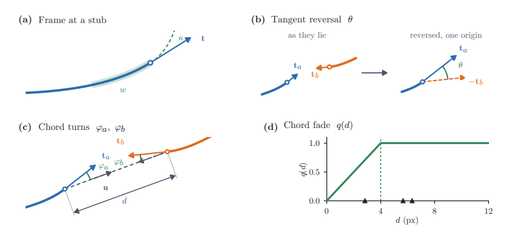
Figure 3 .The stub frame and the terms of the pairing cost.(a)The least-squares arclength fit over windoww, read outward from the tip ats = 0, giving outward tangenttand signed curvatureκ; quadratic when the span allows, linear otherwise.(b)θ, in the two steps its definition takes: the outward tangents where they lie, then the same pair withtb reversed and both read from one origin. A perfect continuation makes them antiparallel, soθ = 0.(c)The chord turns φa, φb onto the chordujoining the tips.(d)The fadeq(d)against tip separation; triangles mark the six real separations at the crossing of Figure 4.
出典 · CC BY 4.0 · Oday Allan, Igor Ostanin · PLECTA: Overlap-aware instance segmentation of dense strand networks from binary masks · 論文の図を引用 · 元のPDFの7ページ目から図の部分を抽出しています。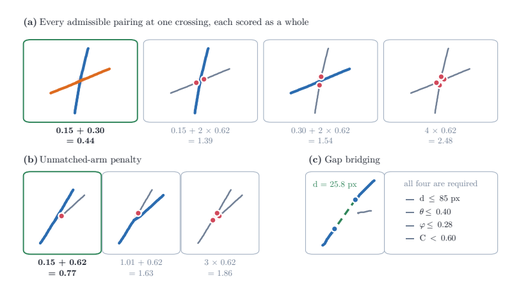
Figure 4 .Candidate-link evaluation and matching outcomes, on the nodes where the decisions were made. Every arm is the skeleton the numbers were measured from, so every angle shown is the one the cost was computed on.(a)Every pairing the admissibility gate allows at a four-arm crossing, each scored as a whole: its edge costs plus the penaltypi = 0.62of each arm it leaves unmatched. The green frame marks the one returned; two further pairs exceedpi +pj = 1.24and are excluded as candidates.(b)A three-arm node where an admissible edge is declined on the total rather than on its own cost.(c)A gap link, which must clear all four gates at once.
出典 · CC BY 4.0 · Oday Allan, Igor Ostanin · PLECTA: Overlap-aware instance segmentation of dense strand networks from binary masks · 論文の図を引用 · 元のPDFの8ページ目から図の部分を抽出しています。グレースケールの明るさによる交差順序の推定
深度段階は、分割が終わった後にグレースケール画像を使い、交差点ごとに上側のストランドを推定します。上側のストランドは交差点を通っても明るさを保ち、下側のストランドは遮られると仮定しています。交差の中心部の中央値m_cを、各ストランドの側面の中央値m_i、m_jと比べ、より近い方を上側のストランドとみなします。符号付きスコアsは、二つの明るさの差を大きい方の値と2σ̂で正規化して計算し、符号は上側のストランド、大きさは根拠の強さを表します。局所的な推定同士は矛盾することがあるため、有向グラフを作り、重み|s|をできるだけ保つ一貫した順序を求めます。その後、巡回のないグラフで最長の経路から必要な最小の層数を決め、重ならないストランド同士に高さを割り当てます。
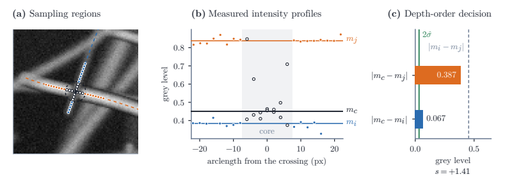
Figure 5 .Local depth evidence at a crossing angle of83.8◦, selected for clarity. Positions and intensities are taken from the stage output.(a)Core samples (open dots) and flank samples (filled dots), with flanks kept clear of the other strand.(b)Intensity along each strand: the pooled core medianmc is closer to strand i’s flank median than to strandj’s, supportingi as the upper strand.(c)Intensity mismatches used to calculates, normalised by the larger of the flank-median separation and twice the local noise estimate (Supplementary Section S2).
出典 · CC BY 4.0 · Oday Allan, Igor Ostanin · PLECTA: Overlap-aware instance segmentation of dense strand networks from binary masks · 論文の図を引用 · 元のPDFの9ページ目から図の部分を抽出しています。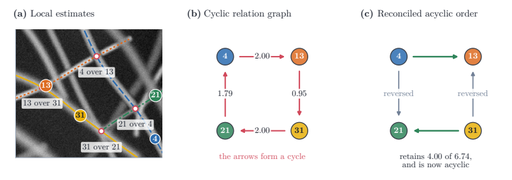
Figure 6 .Resolving contradictory local depth estimates.(a)Four strands and their estimated crossing orders.(b)The corresponding graph, with arrows from the estimated upper strand to the lower strand. The directed cycle prevents a consistent height assignment.(c)The selected order retains the two highest-weight estimates and reverses the two lowest-weight estimates. Reversals are recorded with their original scores. The four strands shown belong to a seven-strand scene; layer assignments depend on the complete connected component.
出典 · CC BY 4.0 · Oday Allan, Igor Ostanin · PLECTA: Overlap-aware instance segmentation of dense strand networks from binary masks · 論文の図を引用 · 元のPDFの9ページ目から図の部分を抽出しています。合成シーンとマスク条件での評価
合成シーン128個で、PLECTAの平均共通断片ペアF1は0.85で、95%ブートストラップ信頼区間は[0.84, 0.86]でした。被覆率が20%から60%に上がると、平均F1は0.91 [0.89, 0.93]から0.77 [0.76, 0.79]へ下がりました。同じシーンで、クリーンな軸と劣化した軸を比べた50個のシーンの平均F1は、それぞれ0.84と0.82で、対応のある差は0.0224(95% CI [0.0113, 0.0333])でした。比較実験は、SIFNE、GraFT、DNAi、Basu et al.と同じ二値マスク、同じ採点コードで行いました。Basu et al.は著者らが再実装しています。
比較手法の設定は元の手法に有利になるよう合わせており、この条件ではPLECTAがすべての密度と二つのマスク条件で最も高い結果でした。ただし、この比較は密な交差ネットワークのマスクベースのグルーピングに限られており、各手法の元の応用分野を評価したものではありません。
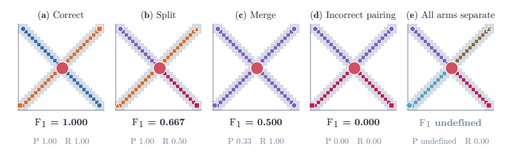
Figure 7 .Pairwise scoring at a crossing. Removing junction pixels (red) leaves four arms and six fragment pairs. Tip markers identify arms assigned to the same strand.(a)Reference grouping.(b)A split reduces recall.(c)A merge reduces precision.(d)Incorrect pairing changes strand identities. (e)Separating every arm produces no predicted positive pair, so precision and F1 are undefined.
出典 · CC BY 4.0 · Oday Allan, Igor Ostanin · PLECTA: Overlap-aware instance segmentation of dense strand networks from binary masks · 論文の図を引用 · 元のPDFの10ページ目から図の部分を抽出しています。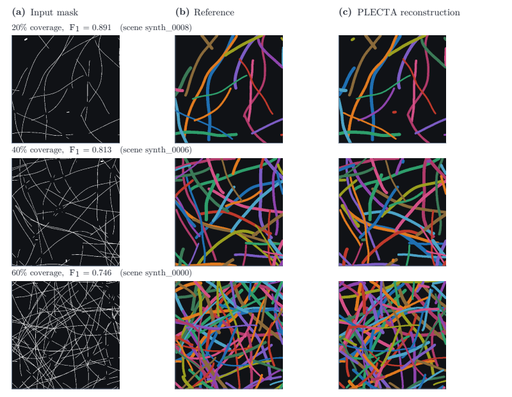
Figure 8 .Segmentation at three coverage levels, each the scene closest to the median F1 of its stratum, shown as a horizontal window of the scene. Columns: the degraded input mask, the overlap-aware reference, and PLECTA’s strands at their fitted widths. The score beside each row is the grouping’s, not the rendering’s. Strand colours are arbitrary and not matched between columns.
出典 · CC BY 4.0 · Oday Allan, Igor Ostanin · PLECTA: Overlap-aware instance segmentation of dense strand networks from binary masks · 論文の図を引用 · 元のPDFの11ページ目から図の部分を抽出しています。CNT SEM画像での結果
実際のCNT SEM画像3枚では、参照アノテーションから作った軸を入力にすると平均F1は0.89で、自動のnnU-Net軸を入力にすると0.46でした。自動軸での追加の誤りは主に見逃した連結で、併合誤りは主な原因ではありませんでした。2人のアノテーターが独立に付けた骨格を入力したときのF1は0.38で、これは2人のアノテーター間の一致範囲0.36–0.53の中に収まります。したがって、自動軸のスコアは、アノテーションの定義のあいまいさも合わせて読む必要があります。3枚は独立した評価サンプルですが、数が少ないため、結果は技術的な観察として読むべきです。
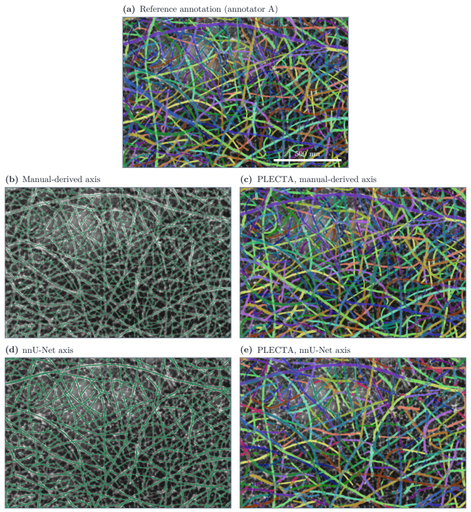
Figure 12 .Segmentation of the whole B58_110 field from two input-mask sources; the scale bar in (a) is 500nm. B58_110 is the densest of the three fields and the lowest-scoring on the reference-derived axis.(a)Reference annotation;(b)reference-derived axis;(c)PLECTA from that axis;(d)automatic axis; and(e)PLECTA from that axis with the same parameters. Input axes are dilated by one pixel for legibility. Predicted strands take the colour of their matched reference strand; crimson indicates no match.
出典 · CC BY 4.0 · Oday Allan, Igor Ostanin · PLECTA: Overlap-aware instance segmentation of dense strand networks from binary masks · 論文の図を引用 · 元のPDFの15ページ目から図の部分を抽出しています。方向の連続性の仮定と深度段階の適用範囲
PLECTAは、交差点を通る方向の連続性を仮定しており、前段のマスクの誤りに敏感です。間隔は短いものであればつなげられますが、欠けたストランドを復元したり、誤った軸を信頼できる形で直したりすることはできません。深度段階の大域的な順序は、交差点グラフでつながったストランドの中でのみ確定し、同じ連結成分に属するペアは深度実験で0.36–0.84の範囲でした。深度実験は、深度の基準値が分かっている合成シーン12個だけで行い、実際のSEMには深度の基準値がないため定量評価はできませんでした。評価実験も、ほかの材料や倍率へは広げていません。
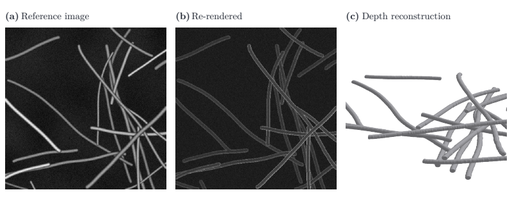
Figure 9 .Depth reconstruction of a synthetic scene from its binary axis mask. The panels show the rendered greyscale image, a forward-model re-rendering from the reconstructed depths and radii, and the inferred strand stack. The re-rendering is a visual consistency check, not a scored quantity. The scene is 512px across in the generator’s pixel units.
出典 · CC BY 4.0 · Oday Allan, Igor Ostanin · PLECTA: Overlap-aware instance segmentation of dense strand networks from binary masks · 論文の図を引用 · 元のPDFの13ページ目から図の部分を抽出しています。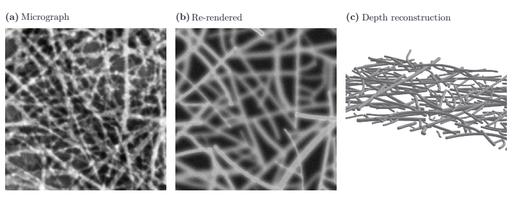
Figure 10 .The same comparison on a real CNT SEM field, reconstructed from the reference axis mask. The crop is 512px across, about 0.55µm of field B58_100. Real SEM provides no depth ground truth, so the depth order is shown qualitatively; the forward-model appearance parameters are fitted to this micrograph.
出典 · CC BY 4.0 · Oday Allan, Igor Ostanin · PLECTA: Overlap-aware instance segmentation of dense strand networks from binary masks · 論文の図を引用 · 元のPDFの13ページ目から図の部分を抽出しています。論文情報
- 著者
- Oday Allan, Igor Ostanin
- 学会・ジャーナル
- arXiv · プレプリント
- 公開日
- 2026年11月16日
- 登録日
- 2026年11月18日
- 更新日
- 2026年11月16日
- バージョン
- v1
- arXiv
- 2611.21283
- カテゴリ
- cs.CV · cond-mat.soft
- ライセンス
- CC BY 4.0
- 掲載内容
- 論文情報・解説・論文の図
この解説は、Refivuの韓国語解説をAIで翻訳したものです。不正確な翻訳や誤りが含まれる可能性があります。論文と図の利用条件は各出典に従います。
アブストラクト
Many materials and tissues, including carbon-nanotube sheets, collagen and paper, comprise overlapping strands whose arrangement influences their effective properties. Measuring this geometry from micrographs requires individual strands to be traced through crossings and signal gaps, which merge distinct strands or split one strand into disconnected fragments. We present PLECTA (from Latin plecta, a braid), a deterministic method that segments individual strands using only a binary image whose foreground pixels mark strand centrelines. At each junction, PLECTA selects which strand segments continue into one another while allowing segments to terminate. It formulates this decision as an exact maximum-weight partial-matching problem, with an explicit penalty for unpaired segments and no restriction on the number of segments entering a junction. The output permits crossing pixels to belong to multiple strands. On synthetic scenes, PLECTA resolved strand identities more accurately than three released alternatives at every density tested. The same ranking held on an independently published generator run at its own settings. A separate stage uses the corresponding greyscale micrograph to estimate which strand lies on top at each crossing. The complete workflow is demonstrated on scanning electron micrographs of carbon nanotube sheets, from raw images to individual strand instances with estimated crossing order, without manual annotations for training or as pipeline inputs.
この論文を引用
Oday Allan, Igor Ostanin (2026). PLECTA: Overlap-aware instance segmentation of dense strand networks from binary masks. arXiv:2611.21283v1. https://arxiv.org/abs/2611.21283v1
BibTeX
@misc{allan2026plecta,
  title = {{PLECTA: Overlap-aware instance segmentation of dense strand networks from binary masks}},
  author = {Oday Allan and Igor Ostanin},
  year = {2026},
  eprint = {2611.21283},
  archivePrefix = {arXiv},
  url = {https://arxiv.org/abs/2611.21283v1}
}