論文解説
Out of Sight, Into Memory: Compact Visual Latents Retain Local Evidence in Ultra-High-Resolution Remote Sensing
視界から記憶へ:圧縮された視覚latentは超高解像度リモートセンシングで局所的な証拠を保持する
- 課題 UHRの広域画像を縮小すると小さな物体や細かい属性が失われるため、高解像度cropのトークンをすべて文脈に残すことは難しいです。
- 手法 cropをresamplerで64個の連続メモリトークンに圧縮し、元のcropトークンを取り除いたうえで、メモリの内容を差し替えたり取り除いたりする介入により依存度を測定します。
UHRリモートセンシングで局所的な証拠が失われる問題
超高解像度(UHR)のリモートセンシング画像は数億ピクセルに達し、全体画像を縮小すると小さな物体や細かい属性を区別できなくなります。近年の手法は関心領域を選んで高解像度のcropを見ますが、各cropの視覚トークンをそのまま文脈に残すと、文脈の予算が大きく減ります。そのため、cropを連続的な視覚潜在トークンに圧縮し、元のトークンを捨てる方法が自然な代替案として示されています。本論文は、このときモデルが圧縮された潜在トークンの内容を実際に読んでいるのか、そしてその内容が全体画像から消えた細部の情報を含んでいるのかを問います。一般ドメインの診断研究では、潜在トークンを意味のないベクトルに置き換えたり内容を変えたりしても精度がほとんど変わらないことが報告されてきたため、この問いはUHRリモートセンシングで改めて確かめる必要があります。
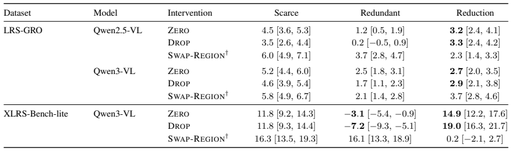
Table 3 .Contextualizing our findings alongside prior latent diagnostics.Results for the general domain are taken from the cited studies. Our values report accuracy changes in percentage points relative to Memory on LRS-GRO for Qwen2.5-VL and Qwen3-VL, respectively. Because models, benchmarks, and latent sources differ, only the direction and qualitative magnitude of the effect are compared.
出典 · CC BY 4.0 · Meng Tang, Siyuan Du, Yuxin Liu, Shuaishuai Cao, Di Wang, Haonan Guo · Out of Sight, Into Memory: Compact Visual Latents Retain Local Evidence in Ultra-High-Resolution Remote Sensing · 論文の図を引用 · 元のPDFの7ページ目から図の部分を抽出しています。crop メモリの構成と学習手順
質問に関連づけられた注釈領域を50%拡張してcropを作り、固定された視覚エンコーダに入力して得た特徴を、resamplerがK個の連続トークンに圧縮します。resamplerは学習可能な64個のqueryがcrop特徴に対してクロスアテンションを行う2層の構造で、出力projectionは0で初期化されています。そのため学習前は、空間平均プーリングのベースラインと同じになるよう設計されています。学習は2段階で進めます。1段階目では、全体画像と質問だけを使って8トークンの形式の接頭辞を学習し、回答の形式と答えの分布のバイアスを吸収させます。その後、すべての条件でこの接頭辞を固定します。2段階目では、resamplerだけを、回答のクロスエントロピー、counterfactual margin loss、圧縮しないcrop入力の上位64トークンに対するlogit distillationで学習します。
バックボーンと視覚エンコーダは凍結されており、LoRAやバックボーンのファインチューニングは使いません。推論時には元のcropトークンを取り除き、質問、全体画像、接頭辞、メモリトークンだけで答えます。
scarce文脈とredundant文脈、そして介入の設計
メモリが持つ情報を、モデルが別の入力からも得られるかを確かめるため、2つの文脈を比べます。scarce文脈は、元のcropトークンを取り除き、質問、全体画像、メモリだけを与える条件です。redundant文脈は、メモリを作った元のcropトークンを再び入力し、同じモデルがピクセルを再び見られるようにした条件です。メモリへの依存度は、同じモデル、質問、メモリで、介入の前後の精度の差であるpaired relianceで測ります。介入は4つです。ZEROはすべてのメモリトークンを零ベクトルに置き換え、DROPはトークンをシーケンスから取り除きます。SWAP-IMAGEは別のシーンのメモリに、SWAP-REGIONは同じシーン内の別の注釈領域のメモリに置き換えます。
2つのSWAP介入は、トークン数、位置、特徴分布を保つため、内容による影響だけを切り分けられます。
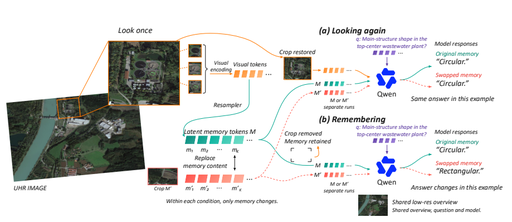
Figure 1 .Writing, keeping and probing the memory.A crop of the annotated region is encoded and compressed by a resampler intoK memory tokens, after which the crop tokens are discarded. In the scarce context the language model sees the question, the thumbnail and the memory, and cannot look again at the crop. In the redundant context the crop pixels are added, so the model can look again. ZERO, DROP, SWAP-IMAGEand SWAP-REGIONact on the memory only.
出典 · CC BY 4.0 · Meng Tang, Siyuan Du, Yuxin Liu, Shuaishuai Cao, Di Wang, Haonan Guo · Out of Sight, Into Memory: Compact Visual Latents Retain Local Evidence in Ultra-High-Resolution Remote Sensing · 論文の図を引用 · 元のPDFの3ページ目から図の部分を抽出しています。メモリの予測効用と圧縮コスト
LRS-GROでK=64のメモリは、サムネイルのベースラインより、Qwen2.5-VLでは54.6%から57.1%へ、Qwen3-VLでは57.2%から62.0%へ精度を上げました。Qwen2.5-VLでは、crop全体による利得の約3分の2を回復し、Qwen3-VLではHigh-Res Cropの61.6%と同程度の62.0%を記録しました。学習なしでXLRS-Bench-liteに移したQwen3-VLでは、サムネイルの36.3%から48.5%へ12.2ポイント高くなりました。これは平均321.8個のcropトークンを5.0倍に圧縮した結果です。同じK=64では、Soft PromptはLRS-GROで53.8%と57.7%にとどまり、サムネイルの近くでした。
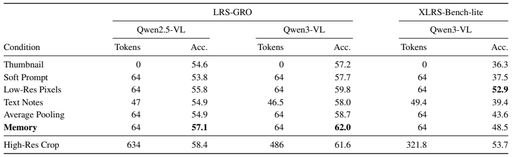
Table 1 .Predictive utility and retained context cost.Accuracy (%) on LRS-GRO (7,393 questions from 839 scenes) and XLRS-Bench- lite (1,657 questions from 856 scenes). All conditions include the question, the downsampled global overview, and the shared frozen 8-token Stage 1 format prefix. Compact representations use a budget ofK= 64tokens, whereas High-Res Crop retains the uncompressed crop tokens as an upper reference. Tokens counts only the regional evidence payload per question beyond this shared context (excluding global overview tokens, the 8-token format prefix, and region label text). Bold values mark the highest accuracy within the budget of K= 64tokens.
出典 · CC BY 4.0 · Meng Tang, Siyuan Du, Yuxin Liu, Shuaishuai Cao, Di Wang, Haonan Guo · Out of Sight, Into Memory: Compact Visual Latents Retain Local Evidence in Ultra-High-Resolution Remote Sensing · 論文の図を引用 · 元のPDFの6ページ目から図の部分を抽出しています。内容を差し替える介入が示す信号
重要な点は、SWAP介入がDROPより精度が低くなり、予測がサムネイルのベースラインの下へ押し下げられたことです。この結果は、メモリが単にトークン数を増やすのではなく、符号化された局所内容に応じて予測を変えるという根拠と解釈されます。著者らは、誤った局所潜在情報がモデルを誤らせると考えています。
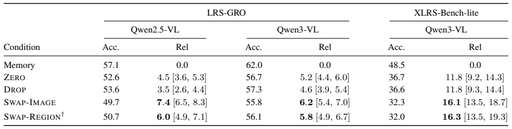
Table 2 .Dependence on memory content.Accuracy (%) and paired relianceRel(percentage points) atK= 64in the scarce context. Relequals the accuracy of the matched Memory reference minus the intervention accuracy, with 95% confidence intervals from a cluster bootstrap over scenes in brackets. Results on the complete evaluation set use the samples in Table 1. †SWAP-REGIONuses a matched Memory reference on the subset of scenes containing multiple annotated regions: 5,295 questions from 514 scenes on LRS-GRO and 1,212 questions from 446 scenes on XLRS-Bench-lite, where reference Memory accuracy on the XLRS-Bench-lite subset is 48.3%. Bold Relvalues highlight interventions that substitute memory content. Paired differences are computed prior to rounding.
出典 · CC BY 4.0 · Meng Tang, Siyuan Du, Yuxin Liu, Shuaishuai Cao, Di Wang, Haonan Guo · Out of Sight, Into Memory: Compact Visual Latents Retain Local Evidence in Ultra-High-Resolution Remote Sensing · 論文の図を引用 · 元のPDFの6ページ目から図の部分を抽出しています。元のcrop復元がメモリへの依存度を下げる仕組み
redundant文脈では、同じモデルと同じメモリを保ったまま、元のcropのピクセルを一緒に与えます。したがって、ピクセルへのアクセスはメモリがない場合の損失を減らしますが、誤った局所内容の影響は防げません。
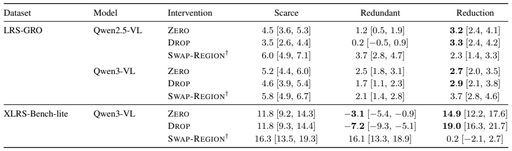
Table 4 .Memory reliance decreases when source evidence is restored.Paired relianceRelin percentage points atK= 64. The scarce context contains the question, global overview, and memory; the redundant context additionally restores the source crop. Reduction equals Relscarce −Rel redundant, computed from unrounded paired results, with 95% confidence intervals from a cluster bootstrap over scenes in brackets. NegativeRelindicates that the intervention increases accuracy. Bold values highlight reductions under ZEROand DROPas well as negative reliance in the redundant context. †SWAP-REGIONuses the subsets specified in Table 2 with matched questions across both contexts.
出典 · CC BY 4.0 · Meng Tang, Siyuan Du, Yuxin Liu, Shuaishuai Cao, Di Wang, Haonan Guo · Out of Sight, Into Memory: Compact Visual Latents Retain Local Evidence in Ultra-High-Resolution Remote Sensing · 論文の図を引用 · 元のPDFの7ページ目から図の部分を抽出しています。注釈領域の固定と、コスト測定の範囲
主な実験では、cropの位置を注釈領域で固定しているため、位置の選択の誤りは評価から切り離されています。そのため、実際の位置探索の性能は本論文の測定に含まれません。圧縮比は、言語モデル内部に保持された視覚文脈量を測ったものであり、視覚エンコーダが各cropを処理するコストと推論の遅延は測定していません。評価はQwen-VLの2世代、LRS-GRO、XLRS-Bench-liteに限られ、他のバックボーンや複数のcrop設定は確認していません。
論文情報
- 著者
- Meng Tang, Siyuan Du, Yuxin Liu, Shuaishuai Cao, Di Wang, Haonan Guo
- 学会・ジャーナル
- arXiv · プレプリント
- 公開日
- 2026年11月16日
- 登録日
- 2026年11月18日
- 更新日
- 2026年11月16日
- バージョン
- v1
- arXiv
- 2611.21457
- カテゴリ
- cs.CV · cs.AI
- ライセンス
- CC BY 4.0
- 掲載内容
- 論文情報・解説・論文の図
この解説は、Refivuの韓国語解説をAIで翻訳したものです。不正確な翻訳や誤りが含まれる可能性があります。論文と図の利用条件は各出典に従います。
アブストラクト
Question answering over ultra-high-resolution (UHR) remote sensing scenes poses a tension for multimodal large language models: global overviews obscure small objects and local attributes, whereas detailed crops consume substantial context. Compressing inspected crops into short sequences of continuous visual latents offers a compact memory once crop tokens are discarded, yet diagnostic studies on natural images find that models often ignore latent content, leaving unclear whether compact latents can retain fine-grained targets lost in downsampled UHR remote sensing scenes. To isolate evidence retention from region selection, we encode high-resolution crops into latent memory tokens for frozen backbones and evaluate both their predictive utility and content dependence. Across two generations of Qwen-VL on LRS-GRO, a 64-token memory achieves 7.6- to 9.9-fold compression of retained crop tokens and improves accuracy by 2.5 to 4.8 percentage points over the downsampled global image alone, recovering most of the high-resolution crop gain with consistent behavior on XLRS-Bench. Substituting memory from another image or another region of the same scene reduces accuracy by 5.8 to 7.4 percentage points and yields lower accuracy than removing memory altogether, demonstrating that predictions depend on the encoded regional evidence. Restoring the source crop within the same model reduces the accuracy loss caused by zeroing or removing memory. These findings establish that compact visual latents retain useful local evidence in UHR remote sensing and identify evidence availability as a key factor governing their contribution.
この論文を引用
Meng Tang, Siyuan Du, Yuxin Liu, Shuaishuai Cao, Di Wang, Haonan Guo (2026). Out of Sight, Into Memory: Compact Visual Latents Retain Local Evidence in Ultra-High-Resolution Remote Sensing. arXiv:2611.21457v1. https://arxiv.org/abs/2611.21457v1
BibTeX
@misc{tang2026sight,
  title = {{Out of Sight, Into Memory: Compact Visual Latents Retain Local Evidence in Ultra-High-Resolution Remote Sensing}},
  author = {Meng Tang and Siyuan Du and Yuxin Liu and Shuaishuai Cao and Di Wang and Haonan Guo},
  year = {2026},
  eprint = {2611.21457},
  archivePrefix = {arXiv},
  url = {https://arxiv.org/abs/2611.21457v1}
}