論文解説
Replicating and Extending Weight-Space Programming: Frontier LLMs Compile Programs into Weights and Read Input Layers
Weight-Space Programmingの再現と拡張:フロンティアLLMがプログラムを重みへコンパイルし入力層を読む能力
- 課題 フロンティアLLMがニューラルネットワークの重みを直接書き、読めるのかどうか、またその能力がどこまで及ぶのかは明らかではありません。
- 手法 Breakoutなど、MinAtarのゲーム用ネットワークをツールなしで書かせ、書かれた重みをPythonへ逆変換するか、平文の重みを読ませて評価しました。
LLMはプログラムを重みとして書けるか
この論文が扱う問いは、フロンティアLLMがツールを使わず、1回の応答で小さなニューラルネットワークの重みを直接書けるかどうかです。さらに、書いた重みを読み直して何をしているのかを把握できるかも問われています。MIT側の報告では、GPT-6 AstraがMinAtar Breakout用のネットワークを単一の応答で作成したとされていますが、この論文はその主張を再現し、適用範囲を検討しています。
問いは二つの方向に分かれます。一つはプログラムを重みに移す書き込みで、もう一つは重みから学習目的を読み取る読み取りです。どちらの能力も、ツールを使わない条件で確かめて初めて意味があります。
重みの作成とBreakoutのスコア
Astraが作成したBreakoutネットワークは、3回の実行で514点、550点、307点を記録しました。元の報告スコアは517点です。
モデルが学習データを暗記したのではないかを確かめるため、元のゲームにはない左右反転Breakoutと上下反転Breakoutを追加で依頼しました。標準Breakout用のネットワークはこの変形版で0.5点と0.0点にとどまりましたが、変形版用に作成されたネットワークは2つの変形で平均515点でした。この結果は、モデルがゲームのコードから規則を取り出して作業していることを示唆しています。
重みのPythonへの逆変換
著者らは2つのモデルに、AstraのBreakoutネットワークをPythonへ逆変換させました。両モデルはネットワークを実行することも、ゲームをシミュレーションすることもできず、受け取ったのは重み、アーキテクチャ、ゲームの規則、入出力の仕様だけです。2つのプログラムは49,189個のゲーム状態でネットワークと同じ行動を選び、1,000ゲームの平均502.9点で、ネットワークと同じスコアを出しました。
この結果は、ネットワークが明示的な計画として書かれたという解釈を裏づけます。1つ目の層の2つのユニットはボールの移動方向を、4つのユニットは壁で跳ね返った後にボールが落ちる列を追跡します。2つ目の層がパドルをその列へ動かす構造と読めます。
手書き数字での限界
プログラムへコンパイルできるゲームとは異なり、手書き数字分類は書くべきプログラムが明確でない課題です。この実験では、隠れ層が2つで各32ユニット、入力784個、出力10個という構造のネットワークを使い、10,000枚のテスト画像の精度で評価しました。
Astraのネットワークは3回の実行の平均で49.6%でした。単純なテンプレート分類器は82.0%、同じ構造を60,000枚の学習画像で学習させたベースラインは96.7%でした。したがって、重みの作成はプログラムに置き換えられる課題では強いものの、曖昧な課題では単純なベースラインにも届きません。
重みの読み取りと入力層の役割
重みをシャッフルすると、両モデルとも無作為な性能までランダムと同程度に下がりました。これは、モデルが重みを実際に読んでいることの根拠です。
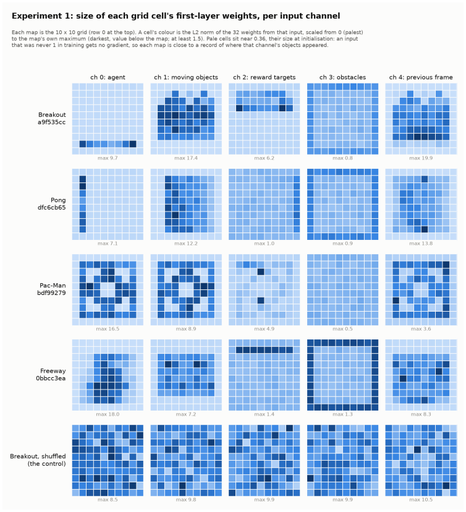
Figure 1 : First-layer weight norms per input channel for the four original games. Each map is the 10 ×10 grid; a cell’s colour is the size of the 32 weights leaving that input, scaled independently from the minimum (palest) to the maximum (darkest) weight for each input channel for each game. The bottom row is the Breakout network with its weights shuffled, as in the original MIT control.
出典 · CC BY 4.0 · Roksana Goworek, Alexander Hickey, Federico Nanni, Martin O'Reilly · Replicating and Extending Weight-Space Programming: Frontier LLMs Compile Programs into Weights and Read Input Layers · 論文の図を引用 · 元のPDFの10ページ目から図の部分を抽出しています。新たに設計した3つのゲームでは、入力層のヒートマップでボード上の位置情報は復元されましたが、行動の意味やゲームの仕組みはほとんど捉えられていませんでした。Whac-A-Moleでは穴の配置を正確に見つけたものの、モグラを叩く行動は十分に説明できませんでした。したがって、重みの読み取りは主に入力層の構造を読む能力とみるのが適切です。
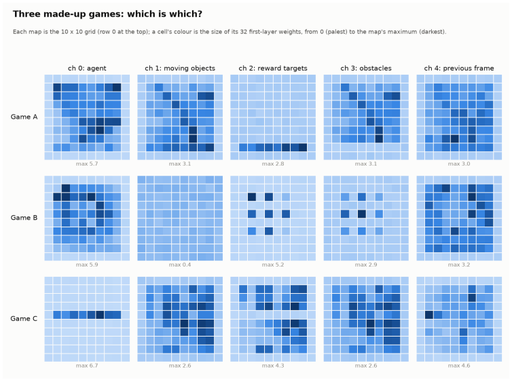
Figure 2 : First-layer heatmaps for three new games (A–C), drawn as in Figure 1, from the best of three networks per game, each trained for a billion steps.
出典 · CC BY 4.0 · Roksana Goworek, Alexander Hickey, Federico Nanni, Martin O'Reilly · Replicating and Extending Weight-Space Programming: Frontier LLMs Compile Programs into Weights and Read Input Layers · 論文の図を引用 · 元のPDFの11ページ目から図の部分を抽出しています。平文の重みの監査
Astraは、学習中に毒性処理されたモデルを10回中10回、学習後に毒性処理されたモデルを10回中7回見つけました。悪意のあるアダプタの識別では、Astraは32個中23個を当て、Qwen3.8-27Bは32個中14個で、偶然に近い結果でした。
しかし、トリガーとなる文言を見つけたり、悪意のある振る舞いを説明したりできたモデルはありませんでした。著者らは、この監査能力は識別の段階にとどまっていると見ています。
限界と未解決の課題
この研究は3日間にわたるスプリントで、ほとんどの結果はモデルと課題それぞれ1回から5回の実行で得られました。スコアは実行ごとに変わり、一部の実行はAPIの失敗で失われました。使用したモデルは独自モデルで、バージョンが変わる可能性があります。
また、ネットワークはいずれも小さく、手書き数字のような曖昧な課題は1つだけ扱いました。公開されたネットワークやログが将来のモデルの学習データに含まれた可能性もあるため、一般化には注意が必要です。
論文情報
- 著者
- Roksana Goworek, Alexander Hickey, Federico Nanni, Martin O'Reilly
- 学会・ジャーナル
- arXiv · プレプリント
- 公開日
- 2026年11月16日
- 登録日
- 2026年11月18日
- 更新日
- 2026年11月16日
- バージョン
- v1
- arXiv
- 2611.21449
- カテゴリ
- cs.CL · cs.AI
- ライセンス
- CC BY 4.0
- 掲載内容
- 論文情報・解説・論文の図
この解説は、Refivuの韓国語解説をAIで翻訳したものです。不正確な翻訳や誤りが含まれる可能性があります。論文と図の利用条件は各出典に従います。
アブストラクト
Researchers at MIT recently reported that GPT-6 Astra, a frontier large language model (LLM), can write the weights of small neural networks directly in a single reply, and can read the raw weights of small networks to say what they were trained to do. In a three-day sprint, we replicated and extended these results. Our four findings: (1) Writing weights reproduces. Astra's networks for the game Breakout scored 514, 550 and 307 (versus MIT's 517), and scored just as well on two modified versions of Breakout. Claude Opus 5.5 can also write working networks, but often runs out of output tokens. (2) What is new is translating programs into weights. Earlier models could write a good policy as code a generation before they could write network weights, and the networks the models write behave like compiled programs: two models independently decompiled Astra's Breakout network into Python matching its actions in all tested states. On classifying handwritten digits, Astra's networks scored 50% on average, below a simple classifier (82%). (3) Reading weights is mostly reading the input layer. Astra and Opus 5.5 identify which game a network plays almost perfectly, but on three new games we designed and trained ourselves, Astra recovered where things are on the board, while mostly missing how the game works. (4) Auditing from weights alone is possible but shallow. Without executing code, Astra picked out a small language model poisoned during training in 10 of 10 runs, one poisoned by extra training afterwards in 7 of 10, and a malicious adapter in 23 of 32 cases, but never identified the trigger or malicious behaviour. Open-weight models lag behind. From this early study, we conclude that LLMs can read and write small networks, but that this currently amounts to compiling hand-designed programs and reading the layout of the input layer. It is a promising but early tool for interpretability.
この論文を引用
Roksana Goworek, Alexander Hickey, Federico Nanni, Martin O'Reilly (2026). Replicating and Extending Weight-Space Programming: Frontier LLMs Compile Programs into Weights and Read Input Layers. arXiv:2611.21449v1. https://arxiv.org/abs/2611.21449v1
BibTeX
@misc{goworek2026replicating,
  title = {{Replicating and Extending Weight-Space Programming: Frontier LLMs Compile Programs into Weights and Read Input Layers}},
  author = {Roksana Goworek and Alexander Hickey and Federico Nanni and Martin O'Reilly},
  year = {2026},
  eprint = {2611.21449},
  archivePrefix = {arXiv},
  url = {https://arxiv.org/abs/2611.21449v1}
}