論文解説
BARF: Bundle-Adjusting Neural Radiance Fields
BARF:Bundle-Adjusting Neural Radiance Fields
- 課題 不完全または未知のカメラポーズから、NeRFのシーン表現とカメラ位置合わせを同時に学習する手法を扱います。
- 手法 位置エンコーディングの周波数帯域を低周波から高周波へ段階的に有効にする、coarse-to-fineの位置合わせ戦略をNeRFに適用します。
- 結果 合成オブジェクトのシーンでBARFは、平均回転誤差0.193度でポーズを位置合わせしながら、参照NeRFに近い視点合成品質を報告しています。
カメラポーズなしでNeRFを学習する問題
NeRFは、シーンの3D点の位置を色と体積密度に写像するニューラルネットワークを学習し、ボリュームレンダリングで新しい視点の画像を合成します。ただし、NeRFは各学習画像の正確なカメラポーズが与えられなければ学習できません。このポーズは通常、外部の補助アルゴリズムで取得されます。
最も単純な代替案は、ポーズのパラメータを逆伝播でNeRFと同時に最適化する方法です。著者らは、この方法は初期化に敏感で、シーン表現が悪い解に留まる可能性があり、その結果、視点合成の品質が下がることがあると説明しています。そのため本研究では、不完全または未知のポーズからシーン表現の学習とカメラ位置合わせを同時に行う問題を扱います。
2D位置合わせから得たcoarse-to-fineの考え方
著者らはまず、古典的な平面画像の位置合わせを確認します。2枚の画像の輝度誤差を最小化するワーピングパラメータを、Gauss-Newton法や勾配ベースの最適化で求めるとき、信号が滑らかなほど、画素差から予測される更新は一貫したものになります。そのため古典的な手法では、画像をぼかして収束範囲を広げるcoarse-to-fine戦略が使われます。
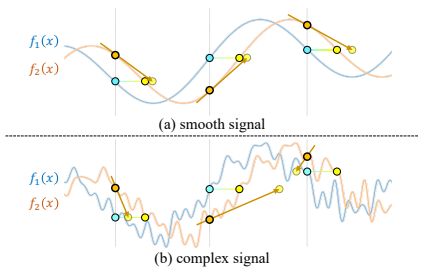
Figure 2 : Predicting alignment from signal differences. Consider two 1D signals wheref1(x) = f2(x +c) differs by an offsetc. When solving for alignment, smoother sig- nals can predict more coherent displacements than complex signals, which easily results in suboptimal alignment.
出典 · CC BY 4.0 · Chen-Hsuan Lin, Wei-Chiu Ma, Antonio Torralba, Simon Lucey · BARF: Bundle-Adjusting Neural Radiance Fields · 論文の図を引用 · 元のPDFの3ページ目から図の部分を抽出しています。同じ考え方は、座標ベースのニューラル表現を位置合わせの目的関数に組み込む場合にも当てはまります。この関係は、NeRFの合成ベースの目的関数でも成り立ちます。著者らは、その目的関数におけるポーズ更新がネットワークfのヤコビアンと位置エンコーディングの周波数構造に依存するため、平滑度の制御が重要だと解釈しています。
位置エンコーディングの周波数帯域を段階的に有効化
BARFの中心的な変更点は、位置エンコーディングの周波数帯域ごとに重みを掛けることです。k番目の周波数成分には重みw_k(α)が掛けられます。重みは、αがkより小さいときは0、α−kが0から1の間にあるときは滑らかに増えるコサイン型、α−kが1以上のときは1です。したがって、αが0であれば生の3D座標だけが使われ、αがLであれば元のNeRFの完全な位置エンコーディングと同じになります。
この重みは勾配にも直接作用します。位置エンコーディングのヤコビアンはw_k(α)を掛けたものになるため、重みが0の高周波成分は勾配への寄与も0になります。学習の初期には滑らかな信号で正しい位置合わせを見つけ、その後、高周波成分を徐々に有効にして高忠実度のシーン表現を学習する構造です。
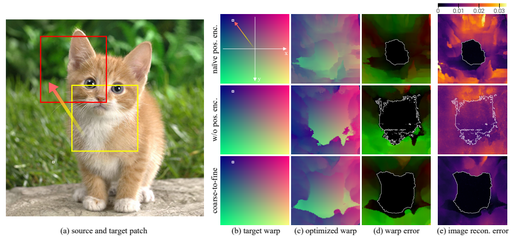
Figure 9 : Visualization of the basin of attraction. (a) We aim to align a center box (yellow) to a target patch (red) atevery possible location within the raw image. For each target patch, we jointly optimizef and the translational warp p to analyze the final warp error and the image reconstruction loss. (b) The target offsets forms a color-coded map, where green indicates horizontal offsets and red indicates vertical offsets. The above example corresponds to the highlighted pixel. (c) The optimized warp parameters and (d) the warp error for every target patch location, where the white contours highlight the offset error threshold of 0.5 pixels. BARF effectively widens the basin of attraction (range of successful alignment) with a smoother landscape compared to naïve positional encoding. (e) Without positional encoding,f has limited capacity of representing the image details, resulting in nonzero image errors despite the registration being successful as well.
出典 · CC BY 4.0 · Chen-Hsuan Lin, Wei-Chiu Ma, Antonio Torralba, Simon Lucey · BARF: Bundle-Adjusting Neural Radiance Fields · 論文の図を引用 · 元のPDFの10ページ目から図の部分を抽出しています。合成オブジェクトシーンでの位置合わせと視点合成
合成オブジェクトの実験では、8つのシーンそれぞれについて、100枚の学習画像と正解のカメラポーズを使用します。ポーズにはδp∼N(0, 0.15I)のノイズを加えて初期化します。BARFは200K回の反復の間、αを20Kから100Kまで線形に調整しながら学習します。比較対象は、完全な位置エンコーディングを使ったNeRFです。ポーズの評価では、最適化したカメラ位置をProcrustes分析で正解の位置に揃えたうえで、回転と並進の誤差を計算します。
報告された結果では、BARFの平均回転誤差は0.193度で、0.2度未満です。視点合成の品質はPSNR、SSIM、LPIPSで測定されており、論文では、BARFが正解ポーズで学習した参照NeRFと同程度の性能を示したと報告されています。完全な位置エンコーディングのNeRFは、カメラポーズを誤って位置合わせしたため、平均回転誤差が6.167度と報告されています。
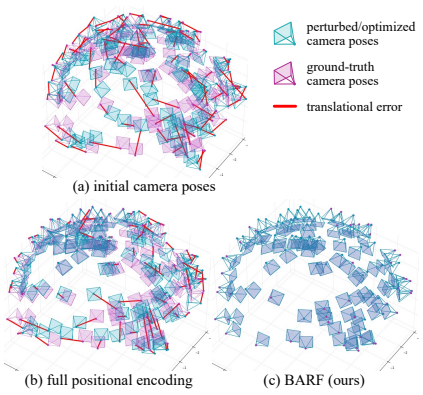
Figure 5 : Visual comparison of the initial and optimized camera poses (Procrustes aligned) for thechair scene. BARF successfully realigns all the camera frames while NeRF naïve positional encoding gets stuck at suboptimal solutions.
出典 · CC BY 4.0 · Chen-Hsuan Lin, Wei-Chiu Ma, Antonio Torralba, Simon Lucey · BARF: Bundle-Adjusting Neural Radiance Fields · 論文の図を引用 · 元のPDFの6ページ目から図の部分を抽出しています。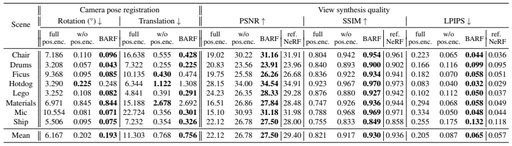
Table 2 : Quantitative results of NeRF on synthetic scenes. BARF successfully optimizes for camera registration (with less than 0.2° rotation error) while still consistently achieving high-quality view synthesis that is comparable to the reference NeRF models (trained under perfect camera poses). Translation errors are scaled by 100.
出典 · CC BY 4.0 · Chen-Hsuan Lin, Wei-Chiu Ma, Antonio Torralba, Simon Lucey · BARF: Bundle-Adjusting Neural Radiance Fields · 論文の図を引用 · 元のPDFの7ページ目から図の部分を抽出しています。LLFF実世界シーンでの未知ポーズの学習
実世界の実験は、LLFFデータセットの8つの前方向シーンで行われました。すべてのカメラポーズは恒等変換で初期化され、カメラの内部パラメータはデータセットが提供した値が既知であると仮定します。学習は200K回の反復で行われ、BARFはαを20Kから100Kまで調整します。この設定はポーズが未知の状況を模したものですが、カメラの内部パラメータは既知のままであるという点も併せて押さえておく必要があります。

Table 4 : Dataset statistics of the train/test splits for the real- world scene (LLFF) experiments, where we hold out the last 10% frames from each sequences.
出典 · CC BY 4.0 · Chen-Hsuan Lin, Wei-Chiu Ma, Antonio Torralba, Simon Lucey · BARF: Bundle-Adjusting Neural Radiance Fields · 論文の図を引用 · 元のPDFの10ページ目から図の部分を抽出しています。結果として、BARFの平均回転誤差は0.6度未満です。論文では、この値がSfMで推定したポーズとの一致を示すと解釈されています。ただし、LLFFのポーズの基準自体がSfMの推定値であるため、この評価は幾何学的なポーズ推定との一致の度合いを示すものと捉えるべきです。完全な位置エンコーディングのNeRFは、誤った位置に発散するため、視点合成の品質は低いと報告されています。
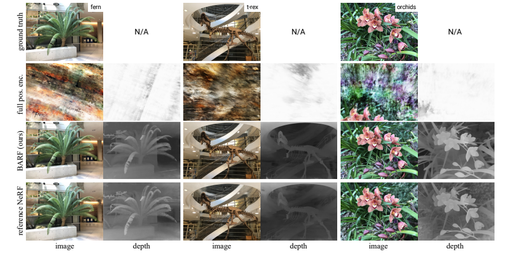
Figure 7 : Qualitative results of NeRF on real-world scenes from unknown camera poses. Compared to a reference NeRF model trained with camera poses provided from Sf M [44], BARF can effectively optimize for the poses jointly with the scene representation. NeRF models with full positional encoding diverge to incorrect localization and hence poor synthesis quality.
出典 · CC BY 4.0 · Chen-Hsuan Lin, Wei-Chiu Ma, Antonio Torralba, Simon Lucey · BARF: Bundle-Adjusting Neural Radiance Fields · 論文の図を引用 · 元のPDFの8ページ目から図の部分を抽出しています。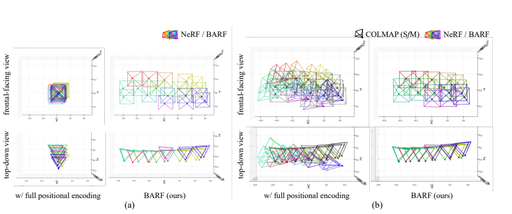
Figure 10 : Visualization of the optimized camera poses for the fern scene. The poses for both the baseline NeRF (with full positional encoding) and BARF are initialized to the identity transform for all frames. (a) The camera poses of the baseline NeRF get stuck in a suboptimal solution that does not accurately reflect the actual viewpoints, whereas BARF can effectively optimize for the underlying poses. (b) We compare the optimized poses to those computed from Sf M [44] (colored in black), where we align the pose trajectories using Procrustes analysis. The camera poses optimized by BARF highly agree with those from Sf M, whereas those from the baseline NeRF cannot be well-aligned with Procrustes analysis. Therefore, there is no systematic way of finding a reasonable set of corresponding held-out views with respect to the optimized coordinate system.
出典 · CC BY 4.0 · Chen-Hsuan Lin, Wei-Chiu Ma, Antonio Torralba, Simon Lucey · BARF: Bundle-Adjusting Neural Radiance Fields · 論文の図を引用 · 元のPDFの11ページ目から図の部分を抽出しています。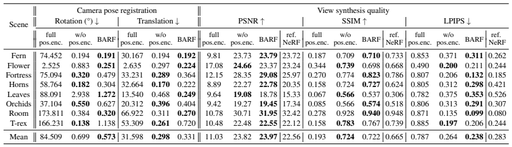
Table 5 : Full quantitative comparison of NeRF on the LLFF forward-facing scenes from unknown camera poses. BARF and our baseline without positional encoding are competitive in different metrics. An optimal coarse-to-fine schedule for BARF could be theoretically found per scene that are at least as good as the baseline methods; exhaustively or adaptively search for such optimal schedule is currently out of scope of this paper. Translation errors are scaled by 100.
出典 · CC BY 4.0 · Chen-Hsuan Lin, Wei-Chiu Ma, Antonio Torralba, Simon Lucey · BARF: Bundle-Adjusting Neural Radiance Fields · 論文の図を引用 · 元のPDFの11ページ目から図の部分を抽出しています。適用範囲と残された限界
著者らは、BARFが元のNeRFと似た限界を持つことを明らかにしています。最適化とレンダリングが遅く、剛体の仮定を用いており、密な3Dサンプリングに敏感です。さらに、coarse-to-fineのスケジュールはヒューリスティックに決める必要があります。
LLFFの付録にある深度空間の実験でも、完全な位置エンコーディングのNeRFはすべての指標で依然として低い値にとどまります。一方で、位置エンコーディングを使わない手法が、一部の設定ではBARFを上回る可能性があります。そのため、周波数スケジュールの最適化や最適な深度パラメータ化は、本論文の範囲外です。
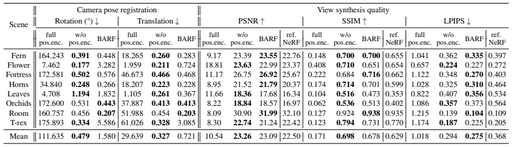
Table 6 : Quantitative results of NeRF on the LLFF forward-facing scenes fromunknown camera poses, sampling the 3D points in the regular depth space (instead of the inverse depth space). Translation errors are scaled by 100.
出典 · CC BY 4.0 · Chen-Hsuan Lin, Wei-Chiu Ma, Antonio Torralba, Simon Lucey · BARF: Bundle-Adjusting Neural Radiance Fields · 論文の図を引用 · 元のPDFの13ページ目から図の部分を抽出しています。論文情報
- 著者
- Chen-Hsuan Lin, Wei-Chiu Ma, Antonio Torralba, Simon Lucey
- 学会・ジャーナル
- arXiv · プレプリント
- 公開日
- 2021年4月13日
- 登録日
- 2026年11月5日
- 更新日
- 2021年8月19日
- バージョン
- v2
- arXiv
- 2104.06405
- カテゴリ
- cs.CV · cs.GR · cs.LG · cs.RO
- ライセンス
- CC BY 4.0
- 掲載内容
- 論文情報・解説・論文の図
この解説は、Refivuの韓国語解説をAIで翻訳したものです。不正確な翻訳や誤りが含まれる可能性があります。論文と図の利用条件は各出典に従います。
アブストラクト
Neural Radiance Fields (NeRF) have recently gained a surge of interest within the computer vision community for its power to synthesize photorealistic novel views of real-world scenes. One limitation of NeRF, however, is its requirement of accurate camera poses to learn the scene representations. In this paper, we propose Bundle-Adjusting Neural Radiance Fields (BARF) for training NeRF from imperfect (or even unknown) camera poses -- the joint problem of learning neural 3D representations and registering camera frames. We establish a theoretical connection to classical image alignment and show that coarse-to-fine registration is also applicable to NeRF. Furthermore, we show that naïvely applying positional encoding in NeRF has a negative impact on registration with a synthesis-based objective. Experiments on synthetic and real-world data show that BARF can effectively optimize the neural scene representations and resolve large camera pose misalignment at the same time. This enables view synthesis and localization of video sequences from unknown camera poses, opening up new avenues for visual localization systems (e.g. SLAM) and potential applications for dense 3D mapping and reconstruction.
この論文を引用
Chen-Hsuan Lin, Wei-Chiu Ma, Antonio Torralba, Simon Lucey (2021). BARF: Bundle-Adjusting Neural Radiance Fields. arXiv:2104.06405v2. https://arxiv.org/abs/2104.06405v2
BibTeX
@misc{lin2021barf,
  title = {{BARF: Bundle-Adjusting Neural Radiance Fields}},
  author = {Chen-Hsuan Lin and Wei-Chiu Ma and Antonio Torralba and Simon Lucey},
  year = {2021},
  eprint = {2104.06405},
  archivePrefix = {arXiv},
  url = {https://arxiv.org/abs/2104.06405v2}
}