論文解説
Understanding the Role of Reasoning Data in Pretraining
事前学習での推論データの役割の理解
- 課題 固定の事前学習予算で、原子的事実と推論軌跡の比率をどう配分すべきかは明確ではありません。
- 手法 全遷移を原子的に与え、一部の遷移だけを推論軌跡に入れます。そのうえで線形アテンションモデルの最適な原子重みを分析し、チェーン長とカバレッジに応じた傾向を確かめます。
- 結果 1層Transformerの実験では、混合が2つの純粋なソースのどちらよりもOOD精度を高めました。理論上の最適中心は、チェーン長Lが大きくなるほど増え、held fraction qが大きくなるほど減りました。
固定予算での配分の問い
事前学習でトークン予算が決まっているとき、原子的事実データと推論軌跡データをどの比率で配分すべきかが、この研究の問いです。推論軌跡は、複数の段階にわたって事実を合成する練習になります。ただし、限られた軌跡の集合では、評価に必要な事実のうち一部しか含められない場合があります。そのため、推論チェーンが長くなるほど合成学習の価値は高まりますが、予算が軌跡に偏ると事実の幅広いカバレッジは下がります。この論文は、このトレードオフを推論チェーン長Lと、推論軌跡に入れた事実の比率に分けて分析しています。この問いは、推論データを事後学習ではなく事前学習の混合に入れる最近の流れと直接関係しています。
状態追跡の設定
この研究では、state-tracking worldと呼ばれる統制された設定を作ります。エンティティと関係が固定された順列で結ばれた世界で、すべての遷移を原子的な例として1回ずつ与えます。ただし、推論軌跡にはその一部の遷移だけを入れます。推論軌跡に入らなかった遷移をheld transitionと呼びます。モデルはこの遷移を個別には学習していますが、複数段階のチェーンの中でその事実を使ったことはありません。そのため、held transitionでの性能は、事実は知っているものの合成には使えない状態で、どの程度汎化するかを測る指標になります。原子的な例は最初の遷移だけに教師信号を与え、推論の例はチェーン全体の状態に教師信号を与えます。
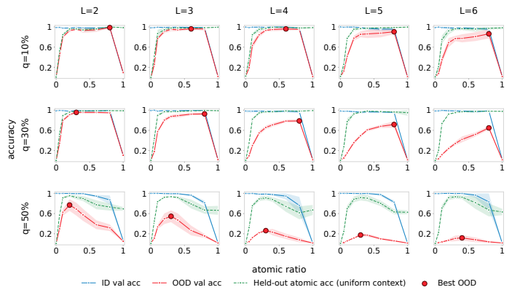
Figure 4 :Held-out atomic recall.ID and OOD final-answer accuracy and held-out atomic accuracy versus atomic example ratio, using the same setting as Figure 1. For held- out atomic evaluation (green dashed), we sample (e 0,r 1) uniformly from held-out facts and r2,...,r L independently and uniformly from all relations, scoring onlye 1 =π r1(e0). Curves and shaded regions show the mean and±1 standard deviation across three training seeds.
出典 · CC BY 4.0 · Jianhao Huang, Allan Zhang, Ali Payani, Baharan Mirzasoleiman · Understanding the Role of Reasoning Data in Pretraining · 論文の図を引用 · 元のPDFの21ページ目から図の部分を抽出しています。1層Transformerでの混合実験
1層のソフトマックスアテンションとMLPからなるTransformerで、原子的な例と推論の例の比率を変えて実験しました。64個のエンティティと8個の関係で構成した世界で原子的な例の比率を変えると、混合設定は2つの純粋なソースのどちらよりもOOD accuracyが高くなりました。ここでOOD accuracyとは、推論学習から除外された事実を含む質問で測った精度です。好ましい原子的な例の比率は、おおむねチェーン長Lが長くなるほど大きくなり、held fraction qが大きくなるほど小さくなりました。ただし、Lが3と4で、q=30%の設定では、この傾向とは異なる最大値が出ました。このときは、複数の比率がほぼ同じ平均精度を示す平らな区間でした。
結果は、3つの学習シードの平均と標準偏差で示されています。
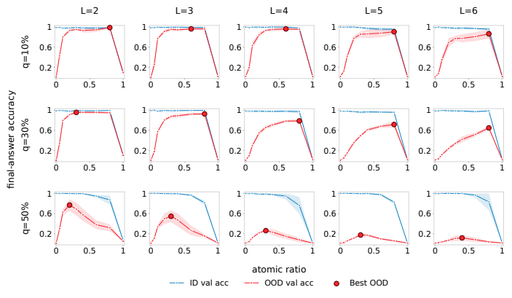
Figure 1 :Effect of atomic–reasoning mixing on state-tracking accuracy.Final- answer accuracy as a function of the atomic ratio in a synthetic world with 64 entities and 8 relations, each sampled as an independent random permutation. Curves and shaded regions indicate the mean and±1 standard deviation across three training seeds. The empirically optimal atomic example ratio generally increases with reasoning lengthLand decreases with the held-out fact fractionq. The selected grid maximizers forL∈{3,4}atq= 30% deviate from the latter trend; however, these panels exhibit near-optimal plateaus, with several tested mixture ratios achieving very similar mean OOD accuracy.
出典 · CC BY 4.0 · Jianhao Huang, Allan Zhang, Ali Payani, Baharan Mirzasoleiman · Understanding the Role of Reasoning Data in Pretraining · 論文の図を引用 · 元のPDFの6ページ目から図の部分を抽出しています。線形アテンションでの最適な原子重み
線形アテンションsurrogateは、ソフトマックスの正規化を取り除き、トークン間の双線形スコアに位置ゲートをHadamard積で掛けたうえで、スカラーの線形読み出しを加えたモデルです。原子的な例と推論の例の二乗損失をβで混ぜ、重みはB(0)=0、読み出し重みは1、ルーティング係数はE11から始めて、gradient flowで学習させます。除外された遷移での二乗誤差EHを最小化するβを、最適な原子重みと定義します。中心となる結果は、均衡した状態追跡の世界での結果です。この仮定では、エンティティ数Nと関係数Mを等しいとし、任意の2つのエンティティが正確に1つの関係で結ばれていると見なします。Nが十分大きければ、高い確率で最適なβ*は(1/3, 2/3)の中で一意になります。
また、z=L(1−q)について、β(z)=1/(2−z+√(z²−z+1))に、O(√(log(2/δ)/N))の誤差の範囲で近づきます。この中心β(z)は、Lが大きくなるほど大きくなり、qが大きくなるほど小さくなります。つまり、チェーンが長いほど原子的な例の比重を高めるほうがよく、除外の比率が大きいほど比重を下げるほうがよい、ということです。この結果は、τ、L、qを固定した条件付きの定理です。完全なソフトマックスTransformerでも同じ最適中心が成り立つことを証明したものではありません。
統制された多段階推論の実験
2つ目の自然言語実験は、人物間の関係をH回たどって最終的な人物を探す、統制されたタスクです。原子文書の比率aと、推論の例から除外する人物-関係ペアの比率qを変えました。すべての事実は原子コーパスに残し、OOD質問には推論学習から除外されたペアが少なくとも1つ含まれるようにしました。4ホップのタスクでは、2ホップと3ホップのタスクよりも原子比率が大きい混合が有利でした。また、除外比率qを大きくするほど最高のOOD精度は下がり、最適な区間もより小さい原子比率の側に移りました。すべての設定で、内部の混合は2つの純粋なソースの端点よりも高いOOD精度を示しました。
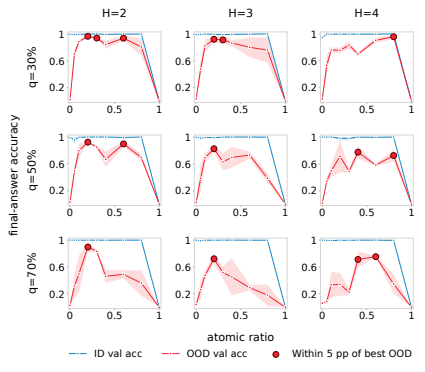
Figure 2 : Multi-hop final-answer accuracy as a function of the atomic ratio in a synthetic world with 32 people and 32 relations. Columns vary hop countHand rows vary reasoning holdout fractionq. Curves and shaded regions indicate the mean and±1 standard deviation across three training seeds. Large red circles mark OOD accuracies within five percentage points of each panel’s maximum.
出典 · CC BY 4.0 · Jianhao Huang, Allan Zhang, Ali Payani, Baharan Mirzasoleiman · Understanding the Role of Reasoning Data in Pretraining · 論文の図を引用 · 元のPDFの8ページ目から図の部分を抽出しています。FineMathとMathLakeによる事前学習
最後の実験は、Olmo-3 150Mを10Bトークンの予算で、FineMathとMathLakeのOpenMathInstruct-2の部分集合を混ぜて事前学習するものです。MathLakeの比率を0%から100%まで10%刻みで変えると、GSM8K CEはFineMath 100%で1.785、MathLake 100%で7.513でした。20%の混合で1.608と最も低く、両端はいずれも最適ではありませんでした。同じ予算で、held-out比率と難易度を変えた分析も、著者らは定理と同じ方向を示すものだと見ています。この結果は、150Mモデル1つと固定された10Bトークン予算で得られた観察です。
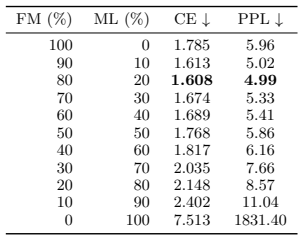
Table 1 : Mixture-ratio sweep be- tween FineMath and MathLake (Olmo-3 150M, 10B tokens). Zero- shot GSM8K test CE and PPL over the solution sequence. Best in bold.
出典 · CC BY 4.0 · Jianhao Huang, Allan Zhang, Ali Payani, Baharan Mirzasoleiman · Understanding the Role of Reasoning Data in Pretraining · 論文の図を引用 · 元のPDFの9ページ目から図の部分を抽出しています。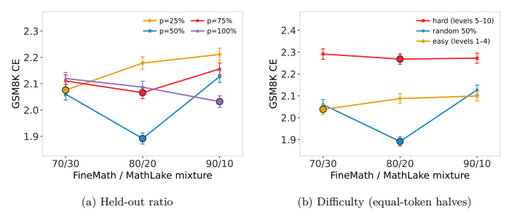
Figure 3 : GSM8K CE at step 5000, with uncertainty estimated by bootstrapping evaluation examples 3 times. (a) Varying the fractionpof the MathLake pool available for training, at three FineMath/MathLake ratios. (b) Training on the easy or hard half of MathLake versus a random 50% subset.
出典 · CC BY 4.0 · Jianhao Huang, Allan Zhang, Ali Payani, Baharan Mirzasoleiman · Understanding the Role of Reasoning Data in Pretraining · 論文の図を引用 · 元のPDFの9ページ目から図の部分を抽出しています。限界
統制された設定は、大規模な事前学習に含まれる異質なデータソースとデータ品質の差を抽象化しています。事後学習であるSFTとRLで、混合比率がどのような影響を与えるかは実験していません。理論分析は、線形アテンションsurrogateと均衡した世界の仮定のもとでの結果です。他のモデル構造や仮定で同じ最適中心が得られるという結果は示していません。
論文情報
- 著者
- Jianhao Huang, Allan Zhang, Ali Payani, Baharan Mirzasoleiman
- 学会・ジャーナル
- arXiv · プレプリント
- 公開日
- 2026年11月14日
- 登録日
- 2026年11月17日
- 更新日
- 2026年11月14日
- バージョン
- v1
- arXiv
- 2611.19042
- カテゴリ
- cs.LG · cs.AI
- ライセンス
- CC BY 4.0
- 掲載内容
- 論文情報・解説・論文の図
この解説は、Refivuの韓国語解説をAIで翻訳したものです。不正確な翻訳や誤りが含まれる可能性があります。論文と図の利用条件は各出典に従います。
アブストラクト
Reasoning data expose models to multi-step reasoning, but reasoning traces may cover only a subset of the available facts. How should pretraining balance atomic facts with reasoning traces? We study this question by constructing a setting in which every fact provides an atomic training signal, while only a subset appears in reasoning supervision, enabling us to measure generalization to transitions observed atomically but never used in training traces. For a linear transformer, we derive the weight assigned to atomic training signals that minimizes held-transition squared error and show that its leading-order optimum increases with reasoning-chain length and decreases with the fraction of facts held out from reasoning traces. These trends persist in a full transformer layer with an MLP, softmax attention, and cross-entropy loss. We further validate the role of reasoning complexity and data coverage in two natural-language settings: controlled multi-hop reasoning and mathematical pretraining. Together, our results provide a principled view of how reasoning-chain structure and data coverage should shape the allocation of training data during pretraining.
この論文を引用
Jianhao Huang, Allan Zhang, Ali Payani, Baharan Mirzasoleiman (2026). Understanding the Role of Reasoning Data in Pretraining. arXiv:2611.19042v1. https://arxiv.org/abs/2611.19042v1
BibTeX
@misc{huang2026understanding,
  title = {{Understanding the Role of Reasoning Data in Pretraining}},
  author = {Jianhao Huang and Allan Zhang and Ali Payani and Baharan Mirzasoleiman},
  year = {2026},
  eprint = {2611.19042},
  archivePrefix = {arXiv},
  url = {https://arxiv.org/abs/2611.19042v1}
}