論文解説
Latency, Speech Recognition and Turn-Taking in Voice Agents for Spanish Phone Negotiation: An Externally Measured Comparison of Pipecat, LiveKit and GPT-Live
スペイン語電話交渉向け音声エージェントにおける遅延、音声認識、ターンテイキング:Pipecat、LiveKit、GPT-Liveの外部計測による比較
- 課題 電話交渉用の音声エージェントは、速い応答、金額の認識、相づちへの対応を同時に満たす必要がありますが、構成ごとの違いは外部から公平に比較されていませんでした。
- 手法 同じ録音の音声をharnessで再生し、Pipecat、LiveKit Agents、GPT-Liveを聞き手側から同じ基準で計測しました。
- 結果 中央値の応答遅延はGPT-Liveが2,444.8 ms、Pipecatが2,616.0 ms、LiveKit Agentsが3,090.0 msでした。金額認識の誤りはGPT-Liveが2.86%、Pipecatが13.01%でした。
音声交渉エージェントが解くべき課題
この論文は、SPOTSがWhatsAppで進めている貨物運賃の交渉を電話音声に移す際に生じる問題を扱っています。音声エージェントは、相手が話し終えた後すぐに応答しなければならず、電話の音質でも金額を正確に聞き取る必要があります。さらに、相手が話を遮ったり相づちを打ったりしたときに、話すのをやめるか続けるかも判断しなければなりません。この3つの要件は、テキストによる交渉にはなかったものです。
この論文は3つの構成を比較しています。PipecatとLiveKit Agentsは、音声認識、言語モデル、音声合成を段階的につなげたcascadeです。GPT-Liveは段階を分けず、聞いて話す音声モデルです。目的は、対話全体の品質ではなく、遅延、音声認識の誤り、ターンテイキングという音声技術に固有の違いを測ることです。
聞き手側で計測する仕組み
計測は、harnessというプログラムがcarrierの役割を担い、録音された47個のラインを再生する方法で行われました。3つの構成に同じ録音が同じように入るため、発話の揺らぎが比較を曇らせることはなく、発話の終了時点も正確に把握できます。音声は8 kHzのµ-law電話形式に変換されました。
遅延は、carrierの発話終了から、agentの内容的な応答の最初の可聴フレームまでと定義しました。フレームワークが自己申告する遅延とは異なり、聞き手側で記録しています。転送遅延は、入力側の転送と出力側の転送に分けてそれぞれ計算しました。計測ツールは、既知の遅延を持つsimulated agentを使い、3つの経路ごとに検証しました。Pipecat経路の最大誤差は86.4 msでした。
応答遅延の比較
GPT-Liveの中央値の応答遅延は2,444.8 msでした。Pipecatは2,616.0 ms、LiveKit Agentsは3,090.0 msでした。GPT-LiveがPipecatより171.2 ms速い差については、信頼区間に0が含まれているため、2つの構成を区別するのは難しいです。
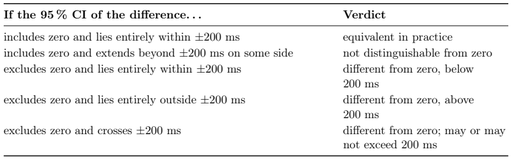
Table 5 . How the 95 % CI of a difference is read against the 200 ms margin
出典 · CC BY 4.0 · Jovan Popoca Moran, Eduardo de Avila-Armenta, Raúl Alejandro Aquino-Ibarra, Jorge Octavio Nicolás-Díaz, Umberto Leon-Dominguez · Latency, Speech Recognition and Turn-Taking in Voice Agents for Spanish Phone Negotiation: An Externally Measured Comparison of Pipecat, LiveKit and GPT-Live · 論文の図を引用 · 元のPDFの11ページ目から図の部分を抽出しています。運送遅延を差し引いた値では、PipecatとLiveKit Agentsの差は−25.2 msで、実質的には同等でした。LiveKitの追加遅延は、主に入力と出力の転送経路で生じていました。ツールコールは3つの構成すべてに0.9~1.1 s加わり、構成間の差よりも大きくなりました。
金額認識の誤り
交渉で費用に直結する金額表現だけを別に数えると、差はさらに大きくなりました。
訂正の場面でも差が見られました。carrierが18,000を18,500と言い直したとき、GPT-Liveは13件の呼び出しのうち7件すべてで18,500を理解しました。PipecatとLiveKit Agentsは大半で18,000のままでした。原因の大部分は、文字起こしで'quinientos'が抜けたことでした。この比較は1ラインで呼び出しごとに13件という規模なので、差の大きさを精密に推定してはいません。
相づちと割り込みの処理
carrierが話を遮る場面では、3つの構成すべてがおおむね話すのをやめて応答しました。一方、相づち'ajá'や'ok'が入ったとき、PipecatとLiveKit Agentsは初期設定ではほとんどの場合話すのをやめましたが、その相づちをcarrierの回答として受け取るケースもありました。'ok'の後に合意が登録された例は、Pipecatが3/15、LiveKitが2/15、GPT-Liveが0/15でした。これは検定を行っていない記述統計です。
著者らは、この結果はPipecatとLiveKitの既定の割り込み処理の仕組みに由来すると見ています。会話再開の分類と、理解された金額の判定は1名の評価者が行い、評価者間の一致度は確認していません。
限界
carrierは1名が録音したラインでシミュレーションされ、電話網は経由していません。実際の通話では、認識結果はさらに悪化する可能性が高いです。GPT-LiveはPipecatおよびLiveKitとは別の日に計測されたため、その間のネットワークや提供事業者の変化が差に混ざる可能性があります。
また、フレームワークごとに既定の設定を1つだけ試しました。会話再開の分類と理解の判定は1名の評価者が行いました。実験はスペイン語のみで行われました。
論文情報
- 著者
- Jovan Popoca Moran, Eduardo de Avila-Armenta, Raúl Alejandro Aquino-Ibarra, Jorge Octavio Nicolás-Díaz, Umberto Leon-Dominguez
- 学会・ジャーナル
- arXiv · プレプリント
- 公開日
- 2026年11月14日
- 登録日
- 2026年11月17日
- 更新日
- 2026年11月14日
- バージョン
- v1
- arXiv
- 2611.19118
- カテゴリ
- cs.CL · cs.AI · cs.SD
- ライセンス
- CC BY 4.0
- 掲載内容
- 論文情報・解説・論文の図
この解説は、Refivuの韓国語解説をAIで翻訳したものです。不正確な翻訳や誤りが含まれる可能性があります。論文と図の利用条件は各出典に従います。
アブストラクト
A voice agent that negotiates by phone must answer quickly, understand spoken amounts and cope with a caller who talks over it. We compared three architectures for such an agent, negotiating freight rates in Spanish: two cascades (speech recognition, language model and speech synthesis) orchestrated by Pipecat and by LiveKit Agents, and GPT-Live, an OpenAI speech model that listens and speaks without separate stages. A program played the carrier with the same 47 recordings of one speaker for all agents, without the telephone network, in 77 calls per architecture over five negotiation scenarios, and measured latency on the listener's side with a validated instrument. Median latency to the content response was 2,616.0 ms (Pipecat), 3,090.0 ms (LiveKit) and 2,444.8 ms (GPT-Live); the confidence interval of GPT-Live's 171.2 ms advantage over Pipecat includes zero. According to its own timestamps, GPT-Live began to answer 800 ms after the end of the line, close to the 0.8 s published by OpenAI; most of the remaining wait, about 1,367 ms and nearly constant, is the audio's round trip through OpenAI's service. A tool call added 0.9-1.1 s in every architecture, more than any difference between them, and the frameworks' self-reported latency fell short of the listener's wait by 9% (Pipecat) and 22% (LiveKit). Word error rates were low (6.03, 4.93 and 1.47%), but the error on amounts was 13.01% and 12.61% in the cascades, against 2.86% in GPT-Live. With default settings, Pipecat and LiveKit stopped at almost every backchannel and often took it as the carrier's answer: an "ok" spoken over the agent ended in a registered agreement in 3 of 15 Pipecat calls, 2 of 15 LiveKit calls and no GPT-Live call (descriptive counts, not tested). Latency should therefore be measured on the listener's side, and a cascade needs safeguards for spoken amounts and backchannels.
この論文を引用
Jovan Popoca Moran, Eduardo de Avila-Armenta, Raúl Alejandro Aquino-Ibarra, Jorge Octavio Nicolás-Díaz, Umberto Leon-Dominguez (2026). Latency, Speech Recognition and Turn-Taking in Voice Agents for Spanish Phone Negotiation: An Externally Measured Comparison of Pipecat, LiveKit and GPT-Live. arXiv:2611.19118v1. https://arxiv.org/abs/2611.19118v1
BibTeX
@misc{moran2026latency,
  title = {{Latency, Speech Recognition and Turn-Taking in Voice Agents for Spanish Phone Negotiation: An Externally Measured Comparison of Pipecat, LiveKit and GPT-Live}},
  author = {Jovan Popoca Moran and Eduardo de Avila-Armenta and Raúl Alejandro Aquino-Ibarra and Jorge Octavio Nicolás-Díaz and Umberto Leon-Dominguez},
  year = {2026},
  eprint = {2611.19118},
  archivePrefix = {arXiv},
  url = {https://arxiv.org/abs/2611.19118v1}
}