論文解説
RVLM: Fewer Tokens, Better Resolution Scaling, Fine-Grained Spatial Grounding
画像を見た目の近いパッチ同士の領域に分けて視覚トークンを減らすVLM
- 課題 VLMは画像を一様なパッチに分けて視覚トークンにするため、トークン数が画素数で決まり、画像の中身に関係なく予算が使われてしまいます。
- 手法 RVLMは、学習が要らないFelzenszwalb-Huttenlocher分割で画像を連結した領域に分け、同じ領域内のパッチ特徴を1つの視覚トークンにまとめます。
- 結果 同じ条件のパッチ版PVLMと比べて、視覚トークン数を21.5%減らしながら、例の平均の性能は0.6ポイント向上しました。
パッチ分割で視覚トークンが増える理由
VLMは画像を一様なパッチの格子に分け、それぞれを視覚トークンとして言語モデルに渡すのが一般的です。そのためトークン数は画素数に結びつき、画像の中身は反映されません。文書の余白は面積が大きいというだけで文字と同じだけトークンを使い、大きな物体1つを写した高解像度画像は雑然とした場面より多くのトークンを要します。この内容に依らない配分は予算を無駄にし、固定予算で扱える画像の最大解像度を制限します。
既存の削減策は、固定の空間プーリングと、パッチトークンの枝刈りや統合の二つに大別されます。固定プーリングは内容を無視し、枝刈りや統合は空間の被覆を失ったり、トークンと画像位置の対応を曖昧にしたりします。後者は接地に必要な対応関係を崩すため、ポインティングや分割のような空間的なタスクで性能が落ちやすくなります。一方、内容に沿った視覚単位を作る手法は学習済みの特徴や分割モデルに頼るため、計算コストが増えたり、VLMの学習の影響を受けたりします。
そこで問題は、どのような領域なら学習の中で視覚単位として機能し続けるかになります。著者らは、領域トークンの効果は意味的なまとまりよりも、領域が画像全体を覆うかどうかに左右されると見ています。この前提から、画像全体を覆い、学習を通じて連結性を保てる領域の作り方が必要になります。
内容に沿った領域をトークンにする発想
RVLMの核心は、近くにあるパッチのうち見た目が似ているものを束ね、その束を1つの視覚トークンにすることです。固定ウィンドウではトークンの範囲が位置だけで決まりますが、領域では画像の構造に沿って範囲が決まります。領域は必ずしも物体全体と一致しなくてよく、複数の領域にまたがる物体はLLMがトークンをまたいで情報を組み合わせます。
著者らは、トークン数を画素数ではなく内容に応じた領域数で決められれば、高解像度でも予算を抑えられると期待しています。ただし領域は粗い単位になるため、そのまま使うと細かい位置を指定しにくくなります。そこで、パッチと領域の対応を保持しておき、領域、パッチ、位置の順に絞り込む粗から細への復号で精密な位置を返す設計にしました。領域が画像の大部分を占めても、最後の段階で位置を細かく決められるため、トークンを粗くしても接地の精度を保てるという考えです。
従来の固定窓プーリングとの違いは、窓を位置で切るのではなく、学習不要の分割で作った領域を単位にする点です。この分割は画像だけで決まるため、学習中にVLMの特徴が変わっても領域の数や広がりは変わりません。
FH分割からトークン化、粗から細への接地まで
処理はまずFH分割で画像を連結した領域に分けるところから始まります。FHは隣接する成分を色の近さと領域内のばらつきで結合していく手法で、学習を必要としません。この処理はCPUのデータローダで行うため、GPUの計算時間と競合しません。
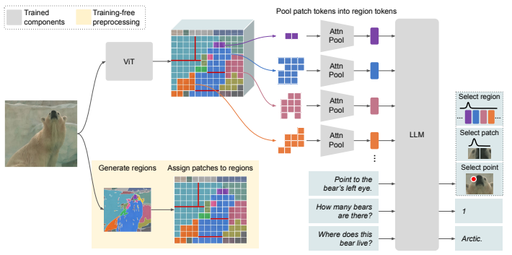
Figure 2 :Overview of RVLM.We generate content-adaptive regions using Felzenszwalb- Huttenlocher segmentation and assign each ViT patch to a region. This is a CPU-side preprocessing that runs in parallel to the model execution. Patch features within each region are aggregated through attention pooling to produce a sequence of region tokens for the LLM. The retained patch-to-region correspondence enables coarse-to-fine spatial grounding, where the LLM selects a region, then a patch within it, and finally a precise point within the patch.
出典 · CC BY 4.0 · Savya Khosla, Chris Dongjoo Kim, Alex Schwing, Derek Hoiem, Christopher Clark, Sangho Lee · RVLM: Fewer Tokens, Better Resolution Scaling, Fine-Grained Spatial Grounding · 論文の図を引用 · 元のPDFの4ページ目から図の部分を抽出しています。次に各ViTパッチを、面積の25%以上を覆う最小の領域に割り当てます。該当する領域がなければ最も重なりの大きい領域を使い、細い文字の構造を残します。この分割と網羅的で排他的な割り当ては、どちらも接地に必要だとされています。分割がないと粗から細への復号で各パッチを選べず、割り当てが排他的でないと対象が一意に決まらないためです。
グループ内の有効なパッチ特徴の平均をクエリとし、個々のパッチ特徴をキーと値とするマルチヘッドのクロスアテンションで1つにまとめます。その結果をMLPでLLMの埋め込み空間へ射影し、グループごとに1つの視覚トークンを得ます。位置はM-RoPEで、時間tと、領域の中心に最も近いパッチの座標(h, w)を与えるため、領域が長方形でなくても位置を表せます。パッチ特徴は捨てられず、接地のヘッドは未プールのパッチ特徴を読めます。
低解像度の全体像は2×2のパッチプーリングで196トークンになり、全体の文脈のためだけに使われます。学習はSigLIP2-So400m/14とQwen3-4B-Instructで初期化し、ステージ1で31,971ステップ、ステージ2で24,000ステップ共同で学習します。セグメンテーションでは、各セルについて領域、パッチ、セルの3段階のスコアを足してマスクのロジットを作り、0.5で二値化します。
PVLMとの比較で効率と精度を確かめる
比較対象のPVLMは、RVLMとアーキテクチャ、学習データ、レシピを同じにしたパッチ版で、視覚トークン化の違いだけを分けます。同規模の開放重みVLMと並べると、PixMo-PointでRVLM-4Bは86.4、PVLM-4Bは85.2で、PVLMが十分強い比較基準であることが分かります。
35タスクで比べると、例の平均はPVLMの82.8からRVLMの83.4へ0.6ポイント向上し、視覚トークン数は985から773へ21.5%減りました。タスク家族ごとに均等に重みを付けた平均でも79.1から79.8へ0.7ポイント上がり、どちらの集計でも悪化は見られません。カウントで+0.9、セグメンテーションで+1.3、深度で+1.9と、空間的なタスクで差が大きくなります。深度では平均が83.5から85.4になり、視覚トークンは1,617から916に減りました。これは、領域が一貫した物体や面を表すのに向いているためと解釈されています。

Table 2 :Patch vs. region tokenization.RVLM preserves or improves overall performance over the identically trained patch baseline while using fewer visual tokens. Its main advantage, however, comes from enabling higher-resolution processing, as shown in Figure 1b. Example-weighted aver- ages give equal weight to every example, while family-weighted averages give equal weight to each task family. Token counts are averaged across examples.
出典 · CC BY 4.0 · Savya Khosla, Chris Dongjoo Kim, Alex Schwing, Derek Hoiem, Christopher Clark, Sangho Lee · RVLM: Fewer Tokens, Better Resolution Scaling, Fine-Grained Spatial Grounding · 論文の図を引用 · 元のPDFの7ページ目から図の部分を抽出しています。小さな文字が大きな周囲の領域に吸収され、空間の精度が落ちることが原因として挙げられています。つまり、細かい文字が意味を持つ文書系の質問応答では、領域化の弱点がそのまま性能差になります。
解像度を上げたときのスケーリング
高解像度の例を2.08-2.63 MPの範囲から21,273件集め、最大解像度の上限を7段階に変えて両モデルを再評価しました。画像サイズは0.3から2.4 Megapixelsの5区分で整理され、解像度が上がるほど利得が増えています。利得は+0.0から+5.3まで増え、学習時の解像度を超えた範囲でより大きくなります。最も高い解像度設定では、51.8%少ない視覚トークンで5.3ポイント向上しました。
視覚トークン予算を揃えて比べると、領域版は同じトークン数でより高解像度の入力を表せるため、LLMに同程度のトークンを与える条件でPVLMを上回るとされています。つまり、節約したトークンを高解像度化に回せるという解釈です。ただし、この結果は学習を変えず、推論時に解像度の上限だけを変えて両モデルを再評価したものです。
推論速度と事後圧縮との比較
速度は、PixMo-Capの512件をH100で、生成を1トークンに制限して測り、データ読み込みと領域構成も含めました。この速度向上は、LLMが処理する視覚シーケンスが短くなったことによるものです。ただし、バッチサイズ1で1クロップと4クロップの場合は、PVLMのほうがわずかに速くなります。
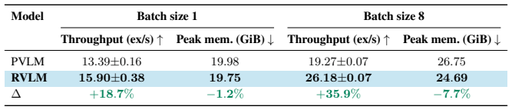
Table 3 :Inference cost.Throughput is examples processed per second of wall-clock time over 512 randomly sampled examples from PixMo-Cap, including data loading and region construction. Generation is capped at one output token, so throughput reflects prefill. Measurements use a single NVIDIA H100 after 64 warm-up batches. We report the mean and standard deviation over five runs. Shorter visual sequences increase throughput and reduce peak memory, with larger gains at larger batch sizes. Table 11 shows a finer-grained cost comparison across image resolutions.
出典 · CC BY 4.0 · Savya Khosla, Chris Dongjoo Kim, Alex Schwing, Derek Hoiem, Christopher Clark, Sangho Lee · RVLM: Fewer Tokens, Better Resolution Scaling, Fine-Grained Spatial Grounding · 論文の図を引用 · 元のPDFの8ページ目から図の部分を抽出しています。事後圧縮との比較では、FastV、ToMe、VisionZipをPVLMに適用し、各画像の目標トークン数をRVLMの領域トークン数に合わせました。画像QAでは各手法がほぼ同等ですが、ポインティングではRVLMの67.1に対し、最も良い圧縮手法でも64.2にとどまります。RVLMはパッチから領域への割り当てを明示的に保つため、粗から細への復号で位置を戻せると説明されています。
領域の作り方で何が変わるか
まずT-RENで領域トークンを直接作る方法を試しましたが、VLMの学習で領域の連結性が崩れる問題が出ました。C-RADIOv4-Hを使っても、1,000ステップ後には文字の多い画像で約37%の領域トークンが空間的に非連結になりました。1つの位置IDでは非連結な部分を表せず、視覚内容と位置の対応が崩れるためです。
ViTの特徴でパッチをまとめる方法では、凍結したViTなら性能が落ち、学習可能にすると特徴の変化で領域が非連結になります。SAMは精密な領域を作れる一方、画像全体を覆わず、割り当てられないパッチが残ります。EPOCは被覆を確保しますが、8ワーカーでFHが159 images/sなのに対し、EPOCは23 images/sにとどまります。
SLICとFHは学習不要で画素から直接領域を作るため、領域の質がVLMのビジョンエンコーダに左右されません。領域の数と広がりを入力だけで決められるため、データローダが位置IDや可変長系列を前もって準備でき、GPUの計算と並列に進められます。意味的なまとまりを加える効果は小さいとされ、3つの性質を満たすFHを採用しています。
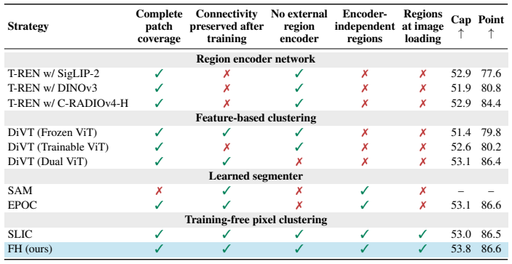
Table 4 :Comparing region generation strategies.Properties are derived from the failure modes discussed in Section 4.4. Performance is reported on PixMo-Cap (Cap) and PixMo-Point (Point) after stage-1 training with Qwen3-1.7B as the language model.
出典 · CC BY 4.0 · Savya Khosla, Chris Dongjoo Kim, Alex Schwing, Derek Hoiem, Christopher Clark, Sangho Lee · RVLM: Fewer Tokens, Better Resolution Scaling, Fine-Grained Spatial Grounding · 論文の図を引用 · 元のPDFの9ページ目から図の部分を抽出しています。限界と未解決の課題
効率の計測は4Bパラメータのモデルに限られ、より大きなLLMで短い視覚シーケンスの効果がどう変わるかは確かめられていません。動画は学習に含めずに評価し、PVLMと0.5ポイント以内の差で3×少ない視覚トークンで動作しました。長い動画にわたって領域をフレームをまたいでまとめることは、今後の課題とされています。
分割と割り当てのルールがないと、粗から細への接地が崩れるため、この設計は欠かせません。領域トークンを単純に置き換えると、PixMo-Pointの粗から細の性能は10.0まで下がり、パッチトークンの84.4や提案設計の86.6と比べて大きな差になります。
論文情報
- 著者
- Savya Khosla, Chris Dongjoo Kim, Alex Schwing, Derek Hoiem, Christopher Clark, Sangho Lee
- 学会・ジャーナル
- arXiv · プレプリント
- 公開日
- 2026年11月22日
- 登録日
- 2026年11月24日
- 更新日
- 2026年11月22日
- バージョン
- v1
- arXiv
- 2611.29146
- カテゴリ
- cs.CV
- ライセンス
- CC BY 4.0
- 掲載内容
- 論文情報・解説・論文の図
この解説は、Refivuの韓国語解説をAIで翻訳したものです。不正確な翻訳や誤りが含まれる可能性があります。論文と図の利用条件は各出典に従います。
アブストラクト
Vision-Language Models (VLMs) tokenize images using fixed spatial grids, so visual token count grows with pixel area rather than scene content. We propose to group neighboring patches based on their visual appearance, allowing tokens to represent coherent image regions rather than fixed spatial windows. We introduce RVLM, a VLM trained to use regions rather than patches as its visual units. Analyzing region construction for general-purpose VLMs, we find that regions must cover the full image, stay spatially connected during end-to-end training, and preserve fine structure such as small text, while semantic grouping adds little. RVLM therefore partitions images using training-free Felzenszwalb-Huttenlocher segmentation, assigns each ViT patch to a region, and pools patches within each region into a variable-length sequence of visual tokens. The patch-to-region assignment is retained to support spatially precise prediction through coarse-to-fine decoding. Across tasks spanning VQA, pointing, counting, segmentation, and depth estimation, RVLM matches or improves example-weighted task performance while using 21.5% fewer visual tokens than an identically trained patch baseline. The advantage grows with image resolution, reaching a 5.3-point gain while using 51.8% fewer visual tokens at the highest-resolution setting. The gains are largest on spatially demanding tasks, where prior token-reduction methods degrade most sharply. RVLM adds no model parameters and improves inference throughput by up to 35.9%. On unseen pathology and satellite images and on video benchmarks without any video training, RVLM performs on par with the patch baseline while using 2-3$\times$ fewer visual tokens. These results establish regions as a scalable alternative to patch-based visual representations while preserving the spatial precision required for grounded prediction.
論文の図
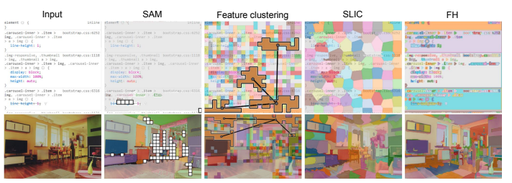
Figure 4 :Comparing region generation methods.SAM leaves image regions uncovered (white boxes), while learned feature-based methods (DiVT, T-REN) produce disconnected regions during VLM training. SLIC often fails to isolate text, whereas FH preserves fine text structures with con- nected regions and complete image coverage.
出典 · CC BY 4.0 · Savya Khosla, Chris Dongjoo Kim, Alex Schwing, Derek Hoiem, Christopher Clark, Sangho Lee · RVLM: Fewer Tokens, Better Resolution Scaling, Fine-Grained Spatial Grounding · 論文の図を引用 · 元のPDFの9ページ目から図の部分を抽出しています。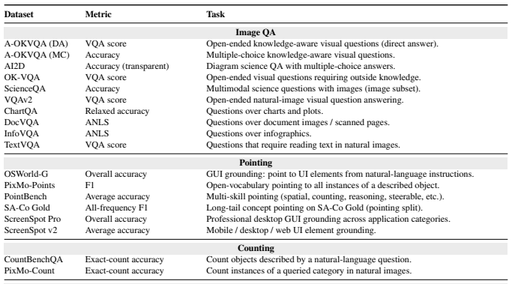
Table 7 :Our main evaluation suite. Metrics match those reported in the main native-resolution comparison. The 35 tasks span natural images, documents, charts, diagrams, infographics, scene text, GUI screenshots, driving scenes, egocentric, exocentric, and stereo video frames, and indoor and outdoor RGB-D.
出典 · CC BY 4.0 · Savya Khosla, Chris Dongjoo Kim, Alex Schwing, Derek Hoiem, Christopher Clark, Sangho Lee · RVLM: Fewer Tokens, Better Resolution Scaling, Fine-Grained Spatial Grounding · 論文の図を引用 · 元のPDFの18ページ目から図の部分を抽出しています。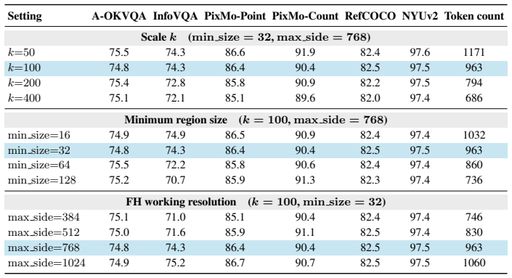
Table 8 :FH parameter ablation.Default settings are highlighted in blue. Token count is the mean visual-token count over the six tasks. NYUv2 reports scale-invariantδ 1 using per-image median scale alignment.
出典 · CC BY 4.0 · Savya Khosla, Chris Dongjoo Kim, Alex Schwing, Derek Hoiem, Christopher Clark, Sangho Lee · RVLM: Fewer Tokens, Better Resolution Scaling, Fine-Grained Spatial Grounding · 論文の図を引用 · 元のPDFの19ページ目から図の部分を抽出しています。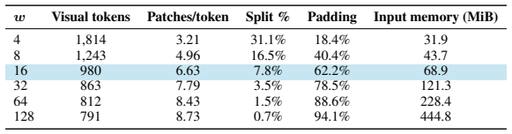
Table 9 :Structural effect of connector widthw.Statistics are pooled over1,480images from six tasks. Input memory estimates the storage of the padded bf16 connector input for one image; it excludes model parameters and intermediate activations.
出典 · CC BY 4.0 · Savya Khosla, Chris Dongjoo Kim, Alex Schwing, Derek Hoiem, Christopher Clark, Sangho Lee · RVLM: Fewer Tokens, Better Resolution Scaling, Fine-Grained Spatial Grounding · 論文の図を引用 · 元のPDFの19ページ目から図の部分を抽出しています。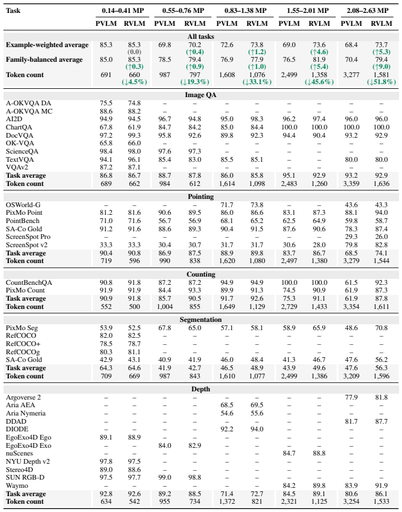
Table 10 :PVLM vs. RVLM across five native-resolution ranges.Task metrics are computed over all examples within each resolution range. A dash (–) indicates that the dataset contains no images in that range.
出典 · CC BY 4.0 · Savya Khosla, Chris Dongjoo Kim, Alex Schwing, Derek Hoiem, Christopher Clark, Sangho Lee · RVLM: Fewer Tokens, Better Resolution Scaling, Fine-Grained Spatial Grounding · 論文の図を引用 · 元のPDFの20ページ目から図の部分を抽出しています。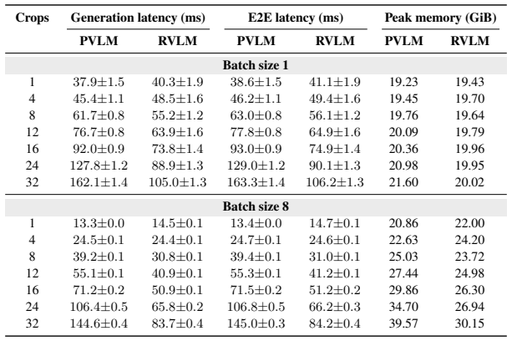
Table 11 :Inference cost across image resolutions.Generation latency, end-to-end (E2E) latency, and peak GPU memory for PVLM and RVLM at batch sizes 1 and 8. Measurements use 512 randomly sampled PixMo-Cap examples on a single NVIDIA H100, with 64 warm-up batches and five runs. Generation is capped at one output token. Latencies are reported as mean±standard deviation. While PVLM is slightly faster at low crop counts, RVLM achieves increasing latency and memory savings as image resolution grows.
出典 · CC BY 4.0 · Savya Khosla, Chris Dongjoo Kim, Alex Schwing, Derek Hoiem, Christopher Clark, Sangho Lee · RVLM: Fewer Tokens, Better Resolution Scaling, Fine-Grained Spatial Grounding · 論文の図を引用 · 元のPDFの21ページ目から図の部分を抽出しています。
Table 12 :Demonstrating importance of region splitting and ensuring exhaustive, exclusive patch assignment.Naively substituting patch tokens with region tokens fails catastrophically on PixMo-Point (row 2). Ensuring region tokens are capped to span a maximum number of patches and the partitioning is exhaustive and exclusive (row 3) enables RVLM to outperform patch-based baseline on pointing. The results are reported at 1.7B scale.
出典 · CC BY 4.0 · Savya Khosla, Chris Dongjoo Kim, Alex Schwing, Derek Hoiem, Christopher Clark, Sangho Lee · RVLM: Fewer Tokens, Better Resolution Scaling, Fine-Grained Spatial Grounding · 論文の図を引用 · 元のPDFの21ページ目から図の部分を抽出しています。
Table 14 :FH segments unseen domains more reliably than SAM.FH achieves higher boundary recall (BR) on every dataset and covers every pixel by construction, whereas SAM leaves 13–29% of pixels uncovered.
出典 · CC BY 4.0 · Savya Khosla, Chris Dongjoo Kim, Alex Schwing, Derek Hoiem, Christopher Clark, Sangho Lee · RVLM: Fewer Tokens, Better Resolution Scaling, Fine-Grained Spatial Grounding · 論文の図を引用 · 元のPDFの22ページ目から図の部分を抽出しています。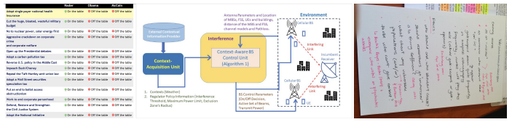
Figure 5 :Failure cases of T-REN-based RVLM.During VLM training, region tokens become spa- tially disconnected, making it difficult to associate text and visual elements with their correct loca- tions. The model recognizes individual labels but misattributes them to neighboring rows, columns, or objects, producing incorrect descriptions of the image structure. For instance, in the first exam- ple, it incorrectly describes some initiatives as “on the table” for Obama, even though the image lists none. PVLM and FH-based RVLM do not show these failures.
出典 · CC BY 4.0 · Savya Khosla, Chris Dongjoo Kim, Alex Schwing, Derek Hoiem, Christopher Clark, Sangho Lee · RVLM: Fewer Tokens, Better Resolution Scaling, Fine-Grained Spatial Grounding · 論文の図を引用 · 元のPDFの24ページ目から図の部分を抽出しています。この論文を引用
Savya Khosla, Chris Dongjoo Kim, Alex Schwing, Derek Hoiem, Christopher Clark, Sangho Lee (2026). RVLM: Fewer Tokens, Better Resolution Scaling, Fine-Grained Spatial Grounding. arXiv:2611.29146v1. https://arxiv.org/abs/2611.29146v1
BibTeX
@misc{khosla2026rvlm,
  title = {{RVLM: Fewer Tokens, Better Resolution Scaling, Fine-Grained Spatial Grounding}},
  author = {Savya Khosla and Chris Dongjoo Kim and Alex Schwing and Derek Hoiem and Christopher Clark and Sangho Lee},
  year = {2026},
  eprint = {2611.29146},
  archivePrefix = {arXiv},
  url = {https://arxiv.org/abs/2611.29146v1}
}