論文解説
Editing Conditional Radiance Fields
条件付きRadiance Fieldsの編集
- 課題 NeRFは、シーンごとに最適化される放射輝度場で新しい視点の画像を高い品質で合成できますが、カテゴリ単位の条件付き放射輝度場を、ユーザーが2Dスクリブルで色や形状を編集する方法は明確ではありません。
- 手法 条件付き放射輝度場を形状の分岐を共有する構造で学習させたあと、編集時には色はF_radと色コードを、形状はF_fuseとF_densを更新するハイブリッドな更新によって、ユーザーの制約に合わせます。
- 結果 PhotoShapeの色編集では、提案手法はPSNR 35.25、LPIPS 0.027を示しました。Aubryの形状編集ではPSNR 24.57、LPIPS 0.081、37.4秒と報告されています。
カテゴリ単位のNeRFを編集するのが難しい理由
NeRFは、シーンごとに最適化されるニューラル放射輝度場で、新しい視点のビューを高い品質で合成できます。この論文は、これを1つの物体カテゴリ全体で学習した条件付き放射輝度場(conditional radiance field)を、ユーザーが編集できるようにする問題を扱います。この表現はシーンがニューラルネットワークの重みに暗黙的に埋め込まれるため、メッシュやテクスチャのように特定の部分を直接選ぶことが難しいです。
著者らは2つの難点を挙げています。1つ目は、ユーザーが描いたまばらな2Dスクリブルを、3D空間の対応する領域全体にどう伝搬させるかが明らかでないことです。2つ目は、ネットワークは数百万個のパラメータを持つため、どのパラメータが形状と色を制御しているのか、また、まばらで局所的な入力に応じて何を変えるべきかが明らかでないことです。この論文は、編集の対象を、色の変更、形状の修正(部分の削除と追加)、色と形状の転送の3つに限定します。
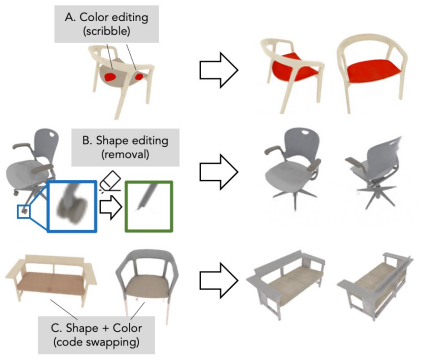
Figure 1 : Editing a conditional radiance field. Given a condi- tional radiance field trained over a class of objects, we demonstrate three editing applications: (A) color editing, (B) shape editing, and (C) color/shape transfer. A user provides coarse scribbles over a local region of interest or selects a target object instance. Local edits propagate to the desired region in 3D and are consistent across different rendered views.
出典 · CC BY 4.0 · Steven Liu, Xiuming Zhang, Zhoutong Zhang, Richard Zhang, Jun-Yan Zhu, Bryan Russell · Editing Conditional Radiance Fields · 論文の図を引用 · 元のPDFの1ページ目から図の部分を抽出しています。形状分岐を共有する条件付き放射輝度場
提案モデルは、3次元位置x、視点方向d、そしてインスタンスごとの形状コードz(s)と色コードz(c)を入力とし、放射色cとスカラーの密度σを出力します。密度は視点方向に依存せず、色は位置と視点方向の両方に依存するように設計されています。レンダリングでは、光線上のサンプル点について、アルファ合成(alpha compositing)の演算によりピクセルの色を計算します。
ネットワークは、カテゴリ全体で共有される形状ネットワークF_share、インスタンスごとの形状ネットワークF_inst、そして2つの結果を統合する融合形状ネットワークF_fuseから構成されます。密度はF_fuseの出力を線形層であるF_densに通して得ます。色はF_fuseの出力、色コード、視点方向のエンコーディングを連結したものを、2層のMLPであるF_radで予測します。著者らは、共有形状の分岐が物体インスタンス間で共通する形状の特徴を保持するよう導くと説明しています。この導く効果は著者らの解釈によるものであり、この論文は個々の重みの意味としてそれを直接証明してはいません。
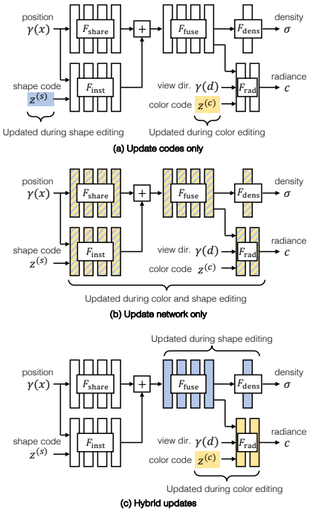
Figure 2 : Conditional radiance field network. Our network maps a 3D location x, viewing direction d, and instance-specific shape code z(s) and color code z(c) to radiance c and scalar density σ. The network is composed of modular parts for better shape and color disentanglement. We train our network over a collection of 3D objects (Section 3.1). As highlighted, only a subset of the network components need to be updated during editing (Section 3.2).
出典 · CC BY 4.0 · Steven Liu, Xiuming Zhang, Zhoutong Zhang, Richard Zhang, Jun-Yan Zhu, Bryan Russell · Editing Conditional Radiance Fields · 論文の図を引用 · 元のPDFの3ページ目から図の部分を抽出しています。ハイブリッドなネットワーク更新と編集最適化の高速化
編集は、インスタンスを表すネットワークとコードのうち、どちらを更新するかで分けられます。コードだけを更新する方法は効率的ですが編集品質が低く、ネットワーク全体を更新する方法は遅く、編集していない領域まで変わることもあります。提案手法のハイブリッド更新は、編集の種類に応じて一部の層だけを更新します。色の編集ではF_radとz(c)だけを更新し、形状の編集ではF_fuseとF_densを更新します。
この選択により最適化の時間が短くなります。著者らは、色の編集では最適化時間がネットワーク全体の最適化の972秒から260秒に、形状の編集では1,081秒から342秒に減ったと報告しています。編集時にはさらに2つの高速化を使います。1つは、ユーザー制約の光線の一部をサンプリングする方法で、色の編集では64本、形状の編集では8,192本の光線をランダムに使います。もう1つは、編集中に変わらないネットワーク出力をキャッシュする方法です。著者らは特に、色の編集ではF_radの入力が変わらないため、これをキャッシュできると説明しています。
色と形状の編集の損失
色の編集では、ユーザーが指定した前景光線の目標色と、背景光線の元の色を合わせる再構成損失L_recを定義します。これに、元のモデルの重みから離れる度合いを罰する正則化項L_regを加えて、L_color = L_rec + λ_reg·L_regを最適化します。λ_regは10に設定します。この損失はz(c)とF_radについて最適化されます。
形状の部分削除では、ユーザーが塗った領域を前景、残りを背景として編集用の例を作ります。このとき、前景光線の密度ベクトルに対するエントロピーベースの損失L_dens = −Σ σ_r^T log(σ_r)を使い、密度ベクトルは単位長に正規化されます。エントロピーのペナルティは光線の密度をスパースにし、削除された領域の密度を0へ導きます。形状の追加では、新しい物体の一部を元のシーンに貼り付けた合成画像に合わせる再構成損失を使います。この方法は学習の反復が多いため遅いと報告されています。
色編集の結果
色の編集は、PhotoShapeの椅子データセットで評価されました。目標は、ソースの学習インスタンスを、同じ形状で色が異なる目標インスタンスに合わせることです。編集後、40個の視点でレンダリングし、PSNRとLPIPSで比較します。提案手法はPSNR 35.25、LPIPS 0.027を報告しています。ほかのベースラインは、単一インスタンスNeRFのファインチューニングが29.53、色コードのみのファインチューニングが26.29、すべての重みのファインチューニングが31.00、Model Rewritingが18.42です。
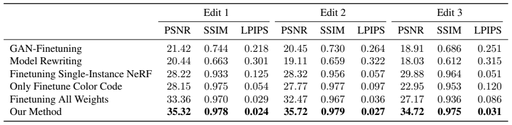
Table 7 : Color editing quantitative results. We evaluate color editing of a source object instance to match a target instance. Please refer to Figure 8 (this supplemental) for a visualization of each of the edits. Notice that our method outperforms the baselines for all color edits on all criteria.
出典 · CC BY 4.0 · Steven Liu, Xiuming Zhang, Zhoutong Zhang, Richard Zhang, Jun-Yan Zhu, Bryan Russell · Editing Conditional Radiance Fields · 論文の図を引用 · 元のPDFの15ページ目から図の部分を抽出しています。この結果は、3つの色編集の平均です。色コードだけをファインチューニングすると編集に合わせにくく、ネットワーク全体を変えると、密度の出力を通じて形状が大きく変わると著者らは説明しています。GANベースの編集は新しい視点に一般化できず、単一インスタンスNeRFはカテゴリ単位の外観の事前知識がないため、別の視点でアーティファクトを生じました。この比較は、PhotoShapeの色編集という条件に限られます。
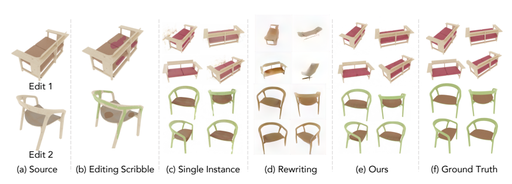
Figure 3 : Color editing qualitative results. We visualize color editing results where the goal is to match a source instance’s colors to a target. Our method accurately captures the colors of the target instance given scribbles over one view. Notice how (c) Editing a Single-Instance NeRF causes visual artifacts, and (d) Rewriting a GAN [8] fails to propagate the edit to unseen views and generates unrealistic outputs.
出典 · CC BY 4.0 · Steven Liu, Xiuming Zhang, Zhoutong Zhang, Richard Zhang, Jun-Yan Zhu, Bryan Russell · Editing Conditional Radiance Fields · 論文の図を引用 · 元のPDFの7ページ目から図の部分を抽出しています。形状編集の結果とアブレーション実験
形状の編集は、Aubryの椅子データセットで、ソースインスタンスを似た形状の目標インスタンスに変える実験です。3つの編集の平均結果では、提案手法はPSNR 24.57、LPIPS 0.081、時間37.4秒を報告しています。形状コードだけをファインチューニングした方法はPSNR 22.07、密度ネットワークだけをファインチューニングした方法は21.84、すべての重みのファインチューニングは20.31で、時間は66.4秒でした。提案手法はPSNRとLPIPSで最も高い品質を示し、コストは全体のファインチューニングより低くなりました。
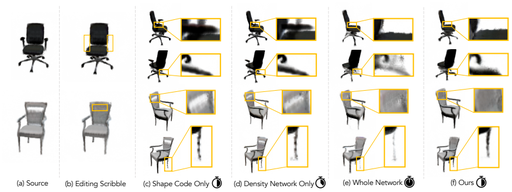
Figure 4 : Shape editing qualitative results. Our method successfully removes the arms and fills in the hole of a chair. Notice how only optimizing the shape code or branch are unable to fit both edits. Optimizing the whole network is slow and causes unwanted changes in the instance.
出典 · CC BY 4.0 · Steven Liu, Xiuming Zhang, Zhoutong Zhang, Richard Zhang, Jun-Yan Zhu, Bryan Russell · Editing Conditional Radiance Fields · 論文の図を引用 · 元のPDFの8ページ目から図の部分を抽出しています。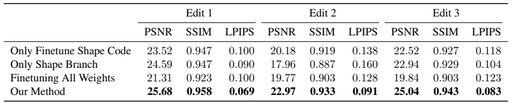
Table 8 : Shape editing quantitative results. We evaluate shape editing of a source object instance to match a target instance. Please refer to Figure 11 for a visualization of each of the edits. Notice that our method outperforms the baselines for all color edits on all criteria.
出典 · CC BY 4.0 · Steven Liu, Xiuming Zhang, Zhoutong Zhang, Richard Zhang, Jun-Yan Zhu, Bryan Russell · Editing Conditional Radiance Fields · 論文の図を引用 · 元のPDFの19ページ目から図の部分を抽出しています。視点の再構成に関するアブレーション実験では、PhotoShapesとAubryのデータセットで、単一NeRF、学習された潜在コードの追加、形状と色のコードを分離したもの、共有形状の分岐を比較します。共有形状の分岐を含むモデルはPhotoShapesでPSNR 37.67、Aubryで21.78を報告しており、個別インスタンスNeRFはPhotoShapesで37.31、Aubryで24.15でした。そのため、Aubryのデータセットでは個別インスタンスNeRFの方が高いPSNRを示した点も合わせて読む必要があります。
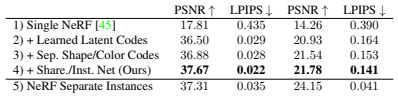
Table 1 : Ablation study. We evaluate our model and several abla- tions on view reconstruction. Notice how separating the shape and color codes and using the shared/instance network improves the view synthesis quality. Our model even outperforms single-instance NeRF models (each trained on one object).
出典 · CC BY 4.0 · Steven Liu, Xiuming Zhang, Zhoutong Zhang, Richard Zhang, Jun-Yan Zhu, Bryan Russell · Editing Conditional Radiance Fields · 論文の図を引用 · 元のPDFの6ページ目から図の部分を抽出しています。対話性と適用範囲
著者らは、形状編集ではユーザーのフィードバックを受けるのに1分以上かかるため、対話性が制限されると明らかにしています。計算の大部分は編集そのものよりビューのレンダリングに使われ、NeRFのレンダリング速度改善の研究によって減らせると提案しています。また、学習カテゴリのインスタンスと大きく異なる新しい物体は再構成できないと報告しています。
実写真の編集では、入力画像の視点を手動で選び、学習済みの放射輝度場をその画像にファインチューニングする手順を踏みます。この論文は、この手順が、入力は学習データと似た物体クラスと背景を持つと仮定していると明らかにしています。そのため、実写真の結果は、この仮定が成り立つ条件に限定して読む必要があります。
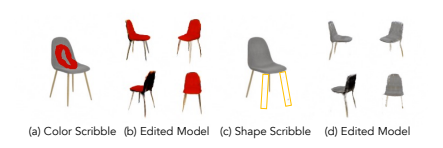
Figure 6 : Real image editing results. Our method first finetunes a conditional radiance field to match a real still image input. Editing the resulting radiance field successfully changes the chair seat color to red and removes two of the chair’s legs.
出典 · CC BY 4.0 · Steven Liu, Xiuming Zhang, Zhoutong Zhang, Richard Zhang, Jun-Yan Zhu, Bryan Russell · Editing Conditional Radiance Fields · 論文の図を引用 · 元のPDFの8ページ目から図の部分を抽出しています。論文情報
- 著者
- Steven Liu, Xiuming Zhang, Zhoutong Zhang, Richard Zhang, Jun-Yan Zhu, Bryan Russell
- 学会・ジャーナル
- arXiv · プレプリント
- 公開日
- 2021年5月13日
- 登録日
- 2026年11月5日
- 更新日
- 2021年6月4日
- バージョン
- v2
- arXiv
- 2105.06466
- カテゴリ
- cs.CV · cs.GR · cs.LG
- ライセンス
- CC BY 4.0
- 掲載内容
- 論文情報・解説・論文の図
この解説は、Refivuの韓国語解説をAIで翻訳したものです。不正確な翻訳や誤りが含まれる可能性があります。論文と図の利用条件は各出典に従います。
アブストラクト
A neural radiance field (NeRF) is a scene model supporting high-quality view synthesis, optimized per scene. In this paper, we explore enabling user editing of a category-level NeRF - also known as a conditional radiance field - trained on a shape category. Specifically, we introduce a method for propagating coarse 2D user scribbles to the 3D space, to modify the color or shape of a local region. First, we propose a conditional radiance field that incorporates new modular network components, including a shape branch that is shared across object instances. Observing multiple instances of the same category, our model learns underlying part semantics without any supervision, thereby allowing the propagation of coarse 2D user scribbles to the entire 3D region (e.g., chair seat). Next, we propose a hybrid network update strategy that targets specific network components, which balances efficiency and accuracy. During user interaction, we formulate an optimization problem that both satisfies the user's constraints and preserves the original object structure. We demonstrate our approach on various editing tasks over three shape datasets and show that it outperforms prior neural editing approaches. Finally, we edit the appearance and shape of a real photograph and show that the edit propagates to extrapolated novel views.
この論文を引用
Steven Liu, Xiuming Zhang, Zhoutong Zhang, Richard Zhang, Jun-Yan Zhu, Bryan Russell (2021). Editing Conditional Radiance Fields. arXiv:2105.06466v2. https://arxiv.org/abs/2105.06466v2
BibTeX
@misc{liu2021editing,
  title = {{Editing Conditional Radiance Fields}},
  author = {Steven Liu and Xiuming Zhang and Zhoutong Zhang and Richard Zhang and Jun-Yan Zhu and Bryan Russell},
  year = {2021},
  eprint = {2105.06466},
  archivePrefix = {arXiv},
  url = {https://arxiv.org/abs/2105.06466v2}
}