論文解説
ReconPotBench: Evaluating LLM Honeypots in Multi-Round Linux Reconnaissance
ReconPotBench:多段階のLinux偵察におけるLLMハニーポットの評価
- 課題 既存のLLMハニーポット評価は個々のコマンド出力だけを見ており、複数ラウンドにわたるホスト状態の一貫性は確認できていません。
- 手法 1,032件の3ラウンドのLinux偵察インタラクションと実ホストの参照出力を構成し、authenticity·consistency·utilityをLLM評価者で同時に採点します。
- 結果 Cowrieは一貫性0.45で最も高く、評価したすべてのLLM構成はCowrieより高いhacker utilityを記録しました。
既存のハニーポット評価の空白
LLMベースのハニーポットは、シェルコマンドに対してもっともらしい出力を生成できることが示されてきました。ただ、既存の評価の多くは、コマンド1つの出力を個別に見ています。実際の偵察では、攻撃者は前の出力で得たIPアドレス、ポート、プロセスといったエンティティを、次のコマンドで改めて確認します。そのため、個々の出力が本物らしく見えても、複数ラウンドにわたってホストの状態が保たれなければ、ハニーポットは容易に見破られます。この論文は、こうした相互依存的な複数ラウンドのLinux偵察インタラクションを評価するベンチマークが不足している、という問題を出発点にしています。
ReconPotBenchの構成
ReconPotBenchは、1,032件の3ラウンドのLinux偵察インタラクションで構成されます。各事例はNetwork→Software→Hardwareの階層に従います。1ラウンド目のコマンドはカテゴリごとに手作業で設計し、2ラウンド目と3ラウンド目のコマンドはGPT-5.4で生成したあと、人が確認しました。参照出力は実際のLinuxホストでコマンドを実行して得ています。評価対象のシステムには、生成の段階で参照出力は与えられません。評価対象は1ラウンド目では現在のコマンドのみを受け取り、2ラウンド目と3ラウンド目では、前のコマンドと生成された出力も併せて受け取ります。
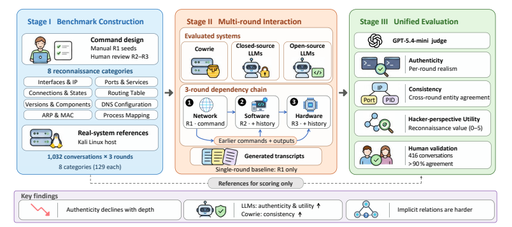
Figure 2 : Overview of ReconPotBench. The benchmark targets multi-round Linux reconnaissance interactions, in which later commands depend on earlier context, and enables unified evaluation of systems along three dimensions: round-level authenticity, cross-round consistency, and hacker-perspective utility.
出典 · CC BY 4.0 · Qianli Wang, Junchao Wu, Binkai Ou, Lidia S. Chao, Derek F. Wong · ReconPotBench: Evaluating LLM Honeypots in Multi-Round Linux Reconnaissance · 論文の図を引用 · 元のPDFの4ページ目から図の部分を抽出しています。authenticity·consistency·utilityの採点
3つの指標はいずれも、GPT-5.4-miniを評価者とするLLM-as-a-judge方式で計算します。authenticityは、各ラウンドの生成出力が参照出力と、コマンドの意味、情報の種類、出力形式の点で一致するかを1または0で判定し、3ラウンドの平均を取ります。consistencyは3ラウンドの系列単位で、エンティティとその関係がラウンドをまたいで変わっていないかを1、0、またはNAで判定します。NAの系列は分母から除外されます。utilityは系列ごとに0から5までの整数を直接付与し、データセット全体では、スコアごとの割合p_sで重み付けした平均Uとして集計します。
人による検証サンプル
自動評価者の信頼性を確かめるため、人が416件の複数ラウンドのインタラクションを確認しました。サンプルは、Claude Sonnet-4.6の結果から8カテゴリそれぞれ52件ずつ抽出し、2名の大学院生が独立に判定しました。その結果、人とGPT-5.4-miniの一致率は、authenticityが90.87%、consistencyが97.36%、utilityが91.35%でした。この検証は、サンプリングされたClaude Sonnet-4.6の出力に対する一致を示しており、すべてのモデルの出力に対する評価精度を証明するものではありません。
CowrieとLLMハニーポットの比較
一貫性スコアは、評価対象のシステムのうちCowrieが0.45で最も高くなりました。残りのLLM構成は0.07から0.21の間にとどまりました。一方、hacker utilityはCowrieが0.66で、評価したすべてのLLM構成はこれより高くなりました。オープンソースモデルの平均は1.99、クローズドソースモデルの平均は2.96でした。authenticityはモデルによって異なりました。すべてのクローズドソースモデルはCowrieの平均0.17を上回りました。オープンソースの結果は、Qwen2.5-7Bが0.21、Llama3.1-8Bが0.13、Hunyuan-7Bが0.03と、ばらつきがありました。
したがって、この結果は、すべてのオープンソースモデルがauthenticityでCowrieより優れているという結論を裏付けるものではありません。
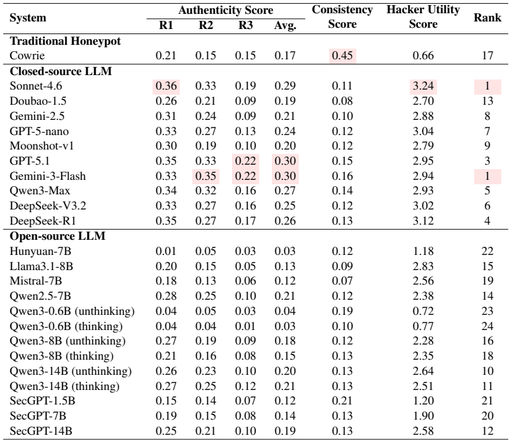
Table 2 : Comprehensive evaluation results for Cowrie and LLM honeypots in multi-round Linux reconnaissance. Authenticity is reported for each round, with “Avg.” denoting the mean across three rounds. Consistency is the fraction of conversations scored as fully consistent. Hacker utility is the weighted average of conversation-level scores from 0 to 5. Rank is computed by first converting hacker utility from the 0 to 5 scale to the 0 to 1 scale by dividing it by 5, and then averaging the converted hacker utility score with authenticity average and consistency. Higher values indicate better performance; all metric values are rounded to two decimals.
出典 · CC BY 4.0 · Qianli Wang, Junchao Wu, Binkai Ou, Lidia S. Chao, Derek F. Wong · ReconPotBench: Evaluating LLM Honeypots in Multi-Round Linux Reconnaissance · 論文の図を引用 · 元のPDFの8ページ目から図の部分を抽出しています。Claude Sonnet-4.6のカテゴリ別結果
Claude Sonnet-4.6のカテゴリ別結果では、一貫性はConnection-to-Process Mappingが0.30で最も高く、続いてPort Connection Statesが0.20、Open Ports & Listening Servicesが0.18でした。一方、Network Interfaces & IPは0.04、Routing Tableは0.03、DNS Configurationは0.02、ARP Cache & MAC Addressesは0.01でした。authenticityの平均が近くても、一貫性は大きく異なります。たとえば、Connection-to-Process Mapping、Open Ports & Listening Services、Service Versions & Componentsは、平均authenticityがいずれも0.36でしたが、一貫性は0.30、0.18、0.08でした。
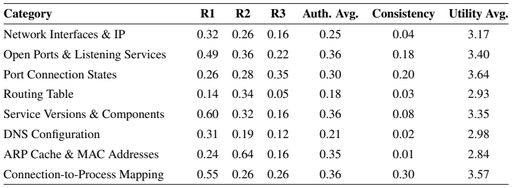
Table 3 : Category-level evaluation scores for Claude Sonnet-4.6. The 1,032 interactions are ordered as eight blocks of 129 interactions following Table 5. R1 to R3 report round-wise authenticity scores, “Auth. Avg.” reports the average authenticity across the three rounds, “Consistency” reports the fraction of conversations with consistency score 1, and “Utility Avg.” reports the weighted average hacker-utility score. All reported values are rounded to two decimal places.
出典 · CC BY 4.0 · Qianli Wang, Junchao Wu, Binkai Ou, Lidia S. Chao, Derek F. Wong · ReconPotBench: Evaluating LLM Honeypots in Multi-Round Linux Reconnaissance · 論文の図を引用 · 元のPDFの9ページ目から図の部分を抽出しています。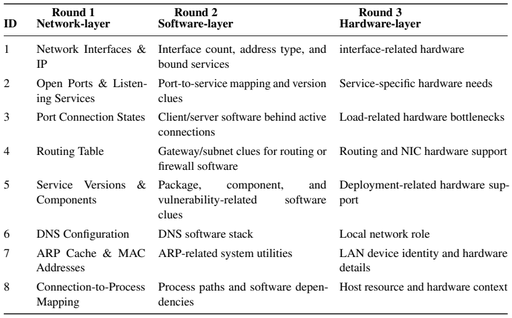
Table 5 : Eight reconnaissance categories and their three-round dependency chain.
出典 · CC BY 4.0 · Qianli Wang, Junchao Wu, Binkai Ou, Lidia S. Chao, Derek F. Wong · ReconPotBench: Evaluating LLM Honeypots in Multi-Round Linux Reconnaissance · 論文の図を引用 · 元のPDFの16ページ目から図の部分を抽出しています。範囲と残る課題
このベンチマークが扱うのは、Linuxターミナル環境で単一の対象を偵察する連鎖だけです。対象をまたぐ偵察や、他のOS、シェル環境は、今回の研究では扱っていません。また、すべてのLLMは同じシステムプロンプトで評価されています。そのため、結果が示すのは、この共通設定での性能にとどまります。別のプロンプトや状態管理の構造での最高性能は確定しません。この論文では、ホストの状態を明示的に保存・更新する参照となる構造との比較は行っていません。
論文情報
- 著者
- Qianli Wang, Junchao Wu, Binkai Ou, Lidia S. Chao, Derek F. Wong
- 学会・ジャーナル
- arXiv · プレプリント
- 公開日
- 2026年11月16日
- 登録日
- 2026年11月17日
- 更新日
- 2026年11月16日
- バージョン
- v1
- arXiv
- 2611.20528
- カテゴリ
- cs.CR · cs.CL
- ライセンス
- CC BY 4.0
- 掲載内容
- 論文情報・解説・論文の図
この解説は、Refivuの韓国語解説をAIで翻訳したものです。不正確な翻訳や誤りが含まれる可能性があります。論文と図の利用条件は各出典に従います。
アブストラクト
Large language models (LLMs) are increasingly used to build interactive honeypots, yet existing evaluations mainly assess isolated command outputs and cannot determine whether a system remains believable when later commands depend on earlier results. We present ReconPotBench, a multi-round benchmark for Linux reconnaissance honeypots. It contains 1{,}032 three-round reconnaissance interactions across eight reconnaissance categories, with reference outputs collected from a real Linux environment. Under a unified testing protocol, we compare Cowrie, open-source LLMs, and closed-source LLMs along three dimensions: round-level authenticity, cross-round contextual consistency, and hacker-oriented reconnaissance value. Results show that multi-round evaluation exposes failures hidden by single-round testing, as authenticity declines with interaction depth and both open-source and closed-source LLMs struggle to maintain coherent state across rounds. LLM-based honeypots nevertheless outperform Cowrie in authenticity and reconnaissance value, while Cowrie remains more consistent because of its rigid templated behavior. Category-level analysis further shows that tasks requiring systems to preserve network relationships across rounds are harder than tasks centered on explicit entities such as ports. ReconPotBench enables reproducible evaluation of LLM honeypots across authenticity, entity consistency, and hacker-perspective utility in dependent multi-round interactions. The dataset is available at: https://github.com/qianli-wang/ReconPotBench
この論文を引用
Qianli Wang, Junchao Wu, Binkai Ou, Lidia S. Chao, Derek F. Wong (2026). ReconPotBench: Evaluating LLM Honeypots in Multi-Round Linux Reconnaissance. arXiv:2611.20528v1. https://arxiv.org/abs/2611.20528v1
BibTeX
@misc{wang2026reconpotbench,
  title = {{ReconPotBench: Evaluating LLM Honeypots in Multi-Round Linux Reconnaissance}},
  author = {Qianli Wang and Junchao Wu and Binkai Ou and Lidia S. Chao and Derek F. Wong},
  year = {2026},
  eprint = {2611.20528},
  archivePrefix = {arXiv},
  url = {https://arxiv.org/abs/2611.20528v1}
}