논문 해설
HDRSplat: Gaussian Splatting for High Dynamic Range 3D Scene Reconstruction from Raw Images
HDRSplat: 원시 이미지로부터 고동적 범위 3D 장면 재구성을 위한 가우시안 스플래팅
- 연구 문제 야간·저조도 장면과 큰 명암비 장면에서 8비트 LDR 기반 재구성은 정보가 손실되며, 14비트 HDR raw 기반 RawNeRF는 학습에 약 8시간이 걸립니다.
- 연구 방법 PMRID로 Bayer raw의 노이즈를 제거한 뒤 선형 14비트 HDR 공간에서 3D Gaussian Splatting을 학습합니다. 손실은 sg 스케일 L1과 D-SSIM의 결합이며 래스터화 학습률을 조정합니다.
- 주요 결과 표 1의 평균에서 HDRSplat은 PSNR 30.07, SSIM 0.82, LPIPS 0.25를 보고합니다. 학습은 7분, 추론은 120 FPS로 보고되며 RawNeRF의 8시간 학습과 비교됩니다.
야간·저조도 장면에서 LDR 입력의 한계
기존 3DGS 기반 방법과 NeRF 기반 방법은 대부분 8비트 톤매핑된 LDR 이미지로 장면을 재구성합니다. 야간이나 조명이 부족한 실내처럼 신호 대 잡음비가 낮은 장면, 그리고 그림자와 밝은 영역의 대비가 극단적인 주간 장면에서는 이 입력 방식이 정확한 재구성을 어렵게 만듭니다. 원문은 raw에서 8비트 LDR로 변환하는 과정에서 정보가 손실된다고 설명합니다.
RawNeRF는 14비트 선형 HDR 공간에서 noisy raw 입력으로 뷰를 합성하는 선행 모델입니다. 그러나 이 방법은 장면당 약 8시간의 학습이 필요하다고 보고되어 실시간 활용에는 부담이 큽니다. HDRSplat은 이 문제를 3D Gaussian Splatting으로 다루며, 같은 14비트 선형 HDR 공간에서 더 빠르게 학습하는 것을 목표로 합니다.
Bayer 노이즈 제거와 선형 HDR 공간의 3DGS 학습
HDRSplat의 전처리 단계는 PMRID로 Bayer 공간의 광자 샷 노이즈를 제거합니다. PMRID는 k-sigma 변환으로 서로 다른 ISO의 raw 이미지를 ISO에 불변인 신호-노이즈 공간으로 옮겨 학습하는 denoiser입니다. 이후 bilinear demosaicing으로 3채널 14비트 선형 raw 이미지를 얻습니다.
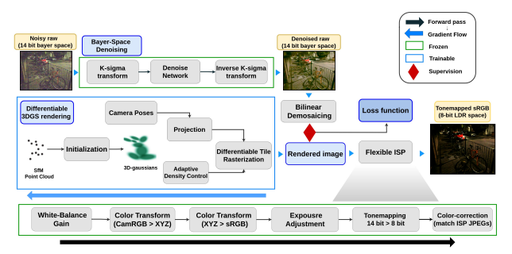
Figure 2 : Rendering Pipeline for generating novel HDR views from noisy raw inputs. The 3 key components highlighted are: (1) Bayer-space-denoising (2) Differentiable 3DGS rasterization (3) Flexible ISP to convert from 14-bit linear raw to tonemapped 8-bit sRGB.
원문 · CC BY 4.0 · Shreyas Singh, Aryan Garg, Kaushik Mitra · HDRSplat: Gaussian Splatting for High Dynamic Range 3D Scene Reconstruction from Raw Images · 원문 그림 인용 · 원본 PDF 4쪽에서 그림 영역을 추출했습니다.학습 단계에서는 이렇게 얻은 denoised 선형 raw 이미지를 감독 신호로 사용해 3D Gaussian을 최적화합니다. 원문은 Noise2Noise의 stop-gradient 스케일 L2 손실을 출발점으로 삼았지만, 노이즈가 있는 목표값에 대한 L2 형식은 명시적 Gaussian 표현에서 편향된 픽셀 분포와 SH 계수 학습 문제를 낳는다고 설명합니다. 그래서 HDRSplat은 사전 학습된 Bayer 공간 denoiser로 입력 노이즈를 먼저 줄이고, sg(.)로 스케일된 L1 손실에 D-SSIM 항을 더합니다. 원문은 이 전체 손실을 식 (4)로 제시합니다. 손실의 목적함수는 렌더링 결과와 denoised 목표 사이의 오차를 줄이는 방향으로 최소화되며, 이 손실은 Gθ(yraw)를 목표로 한 L1과 D-SSIM의 결합입니다.
래스터화 조정과 SfM 초기화 의존성 완화
3DGS는 adaptive densification과 pruning이 SfM 점 구름의 밀집 영역 주변에서 주로 일어나므로, 초기화가 희소하거나 불균일한 영역에서 복원이 부족해질 수 있습니다. HDRSplat은 학습 초기 단계에서 Gaussian pruning을 피하도록 래스터화 파라미터를 조정합니다. 구체적으로 scaling 학습률을 절반으로 줄이고 translation 학습률을 원래 값의 1/5로 설정한다고 본문에서 설명합니다.
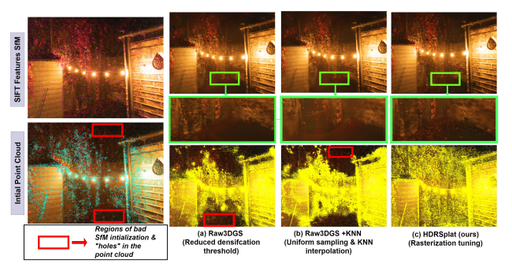
Figure 4 : Point Cloud Densification : (a-b) highlight the non-uniformity and sparsity in regions of poor SfM initialization, leaving holes in the final point cloud. (c) shows improved reconstruction via our rasterization method addressing the under-reconstruction problem By intuitively adjusting rasterization parameters, we show that avoiding Gaussian pruning
원문 · CC BY 4.0 · Shreyas Singh, Aryan Garg, Kaushik Mitra · HDRSplat: Gaussian Splatting for High Dynamic Range 3D Scene Reconstruction from Raw Images · 원문 그림 인용 · 원본 PDF 6쪽에서 그림 영역을 추출했습니다.반면 4.1절 구현 설정은 scaling_lr을 10^-3(원본 구현의 1/5), position_lr_init을 8×10^-5(원본 구현의 1/2)로 적고 있어 두 설명의 수치 표현이 다르게 보고됩니다. 이 조정은 Gaussian의 확장과 이동을 제한해 희소한 영역에서 과적합하거나 위치가 크게 벗어나 pruning되는 것을 막으려는 방식입니다.
RawNeRF와 Raw3DGS 기준선 비교
평가는 RawNeRF의 야간 4032×3024 Bayer raw와 proprietary ISP LDR 쌍 데이터셋에서 수행됩니다. 14개 장면 중 Windowlegovary와 Candle은 다중 노출 캡처 때문에 제외됩니다. 14비트 demosaiced 공간의 렌더링은 8비트 tonemapped LDR로 변환한 뒤 ground truth LDR로 색 보정하여 PSNR, SSIM, LPIPS(VGG-16)로 비교합니다.
비교 기준은 RawNeRF, 자체 구축한 Raw3DGS, LDR-3DGS, Raw3DGS+KNN입니다. Raw3DGS는 demosaic된 noisy raw를 원래 3DGS로 학습하고 RawNeRF 손실을 적용한 기준선입니다. 표 1의 평균에서 HDRSplat은 PSNR 30.07, SSIM 0.82, LPIPS 0.25로 RawNeRF의 29.52, 0.79, 0.26과 Raw3DGS의 27.92, 0.73, 0.30보다 높은 값을 보고합니다. 다만 LPIPS는 낮을수록 좋은 지표이므로 0.25는 개선을 뜻합니다.
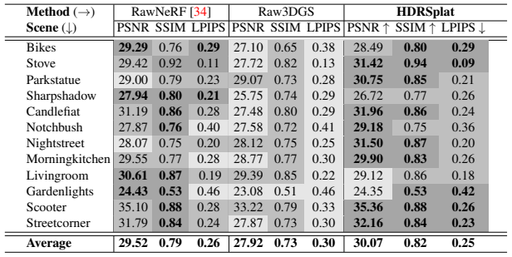
Table 1 : Quantitative Comparison of all models rendering in the 14-bit linear HDR space. We demonstrate superior fidelity of our model over RawNeRF (4% LPIPS(↓), 4% SSIM(↑), 0.5 PSNR(↑)) and our baseline Raw3DGS (17% LPIPS(↓), 12% SSIM(↑), 2.1 dB PSNR(↑)).
원문 · CC BY 4.0 · Shreyas Singh, Aryan Garg, Kaushik Mitra · HDRSplat: Gaussian Splatting for High Dynamic Range 3D Scene Reconstruction from Raw Images · 원문 그림 인용 · 원본 PDF 7쪽에서 그림 영역을 추출했습니다.학습 시간과 점 수의 비용 비교
학습 시간 측정은 단일 NVIDIA RTX 3090 24GB에서 수행되며, 표 2의 지표는 장면당 평균 50개 뷰에 대해 계산됩니다. RawNeRF의 학습 시간은 8시간으로 보고되고, HDRSplat의 학습 시간은 7분, 총 시간은 14분으로 보고됩니다. 추론 속도는 두 3DGS 기반 방법에서 120 FPS로 보고됩니다. 표 2의 PreP는 Bayer 노이즈 제거와 bilinear demosaicing 단계를 뜻하며, HDRSplat의 PreP는 7분입니다.
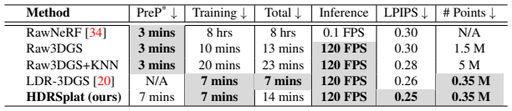
Table 2 : Real time rendering : We are 30x faster than RawNeRF in training and can in- fer at 120 fps. PreP * (Pre-processing) refers to Bayer-space denoising step and bilinear- demosaicing. All metrics have been calculated for an average of 50 views per scene.
원문 · CC BY 4.0 · Shreyas Singh, Aryan Garg, Kaushik Mitra · HDRSplat: Gaussian Splatting for High Dynamic Range 3D Scene Reconstruction from Raw Images · 원문 그림 인용 · 원본 PDF 8쪽에서 그림 영역을 추출했습니다.점 수는 평균 0.35M으로 보고됩니다. 이는 Raw3DGS의 1.5M, Raw3DGS+KNN의 5M과 비교된 값입니다. 이 비용 비교는 같은 장치와 표의 평균 설정에서 얻은 결과이며, 다른 하드웨어나 선행 연구 값과 동일한 통제 실험으로 해석하지 않습니다.
구성요소 제거 실험의 해석
절제 실험은 래스터화 조정, Bayer 노이즈 제거, 손실 함수를 각각 제거하거나 대체한 변형을 비교합니다. 예를 들어 래스터화 조정을 제거한 변형은 PSNR 29.44, LPIPS 0.30, 0.85M 점을 보고하고, Bayer 노이즈 제거를 제거한 변형은 PSNR 29.49, LPIPS 0.27, 0.25M 점을 보고합니다. 전체 모델은 PSNR 30.09, LPIPS 0.25, 0.35M 점입니다.
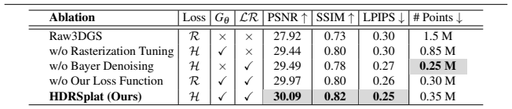
Table 3 : Ablation Study to demonstrate the utility of each component of our pipeline. H refers to our stop-gradient scaled L1 + DSSIM loss, R refers to RawNeRF’s [34] stop- gradient scaled L2. Gθ is Bayer-space denoising and LR refers to our rasterization tuning.
원문 · CC BY 4.0 · Shreyas Singh, Aryan Garg, Kaushik Mitra · HDRSplat: Gaussian Splatting for High Dynamic Range 3D Scene Reconstruction from Raw Images · 원문 그림 인용 · 원본 PDF 9쪽에서 그림 영역을 추출했습니다.원문은 래스터화 조정이 메모리 사용량을 약 60% 줄였다고 설명하며, Bayer 노이즈 제거와 손실 함수가 LPIPS와 SSIM에 가장 큰 영향을 준다고 해석합니다. 이 결과는 각 구성요소를 유지했을 때의 이점을 보여 주며, 모든 구성요소가 모든 지표에서 유익하다는 증명은 아닙니다.
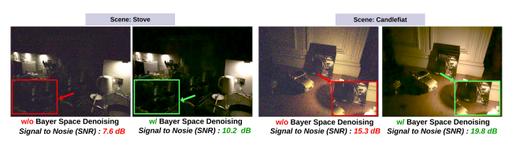
Figure 3 : Importance of bayer space denoising using PMRID: Denoised raw images successfully retrieve scene information from noisy low illumination and saturated bright regions in the raw image space due to a lowered photon shot noise level.
원문 · CC BY 4.0 · Shreyas Singh, Aryan Garg, Kaushik Mitra · HDRSplat: Gaussian Splatting for High Dynamic Range 3D Scene Reconstruction from Raw Images · 원문 그림 인용 · 원본 PDF 5쪽에서 그림 영역을 추출했습니다.적용 범위와 남은 한계
원문은 SfM과 3DGS의 point cloud 초기화 민감성이 저조도 장면에서 여전히 한계라고 결론에서 설명합니다. 저자들은 COLMAP-free 또는 depth projection 기반 초기화가 이 문제를 줄일 수 있다고 향후 과제로 제시합니다. 또한 개별 3D Gaussian에 대한 노이즈 모델이나 파라미터화를 설계하면 외부 denoising 의존성을 줄일 수 있다고 제안합니다.
이 결과는 제공된 야간 RawNeRF 데이터셋과 iPhone-X 기반 장면, 그리고 RTX 3090 조건에서 얻은 것입니다. 다른 카메라나 장면 분포에서의 성능은 이 실험으로 확인되지 않았습니다.
논문 정보
- 저자
- Shreyas Singh, Aryan Garg, Kaushik Mitra
- 학회·저널
- arXiv · 프리프린트
- 최초 공개일
- 2024년 7월 23일
- 등록일
- 2026년 11월 4일
- 수정일
- 2024년 7월 23일
- 버전
- v1
- arXiv
- 2407.16503
- 분류
- cs.CV · eess.IV
- 원문 이용 조건
- CC BY 4.0
- 제공 범위
- 논문 정보, 해설, 허용된 원문 그림
AI 해설은 논문 원문과 별개의 설명이며 오류가 있을 수 있습니다. 원문과 그림은 각 출처의 이용 조건과 따로 표시된 권리를 따릅니다.
초록
The recent advent of 3D Gaussian Splatting (3DGS) has revolutionized the 3D scene reconstruction space enabling high-fidelity novel view synthesis in real-time. However, with the exception of RawNeRF, all prior 3DGS and NeRF-based methods rely on 8-bit tone-mapped Low Dynamic Range (LDR) images for scene reconstruction. Such methods struggle to achieve accurate reconstructions in scenes that require a higher dynamic range. Examples include scenes captured in nighttime or poorly lit indoor spaces having a low signal-to-noise ratio, as well as daylight scenes with shadow regions exhibiting extreme contrast. Our proposed method HDRSplat tailors 3DGS to train directly on 14-bit linear raw images in near darkness which preserves the scenes' full dynamic range and content. Our key contributions are two-fold: Firstly, we propose a linear HDR space-suited loss that effectively extracts scene information from noisy dark regions and nearly saturated bright regions simultaneously, while also handling view-dependent colors without increasing the degree of spherical harmonics. Secondly, through careful rasterization tuning, we implicitly overcome the heavy reliance and sensitivity of 3DGS on point cloud initialization. This is critical for accurate reconstruction in regions of low texture, high depth of field, and low illumination. HDRSplat is the fastest method to date that does 14-bit (HDR) 3D scene reconstruction in $\le$15 minutes/scene ($\sim$30x faster than prior state-of-the-art RawNeRF). It also boasts the fastest inference speed at $\ge$120fps. We further demonstrate the applicability of our HDR scene reconstruction by showcasing various applications like synthetic defocus, dense depth map extraction, and post-capture control of exposure, tone-mapping and view-point.
원문 인용
Shreyas Singh, Aryan Garg, Kaushik Mitra (2024). HDRSplat: Gaussian Splatting for High Dynamic Range 3D Scene Reconstruction from Raw Images. arXiv:2407.16503v1. https://arxiv.org/abs/2407.16503v1
BibTeX
@misc{singh2024hdrsplat,
  title = {{HDRSplat: Gaussian Splatting for High Dynamic Range 3D Scene Reconstruction from Raw Images}},
  author = {Shreyas Singh and Aryan Garg and Kaushik Mitra},
  year = {2024},
  eprint = {2407.16503},
  archivePrefix = {arXiv},
  url = {https://arxiv.org/abs/2407.16503v1}
}