논문 해설
MemInStream: Memorizing or Merely Recognizing? Rethinking Streaming Video Memory Evaluation
MemInStream: 암기인가, 단순 인식인가? 스트리밍 비디오 메모리 평가를 다시 생각하기
- 연구 문제 기존 스트리밍 비디오 QA 정확도는 오답과 정답의 원인이 메모리인지 이해 실패나 언어 단서인지 구분하지 못합니다.
- 연구 방법 질문마다 증거 구간을 주석하고, 증거 제공·텍스트만·증거 이후 설정으로 solvability와 necessity를 검증해 질문을 걸러 벤치마크를 구축합니다.
기존 QA 정확도로는 메모리를 재기 어려운 이유
스트리밍 비디오 이해에서는 과거 관측을 보존하고 꺼내 쓰는 능력이 중요해졌지만, 기존 벤치마크의 질문 응답 정확도는 이 능력을 직접 재지 못합니다. 오답은 과거를 잊어서가 아니라 시각 이해가 부족해서 생길 수 있고, 정답은 과거 기억 없이 언어적 단서나 최근 관측만으로도 나올 수 있습니다. 논문은 이 두 가지 모호성을 각각 메모리 solvability(증거가 주어졌을 때 답할 수 있는가)와 메모리 necessity(과거 증거가 없으면 답할 수 없는가)로 나눠 다룹니다. 저자들은 기존 평가가 과거 메모리를 우회하는 지름길을 허용할 수 있다고 봅니다. 이 문제의식이 MemInStream을 설계한 출발점입니다.
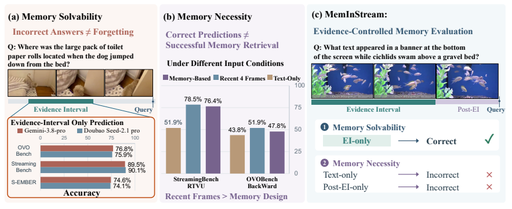
Figure 1 : (a)Memory Solvability. Models may fail to answer questions even when the required evidence intervals are directly provided. Results are reported on the backward tracing tasks of OVO-Bench, the real-time video understanding tasks of StreamingBench, and S-EMBER. (b)Memory Necessity. We compare a memory-based method (FluxMem [1]) with SimpleStream [2], which uses only the four most recent frames, and a text-only baseline. (c) Our evidence-controlled validation protocol ensures both memory solvability and memory necessity, providing a comprehensive benchmark dedicated to evaluating memory capabilities in streaming video understanding.
원문 · CC BY 4.0 · Zhenqi He, Dunyuan Xu, Yang Bo, Kien T. Pham, Yanghao Wang, Shuhan Li, Xintong Guo, Yuyang He, Fang Liu, Huankang Guan, Jingyan Chen, Rui Liu, Long Chen · MemInStream: Memorizing or Merely Recognizing? Rethinking Streaming Video Memory Evaluation · 원문 그림 인용 · 원본 PDF 2쪽에서 그림 영역을 추출했습니다.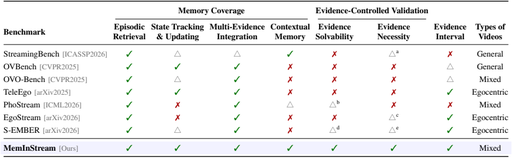
Table 1 : Comparison of streaming video benchmarks in terms of memory coverage and evidence-controlled validation. ✓indicates explicit coverage, while△denotes partial coverage or related validation mechanisms.
원문 · CC BY 4.0 · Zhenqi He, Dunyuan Xu, Yang Bo, Kien T. Pham, Yanghao Wang, Shuhan Li, Xintong Guo, Yuyang He, Fang Liu, Huankang Guan, Jingyan Chen, Rui Liu, Long Chen · MemInStream: Memorizing or Merely Recognizing? Rethinking Streaming Video Memory Evaluation · 원문 그림 인용 · 원본 PDF 3쪽에서 그림 영역을 추출했습니다.증거 제어 검증 프로토콜
MemInStream은 질문마다 질의 시점 t_q와 과거 증거 구간 E_q를 주석합니다. 검증은 두 단계로 이뤄집니다. 먼저 증거 구간만 제공했을 때 두 검증 모델이 모두 맞히는 질문만 남겨 solvability를 확인합니다. 다음으로 텍스트만 제공한 설정과 증거 이후(Post-EI) 관측만 제공한 설정에서 두 모델이 모두 틀리는 질문만 남겨 necessity를 확인합니다. 맥락 기억 과제에는 관련 대화 턴과 증거를 함께 요구하는 세 가지 조건이 추가됩니다. 이렇게 하면 시각 이해 실패와 메모리 무관 지름길에 의한 질문이 걸러집니다. 검증 모델은 Gemini-3.8-Flash와 Doubao Seed-2.1-Pro이며, 이후 사람이 정답과 시간 정렬을 확인합니다.
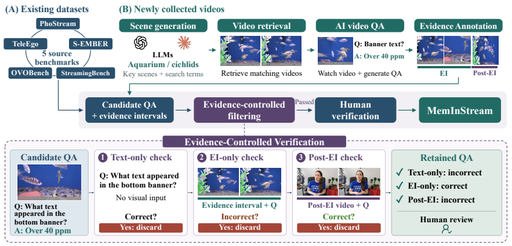
Figure 2 : Overview of the MEMINSTREAMconstruction pipeline.
원문 · CC BY 4.0 · Zhenqi He, Dunyuan Xu, Yang Bo, Kien T. Pham, Yanghao Wang, Shuhan Li, Xintong Guo, Yuyang He, Fang Liu, Huankang Guan, Jingyan Chen, Rui Liu, Long Chen · MemInStream: Memorizing or Merely Recognizing? Rethinking Streaming Video Memory Evaluation · 원문 그림 인용 · 원본 PDF 6쪽에서 그림 영역을 추출했습니다.벤치마크 구성과 과제 범주
MEMINSTREAM은 기존 벤치마크의 질문과 새로 수집한 영상·생성 질문을 함께 사용해 구축했습니다. 과제는 Episodic Retrieval, State Tracking & Updating, Multi-Evidence Integration, Contextual Memory의 4개 범주와 17개 세부 과제로 나뉩니다. 범주는 과제의 주된 메모리 요구에 따라 정의되며 상호 배타적이지 않습니다. 전체 질문은 3,799개이고 8,217개의 증거 구간이 주석되었습니다. 질문당 평균 증거 구간은 2.16개이며, 56.7%의 질문이 여러 증거 구간을 요구합니다.
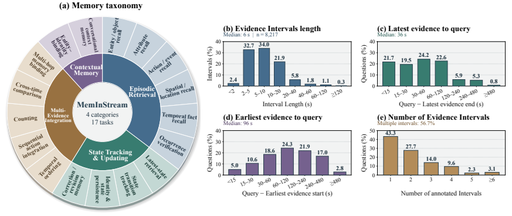
Figure 3 : (a) Hierarchical taxonomy comprising four major memory categories and 17 fine-grained tasks. (b) Distribution of evidence interval lengths. (c–d) Temporal distances from the latest and earliest evidence intervals to the query, respectively. (e) Distribution of the number of evidence intervals per question.
원문 · CC BY 4.0 · Zhenqi He, Dunyuan Xu, Yang Bo, Kien T. Pham, Yanghao Wang, Shuhan Li, Xintong Guo, Yuyang He, Fang Liu, Huankang Guan, Jingyan Chen, Rui Liu, Long Chen · MemInStream: Memorizing or Merely Recognizing? Rethinking Streaming Video Memory Evaluation · 원문 그림 인용 · 원본 PDF 7쪽에서 그림 영역을 추출했습니다.평가 방식과 정확 일치 지표
답변은 단일 정답과 복수 정답을 섞은 형식이며, 모델에는 정답 개수를 알리지 않습니다. 예측 답변 집합이 정답 집합과 정확히 같을 때만 맞다고 보는 strict exact-match accuracy를 사용합니다. 전체 정확도와 과제별 점수를 평균한 macro-average 정확도를 함께 보고합니다. 최근 프레임 설정은 질의 직전 N초의 프레임(N∈{4,30}, 1fps)을 쓰며, 오프라인 모델은 이 프레임만 입력받습니다. 온라인 모델은 각자의 메모리 메커니즘으로 질의 시점의 문맥을 유지합니다.
모델별 메모리 성능 차이
이는 같은 표에서 평가한 독점 모델보다 두 범주에서 높은 값입니다. 반면 Multi-hop Memory Binding은 Gemini-3.8-Flash(30 frames)에서 13.07%, StreamForest에서 23.86%로 낮았습니다. Episodic Retrieval에서 Gemini-3.8-Flash는 입력 프레임을 4에서 30으로 늘릴 때 26.38%에서 44.96%로 올랐지만, 모든 범주에서 같은 향상이 나타나지는 않았습니다.
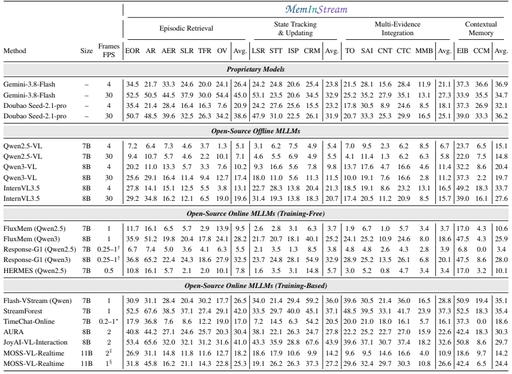
Table 2 : Comparison on MEMINSTREAM. Task scores are exact-match accuracy (%); each Avg. is the macro-average over tasks within that category. Frames/FPS reports input frame counts for proprietary and open-source offline models, and sampling rates (fps) for online models. Offline models use only the N most recent sampled frames before the query. †Response-G1 dynamically adjusts the fps between 0.25 and 1. ‡Up to 60 recent frames per query. ∗TimeChat-Online uses 4–316 input frames with adaptive sampling at 0.2, 0.5, or 1 fps. §Up to 768 input frames.
원문 · CC BY 4.0 · Zhenqi He, Dunyuan Xu, Yang Bo, Kien T. Pham, Yanghao Wang, Shuhan Li, Xintong Guo, Yuyang He, Fang Liu, Huankang Guan, Jingyan Chen, Rui Liu, Long Chen · MemInStream: Memorizing or Merely Recognizing? Rethinking Streaming Video Memory Evaluation · 원문 그림 인용 · 원본 PDF 9쪽에서 그림 영역을 추출했습니다.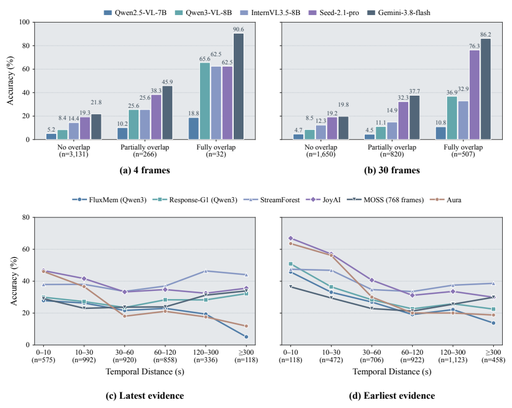
Figure 4 : Accuracy under different evidence overlap levels and temporal distances. (a, b) Accuracy for 4-frame and 30-frame inputs, respectively. No overlap, partial overlap, and full overlap indicate that the input window covers none, some, or all of the annotated evidence intervals, respectively. (c, d) Accuracy versus temporal distance to the query, measured from the latest evidence end and the earliest evidence start, respectively.
원문 · CC BY 4.0 · Zhenqi He, Dunyuan Xu, Yang Bo, Kien T. Pham, Yanghao Wang, Shuhan Li, Xintong Guo, Yuyang He, Fang Liu, Huankang Guan, Jingyan Chen, Rui Liu, Long Chen · MemInStream: Memorizing or Merely Recognizing? Rethinking Streaming Video Memory Evaluation · 원문 그림 인용 · 원본 PDF 10쪽에서 그림 영역을 추출했습니다.메모리 사용 여부에 따른 JoyAI 변화
JoyAI-VL-Interaction을 최대 60개 최근 프레임(2fps)으로 고정한 상태에서 메모리 사용 여부만 바꿔 비교했습니다. 메모리를 켜면 Episodic Retrieval 평균이 31.8%에서 41.0%로, State Tracking & Updating이 28.6%에서 43.9%로 올랐습니다. Multi-Evidence Integration은 22.3%에서 32.6%, Contextual Memory는 26.9%에서 29.7%로 올랐습니다. 가장 큰 상승은 상태 추적과 다중 증거 통합에서 나타났습니다. 이는 최근 관측 예산을 고정한 조건에서 메모리가 쓸모 있다는 관찰이며, 다른 모델이나 예산에서 같은 크기의 효과가 있다는 뜻은 아닙니다.
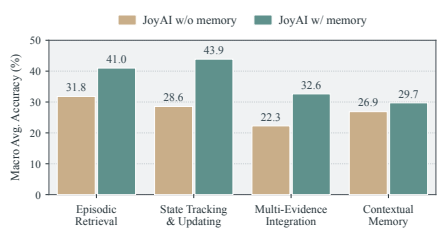
Figure 5 : Effect of memory on JoyAI-VL-Interaction.
원문 · CC BY 4.0 · Zhenqi He, Dunyuan Xu, Yang Bo, Kien T. Pham, Yanghao Wang, Shuhan Li, Xintong Guo, Yuyang He, Fang Liu, Huankang Guan, Jingyan Chen, Rui Liu, Long Chen · MemInStream: Memorizing or Merely Recognizing? Rethinking Streaming Video Memory Evaluation · 원문 그림 인용 · 원본 PDF 11쪽에서 그림 영역을 추출했습니다.긴 시간 간격에 대한 한계
저자들은 현재 벤치마크가 매우 긴 비디오 스트림에서 증거와 질의 사이의 간격이 큰 경우를 충분히 다루지 못한다고 밝힙니다. 이 한계는 향후 더 긴 비디오와 더 큰 시간 간격으로 벤치마크를 확장하려는 계획으로 이어집니다.
논문 정보
- 저자
- Zhenqi He, Dunyuan Xu, Yang Bo, Kien T. Pham, Yanghao Wang, Shuhan Li, Xintong Guo, Yuyang He, Fang Liu, Huankang Guan, Jingyan Chen, Rui Liu, Long Chen
- 학회·저널
- arXiv · 프리프린트
- 최초 공개일
- 2026년 11월 11일
- 등록일
- 2026년 11월 13일
- 수정일
- 2026년 11월 11일
- 버전
- v1
- arXiv
- 2611.15640
- 분류
- cs.CV · cs.AI
- 원문 이용 조건
- CC BY 4.0
- 제공 범위
- 논문 정보, 해설, 허용된 원문 그림
AI 해설은 논문 원문과 별개의 설명이며 오류가 있을 수 있습니다. 원문과 그림은 각 출처의 이용 조건과 따로 표시된 권리를 따릅니다.
초록
Streaming video understanding aims to continuously process incoming visual observations, making the retention and retrieval of relevant information increasingly important as the video history grows. Although existing benchmarks include memory-related questions, question-answering accuracy alone does not reliably measure memory capabilities. Incorrect predictions may arise from failures in visual understanding rather than forgetting, whereas correct predictions may rely on linguistic priors or recent observations without requiring historical memory. To address these ambiguities, we introduce MemInStream, a benchmark dedicated to evaluating memory capabilities in streaming video understanding. We develop an evidence-controlled validation protocol that associates each question with temporally localized evidence intervals. The protocol validates evidence solvability and memory necessity by retaining questions that models can answer from the annotated evidence but cannot resolve using recent observations, post-evidence observations, or textual input alone. This helps disentangle memory limitations from understanding failures while reducing memory-independent shortcuts. MemInStream provides a systematic evaluation of memory capabilities through four major categories, covering Episodic Retrieval, State Tracking \& Updating, Multi-Evidence Integration, and Contextual Memory across diverse video scenarios. Overall, \textsc{MemInStream} provides a comprehensive and reliable benchmark for systematically evaluating memory capabilities in streaming video understanding.
원문 인용
Zhenqi He, Dunyuan Xu, Yang Bo, Kien T. Pham, Yanghao Wang, Shuhan Li, Xintong Guo, Yuyang He, Fang Liu, Huankang Guan, Jingyan Chen, Rui Liu, Long Chen (2026). MemInStream: Memorizing or Merely Recognizing? Rethinking Streaming Video Memory Evaluation. arXiv:2611.15640v1. https://arxiv.org/abs/2611.15640v1
BibTeX
@misc{he2026meminstream,
  title = {{MemInStream: Memorizing or Merely Recognizing? Rethinking Streaming Video Memory Evaluation}},
  author = {Zhenqi He and Dunyuan Xu and Yang Bo and Kien T. Pham and Yanghao Wang and Shuhan Li and Xintong Guo and Yuyang He and Fang Liu and Huankang Guan and Jingyan Chen and Rui Liu and Long Chen},
  year = {2026},
  eprint = {2611.15640},
  archivePrefix = {arXiv},
  url = {https://arxiv.org/abs/2611.15640v1}
}