논문 해설
A Certified Unlearning Approach without Access to Source Data
원본 데이터에 접근하지 않는 certified unlearning 접근법
- 연구 문제 원본 학습 데이터가 없는 상황에서도 대체 데이터셋과 학습된 모델만으로 certified unlearning을 수행할 수 있는지 다룹니다.
- 연구 방법 대체 데이터의 Hessian으로 retain Hessian을 근사하고 단일 단계 2차 Newton 업데이트 뒤, 분포 거리 상한에 맞춘 가우시안 노이즈를 더합니다.
- 주요 결과 합성 및 실제 이미지 데이터 실험에서 제안 방법 Unlearn (-)은 재학습 및 Unlearn (+)과 비교 가능한 정확도를 보고합니다.
원본 데이터 없이 언러닝을 인증하는 문제
기존 certified unlearning은 잊을 샘플 Du를 제외한 나머지 retain 데이터 Dr에 접근할 수 있다는 가정 아래 설계되었습니다. 그러나 개인정보 규제, 저장 공간 제한, 제3자 학습 등의 이유로 원본 학습 데이터가 더 이상 남아 있지 않은 상황이 현실에서 생깁니다. 이 논문은 이 조건에서 모델 w*와 잊을 집합 Du만으로 언러닝을 수행하되, 재학습된 모델과의 구분 불가능성을 (ϵ, δ) 수준으로 보장할 수 있는지를 묻습니다. 이를 위해 원본 분포 ρ와 대체 데이터셋 Ds의 분포 ν 사이의 통계적 거리에 따라 노이즈 크기를 조정하는 것이 핵심 아이디어입니다.
대체 Hessian 기반 업데이트와 거리 조정 노이즈
방법은 세 단계로 구성됩니다. 첫째, 원본 Hessian을 알 수 없으므로 대체 데이터의 Hessian HDs와 잊을 집합의 Hessian HDu로 retain Hessian을 bHDr = (n HDs − m HDu)/(n − m)로 근사합니다. 둘째, 이 추정치의 역행렬과 Du의 기울기를 사용해 w*로부터 단일 단계 2차 Newton 업데이트 bwr = w* + m/(n−m) bHDr^{-1}∇L(Du, w*)를 수행합니다. 셋째, 상한 ∆에 따라 σ = (∆/ϵ)√(2 ln(1.25/δ))로 정한 가우시안 노이즈를 더해 최종 모델 bw′r을 얻습니다. 상한 ∆는 ∥w*r − bwr∥2 ≤ ∆를 만족하도록 Hessian 차이에서 나온 항과 TV(ρ∥ν)에 비례하는 항을 포함합니다.
따라서 대체 데이터가 원본과 더 다를수록 노이즈가 커집니다. 이 상한은 Assumption 4.1의 L-Lipschitz, α-강볼록, β-매끄러움, γ-Hessian Lipschitz 조건 아래에서 성립합니다.
TV 거리 상한과 KL 기반 근사
정확한 TV(ρ∥ν)를 계산하려면 원본 데이터가 필요하므로, 논문은 KL 발산을 이용한 근사를 제시합니다. 먼저 TV 거리는 Bretagnolle-Huber 부등식을 통해 TV(ν∥ρ) ≤ √(1 − exp(−KL(ν∥ρ)))로 KL 발산의 함수로 상한이 주어집니다. 이후 KL(ν∥ρ)은 대체 데이터에 대한 모델 확률의 로그비 평균과 입력 주변 분포 항 KL(ν(x)∥ρ(x))의 합으로 분해됩니다. 입력 주변 분포 ρ(x)는 학습된 모델의 에너지 기반 해석에서 얻은 에너지 E(x)로 정의되며, SGLD로 샘플링한 ˆρ(x)를 사용해 Donsker-Varadhan 변분 표현으로 근사합니다. 이 근사는 정확한 인증이 아니라 휴리스틱 추정이므로 보장은 근사적 성격을 가집니다.
합성·실제 데이터와 다른 설정에서의 검증
합성 실험은 50차원 표준 가우시안 N(0, I)에서 15000개의 원본 샘플을 만들고, 대체 데이터는 ζ 값에 따라 조절된 공분산을 갖는 가우시안에서 같은 크기로 생성합니다. 이 설정에서 잊을 비율은 0.1, L2 정규화 상수 λ는 0.01입니다. 실제 데이터 실험은 CIFAR10, StanfordDogs, Caltech256을 Dirichlet 분포의 농도 매개변수 ξ로 소스와 대체 부분집합으로 나누고, ResNet18 임베딩을 사용합니다. 혼합 선형 네트워크 실험은 NTK 기반 선형화로 가정을 만족시키는 구조를 사용합니다. MNIST와 USPS 교차 실험은 한쪽을 대체 데이터로 사용해 두 방향의 설정을 확인합니다.
결과는 Unlearn (-)이 재학습 및 Unlearn (+)과 비슷한 정확도와 MIA 수준을 보인다는 것입니다. 다만 이는 특정 모델과 데이터 설정에서 얻은 관찰입니다.
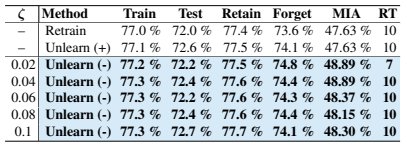
Table 1 . Evaluation of unlearning performance while varying the off-diagonal elements (ζ) of the unit covariance.
원문 · CC BY 4.0 · Umit Yigit Basaran, Sk Miraj Ahmed, Amit Roy-Chowdhury, Basak Guler · A Certified Unlearning Approach without Access to Source Data · 원문 그림 인용 · 원본 PDF 7쪽에서 그림 영역을 추출했습니다.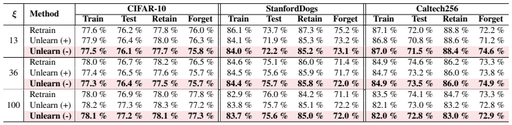
Table 2 . Train, test, retain, forget set accuracies for each method across CIFAR10, StanfordDogs, and Caltech256 datasets while varying the concentration parameter (ξ) of the Dirichlet distribution.
원문 · CC BY 4.0 · Umit Yigit Basaran, Sk Miraj Ahmed, Amit Roy-Chowdhury, Basak Guler · A Certified Unlearning Approach without Access to Source Data · 원문 그림 인용 · 원본 PDF 8쪽에서 그림 영역을 추출했습니다.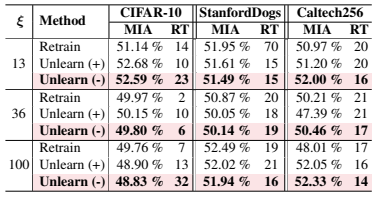
Table 3 . MIA and RT metrics given for each method across CI- FAR10, StanfordDogs, and Caltech256 datasets while varying the concentration parameter (ξ) of the Dirichlet distribution.
원문 · CC BY 4.0 · Umit Yigit Basaran, Sk Miraj Ahmed, Amit Roy-Chowdhury, Basak Guler · A Certified Unlearning Approach without Access to Source Data · 원문 그림 인용 · 원본 PDF 8쪽에서 그림 영역을 추출했습니다.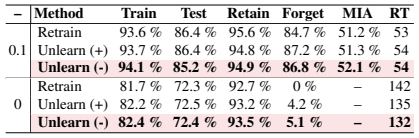
Table 5 . Evaluation of unlearning performance on CIFAR-10 using mixed-linear networks with ξ= 100 . In this table, ”0.1” indicates that 10% of the data is used as the forget set, and ”0” denotes the class selected for unlearning.
원문 · CC BY 4.0 · Umit Yigit Basaran, Sk Miraj Ahmed, Amit Roy-Chowdhury, Basak Guler · A Certified Unlearning Approach without Access to Source Data · 원문 그림 인용 · 원본 PDF 8쪽에서 그림 영역을 추출했습니다.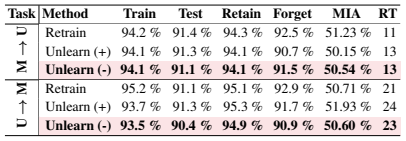
Table 7 . Evaluation of unlearning performance with MNIST and USPS dataset experiments.
원문 · CC BY 4.0 · Umit Yigit Basaran, Sk Miraj Ahmed, Amit Roy-Chowdhury, Basak Guler · A Certified Unlearning Approach without Access to Source Data · 원문 그림 인용 · 원본 PDF 9쪽에서 그림 영역을 추출했습니다.근사 보장과 적용 범위
이 방법의 보장은 가정 아래에서 성립하며, 실제 구현은 α, L, β, γ를 실험마다 튜닝하여 이론적 엄밀성이 완전히 유지되지 않을 수 있습니다. 또한 TV 거리는 KL 기반 휴리스틱으로 근사되므로 얻어지는 인증은 근사적입니다. 원문은 실험에서 계산된 근사 ˆ∆가 정확한 ∆보다 커질 수 있음을 보고하면서도 모델 성능은 Unlearn (+)과 일치한다고 설명합니다. 따라서 이 결과는 정확한 인증의 증명이 아니라, 근사 거리와 실제 성능 사이의 경험적 일치에 가깝습니다.
논문 정보
- 저자
- Umit Yigit Basaran, Sk Miraj Ahmed, Amit Roy-Chowdhury, Basak Guler
- 학회·저널
- arXiv · 프리프린트
- 최초 공개일
- 2025년 6월 6일
- 등록일
- 2026년 10월 30일
- 수정일
- 2025년 12월 18일
- 버전
- v3
- arXiv
- 2506.06486
- 분류
- cs.LG · cs.CR · stat.ML
- 원문 이용 조건
- CC BY 4.0
- 제공 범위
- 논문 정보, 해설, 허용된 원문 그림
AI 해설은 논문 원문과 별개의 설명이며 오류가 있을 수 있습니다. 원문과 그림은 각 출처의 이용 조건과 따로 표시된 권리를 따릅니다.
초록
With the growing adoption of data privacy regulations, the ability to erase private or copyrighted information from trained models has become a crucial requirement. Traditional unlearning methods often assume access to the complete training dataset, which is unrealistic in scenarios where the source data is no longer available. To address this challenge, we propose a certified unlearning framework that enables effective data removal \final{without access to the original training data samples}. Our approach utilizes a surrogate dataset that approximates the statistical properties of the source data, allowing for controlled noise scaling based on the statistical distance between the two. \updated{While our theoretical guarantees assume knowledge of the exact statistical distance, practical implementations typically approximate this distance, resulting in potentially weaker but still meaningful privacy guarantees.} This ensures strong guarantees on the model's behavior post-unlearning while maintaining its overall utility. We establish theoretical bounds, introduce practical noise calibration techniques, and validate our method through extensive experiments on both synthetic and real-world datasets. The results demonstrate the effectiveness and reliability of our approach in privacy-sensitive settings.
원문 인용
Umit Yigit Basaran, Sk Miraj Ahmed, Amit Roy-Chowdhury, Basak Guler (2025). A Certified Unlearning Approach without Access to Source Data. arXiv:2506.06486v3. https://arxiv.org/abs/2506.06486v3
BibTeX
@misc{basaran2025certified,
  title = {{A Certified Unlearning Approach without Access to Source Data}},
  author = {Umit Yigit Basaran and Sk Miraj Ahmed and Amit Roy-Chowdhury and Basak Guler},
  year = {2025},
  eprint = {2506.06486},
  archivePrefix = {arXiv},
  url = {https://arxiv.org/abs/2506.06486v3}
}