논문 해설
A Survey on Deep Learning-Based Monocular Spacecraft Pose Estimation: Current State, Limitations and Prospects
딥러닝 기반 단안 우주선 자세 추정에 관한 서베이: 현재 상태, 한계 및 전망
- 연구 문제 단안 영상으로 비협력 우주선의 자세를 추정하는 문제는 우주 임무의 근접 운용에 필요하지만, 합성 데이터로 학습한 딥러닝 모델의 실험실 및 우주 영상 성능 저하가 배포를 어렵게 합니다.
- 연구 방법 이 설문은 딥러닝 기반 자세 추정 방법을 키포인트 기반 hybrid modular 접근법과 단일 모델 direct end-to-end 접근법으로 나누어 정리합니다.
- 주요 결과 보고된 값을 모은 비교에서 hybrid 접근법이 KSPEC'19 상위 방법들에서 direct 접근법보다 낮은 평균 오차를 보였습니다. 다만 극단적 조명 조건에서는 최고 수준 방법의 정확도도 크게 떨어집니다.
단안 영상 기반 우주선 자세 추정의 문제
이 논문은 비협력 우주선의 자세를 단일 단안 카메라 영상에서 추정하는 문제를 다룹니다. 궤도상 서비스(OOS)와 능동 파편 제거(ADR)처럼 근접 운용이 필요한 임무에서는 목표 우주선의 위치와 방향을 알아야 상대 항법을 수행할 수 있습니다. 단안 카메라는 LIDAR나 RADAR보다 작고 가볍고 전력 요구가 적어 널리 선호됩니다. 과거에는 손으로 설계한 특징점과 3D 대응을 쓰는 방식이 주로 쓰였지만, 우주의 강한 조명과 낮은 신호 대 잡음비에서는 성능이 떨어집니다. 이후 딥러닝 기반 방법이 늘었으나, 학습에는 합성 데이터가 주로 쓰이고 실험실이나 우주 영상에서 성능이 떨어지는 도메인 격차가 남아 있습니다.
두 접근법의 구조와 계산 흐름
설문은 딥러닝 기반 방법을 hybrid modular 접근법과 direct end-to-end 접근법으로 나눕니다. Hybrid modular 접근법은 우주선 위치 파악, 키포인트 예측, 자세 계산의 세 단계로 구성됩니다. 위치 파악 단계에서는 객체 검출기가 경계 상자를 예측하고 관심 영역을 잘라냅니다. 키포인트 예측 단계에서는 CAD 모델 등에서 얻은 사전 정의된 3D 키포인트의 2D 투영을 DL 모델이 회귀하거나 히트맵으로 예측합니다. 자세 계산 단계에서는 RANSAC으로 잘못 예측된 키포인트를 제거한 뒤 PnP solver로 자세를 구하고, 기하 손실로 정제합니다. Direct end-to-end 접근법은 하나의 DL 모델이 영상에서 7차원 자세 벡터를 직접 회귀하며, 카메라 파라미터와 3D 모델 없이 자세 정답 라벨만으로 학습합니다.
URSONet처럼 위치는 회귀하고 방향은 soft classification으로 추정하는 설계도 설명됩니다.
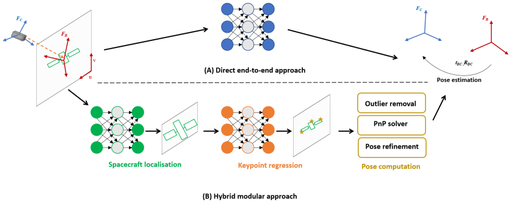
Figure 4 : Illustration of different approaches for spacecraft pose estimation. A) Direct end-to-end approaches which use deep learning. B) Hybrid modular approaches which consist of three steps: object detection/localisation, keypoint regression, and pose computation. The first two steps use deep learning and the third step uses a classical algorithm which performs outlier removal necessary for the PnP solver and finally pose refinement.
원문 · CC BY 4.0 · Leo Pauly, Wassim Rharbaoui, Carl Shneider, Arunkumar Rathinam, Vincent Gaudilliere, Djamila Aouada · A Survey on Deep Learning-Based Monocular Spacecraft Pose Estimation: Current State, Limitations and Prospects · 원문 그림 인용 · 원본 PDF 4쪽에서 그림 영역을 추출했습니다.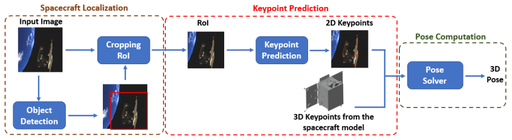
Figure 5 : Hybrid modular approach for spacecraft pose estimation. The spacecraft localisation stage is outlined in blue, the keypoint prediction stage is in red and the pose computation stage is shown in green. Spacecraft image from the SPARK2 dataset is used for illustration [127].
원문 · CC BY 4.0 · Leo Pauly, Wassim Rharbaoui, Carl Shneider, Arunkumar Rathinam, Vincent Gaudilliere, Djamila Aouada · A Survey on Deep Learning-Based Monocular Spacecraft Pose Estimation: Current State, Limitations and Prospects · 원문 그림 인용 · 원본 PDF 4쪽에서 그림 영역을 추출했습니다.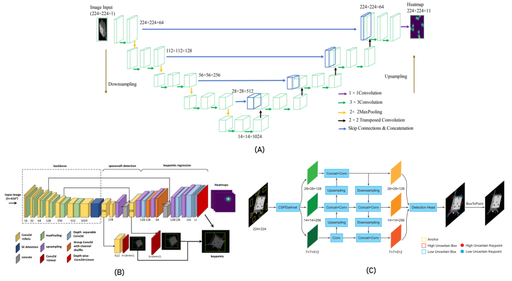
Figure 7 : (A) Keypoint heatmap prediction with a ResNet-UNet architecture [29] (B) YOLO-like CNN detector with a heatmap regression subnetwork [60] (C) Keypoint prediction is formulated as a keypoint bounding box detection problem [81].
원문 · CC BY 4.0 · Leo Pauly, Wassim Rharbaoui, Carl Shneider, Arunkumar Rathinam, Vincent Gaudilliere, Djamila Aouada · A Survey on Deep Learning-Based Monocular Spacecraft Pose Estimation: Current State, Limitations and Prospects · 원문 그림 인용 · 원본 PDF 5쪽에서 그림 영역을 추출했습니다.알고리즘 비교와 주요 결과
설문은 보고된 위치 오차와 방향 오차를 모아 알고리즘을 비교합니다. 위치 오차는 예측과 정답 translation 벡터의 차이의 노름이고, 방향 오차는 예측과 정답 쿼터니언 내적의 절댓값으로 계산된 각도입니다. SPEED 합성 테스트 세트의 값이 보고된 경우 그 값을 쓰고, 없으면 해당 합성 데이터셋의 값을 씁니다. ESA KSPEC'19 상위 10개 방법 분석에서 hybrid 접근법의 평균 위치 오차는 0.0083 ± 0.0269 m, 평균 방향 오차는 1.31 ± 2.24°였고, direct 접근법은 0.0328 ± 0.0430 m, 9.76 ± 18.51°였습니다. KSPEC'21에서도 우승 방법이 hybrid 접근법을 사용했다는 비슷한 경향이 보고됩니다.
파라미터 수와 성능의 절충은 그림 13과 표 1·2에 정리됩니다. 다만 이 비교는 저자들이 모은 보고 값의 비교이며 모든 방법을 같은 조건에서 새로 측정한 결과가 아닙니다.
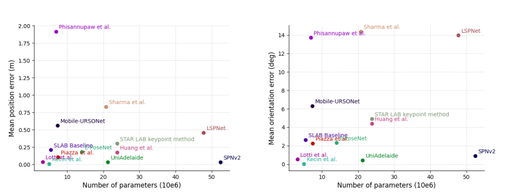
Figure 13 : Comparison of pose estimation algorithms in terms of number of parameters versus (a) position error and (b) orientation error.
원문 · CC BY 4.0 · Leo Pauly, Wassim Rharbaoui, Carl Shneider, Arunkumar Rathinam, Vincent Gaudilliere, Djamila Aouada · A Survey on Deep Learning-Based Monocular Spacecraft Pose Estimation: Current State, Limitations and Prospects · 원문 그림 인용 · 원본 PDF 9쪽에서 그림 영역을 추출했습니다.배포성, 해석성, 조명 강건성의 한계
설문은 배포 가능성에 세 가지 한계를 제시합니다. 첫째, 엣지 시스템에서 평가된 연구가 적고, 많은 논문이 지연 시간, 추론 시간, 메모리, 전력 소비 같은 요인을 보고하지 않습니다. 둘째, 상용 DL 모델과 프레임워크를 많이 쓰는데 이는 자원이 풍부한 워크스테이션을 전제하며 우주용 AI 가속기는 일부 층만 지원할 수 있습니다. 셋째, 해석성 측면에서 direct 접근법은 블랙박스 특성 때문에 오류를 해석하기 어렵고, hybrid 접근법도 추론과 불확실성 모델링 능력이 부족합니다. 조명 강건성도 한계로 제시됩니다. 그림 14에서 KSPEC'21 우승 방법의 최악 예측은 lightbox와 sunlamp의 극단적 조명 영상에서 정확도가 크게 떨어졌습니다.
이는 해당 결과의 관찰이며, 이 설문이 모든 조명 조건을 체계적으로 측정했다는 뜻은 아닙니다.
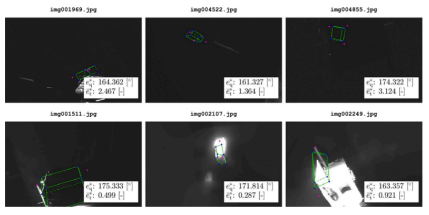
Figure 14 : . Visualization of the worst 3 predictions made by stream-1 winning method of the KSPEC’21 challenge on lightbox (top-row) and sunlamp (bottom-row) images [112]. These results show considerable drop in accuracy of estimated poses (shown in green) under extreme lighting conditions, highlighting a important limitation of vision-based spacecraft pose estimation algorithms.
원문 · CC BY 4.0 · Leo Pauly, Wassim Rharbaoui, Carl Shneider, Arunkumar Rathinam, Vincent Gaudilliere, Djamila Aouada · A Survey on Deep Learning-Based Monocular Spacecraft Pose Estimation: Current State, Limitations and Prospects · 원문 그림 인용 · 원본 PDF 9쪽에서 그림 영역을 추출했습니다.데이터셋, 합성 생성과 도메인 격차 완화
설문은 SHIRT, SPARK2, SPEED, SPEED+, URSO, PRISMA12K 등 주요 데이터셋을 해상도, 채널, 거리, 렌더링 도구 기준으로 정리합니다. 대부분의 데이터셋은 10^4~10^5 규모이며 공개된 우주 영상 데이터는 부족합니다. 합성 학습 모델이 실험실 영상에서 성능이 떨어지는 도메인 격차를 줄이기 위해 데이터 수준 방법으로 데이터 증강과 도메인 랜덤화를, 알고리즘 수준 방법으로 다중 작업 학습과 도메인 적대적 학습을 소개합니다. 도메인 적대적 학습에서는 도메인 분류기를 학습 중 최대화되는 손실로 붙여, 분류기가 소스와 타깃 도메인을 잘 구분하지 못할수록 특징이 도메인 불변에 가까워진다고 설명합니다.
SPNv2는 다중 작업 학습과 온라인 도메인 정제를 함께 사용하며, 이 설문은 이를 도메인 격차 완화의 사례로 소개합니다.
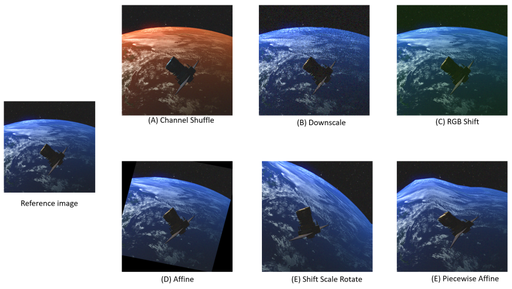
Figure 16 : Illustration of different data augmentation methods used on the same reference image taken from SPARK2 [127] dataset. Images A, B and C show examples of pixel-wise augmentation methods and images D, E and F show the application of spatial augmentation methods. The captions refer to the corresponding functions used by the Albumentations Python library.
원문 · CC BY 4.0 · Leo Pauly, Wassim Rharbaoui, Carl Shneider, Arunkumar Rathinam, Vincent Gaudilliere, Djamila Aouada · A Survey on Deep Learning-Based Monocular Spacecraft Pose Estimation: Current State, Limitations and Prospects · 원문 그림 인용 · 원본 PDF 18쪽에서 그림 영역을 추출했습니다.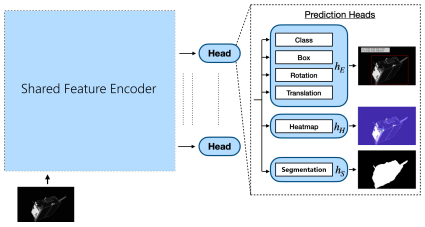
Figure 17 : A model architecture used for multi-task learning, where some layers are shared between all tasks, and some layers are dedicated to specific tasks. Adopted from [110].
원문 · CC BY 4.0 · Leo Pauly, Wassim Rharbaoui, Carl Shneider, Arunkumar Rathinam, Vincent Gaudilliere, Djamila Aouada · A Survey on Deep Learning-Based Monocular Spacecraft Pose Estimation: Current State, Limitations and Prospects · 원문 그림 인용 · 원본 PDF 18쪽에서 그림 영역을 추출했습니다.논문 정보
- 저자
- Leo Pauly, Wassim Rharbaoui, Carl Shneider, Arunkumar Rathinam, Vincent Gaudilliere, Djamila Aouada
- 학회·저널
- arXiv · 프리프린트
- 최초 공개일
- 2023년 5월 12일
- 등록일
- 2026년 11월 6일
- 수정일
- 2023년 5월 17일
- 버전
- v3
- arXiv
- 2305.07348
- DOI
- 10.1016/j.actaastro.2023.08.001
- 분류
- cs.CV · cs.AI
- 원문 이용 조건
- CC BY 4.0
- 제공 범위
- 논문 정보, 해설, 허용된 원문 그림
AI 해설은 논문 원문과 별개의 설명이며 오류가 있을 수 있습니다. 원문과 그림은 각 출처의 이용 조건과 따로 표시된 권리를 따릅니다.
초록
Estimating the pose of an uncooperative spacecraft is an important computer vision problem for enabling the deployment of automatic vision-based systems in orbit, with applications ranging from on-orbit servicing to space debris removal. Following the general trend in computer vision, more and more works have been focusing on leveraging Deep Learning (DL) methods to address this problem. However and despite promising research-stage results, major challenges preventing the use of such methods in real-life missions still stand in the way. In particular, the deployment of such computation-intensive algorithms is still under-investigated, while the performance drop when training on synthetic and testing on real images remains to mitigate. The primary goal of this survey is to describe the current DL-based methods for spacecraft pose estimation in a comprehensive manner. The secondary goal is to help define the limitations towards the effective deployment of DL-based spacecraft pose estimation solutions for reliable autonomous vision-based applications. To this end, the survey first summarises the existing algorithms according to two approaches: hybrid modular pipelines and direct end-to-end regression methods. A comparison of algorithms is presented not only in terms of pose accuracy but also with a focus on network architectures and models' sizes keeping potential deployment in mind. Then, current monocular spacecraft pose estimation datasets used to train and test these methods are discussed. The data generation methods: simulators and testbeds, the domain gap and the performance drop between synthetically generated and lab/space collected images and the potential solutions are also discussed. Finally, the paper presents open research questions and future directions in the field, drawing parallels with other computer vision applications.
원문 인용
Leo Pauly, Wassim Rharbaoui, Carl Shneider, Arunkumar Rathinam, Vincent Gaudilliere, Djamila Aouada (2023). A Survey on Deep Learning-Based Monocular Spacecraft Pose Estimation: Current State, Limitations and Prospects. arXiv:2305.07348v3. https://doi.org/10.1016/j.actaastro.2023.08.001
BibTeX
@article{pauly2023survey,
  title = {{A Survey on Deep Learning-Based Monocular Spacecraft Pose Estimation: Current State, Limitations and Prospects}},
  author = {Leo Pauly and Wassim Rharbaoui and Carl Shneider and Arunkumar Rathinam and Vincent Gaudilliere and Djamila Aouada},
  year = {2023},
  eprint = {2305.07348},
  archivePrefix = {arXiv},
  doi = {10.1016/j.actaastro.2023.08.001},
  url = {https://arxiv.org/abs/2305.07348v3}
}