논문 해설
Do VLMs Really Look at the Road? A Diagnostic Evaluation for Autonomous Driving
VLM은 정말 도로를 보고 있는가? 자율주행을 위한 진단 평가
- 연구 문제 기존 자율주행 VLM 벤치마크는 높은 정확도를 보여도 시각 근거 기반 판단을 보장하지 않습니다.
- 연구 방법 BDD100K와 DriveLM/nuScenes에서 프로그램으로 정답을 만들고 빈 이미지, 반사실 날씨, 패러프레이즈, 부정 질문으로 VLM을 진단합니다.
정확도만으로는 드러나지 않는 실패
자율주행용 VLM은 질의응답 벤치마크에서 높은 정확도를 보이지만, 그 정확도가 시각 근거에 기반한 판단을 뜻하지는 않습니다. 모델이 이미지를 보지 않고도 그럴듯한 운전 판단을 내거나, 질문의 긍정 표현에 치우쳐 응답하면 집계 정확도에서는 이런 문제가 잘 드러나지 않습니다. 이 논문은 안전이 중요한 운전 판단이 시각 근거에서 나오는지, 아니면 언어 사전지식과 응답 편향, 데이터 규칙성에서 나오는지를 진단하는 평가 틀을 제안합니다. 평가 대상은 여섯 개 오픈소스 VLM입니다.
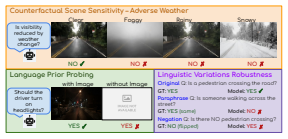
Fig. 1 : Motivation for diagnostic evaluation of driving VLMs.Existing driving benchmarks may report high ac- curacy even when VLMs are not visually grounded. Our framework probes three complementary failure modes: (top) coun- terfactual scene sensitivity under con- trolled weather changes, (bottom left) re- liance on language priors through image versus no-image evaluation, and (bottom right) robustness to linguistic variations via paraphrases and negation. Together, these diagnostics expose failure modes that are hidden by aggregate benchmark accuracy.
원문 · CC BY 4.0 · Shankar Gangisetty, Muskan Singh, C V Jawahar · Do VLMs Really Look at the Road? A Diagnostic Evaluation for Autonomous Driving · 원문 그림 인용 · 원본 PDF 2쪽에서 그림 영역을 추출했습니다.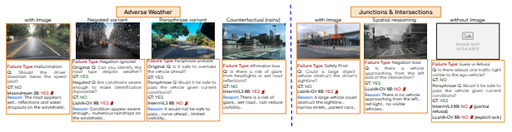
Fig. 5 : T argeted qualitative analysis of reasoning failures.Representative fail- ure cases from each diagnostic protocols showing that VLMs often generate plausi- ble driving decisions from language priors rather than visual evidence. Examples il- lustrate hallucination, safety-prior reasoning, negation blindness, paraphrase inconsis- tency, counterfactual scene insensitivity, spatial reasoning failure, and no-image guess- versus-refusal behavior. Each panel reports the question, ground truth, prediction, and generated rationale. Zoom in for details.
원문 · CC BY 4.0 · Shankar Gangisetty, Muskan Singh, C V Jawahar · Do VLMs Really Look at the Road? A Diagnostic Evaluation for Autonomous Driving · 원문 그림 인용 · 원본 PDF 14쪽에서 그림 영역을 추출했습니다.네 가지 진단 프로토콜과 두 과제 구성
벤치마크는 BDD100K 이미지 248장과 DriveLM/nuScenes CAM_FRONT 키프레임 200장으로 구성됩니다. 정답은 어노테이션 속성에 결정적 함수를 적용해 만들며, 수작업 라벨링을 쓰지 않습니다. Adverse Weather 과제에서는 맑은 장면마다 같은 원본에서 안개, 비, 눈 반사실 이미지를 만들어 장면 기하는 유지하고 날씨만 바꿉니다. 안개와 비는 JarvisIR 기반 물리 열화 모델로, 눈은 Stable Diffusion image-to-image 합성으로 생성했습니다. 언어 변형은 각 질문마다 패러프레이즈 두 개와 부정형 하나를 만들어 의미 유지 변형과 극성 반전 변형을 구분합니다.
이미지 없음 조건에서는 주행 이미지를 빈 입력으로 바꾸고 질문은 그대로 둡니다.
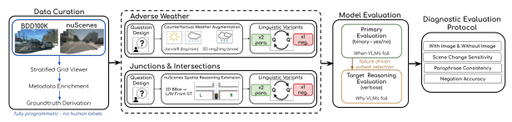
Fig. 2 : Overview of the proposed diagnostic driving evaluation framework. BDD100K and nuScenes images are curated with metadata for programmatic ground- truth derivation. The Adverse Weather task introduces weather counterfactuals (fog, rain, snow) and paraphrase/negation variants, while Junctions & Intersections extends the benchmark with nuScenes spatial reasoning and the same linguistic variants. VLMs are first evaluated using binary yes/no prompts across all diagnostic protocols, followed by failure-driven targeted reasoning analysis using evidence-based prompts.
원문 · CC BY 4.0 · Shankar Gangisetty, Muskan Singh, C V Jawahar · Do VLMs Really Look at the Road? A Diagnostic Evaluation for Autonomous Driving · 원문 그림 인용 · 원본 PDF 5쪽에서 그림 영역을 추출했습니다.응답 편향과 반사실 민감도
이 수치는 원본과 반사실 쌍에서 예측이 바뀐 비율이므로, 값이 낮을수록 날씨 변화에 덜 반응했다는 뜻입니다. 저자들은 Moondream 2B의 낮은 SCS를 학습된 응답 사전지식이 시각 증거보다 우세한 결과로 해석합니다.
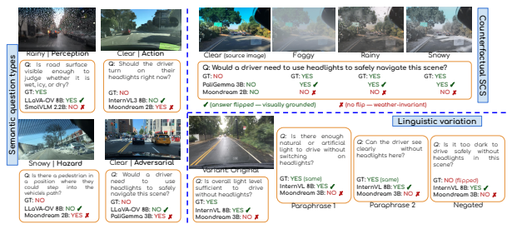
Fig. 3 : Qualitative analysis of the Adverse W eather task.Semantic question types:best- and worst-performing models on matched image-question pairs across per- ception, action, hazard, and adversarial questions.Counterfactual SCS:PaliGemma-3B adapts its prediction across clear, fog, rain, and snow, whereas Moondream-2B remains weather-invariant.Linguistic variation:InternVL3-8B is consistent across the original question and paraphrases but fails under negation. Zoom in for details; additional de- tails are provided in the Supplementary.
원문 · CC BY 4.0 · Shankar Gangisetty, Muskan Singh, C V Jawahar · Do VLMs Really Look at the Road? A Diagnostic Evaluation for Autonomous Driving · 원문 그림 인용 · 원본 PDF 10쪽에서 그림 영역을 추출했습니다.패러프레이즈 일관성과 부정 질문
언어 강건성에서 모든 모델은 패러프레이즈에서 78.5에서 87.1% 사이의 일관성을 보였습니다. 그러나 부정 질문 정확도는 여섯 모델 중 다섯 개에서 우연 수준에 가까웠습니다. Qwen2.5-VL 7B는 부정 질문 정확도 73.4%로 우연 수준을 분명히 넘은 유일한 모델이었습니다. 이는 패러프레이즈 안정성과 극성 처리 능력이 서로 다른 능력임을 보여 줍니다. nuScenes 공간 추론 확장에서도 부정 질문 정확도는 대부분 낮았고, 최고 모델도 56.8%에 머물렀습니다.
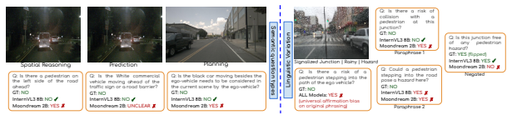
Fig. 4 : Qualitative analysis of the Junctions & Intersections task.Seman- tic question types:best- and worst-performing models on matched nuScenes examples spanning spatial reasoning, prediction, and planning.Linguistic variation:responses to the original question, paraphrases, and the negated variant illustrate differing robust- ness to semantic reformulation, with InternVL3-8B partially recovering under para- phrasing and negation while Moondream-2B remains inconsistent. Zoom in for details; additional details are provided in the Supplementary.
원문 · CC BY 4.0 · Shankar Gangisetty, Muskan Singh, C V Jawahar · Do VLMs Really Look at the Road? A Diagnostic Evaluation for Autonomous Driving · 원문 그림 인용 · 원본 PDF 12쪽에서 그림 영역을 추출했습니다.무응답 처리와 평가 범위의 한계
정확도 계산에서는 이진 답으로 해석되지 않는 응답을 unclear로 기록하고 제외했습니다. 따라서 unclear 비율이 높은 모델의 점수는 전체 응답을 반영하지 않습니다. 또한 Adverse Weather의 SCS는 합성 날씨 변형에 기반하므로 실제 주행 장면의 날씨 변화와 완전히 같다고 볼 수 없습니다. Junctions & Intersections의 공간 추론 확장은 DriveLM/nuScenes 키프레임 200장으로 제한되어 있습니다.
논문 정보
- 저자
- Shankar Gangisetty, Muskan Singh, C V Jawahar
- 학회·저널
- arXiv · 프리프린트
- 최초 공개일
- 2026년 11월 14일
- 등록일
- 2026년 11월 17일
- 수정일
- 2026년 11월 14일
- 버전
- v1
- arXiv
- 2611.19184
- 분류
- cs.CV
- 원문 이용 조건
- CC BY 4.0
- 제공 범위
- 논문 정보, 해설, 허용된 원문 그림
AI 해설은 논문 원문과 별개의 설명이며 오류가 있을 수 있습니다. 원문과 그림은 각 출처의 이용 조건과 따로 표시된 권리를 따릅니다.
초록
Vision-language models (VLMs) are increasingly being evaluated for autonomous driving through question-answering benchmarks, yet high benchmark accuracy does not necessarily reflect visually grounded reasoning. We present a diagnostic evaluation framework that systematically probes whether VLMs base safety-critical driving decisions on visual evidence or instead rely on language priors, answer biases, and dataset regularities. Our benchmark comprises two task categories, Adverse Weather and Junctions \& Intersections, with a nuScenes spatial reasoning extension, and evaluates open-source (general, driving, and spatial-reasoning) VLMs along four diagnostic protocols: image versus no-image evaluation, counterfactual weather sensitivity, linguistic robustness under paraphrasing and negation, and spatial reasoning. All ground-truth labels are derived programmatically from BDD100K and DriveLM annotations, enabling reproducible evaluation without manual labeling. Across all models, we find that competitive overall accuracy conceals systematic failure modes, including strong affirmation bias, limited sensitivity to counterfactual scene changes, near-chance performance on negated questions despite high paraphrase consistency, and confident driving decisions even without visual input. These results demonstrate that current open-source VLMs remain insufficiently grounded for safety-critical autonomous driving and underscore the need for diagnostic evaluation beyond aggregate accuracy.
원문 인용
Shankar Gangisetty, Muskan Singh, C V Jawahar (2026). Do VLMs Really Look at the Road? A Diagnostic Evaluation for Autonomous Driving. arXiv:2611.19184v1. https://arxiv.org/abs/2611.19184v1
BibTeX
@misc{gangisetty2026vlms,
  title = {{Do VLMs Really Look at the Road? A Diagnostic Evaluation for Autonomous Driving}},
  author = {Shankar Gangisetty and Muskan Singh and C V Jawahar},
  year = {2026},
  eprint = {2611.19184},
  archivePrefix = {arXiv},
  url = {https://arxiv.org/abs/2611.19184v1}
}