논문 해설
Learning to Discover at Test Time
테스트 시점에 발견하는 법 학습
- 연구 문제 테스트 시점에 LLM을 강화학습하여 단일 과학 문제의 최고 해를 찾는 방법을 제안합니다.
- 연구 방법 entropic objective와 PUCT 기반 상태 재사용을 결합해 문제별로 정책을 학습합니다.
- 주요 결과 수학, GPU 커널, 알고리즘 설계에서 보고된 최고 결과를 얻었으며, 일부 과제에서는 발견이 보고되지 않았습니다.
과학 문제 해결을 위한 테스트 시점 학습의 필요성
이 논문은 새로운 과학 문제에서 기존 최고 성능(state of the art)을 넘는 해를 어떻게 찾을 수 있는지를 묻습니다. 기존의 테스트 시점 확장(test-time scaling) 연구, 예를 들어 AlphaEvolve는 동결된 LLM에 많은 프롬프트를 주고 진화적 탐색을 수행합니다. 이 방식에서 LLM 자체는 시도를 통해 개선되지 않습니다. 저자들은 테스트 시점에 LLM을 직접 강화학습하여, 그 문제에서 얻은 경험으로 정책 자체를 갱신하는 방향을 제안합니다.
이 설정의 목표는 평균 보상을 높이는 일반적인 강화학습과 다릅니다. 발견 문제에서는 하나의 가장 좋은 해가 중요하며, 정책은 그 해를 얻기 위한 수단입니다. 따라서 평균 성능을 최적화하는 표준 강화학습 목표와 탐색 방식이 발견 문제에 적합하지 않을 수 있다는 점이 출발점입니다. 논문은 연속 보상을 가진 수학, GPU 커널 엔지니어링, 알고리즘 설계, 생물학 문제를 대상으로 이 질문을 검증합니다.
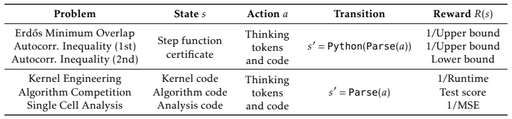
Table 1 . Overview of the science and engineering problems in our paper, and the environments they induce (§2.1). Note that the reward is 0 ifsfails validity checks.
원문 · CC BY 4.0 · Mert Yuksekgonul, Daniel Koceja, Xinhao Li, Federico Bianchi, Jed McCaleb, Xiaolong Wang, Jan Kautz, Yejin Choi, James Zou, Carlos Guestrin, Yu Sun · Learning to Discover at Test Time · 원문 그림 인용 · 원본 PDF 3쪽에서 그림 영역을 추출했습니다.entropic objective와 PUCT 재사용을 결합한 학습 절차
TTT-Discover는 상태 재사용(state reuse)과 학습(train)을 하나의 반복 과정으로 묶습니다. 각 단계에서 재사용 규칙이 버퍼에서 시작 상태를 고르고, 정책이 그 상태와 문맥에서 행동을 샘플링하며, 보상을 계산한 결과를 버퍼에 추가합니다. 그 다음 같은 롤아웃들로 정책 가중치를 갱신합니다.
학습 목표는 entropic objective Jβ입니다. 이 목표는 로그 기대 지수 보상을 최적화하며, β가 커지면 최댓값 보상을 선호하는 방향으로 바뀝니다. 논문은 β를 고정하면 학습 초기에는 불안정하고 후반에는 개선이 작아진다고 보고, 초기 상태마다 정책 분포의 KL 예산을 γ=ln 2로 제한하는 방식으로 β를 적응적으로 정합니다. 재사용 규칙은 PUCT 변형입니다. 상태의 점수는 자식 보상의 최댓값 Q(s), 보상 순위 기반 사전확률 P(s), 방문 횟수 보너스의 합으로 계산됩니다. 평균이 아니라 최댓값을 쓰는 이유는 한 상태에서 도달할 수 있는 최선의 결과가 중요하기 때문이라고 저자들은 설명합니다.
수학 문제에서의 검증 결과
수학 문제에서 저자들은 Erdős 최소 중첩 문제와 첫 번째 자기상관 부등식(AC1)을 주로 보고합니다. Erdős 문제에서는 gpt-oss-120b 기반 TTT-Discover가 상한 0.380876을 얻었으며, 이는 AlphaEvolve의 0.380924보다 낮은 값입니다. 이 결과의 구성은 600조각 비대칭 단계 함수입니다. AlphaEvolve 구성은 95조각이며 최선의 인간 결과는 51조각 구성이라고 보고됩니다.

Figure 2 . We show the normalized step functions including the prior state-of-the-art from AlphaEvolve. The step functionf (x) is the limiting density of setA. Unlike the previous state-of-the-art, the solution from TTT-Discover is an asymmetric construction. TTT-Discover found a 600-piece step function, while AlphaEvolve construction was 95-piece. The best human result was a 51-piece construction [20].
원문 · CC BY 4.0 · Mert Yuksekgonul, Daniel Koceja, Xinhao Li, Federico Bianchi, Jed McCaleb, Xiaolong Wang, Jan Kautz, Yejin Choi, James Zou, Carlos Guestrin, Yu Sun · Learning to Discover at Test Time · 원문 그림 인용 · 원본 PDF 8쪽에서 그림 영역을 추출했습니다.같은 샘플링 예산의 Best-of-25600 기준선과 OpenEvolve도 함께 비교됩니다. 저자들은 특정 Erdős 결과에서 Best-of-25600이 AlphaEvolve 구성을 넘어섰다고도 보고하여, 개선의 원인을 탐색 예산과 방법의 차이로 나누어 읽어야 함을 보여 줍니다. 자기상관 부등식 C1에서는 Qwen3-8B 변형을 포함한 TTT-Discover가 1.50286의 상한을 보고하며, 이는 ThetaEvolve의 1.50313과 AlphaEvolve의 1.50316보다 낮습니다. 반면 C2 문제에서는 AlphaEvolve의 0.961보다 낮은 0.959의 하한을 얻었으므로 발견으로 보고되지 않았습니다.
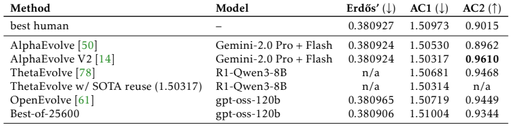
Table 2 . Results in mathematics problems. In the Erdős’ Minimum Overlap Problem and First Autocorrelation Inequality (AC1), TTT-Discover sets the new state-of-the-art. We also report TTT-Discover with Qwen3-8B, for a better comparison to ThetaEvolve. Notable, TTT-Discover with Qwen3-8B outperforms not only ThetaEvolve, baselines including AlphaEvolve which uses Gemini-2.0 family models for the autocorrelation inequalities. Our state-of-the-art constructions are released and can be validated in our codebase.
원문 · CC BY 4.0 · Mert Yuksekgonul, Daniel Koceja, Xinhao Li, Federico Bianchi, Jed McCaleb, Xiaolong Wang, Jan Kautz, Yejin Choi, James Zou, Carlos Guestrin, Yu Sun · Learning to Discover at Test Time · 원문 그림 인용 · 원본 PDF 8쪽에서 그림 영역을 추출했습니다.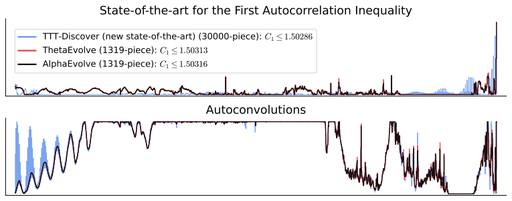
Figure 3 . We show the prior and new state-of-the-art, with the (normalized) step functions and their autocon- volutions. Both AlphaEvolve and TTT-Discover starts the discovery process from scratch, while ThetaEvolve initializes from the AlphaEvolve construction, and thus is very similar to the AlphaEvolve construction. TTT-Discover found a 30,000-piece step function that certifies that the upper bound C1≤ 1.50286, while AlphaEvolve and ThetaEvolve constructions are 1319-piece. We overlay the step functions and their autocon- volution visually for qualitative comparison.
원문 · CC BY 4.0 · Mert Yuksekgonul, Daniel Koceja, Xinhao Li, Federico Bianchi, Jed McCaleb, Xiaolong Wang, Jan Kautz, Yejin Choi, James Zou, Carlos Guestrin, Yu Sun · Learning to Discover at Test Time · 원문 그림 인용 · 원본 PDF 10쪽에서 그림 영역을 추출했습니다.커널 엔지니어링과 알고리즘 설계의 결과
GPU 커널 과제에서 TTT-Discover는 H100 런타임을 보상으로 사용해 TriMul 커널을 학습했습니다. 보고된 최고 커널의 H100 런타임은 1161.2µs이고, 최고 인간 기록은 1371.1µs입니다. A100에서도 최고 인간 커널보다 빠른 결과가 보고되지만, 이 평가는 학습에 사용되지 않은 GPU 종류에 대한 결과라는 점을 함께 읽어야 합니다.

Figure 1 . TTT-Discover continues to train an LLM on a single problem at test time.πθi denotes the policy with the updates weights at test-time training stepi. We plot the reward distribution at step 0, 9, 24, and 49 (final), recorded while test-time training for the GPUMode TriMul competition. We generate 512 solutions at each step. As training progresses, the LLM generates better solutions that ultimately surpass the prior art (best human). For comparison, we plot the reward distribution of best-of-Nwith the same total sampling budget.
원문 · CC BY 4.0 · Mert Yuksekgonul, Daniel Koceja, Xinhao Li, Federico Bianchi, Jed McCaleb, Xiaolong Wang, Jan Kautz, Yejin Choi, James Zou, Carlos Guestrin, Yu Sun · Learning to Discover at Test Time · 원문 그림 인용 · 원본 PDF 1쪽에서 그림 영역을 추출했습니다.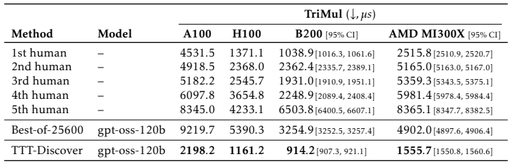
Table 4 . For the TriMul competition, we train a single model using H100 runtime as the reward function and report the runtime of the single best kernel. We only trained using H100 for evaluating kernels during training. The generated kernels happened to generalize to other GPU types. We also report the top-5 human submissions in the leaderboard for comparison (each GPU type has its own top-5 human submissions). For A100 and H100, we submitted to the official leaderboard and report the runtime returned. For B200 and MI300X, we could not submit our kernels due to an infra problem on GPU Mode’s server, and therefore conduct 10 trials for each kernel and report mean and confidence intervals using the same infrastructure as GPUMode, verified by the organizers. Our state-of-the-art kernels are released and can be validated in our codebase.
원문 · CC BY 4.0 · Mert Yuksekgonul, Daniel Koceja, Xinhao Li, Federico Bianchi, Jed McCaleb, Xiaolong Wang, Jan Kautz, Yejin Choi, James Zou, Carlos Guestrin, Yu Sun · Learning to Discover at Test Time · 원문 그림 인용 · 원본 PDF 12쪽에서 그림 영역을 추출했습니다.알고리즘 설계에서는 AtCoder 휴리스틱 대회 ahc039와 ahc058을 사용했습니다. 학습은 로컬 공개 테스트 생성기로 수행되고, 선택된 프로그램을 공식 플랫폼에 제출해 점수를 얻었습니다. ahc039에서 TTT-Discover는 567,062점을 보고하며 최고 인간 점수 566,997보다 높습니다. ahc058의 점수는 최고 인간 점수보다 낮지 않은 848,414,228로 보고되며, 이는 같은 표의 Best-of-25600 기준선보다 높습니다.
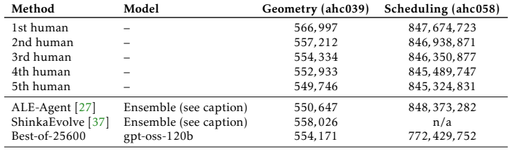
Table 6 . Results in two AtCoder Heuristic Competitions. We train our models with local public tests, and submit the best program we get during training to the official submission platform. Our algorithms are released and can be validated in our codebase. Our solutions in the official AtCoder submission platform are publicly available for ahc039 and ahc058. ALE-Agent uses Gemini-2.5 Pro for ahc039, and Gemini-3 Pro Preview high and gpt-5.2-high for ahc058. ShinkaEvolve uses an ensemble of gpt-5, gpt-5-mini, Gemini-2.5 Pro and Flash, Claude Sonnet 4, o4-mini.
원문 · CC BY 4.0 · Mert Yuksekgonul, Daniel Koceja, Xinhao Li, Federico Bianchi, Jed McCaleb, Xiaolong Wang, Jan Kautz, Yejin Choi, James Zou, Carlos Guestrin, Yu Sun · Learning to Discover at Test Time · 원문 그림 인용 · 원본 PDF 14쪽에서 그림 영역을 추출했습니다.절제 실험이 보여 주는 구성요소의 역할
TriMul 절제 실험에서 저자들은 train 목표와 reuse 규칙을 따로 바꾸었습니다. 고정 β=2 entropic objective의 최고 런타임은 1483.83µs이고, 기대 보상 목표는 1985.67µs, 재사용 없는 TTT는 2060.70µs로 보고됩니다. 적응 β와 PUCT를 사용한 전체 설정은 1203.10µs입니다. reuse를 ε-greedy로 바꾸면 1328.89µs가 되며, 재사용 없이 entropic objective만 쓰면 5274.03µs입니다.
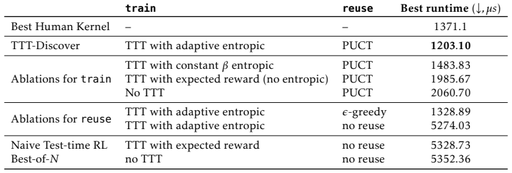
Table 8 . Ablation results for the TriMul GPUMode competition where we time the kernels with an H100 GPU. We report the best kernel we get in each run. We report the reward distributions across steps in Figure 4.
원문 · CC BY 4.0 · Mert Yuksekgonul, Daniel Koceja, Xinhao Li, Federico Bianchi, Jed McCaleb, Xiaolong Wang, Jan Kautz, Yejin Choi, James Zou, Carlos Guestrin, Yu Sun · Learning to Discover at Test Time · 원문 그림 인용 · 원본 PDF 16쪽에서 그림 영역을 추출했습니다.이 결과는 조작 변수마다 샘플링 예산을 맞춘 상태에서 얻은 것입니다. 저자들은 ε-greedy가 초기의 행운 있는 커널과 함께 비교적 잘 작동했다고 설명하며, 더 긴 탐색이나 과제별 β 일정이 절제 설정의 격차를 줄일 수 있다고 한계를 밝힙니다.
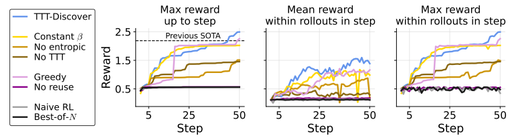
Figure 4 . Reward distributions for each ablation. We match the sampling budget across all ablations. We sample 512 rollouts in each step. For example, for Best-of-N, we haveN= 50×512 = 256000 rollouts.
원문 · CC BY 4.0 · Mert Yuksekgonul, Daniel Koceja, Xinhao Li, Federico Bianchi, Jed McCaleb, Xiaolong Wang, Jan Kautz, Yejin Choi, James Zou, Carlos Guestrin, Yu Sun · Learning to Discover at Test Time · 원문 그림 인용 · 원본 PDF 17쪽에서 그림 영역을 추출했습니다.적용 범위와 해석의 한계
저자들이 밝힌 가장 큰 제한은 방법이 연속 보상을 가진 문제에 적용된다는 점입니다. 희소하거나 이진 보상 문제와 검증 가능한 보상이 없는 영역은 향후 과제로 남습니다. 단일 세포 denoising에서는 OpenProblems 벤치마크 점수가 향상되었지만, 지표가 생물학적 타당성을 보장하지 않는다고 저자들은 밝힙니다. 외부 전문가의 검토 문장도 벤치마크 향상이 새로운 생물학적 통찰로 바로 이어진다는 보장은 없다고 지적합니다.
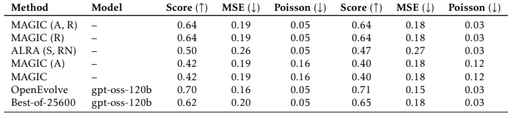
Table 7 . Denoising task for single cell data analysis. We report the score (mean of normalized MSE and Poisson scores), MSE, and Poisson metrics for each dataset. Our state-of-the-art algorithm is released and can be validated in our codebase. MAGIC (A, R) = MAGIC [75] approximate with reversed normalization; MAGIC (R) = MAGIC with reversed normalization; ALRA [40] (S, R) = ALRA sqrt norm with reversed normalization; MAGIC (A) = MAGIC approximate.
원문 · CC BY 4.0 · Mert Yuksekgonul, Daniel Koceja, Xinhao Li, Federico Bianchi, Jed McCaleb, Xiaolong Wang, Jan Kautz, Yejin Choi, James Zou, Carlos Guestrin, Yu Sun · Learning to Discover at Test Time · 원문 그림 인용 · 원본 PDF 15쪽에서 그림 영역을 추출했습니다.또한 여러 비교는 기준선마다 모델, 샘플링 예산, 평가 하드웨어가 다를 수 있으므로, 결과를 하나의 공통 프로토콜로 일반화하지 않아야 합니다.
논문 정보
- 저자
- Mert Yuksekgonul, Daniel Koceja, Xinhao Li, Federico Bianchi, Jed McCaleb, Xiaolong Wang, Jan Kautz, Yejin Choi, James Zou, Carlos Guestrin, Yu Sun
- 학회·저널
- arXiv · 프리프린트
- 최초 공개일
- 2026년 1월 22일
- 등록일
- 2026년 10월 30일
- 수정일
- 2026년 2월 5일
- 버전
- v2
- arXiv
- 2601.16175
- 분류
- cs.LG · cs.AI
- 원문 이용 조건
- CC BY 4.0
- 제공 범위
- 논문 정보, 해설, 허용된 원문 그림
AI 해설은 논문 원문과 별개의 설명이며 오류가 있을 수 있습니다. 원문과 그림은 각 출처의 이용 조건과 따로 표시된 권리를 따릅니다.
초록
How can we use AI to discover a new state of the art for a scientific problem? Prior work in test-time scaling, such as AlphaEvolve, performs search by prompting a frozen LLM. We perform reinforcement learning at test time, so the LLM can continue to train, but now with experience specific to the test problem. This form of continual learning is quite special, because its goal is to produce one great solution rather than many good ones on average, and to solve this very problem rather than generalize to other problems. Therefore, our learning objective and search subroutine are designed to prioritize the most promising solutions. We call this method Test-Time Training to Discover (TTT-Discover). Following prior work, we focus on problems with continuous rewards. We report results for every problem we attempted, across mathematics, GPU kernel engineering, algorithm design, and biology. TTT-Discover sets the new state of the art in almost all of them: (i) Erdős' minimum overlap problem and an autocorrelation inequality; (ii) a GPUMode kernel competition (up to $2\times$ faster than prior art); (iii) past AtCoder algorithm competitions; and (iv) denoising problem in single-cell analysis. Our solutions are reviewed by experts or the organizers. All our results are achieved with an open model, OpenAI gpt-oss-120b, and can be reproduced with our publicly available code, in contrast to previous best results that required closed frontier models. Our test-time training runs are performed using Tinker, an API by Thinking Machines, with a cost of only a few hundred dollars per problem.
원문 인용
Mert Yuksekgonul, Daniel Koceja, Xinhao Li, Federico Bianchi, Jed McCaleb, Xiaolong Wang, Jan Kautz, Yejin Choi, James Zou, Carlos Guestrin, Yu Sun (2026). Learning to Discover at Test Time. arXiv:2601.16175v2. https://arxiv.org/abs/2601.16175v2
BibTeX
@misc{yuksekgonul2026learning,
  title = {{Learning to Discover at Test Time}},
  author = {Mert Yuksekgonul and Daniel Koceja and Xinhao Li and Federico Bianchi and Jed McCaleb and Xiaolong Wang and Jan Kautz and Yejin Choi and James Zou and Carlos Guestrin and Yu Sun},
  year = {2026},
  eprint = {2601.16175},
  archivePrefix = {arXiv},
  url = {https://arxiv.org/abs/2601.16175v2}
}