논문 해설
Interpretable Discovery of One-parameter Subgroups: A Modular Framework for Elliptical, Hyperbolic, and Parabolic Symmetries
단일 매개변수 부분군의 해석 가능한 발견: 타원형, 쌍곡형, 포물형 대칭을 위한 모듈식 프레임워크
- 연구 문제 미지의 연속 대칭을 데이터에서 찾으면서 함수 매핑을 함께 학습하는 문제를 다룹니다.
- 연구 방법 regime별 invariant representation 위에 예측기를 두고 부분군 파라미터를 함께 학습합니다.
- 주요 결과 회귀와 Top Quark Tagging 과제에서 Augerino 대비 높은 생성자 회복과 정확도를 보고합니다.
대칭을 미리 알 수 없을 때의 문제
많은 과학·공학 문제에서 데이터가 따르는 대칭은 미리 알려져 있지 않거나 일부만 알려져 있습니다. 잘못되었거나 지나치게 제한적인 대칭군을 강제하면 학습이 오히려 방해받을 수 있습니다. 이 논문은 이러한 상황에서 데이터로부터 연속 대칭을 추론하는 문제를 다룹니다. 대상은 단일 Lie 대수 원소의 지수 사상으로 생성되는 1차원 연결 Lie 부분군이며, 기하 구조에 따라 elliptical, hyperbolic, parabolic 세 regime으로 분류됩니다. 논문은 regime을 학습 변수가 아니라 모델링 가정으로 취급하고, 가정된 regime 안에서 부분군의 생성자 파라미터를 학습합니다.
Invariant representation과 공동 학습 구조
제안 모델 Hγ-Net은 입력 x를 학습 가능한 행렬 A로 부분군 정렬 좌표 v = Ax로 바꾸고 2차원 블록으로 나눕니다. 첫 번째 블록 v1로 정렬 파라미터 t0를 구하고, 같은 변환을 나머지 블록에 적용하여 orbit을 식별하는 invariant representation invRep(x)를 만듭니다. elliptical, hyperbolic, parabolic 각 regime마다 invRepe, invReph, invRepp가 따로 정의되며, 각 regime은 Lie 대수 구조에 맞춘 canonical 블록을 사용합니다. 예측기는 ϕ ∘ invRep 형태이고, 학습은 A와 λ를 포함하여 경험적 위험을 최소화하는 방식으로 이루어집니다.
학습 후에는 A와 λ로부터 생성자 B = A^{-1} L0 A를 복원할 수 있습니다. 이 구조에서 불변성은 학습이 아니라 구성으로 보장되며, 저자들은 이것이 대칭 없는 해를 표현 불가능하게 만든다고 설명합니다.
불변성과 orbit 분리에 대한 이론적 근거
논문은 invRep이 부분군 action 아래 불변이며, 서로 다른 orbit을 서로 다른 표현으로 분리한다는 명제를 제시합니다. 이를 바탕으로 정리 3.7은 G-불변 함수가 정확히 ϕ(invRep(x)) 형태로 쓰일 수 있다고 주장합니다. 이 결론은 조건부 성질로, invRep의 admissible domain 안에서 t0가 잘 정의된다는 전제와 함께 읽어야 합니다. 제외 영역은 측도 0의 집합으로 설명되지만, 이는 저자가 제시한 논증이며 이 글에서는 원문 정의 범위 안의 결과로만 다룹니다.
회귀 과제에서 Augerino와의 비교
회귀 과제에서 Hγ-Net(e)는 Augerino와 비교되었습니다. Invariant Polynomial, Angled Sine, Double Pendulum 세 과제는 32K 샘플과 50 epochs로 학습되었고, 백본 ϕ는 은닉 차원 (128,128,64,64,32)과 ReLU를 쓰는 MLP였습니다. Angled Sine에서 Augerino의 cosine similarity는 0.616±0.075였고 Hγ-Net(e)는 1.000±0.000이었습니다. 저자들은 invariance error가 여러 자릿수 낮아졌다고 보고합니다. 이 비교는 Augerino를 기준선으로 한 것이며, 다른 방법과의 비교는 부록에서 제한적으로 다루어집니다.
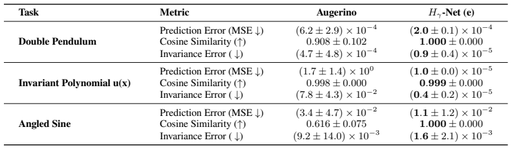
Table 2 .Comparison of Augerino and Hγ-Net (Elliptical) on Regression Tasks. Prediction error and invariance error are reported as (mean±std)×10 k. Lower is better (↓), higher is better (↑).
원문 · CC BY 4.0 · Pavan Karjol, Vivek V Kashyap, Rohan Kashyap, Prathosh A P · Interpretable Discovery of One-parameter Subgroups: A Modular Framework for Elliptical, Hyperbolic, and Parabolic Symmetries · 원문 그림 인용 · 원본 PDF 8쪽에서 그림 영역을 추출했습니다.Top Quark Tagging의 분류 결과
Top Quark Tagging은 Lorentz 군의 대칭을 발견하는 실제 데이터 실험입니다. 이 과제는 64K 샘플과 50 epochs로 학습되었고, 백본으로 ResNet 기반 구조가 쓰였습니다. 정확도는 Augerino 74.9±2.4%, Hγ-Net(e) 83.0±0.1%, Hγ-Net(h) 84.4±0.4%로 보고됩니다. Hγ-Net(h)가 가장 높은 정확도를 보였으며, 저자들은 이를 고에너지 제트 데이터에 boost형 대칭이 있을 가능성과 연결하여 해석합니다. 이 결과는 해당 분류 과제와 설정에 한정된 것입니다.
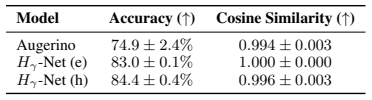
Table 3 .Top-quark tagging performance under different symmetry discovery regimes, where Hγ-Net (Elliptic) and Hγ-Net (Hyper- bolic) employ invRepe and invReph to discover rotational and boost generators of the Lorentz group, respectively; invariance error is unavailable due to the absence of ground-truth targets.
원문 · CC BY 4.0 · Pavan Karjol, Vivek V Kashyap, Rohan Kashyap, Prathosh A P · Interpretable Discovery of One-parameter Subgroups: A Modular Framework for Elliptical, Hyperbolic, and Parabolic Symmetries · 원문 그림 인용 · 원본 PDF 8쪽에서 그림 영역을 추출했습니다.부록의 관성 텐서 실험과 추가 비교
부록 G.2는 Moment of Inertia Prediction을 추가 실험으로 다룹니다. 이 실험에서 관성 텐서의 대칭은 대각 부분군 안의 한 유효한 one-parameter 부분군으로 제한되어 식별되었습니다. Augerino의 cosine similarity는 0.985±0.006, Hγ-Net은 1.000±0.000으로 보고되었습니다. 부록 G.1에서는 parabolic 불변 층이 합성 데이터에서 생성자를 찾는 과정을 Orthogonality Error와 Alignment Similarity로 추적합니다. 같은 부록에서 LieGAN과 LieGG와의 비교도 Angled Sine 기준의 제한된 스냅샷으로 제공됩니다.
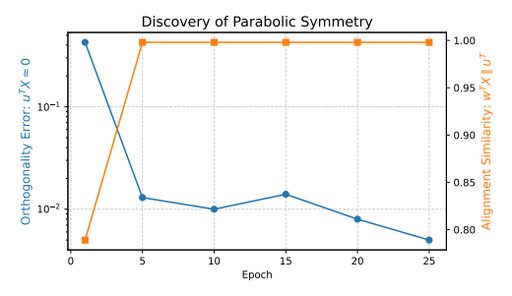
Figure 3 .Symmetry Discovery Dynamics.Starting from a random initialization (Epoch 1), the model rapidly aligns its internal representation with the hidden physical laws of the dataset. Within 5 epochs, the Alignment Similarity (blue) converges to ≈1.0 and Orthogonality Error (red) drops to≈0, indicating the layer has successfully reconstructed the true generatorXfrom raw data.
원문 · CC BY 4.0 · Pavan Karjol, Vivek V Kashyap, Rohan Kashyap, Prathosh A P · Interpretable Discovery of One-parameter Subgroups: A Modular Framework for Elliptical, Hyperbolic, and Parabolic Symmetries · 원문 그림 인용 · 원본 PDF 18쪽에서 그림 영역을 추출했습니다.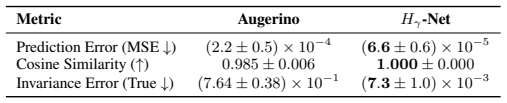
Table 5 . Comparison of Augerino and Hγ-Net on the Moment of Inertia Prediction Task. Prediction and invariance errors are reported as (mean ± std) × 10k .
원문 · CC BY 4.0 · Pavan Karjol, Vivek V Kashyap, Rohan Kashyap, Prathosh A P · Interpretable Discovery of One-parameter Subgroups: A Modular Framework for Elliptical, Hyperbolic, and Parabolic Symmetries · 원문 그림 인용 · 원본 PDF 19쪽에서 그림 영역을 추출했습니다.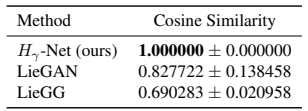
Table 6 .Symmetry-discovery quality on Angled Sine at 32K samples.
원문 · CC BY 4.0 · Pavan Karjol, Vivek V Kashyap, Rohan Kashyap, Prathosh A P · Interpretable Discovery of One-parameter Subgroups: A Modular Framework for Elliptical, Hyperbolic, and Parabolic Symmetries · 원문 그림 인용 · 원본 PDF 20쪽에서 그림 영역을 추출했습니다.적용 범위와 한계
저자들은 기하 regime을 사전에 지정해야 하며, regime과 부분군 파라미터를 동시에 추론하는 것은 어렵다고 설명합니다. parabolic 경우는 nilpotency index가 2인 생성자로 제한되며, 더 높은 차수의 nilpotent 생성자는 향후 과제로 남겨져 있습니다. 또한 Angled Sine 비교의 LieGAN과 LieGG 결과는 부록의 단일 크기 스냅샷이므로 전체 설정에 일반화하지 않습니다.
논문 정보
- 저자
- Pavan Karjol, Vivek V Kashyap, Rohan Kashyap, Prathosh A P
- 학회·저널
- arXiv · 프리프린트
- 최초 공개일
- 2025년 9월 26일
- 등록일
- 2026년 10월 30일
- 수정일
- 2026년 2월 9일
- 버전
- v4
- arXiv
- 2509.22219
- 분류
- cs.LG · cs.AI
- 원문 이용 조건
- CC BY 4.0
- 제공 범위
- 논문 정보, 해설, 허용된 원문 그림
AI 해설은 논문 원문과 별개의 설명이며 오류가 있을 수 있습니다. 원문과 그림은 각 출처의 이용 조건과 따로 표시된 권리를 따릅니다.
초록
We propose a modular, data-driven framework for jointly learning unknown functional mappings and discovering the underlying one-parameter symmetry subgroup governing the data. Unlike conventional geometric deep learning methods that assume known symmetries, our approach identifies the relevant continuous subgroup directly from data. We consider the broad class of one-parameter subgroups, which admit a canonical geometric classification into three regimes: elliptical, hyperbolic, and parabolic. Given an assumed regime, our framework instantiates a corresponding symmetry discovery architecture with invariant and equivariant representation layers structured according to the Lie algebra of the subgroup, and learns the exact generator parameters end-to-end from data. This yields models whose invariance or equivariance is guaranteed by construction and admits formal proofs, enabling symmetry to be explicitly traced to identifiable components of the architecture. The approach is applicable to one-parameter subgroups of a wide range of matrix Lie groups, including $SO(n)$, $SL(n)$, and the Lorentz group. Experiments on synthetic and real-world systems, including moment of inertia prediction, double-pendulum dynamics, and high-energy \textit{Top Quark Tagging}, demonstrate accurate subgroup recovery and strong predictive performance across both compact and non-compact regimes.
원문 인용
Pavan Karjol, Vivek V Kashyap, Rohan Kashyap, Prathosh A P (2025). Interpretable Discovery of One-parameter Subgroups: A Modular Framework for Elliptical, Hyperbolic, and Parabolic Symmetries. arXiv:2509.22219v4. https://arxiv.org/abs/2509.22219v4
BibTeX
@misc{karjol2025interpretable,
  title = {{Interpretable Discovery of One-parameter Subgroups: A Modular Framework for Elliptical, Hyperbolic, and Parabolic Symmetries}},
  author = {Pavan Karjol and Vivek V Kashyap and Rohan Kashyap and Prathosh A P},
  year = {2025},
  eprint = {2509.22219},
  archivePrefix = {arXiv},
  url = {https://arxiv.org/abs/2509.22219v4}
}