논문 해설
Step-resolved data attribution for looped transformers
루프형 트랜스포머를 위한 단계별 데이터 기여도 분석
- 연구 문제 루프형 트랜스포머에서 학습 예시의 영향이 반복 단계 중 언제 나타나는지 단일 점수로는 알 수 없습니다.
- 연구 방법 TracIn을 루프 단계별로 분해한 SDI를 제안하고, TensorSketch로 샘플별 기울기를 구체화하지 않고 계산합니다.
- 주요 결과 단계 합이 표준 TracIn과 일치하며, 135.1M 모델에서 스케치 오차가 보고되고, parity·Sudoku·Nanochat에서 단계별 영향 패턴이 관찰됩니다.
단일 점수 영향 추정의 한계
루프형 트랜스포머는 공유 블록을 τ번 반복 적용하여 잠재 추론을 수행합니다. 기존 TracIn은 체크포인트별 기울기 내적을 합산해 학습 예시 하나당 단일 스칼라 점수를 만들기 때문에, 그 예시가 반복 계산의 어느 단계에서 영향을 주는지 드러내지 못합니다. 이 논문은 이 문제를 루프 단계별 영향 궤적으로 바꾸는 것을 목표로 합니다. 따라서 질문은 단일 점수를 단계별로 분해해도 표준 TracIn과 손실 없이 일치하는지, 그리고 그 계산을 대규모 트랜스포머에서 실용적으로 수행할 수 있는지입니다.
Step-Decomposed Influence의 분해와 스케치 계산
Step-Decomposed Influence(SDI)는 루프 몸체 파라미터에 대한 전체 기울기가 τ개 단계의 합으로 펼쳐진다는 점을 이용합니다. 각 단계의 기여를 체크포인트별 학습률 가중 내적으로 합산하면 길이 τ의 SDI 궤적이 얻어지고, 이 궤적의 단계 합은 표준 TracIn과 같습니다. 대규모 계산에서는 샘플별 기울기를 구체화하지 않도록, 역전파 중 캐시된 활성값과 역전파 신호를 TensorSketch로 투영합니다. 파라미터별 스케치는 CountSketch와 TensorSketch를 이어 붙여 하나의 전역 스케치 벡터로 만듭니다.
스케치 오차와 확장성 검증
135.1M 파라미터 루프 GPT 모델(루프 지평 τ=32)에서 스케치 차원 m=2048일 때 SDI와 TracIn의 상대 Frobenius 오차는 각각 0.0388±0.0030과 0.0220±0.0052로 보고됩니다. 이 값은 10회 독립 시도의 평균과 표준편차이며, 정확 기울기 기준선 대비 오차입니다. 이론적으로 Lemma 1은 SDI 추정량의 분산이 (4/m²+6/m) 항으로 상한되어 m에 대해 1/√m 규모로 줄어든다고 주장합니다. 저자들은 이 상한이 기존 8/m 상한보다 엄격히 작다고 주장합니다.
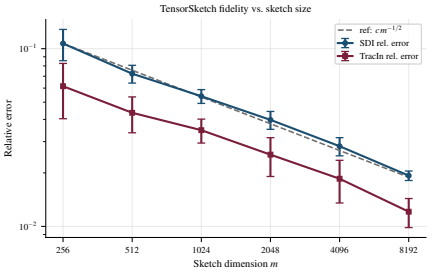
Figure 4 .Empirical error scaling w.r.t sketch dimensionm. Average and standard deviation over 10 trials.
원문 · CC BY 4.0 · Georgios Kaissis, David Mildenberger, Juan Felipe Gomez, Martin J. Menten, Eleni Triantafillou · Step-resolved data attribution for looped transformers · 원문 그림 인용 · 원본 PDF 27쪽에서 그림 영역을 추출했습니다.Parity 과제에서의 단계별 회로 발견
Parity 실험에서 SDI 궤적은 주기 4의 톱니형 진동을 보이며, 답 토큰의 로짓 여백도 같은 주기 구조를 보입니다. 저자들은 답 토큰의 은닉 상태가 소수의 이산 상태 사이를 순환한다고 해석합니다. 이 해석은 PCA 위상도와 k=4 군집화로 얻은 거의 결정론적인 전이 그래프에 기반합니다. 또한 이산 상태를 패리티로 옮기는 조회 표로 만든 대리 회로는 보유 중인 교대 입력에서 100% 정확도를 보고하며, 길이 40 테스트 집합에서는 약 93% 정확도를 보입니다.
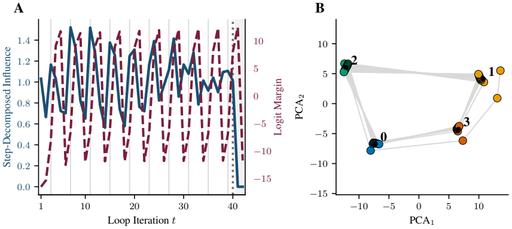
Figure 1 .SDI as a mechanistic discovery toolWe train a looped transformer on parity and apply SDI to an alternating probe (0101. . .). (A)SDI and Logit Margin at the answer token across loop iterations t; light gray guides indicate the SDI peak phase (period 4) and the dotted gray line at t=40 marks the model’s readout step.(B)PCA phase portrait of the answer-token hidden state across loop iterations, coloured by ak=4discretization, revealing a four-state limit cycle.
원문 · CC BY 4.0 · Georgios Kaissis, David Mildenberger, Juan Felipe Gomez, Martin J. Menten, Eleni Triantafillou · Step-resolved data attribution for looped transformers · 원문 그림 인용 · 원본 PDF 6쪽에서 그림 영역을 추출했습니다.Sudoku에서 난이도와 기억화, 후반 단계 영향
SATNet Sudoku 실험에서 루프 예산을 4에서 64 사이로 바꾸어 평가하면, 어려운 퍼즐일수록 루프 수 감소에 더 민감하고 τ≈32 부근까지 정확도가 증가합니다. 자기 영향(self-influence)은 빈칸 수와 양의 상관을 보이며, 어려운 학습 퍼즐의 중앙값은 쉬운 퍼즐보다 큽니다. 교차 영향 질량 C(z)는 자기 영향과 강하게 상관하고, 어려운 학습 퍼즐은 후반 단계 17–32에 더 많은 SDI 에너지를 둡니다. 이 결과들은 저자들이 기억화와 깊은 단계 영향의 연관으로 해석하는 관찰이며, 이 설정은 Sudoku 데이터와 해당 모델 조건에 한정됩니다.
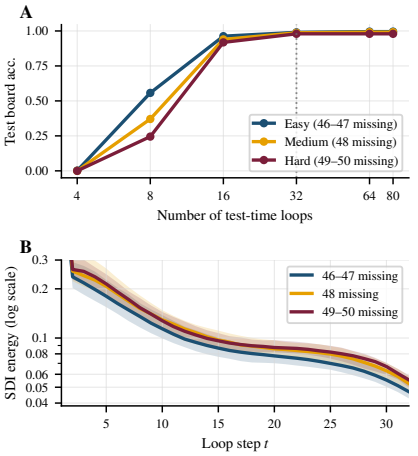
Figure 2 .Scaling laws of loop compute on SATNet Sudoku. (A)Test board accuracy (a board is correct iff all blank cells are correct) versus the number of test-time loops, stratified by puzzle difficulty (binned by the number of initial missing cells; more missing implies harder). Harder puzzles are substantially more compute-sensitive: reducing loops sharply degrades accuracy, while increasing loops yields gains up to about the training-mean depth τ≈32 (dotted line) before saturating; we include >32 loops to show the plateau.(B)SDI energy across loop steps (median and IQR across puzzles in each difficulty bin), where SDI energy at step t is the sum of absolute stepwise SDI scores across training points. Harder puzzles maintain higher SDI energy deeper into the recurrence (slower decay), mirroring their larger marginal gains from additional loop compute.
원문 · CC BY 4.0 · Georgios Kaissis, David Mildenberger, Juan Felipe Gomez, Martin J. Menten, Eleni Triantafillou · Step-resolved data attribution for looped transformers · 원문 그림 인용 · 원본 PDF 7쪽에서 그림 영역을 추출했습니다.재귀 Nanochat의 후반 단계 영향 증가
328.3M 파라미터 재귀 Nanochat에서는 학습 중 절단형 BPTT(k=4)를 쓰지만, 분석에서는 절단 없이 전체 BPTT로 SDI를 재계산합니다. GSM8K 관련 학습 단계에서 영향은 주로 후반 루프 단계에 집중되며, 마지막 단계가 전체 영향의 50% 이상을 차지하는 경우가 많다고 보고됩니다. 저자들은 이 결과를 모델이 루프 진행을 잠재 상태에서 표현하는 것으로 해석하지만, 이는 가설이며 추가 연구가 필요하다고 밝힙니다.
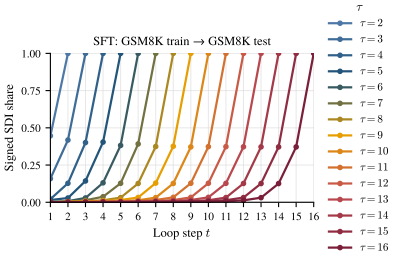
Figure 3 .Geometric influence growth across the loop horizon. Signed SDI share per step t for several analysis horizons τ in mid- training stage, recomputed with full BPTT through the recurrence from GSM8K train to GSM8K test. Removing truncation reveals a smooth, approximately geometric increase of stepwise influence with depth.
원문 · CC BY 4.0 · Georgios Kaissis, David Mildenberger, Juan Felipe Gomez, Martin J. Menten, Eleni Triantafillou · Step-resolved data attribution for looped transformers · 원문 그림 인용 · 원본 PDF 8쪽에서 그림 영역을 추출했습니다.해석과 계산의 한계
TracIn 방식의 SDI는 확률적 경사하강과 체크포인트 기울기 유사성을 전제로 하므로, 모멘텀이나 적응형 전처리가 있는 최적화기의 기하를 완전히 반영하지 않습니다. 또한 절단형 BPTT, 무작위 루프 수, 적응형 정지 조건에서는 단계 인덱스가 예시 간에 비교 가능하지 않을 수 있고, 절단된 단계의 SDI는 구조적으로 0이 됩니다. 전체 지평의 SDI는 긴 재귀에서 여전히 계산 비용이 큽니다.
논문 정보
- 저자
- Georgios Kaissis, David Mildenberger, Juan Felipe Gomez, Martin J. Menten, Eleni Triantafillou
- 학회·저널
- arXiv · 프리프린트
- 최초 공개일
- 2026년 2월 10일
- 등록일
- 2026년 10월 30일
- 수정일
- 2026년 2월 10일
- 버전
- v1
- arXiv
- 2602.10097
- 분류
- cs.LG · cs.AI
- 원문 이용 조건
- CC BY 4.0
- 제공 범위
- 논문 정보, 해설, 허용된 원문 그림
AI 해설은 논문 원문과 별개의 설명이며 오류가 있을 수 있습니다. 원문과 그림은 각 출처의 이용 조건과 따로 표시된 권리를 따릅니다.
초록
We study how individual training examples shape the internal computation of looped transformers, where a shared block is applied for $τ$ recurrent iterations to enable latent reasoning. Existing training-data influence estimators such as TracIn yield a single scalar score that aggregates over all loop iterations, obscuring when during the recurrent computation a training example matters. We introduce \textit{Step-Decomposed Influence (SDI)}, which decomposes TracIn into a length-$τ$ influence trajectory by unrolling the recurrent computation graph and attributing influence to specific loop iterations. To make SDI practical at transformer scale, we propose a TensorSketch implementation that never materialises per-example gradients. Experiments on looped GPT-style models and algorithmic reasoning tasks show that SDI scales excellently, matches full-gradient baselines with low error and supports a broad range of data attribution and interpretability tasks with per-step insights into the latent reasoning process.
원문 인용
Georgios Kaissis, David Mildenberger, Juan Felipe Gomez, Martin J. Menten, Eleni Triantafillou (2026). Step-resolved data attribution for looped transformers. arXiv:2602.10097v1. https://arxiv.org/abs/2602.10097v1
BibTeX
@misc{kaissis2026step,
  title = {{Step-resolved data attribution for looped transformers}},
  author = {Georgios Kaissis and David Mildenberger and Juan Felipe Gomez and Martin J. Menten and Eleni Triantafillou},
  year = {2026},
  eprint = {2602.10097},
  archivePrefix = {arXiv},
  url = {https://arxiv.org/abs/2602.10097v1}
}