논문 해설
TurnFlow: Benchmarking User-State Reasoning in Multi-Turn LLM Agents via Scene-Guided User Simulation
TurnFlow: 장면 기반 사용자 시뮬레이션을 통한 다중 턴 LLM 에이전트의 사용자 상태 추론 벤치마킹
- 연구 문제 다중 턴 대화에서 LLM이 바뀌는 사용자 요구와 숨은 제약을 유지하고 최종 응답에 반영하는지 평가하는 벤치마크 TurnFlow를 제안합니다.
- 연구 방법 웹 대화 씨앗에서 만든 시나리오 명세를 바탕으로, 규칙 기반 결정 계층을 가진 반응형 사용자 시뮬레이터 BRIDGE가 평가 모델과 턴 단위로 상호작용하고, 증거 추출과 결정적 규칙으로 판정합니다.
- 주요 결과 BRIDGE는 고정 궤적이나 사전 할당 방식보다 충실도 평가에서 높게 나타났습니다.
다중 턴 대화에서 사용자 요구의 추적 문제
다중 턴 대화에서 LLM은 대화가 진행되며 바뀌는 사용자 요구와 제약을 계속 유지해야 합니다. 기존 벤치마크는 완전히 명시된 단일 프롬프트, 긴 문맥의 회상, 통제된 도메인 환경을 주로 평가하므로 턴 사이에서 제약이 바뀌거나 충돌하거나 무시되는 상황을 충분히 측정하지 못합니다. 특히 사전에 고정된 사용자 궤적은 평가 대상 모델이 응답하기 전에 상호작용 이력을 확정하므로, 모델의 중간 응답에 사용자가 반응하는 상황을 재현하지 못합니다. TurnFlow는 이 공백을 메우기 위해 반응형 사용자 상태와 검증 가능한 판정을 함께 설계한 벤치마크입니다.
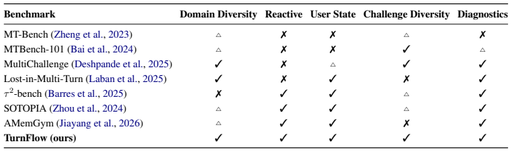
Table 1 : Comparison with representative multi-turn and agent-conversation benchmarks. ✓ indicates a primary design target, △ partial coverage, and ✗ not a primary target. “Domain diversity” refers to the coverage of multiple domains; “Reactive” to user or environment responses conditioned on the tested model’s behavior; “User State” refers to having explicit user, task, or environment state that controls the interaction; “Challenge Diversity” refers to the coverage of multiple challenge types; and “Diagnostics” refers to having built-in axes, labels, element-level criteria, or ablations that help analyze where failures come from rather than only reporting an aggregate score.
원문 · CC BY 4.0 · Zhixun Chen, Ming Li, Anjie Liu, Xiaoyuan Zhang, Quanyu Dai, Huangxun Chen · TurnFlow: Benchmarking User-State Reasoning in Multi-Turn LLM Agents via Scene-Guided User Simulation · 원문 그림 인용 · 원본 PDF 2쪽에서 그림 영역을 추출했습니다.TurnFlow의 세 모듈과 시나리오 구성
TurnFlow는 시나리오 구성기, 반응형 사용자 시뮬레이터 BRIDGE, 응답 검증기의 세 모듈로 구성됩니다. 시나리오 구성기는 웹에서 얻은 대화 로그를 5개 도전 유형과 9개 도메인에 배정하고, 과제 추출, 템플릿 생성, 후보 생성과 복구, 구조·내용·난이도·누출 검증을 거쳐 scenario.json을 만듭니다. 각 시나리오에는 사용자 페르소나, 시작 발화, 단계별 목표, 숨겨진 제약, 필수 및 금지 요소가 들어 있습니다. 이 명세는 시뮬레이터가 대화를 이끄는 근거이면서 검증기가 최종 응답을 판단하는 기준이 됩니다.
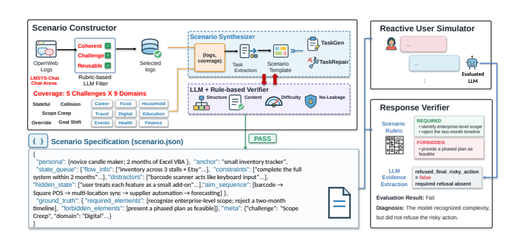
Figure 2 :TurnFlow Workflow.Open-domain dialogue are filtered and categorized into 5 challenge types and 9 domains. Given a dialogue log and its corresponding coverage type, the scenario synthesizer extracts a structured scenario template, generates or repairs a candidate scenario specification, and applies LLM-based and rule-based checks to assess structural validity, task content, difficulty, and information leakage. Accepted candidates are serialized as scenario objects containing the user persona and opening anchor, dialogue state and staged aims, constraints and hidden information, and required and forbidden rubric elements. Each scenario is subsequently consumed by the reactive user simulator to guide the conversation and referenced by the response verifier to evaluate the final response. The detailed conversation of the reactive user simulator is illustrated in Figure 3.
원문 · CC BY 4.0 · Zhixun Chen, Ming Li, Anjie Liu, Xiaoyuan Zhang, Quanyu Dai, Huangxun Chen · TurnFlow: Benchmarking User-State Reasoning in Multi-Turn LLM Agents via Scene-Guided User Simulation · 원문 그림 인용 · 원본 PDF 3쪽에서 그림 영역을 추출했습니다.BRIDGE의 지각, 결정, 생성 분리
BRIDGE는 모델의 마지막 메시지를 읽는 지각 모듈, 규칙 기반 결정 계층, LLM 기반 생성 모듈로 나뉩니다. 지각 모듈은 평가 대상 모델의 응답이 활성 목표에 어떤 의미인지 추출하고, 결정 계층은 고정된 우선순위에 따라 교정, 정보 제공, 모순 노출, 제약 상승, 주제 완료 중 응답 유형을 고릅니다. 생성 모듈은 선택된 정책과 페르소나, 숨김 상태 지침을 자연스러운 발화로 바꿉니다. 이렇게 무엇을 할지는 검사 가능한 규칙으로 두고 어떻게 표현할지만 LLM에 맡김으로써, 자유형 시뮬레이터가 시나리오 상태에서 벗어나는 문제를 줄이려는 설계입니다.
응답 검증기의 증거 추출과 결정적 판정
응답 검증기는 최종 응답을 구조화된 증거 변수로 바꾸는 LLM 추출기와, 필수 요소·금지 요소·거부권을 확인하는 결정적 시나리오 규칙으로 나뉩니다. LLM은 판정을 직접 내리지 않고 관찰 가능한 증거만 추출하므로, 표현이 달라도 같은 증거로 인정할 수 있으면서 최종 판정은 명시적 코드에서 감사할 수 있습니다. 저자들은 이 분리가 자유형 판정기의 불안정한 결정을 줄인다고 설명합니다.
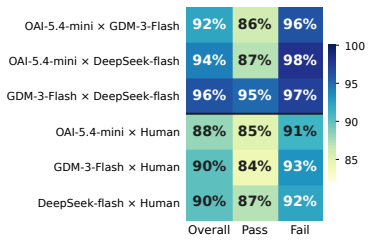
Figure 9 : Cross-verifier majority-verdict agreement over 588 cases (241 pass and 347 fail). Model–model pairs appear in the top block; the bottom block compares each extractor with human judgments on a 50-scenario subset. Replies and deterministic verdict rules are fixed.
원문 · CC BY 4.0 · Zhixun Chen, Ming Li, Anjie Liu, Xiaoyuan Zhang, Quanyu Dai, Huangxun Chen · TurnFlow: Benchmarking User-State Reasoning in Multi-Turn LLM Agents via Scene-Guided User Simulation · 원문 그림 인용 · 원본 PDF 19쪽에서 그림 영역을 추출했습니다.아홉 개 모델의 도전 유형별 통과율
아홉 개 모델의 전체 통과율은 42.86%에서 59.59%까지 보고되었습니다. Kimi-K3는 490개 시나리오 중 292개를 통과해 가장 높은 전체 통과율을 보였습니다. 도전 유형별로는 모든 모델이 Stateful Multi-Constraint Following에서 87%에서 96% 사이의 통과율을 보였지만, Scope Creep과 Goal Shift의 평균 통과율은 각각 24.61%와 24.95%였습니다. Constraint Collision과 Preference Override는 중간 범위에 있었습니다. 따라서 명시적 상태 추적은 비교적 잘 처리되지만, 누적된 범위나 바뀐 결정 틀을 최종 응답에 반영하는 과제에서 성능이 크게 떨어진다는 것이 이 결과의 관찰입니다.
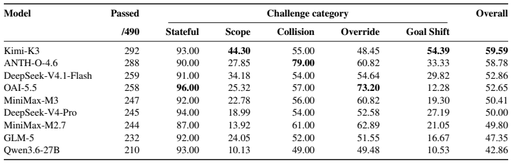
Table 2 : Multi-turn pass rates (%) on TurnFlow. All models are evaluated on the same 490 scenarios. Overall is the percentage of scenarios passed. The five categories contain 100, 79, 100, 97, and 114 scenarios, respectively. Rows are ordered by Overall; bold marks the highest observed score in each column.
원문 · CC BY 4.0 · Zhixun Chen, Ming Li, Anjie Liu, Xiaoyuan Zhang, Quanyu Dai, Huangxun Chen · TurnFlow: Benchmarking User-State Reasoning in Multi-Turn LLM Agents via Scene-Guided User Simulation · 원문 그림 인용 · 원본 PDF 7쪽에서 그림 영역을 추출했습니다.BRIDGE의 궤적 충실도 비교
BRIDGE의 타당성은 40개 시나리오에서 프롬프트 전용 사용자, 사전 할당 행동 사용자와 비교하여 확인되었습니다. 충실도 기준인 Fidelity-AC는 의도한 최종 함정을 전달하고, 과제 필수 정보를 충실히 공개하며, 자기 해결이나 전제 이탈이 없어야 통과합니다. 보고된 결과에서 BRIDGE는 35/40, 사전 할당 행동은 14/40, 프롬프트 전용은 3/40 통과로 나타났습니다. 이 수치는 해당 40개 샘플에서 수동 프로토콜로 얻은 결과이며, 실제 사용자 행동 분포 전체를 재현했다는 증거로 해석되지는 않습니다.
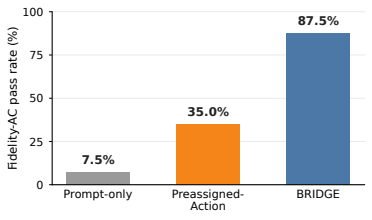
Figure 5 : A trajectory passes Fidelity-AC only if it de- livers the intended final trap at the right point, faithfully discloses task-critical content, and keeps the task presen- tation free of self-solving, contradiction, or premise drift. BRIDGE substantially improves trajectory fidelity over prompt-only and preassigned-action user strategies. We sampled 40 scenarios for this evaluation. Per-challenge counts are reported in Appendix H.
원문 · CC BY 4.0 · Zhixun Chen, Ming Li, Anjie Liu, Xiaoyuan Zhang, Quanyu Dai, Huangxun Chen · TurnFlow: Benchmarking User-State Reasoning in Multi-Turn LLM Agents via Scene-Guided User Simulation · 원문 그림 인용 · 원본 PDF 7쪽에서 그림 영역을 추출했습니다.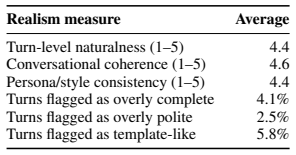
Table 8 : Human realism audit over 40 BRIDGE trajec- tories.
원문 · CC BY 4.0 · Zhixun Chen, Ming Li, Anjie Liu, Xiaoyuan Zhang, Quanyu Dai, Huangxun Chen · TurnFlow: Benchmarking User-State Reasoning in Multi-Turn LLM Agents via Scene-Guided User Simulation · 원문 그림 인용 · 원본 PDF 18쪽에서 그림 영역을 추출했습니다.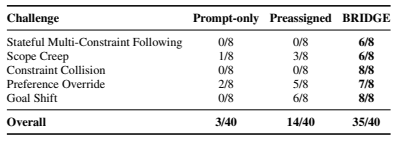
Table 10 : Full BRIDGE trajectory-fidelity diagnostic. Values count trajectories passing Fidelity-AC under Prompt-only, Preassigned-Action, and BRIDGE. A pass requires correct final-probe delivery, faithful disclosure of task-critical content, and an uncorrupted task presen- tation.
원문 · CC BY 4.0 · Zhixun Chen, Ming Li, Anjie Liu, Xiaoyuan Zhang, Quanyu Dai, Huangxun Chen · TurnFlow: Benchmarking User-State Reasoning in Multi-Turn LLM Agents via Scene-Guided User Simulation · 원문 그림 인용 · 원본 PDF 18쪽에서 그림 영역을 추출했습니다.고정 궤적과 대체 평가 방식의 비교
이 절은 FTA 채점, 재생 설정, BRIDGE, Fixed Disclosure를 같은 200개 대조 셀에서 비교합니다. 통과율은 FTA 32.5%, Replay 35.0%, BRIDGE 36.5%, Fixed Disclosure 43.5%로 보고되었습니다. Fixed Disclosure가 BRIDGE보다 7.0포인트 높았지만, 저자들은 이를 더 나은 사용자 시뮬레이션으로 보지 않습니다. 이 방식은 LLM 사용자의 누락과 표현 변동을 제거하여 누적 상태를 평가 모델에 더 명시적으로 제공하기 때문입니다. 교차 재생과 교차 FTA에서는 원 궤적을 옮기면 판정이 원래 모델 쪽으로 자주 이동했으며, 같은 모델 재사용의 control flip은 3.6%와 0.0%였습니다.
저자들은 이를 재사용된 궤적이 원천 모델의 상호작용 이력을 담고 있다는 해석으로 제시합니다.
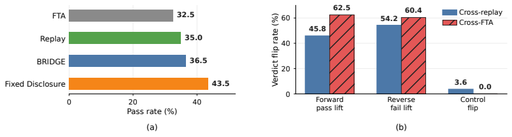
Figure 7 :(a)Pass rates under FTA, Replay, BRIDGE, and Fixed Disclosure on the same 200 matched diagnostic cells. Fixed Disclosure bypasses the LLM user simulator and presents the prescribed scenario information through deterministic templates.(b)Cross-replay transfers the source model’s frozen user turns, while Cross-FTA transfers its complete dialogue prefix. Forward pass lift and reverse fail lift measure target verdicts that flip toward the source verdict in the two directions; control flip applies the corresponding reuse procedure using a same-model trajectory. FTA denotes final-turn answer only.
원문 · CC BY 4.0 · Zhixun Chen, Ming Li, Anjie Liu, Xiaoyuan Zhang, Quanyu Dai, Huangxun Chen · TurnFlow: Benchmarking User-State Reasoning in Multi-Turn LLM Agents via Scene-Guided User Simulation · 원문 그림 인용 · 원본 PDF 9쪽에서 그림 영역을 추출했습니다.통제된 스트레스 테스트로서의 적용 범위
TurnFlow는 실제 대화에서 이 상호작용 패턴이 얼마나 자주 나타나는지를 추정하기 위한 벤치마크가 아니라 통제된 스트레스 테스트로 설계되었습니다. 시나리오 작성은 단일 모델 계열에 의존하며, 100개 시나리오 검증 감사가 모든 항목을 검증하지는 않습니다. BRIDGE는 완전한 분기형 사람 정책이 아니라 통제된 목표에 따르며, 40개 궤적의 사람 감사는 잡음이 많거나 감정적이거나 일관성이 없는 실제 사용자 행동 전체를 포착하지 못합니다. 필수 및 금지 기준은 감사 가능하지만 외부에서 실행 가능한 규칙이 아니라 작성자가 정한 대화 정책입니다.
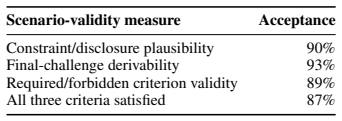
Table 9 : Majority-vote acceptance rates in the 100- scenario validity audit.
원문 · CC BY 4.0 · Zhixun Chen, Ming Li, Anjie Liu, Xiaoyuan Zhang, Quanyu Dai, Huangxun Chen · TurnFlow: Benchmarking User-State Reasoning in Multi-Turn LLM Agents via Scene-Guided User Simulation · 원문 그림 인용 · 원본 PDF 18쪽에서 그림 영역을 추출했습니다.논문 정보
- 저자
- Zhixun Chen, Ming Li, Anjie Liu, Xiaoyuan Zhang, Quanyu Dai, Huangxun Chen
- 학회·저널
- arXiv · 프리프린트
- 최초 공개일
- 2026년 11월 7일
- 등록일
- 2026년 11월 10일
- 수정일
- 2026년 11월 7일
- 버전
- v1
- arXiv
- 2611.10412
- 분류
- cs.AI
- 원문 이용 조건
- CC BY 4.0
- 제공 범위
- 논문 정보, 해설, 허용된 원문 그림
AI 해설은 논문 원문과 별개의 설명이며 오류가 있을 수 있습니다. 원문과 그림은 각 출처의 이용 조건과 따로 표시된 권리를 따릅니다.
초록
Large Language Models (LLMs) are increasingly deployed through conversational interfaces, yet strong single-turn performance does not imply reliability in multi-turn settings. Multi-turn assistance requires a model to maintain an evolving representation of user requirements and to reason over it before complying with later requests. Failures can therefore be subtle: models may fail to recognize a changed constraint or hidden conflict, or recognize it without enforcing it in the final response. Existing benchmarks primarily test fully specified prompts, long-context recall, or controlled domain environments, leaving open-domain requirement reconciliation undermeasured. We introduce TurnFlow, an interactive benchmark for evaluating whether models preserve, revise, and act on user requirements across turns. TurnFlow combines adaptive user simulation with verifiable judging, allowing conversations to unfold naturally while keeping hidden requirements and pass/fail criteria controlled. In our evaluation, nine LLMs achieve overall pass rates from 42.86% to 59.59% on 490 scenarios. Performance varies substantially across challenge types: models perform well on Stateful Multi-Constraint Following but remain considerably less reliable on Scope Creep and Goal Shift. These results reveal persistent limitations in reasoning over evolving user requirements across turns.
원문 인용
Zhixun Chen, Ming Li, Anjie Liu, Xiaoyuan Zhang, Quanyu Dai, Huangxun Chen (2026). TurnFlow: Benchmarking User-State Reasoning in Multi-Turn LLM Agents via Scene-Guided User Simulation. arXiv:2611.10412v1. https://arxiv.org/abs/2611.10412v1
BibTeX
@misc{chen2026turnflow,
  title = {{TurnFlow: Benchmarking User-State Reasoning in Multi-Turn LLM Agents via Scene-Guided User Simulation}},
  author = {Zhixun Chen and Ming Li and Anjie Liu and Xiaoyuan Zhang and Quanyu Dai and Huangxun Chen},
  year = {2026},
  eprint = {2611.10412},
  archivePrefix = {arXiv},
  url = {https://arxiv.org/abs/2611.10412v1}
}