논문 해설
Bayesian Physics-Informed Neural Networks for real-world nonlinear dynamical systems
실세계 비선형 동역학 시스템을 위한 베이지안 물리 정보 신경망
- 연구 문제 실제 2021년 전 세계 일일 COVID-19 사례 자료에서 신경망, Bayesian Inference, 두 방법의 결합이 학습 구간과 예측 구간을 어떻게 설명하는지 비교합니다.
- 연구 방법 damped harmonic oscillator를 물리 모델로 두고, 신경망, Physics-Informed Neural Network, Bayesian Inference, Bayesian 신경망 계열을 같은 자료에서 비교합니다.
- 주요 결과 신경망은 학습 구간에는 잘 맞지만 예측 구간에서 실패하고, Physics-Informed 및 Bayesian Inference 계열은 예측 구간을 더 잘 근사하며 Bayesian 방법은 신뢰 구간을 제공합니다.
실제 COVID-19 자료에서 방법을 비교하는 이유
이 논문은 실제 전 세계 일일 신규 COVID-19 사례 자료를 대상으로 신경망, Bayesian Inference, 그리고 두 방법을 결합한 접근이 어떻게 다르게 작동하는지 살펴봅니다. 기존의 신경망은 데이터에 잘 맞추어도 학습 구간 바깥의 예측에서 실패하기 쉽고, 물리 법칙을 직접 반영하지 않으면 그럴듯하지 않은 예측을 낼 수 있습니다. 저자들은 이 한계를 다루기 위해 damped harmonic oscillator를 단순한 물리 모델로 두고, 2021년 자료의 처음 225일을 학습하고 나머지 140일을 예측 구간으로 삼아 비교합니다.
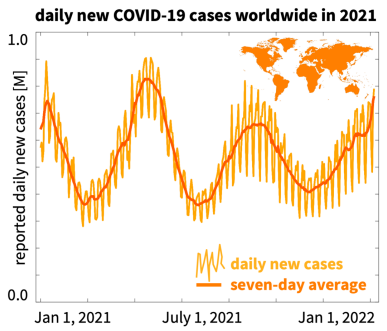
Figure 1 : Data - Daily new COVID-19 cases worldwide in 2021. Thin fluctuating line illustrates the reported daily new cases of COVID-19 worldwide; thick smooth line illustrates the seven-day moving average of the daily new cases, from January 1, 2021 to December 31, 2021.
원문 · CC BY 4.0 · Kevin Linka, Amelie Schafer, Xuhui Meng, Zongren Zou, George Em Karniadakis, Ellen Kuhl · Bayesian Physics-Informed Neural Networks for real-world nonlinear dynamical systems · 원문 그림 인용 · 원본 PDF 4쪽에서 그림 영역을 추출했습니다.신경망과 물리 잔차 손실
순수 신경망은 시간 t를 입력으로 받아 두 개의 은닉층(각 32개 노드, 하이퍼볼릭 탄젠트 활성화)을 거쳐 사례 수를 출력하며, 데이터 손실로 학습합니다. Physics-Informed Neural Network는 같은 구조에 물리 잔차 항을 더한 손실 (1−ε)L_data + ε L_phys를 최소화하며, 감쇠 계수 c, 강성 k, 오프셋 x0도 함께 학습합니다. 물리 손실의 시간 도함수는 automatic differentiation으로 계산됩니다. Self Adaptive 변형은 가중치 ε(t)를 고정값이 아니라 학습 대상으로 둡니다.
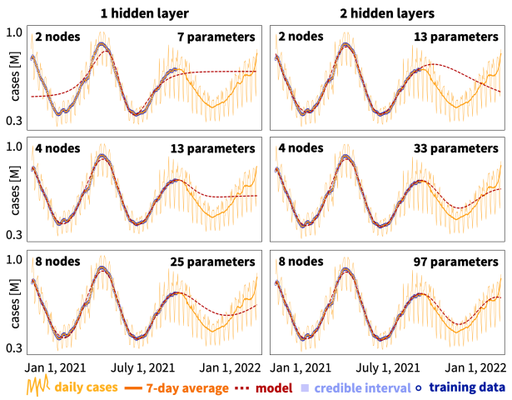
Figure 5 : Neural Network modeling. Grid search for Physics Informed Neural Network.The performance and number of parameters of the Physics Informed Neural Network increases with increasing number of hid- den layers (left to right) and increasing number of nodes per layer (top to bottom). For both one and two hidden layers, the performance does not increase markedly beyond eight nodes (bottom row). Throughout this manuscript, we use a Neural Network with two hidden layers and 32 nodes. Thin yellow lines indicate daily new case data, thick orange lines are their seven-day average, dashed red lines are the physics-based model, light blue areas are its credible intervals, blue dots are the training data.
원문 · CC BY 4.0 · Kevin Linka, Amelie Schafer, Xuhui Meng, Zongren Zou, George Em Karniadakis, Ellen Kuhl · Bayesian Physics-Informed Neural Networks for real-world nonlinear dynamical systems · 원문 그림 인용 · 원본 PDF 11쪽에서 그림 영역을 추출했습니다.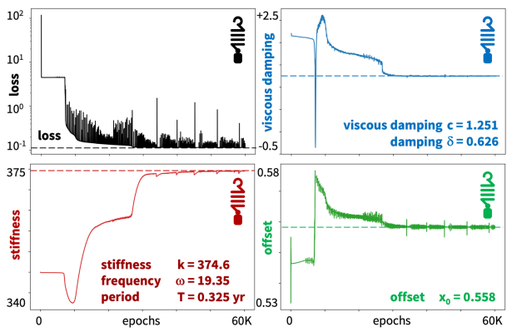
Figure 8 : Physics Informed Neural Network. History of loss function L and physics parameters damp- ing c, stiffness k, and offsetx0. Within 60K epochs, the physics parameters converge towards a viscous damping coefficient of c = 1.251, a stiffness of k = 374.6, and an offset of x0 = 0.558. This corresponds to a damping of δ = 0.626, a frequency of ω = 19.35, and a period of T = 0.325 years. Simulation with weighting coefficient of ε = 10−3 and training window of ntrn = 225 days.
원문 · CC BY 4.0 · Kevin Linka, Amelie Schafer, Xuhui Meng, Zongren Zou, George Em Karniadakis, Ellen Kuhl · Bayesian Physics-Informed Neural Networks for real-world nonlinear dynamical systems · 원문 그림 인용 · 원본 PDF 14쪽에서 그림 영역을 추출했습니다.Bayesian Inference와 물리 매개변수의 사후 분포
Bayesian Inference는 damped harmonic oscillator의 물리 매개변수 ϑ = {c, k, x0}의 사후 분포 P(ϑ|x̂)를 Bayes 정리로 추정합니다. 우도는 일일 사례 수에 대한 정규 분포로 정의되고, 사전 분포는 로그 정규 분포로 둡니다. 샘플링은 NO-U-Turn sampler로 수행됩니다. Bayesian Neural Network와 Bayesian Physics Informed Neural Network는 네트워크 가중치와 편향에 대한 사후 분포를 Hamiltonian Monte Carlo로 샘플링하며, 후자는 물리 잔차를 추가 우도로 포함합니다.
학습 구간과 예측 구간의 비교 결과
신경망은 첫 225일 학습 구간에는 잘 맞지만, 예측 구간에서는 학습된 추세를 이어 가 평평한 추세를 보입니다. 반면 Physics-Informed Neural Network는 예측 구간에서도 칠일 이동 평균에 가까운 곡선을 유지합니다. Bayesian Inference는 학습과 예측 구간 모두를 근사하면서 신뢰 구간을 함께 제공합니다. 이 결과는 본 연구가 선택한 225일 학습 구간과 damped harmonic oscillator 모델에서 얻은 관찰입니다.
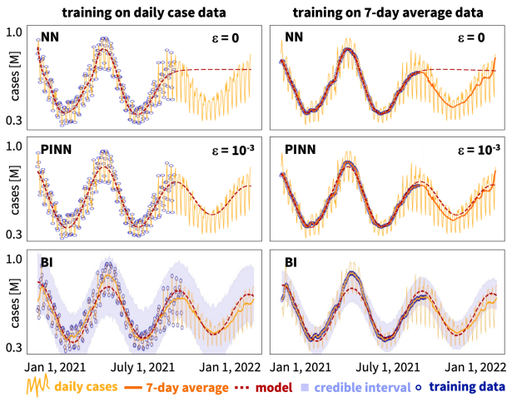
Figure 3 : Machine learning - Integrating data and physics. Neural Networks approximate the training data well, but fail to predict the behavior outside the training window, when trained on both, the daily case data (top left) and the seven-day average (top right). Physics Informed Neural Networks approximate both the training data and the behavior outside the training window, when trained on both, the daily case data (middle left) and the seven-day average data (middle right). Bayesian Inference not only approximates both, the training data and the behavior outside the training window, but also provides credible intervals, which are wider when model parameters are inferred using the daily case data (bottom left) than when using the seven-day average data (bottom right). Thin yellow lines indicate daily new case data, thick orange lines are their seven-day average, dashed red lines are the model simulations, light blue areas are its credible intervals, blue dots are the training data, here for 225 out of 365 days.
원문 · CC BY 4.0 · Kevin Linka, Amelie Schafer, Xuhui Meng, Zongren Zou, George Em Karniadakis, Ellen Kuhl · Bayesian Physics-Informed Neural Networks for real-world nonlinear dynamical systems · 원문 그림 인용 · 원본 PDF 7쪽에서 그림 영역을 추출했습니다.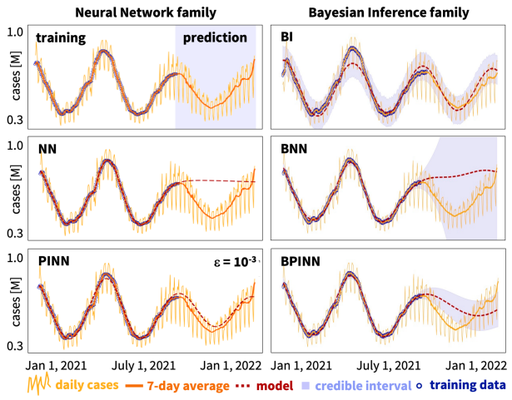
Figure 14 : Comparison of Neural Network and Bayesian Inference models.Neural Networks approximate the training data well, but fail to predict the behavior outside the training window (top left). Physics Informed Neural Networks approximate both the training data and the behavior outside the training window, but are sen- sitive to the weighting coefficient (middle left). Self Adaptive Physics Informed Neural Networks approximate both the training data and the behavior outside the training window, and simultaneously learn the weighting term ε(t) (bottom left). Bayesian Inference not only approximates both, the training data and the behavior outside the training window, but also provides credible intervals of the model (top right). Bayesian Neural Net- works approximate the training data well, but fail to predict the behavior outside the training window where they generate a wide credible intervals (middle right). Bayesian Physics Informed Neural Networks approximate the training data well, but fail to predict the behavior outside the training window (bottom right). Thin yellow lines indicate daily new case data, thick orange lines are their seven-day average, dashed red lines are the model, light blue areas are its credible intervals, blue dots are the training data.
원문 · CC BY 4.0 · Kevin Linka, Amelie Schafer, Xuhui Meng, Zongren Zou, George Em Karniadakis, Ellen Kuhl · Bayesian Physics-Informed Neural Networks for real-world nonlinear dynamical systems · 원문 그림 인용 · 원본 PDF 22쪽에서 그림 영역을 추출했습니다.매개변수 추정과 학습 데이터 크기의 영향
Bayesian Inference는 감쇠 계수 c=1.111±0.126, 강성 k=402.4±1.7, 오프셋 x0=0.541±0.002를 추정합니다. Bayesian Physics Informed Neural Network는 c=1.312±0.391, k=319.4±38.6, x0=0.571±0.020를 추정하며, 저자들은 이 방법의 표준편차가 고전적 Bayesian Inference보다 넓다고 보고합니다. 학습 데이터 크기를 150일부터 275일까지 바꾼 민감도 분석에서는 학습 데이터가 늘수록 Bayesian Inference의 신뢰 구간 폭이 줄어듭니다.
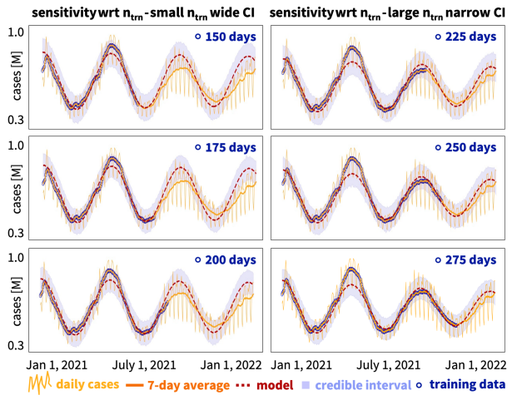
Figure 10 : Bayesian Inference. Sensitivity analysis for varying size of training data set. With increasing training data size of 150, 175, 200, 225, 250, and 275 days, the error in the descriptive window increases, the error in the predictive window decreases, and the width of the credible interval decreases (top left to bottom right). Thin yellow lines indicate daily new case data, thick orange lines are their seven-day average, dashed red lines are the physics-based model, light blue areas are its credible intervals, blue dots are the training data.
원문 · CC BY 4.0 · Kevin Linka, Amelie Schafer, Xuhui Meng, Zongren Zou, George Em Karniadakis, Ellen Kuhl · Bayesian Physics-Informed Neural Networks for real-world nonlinear dynamical systems · 원문 그림 인용 · 원본 PDF 19쪽에서 그림 영역을 추출했습니다.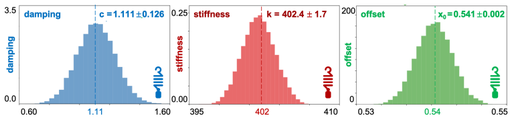
Figure 11 : Bayesian Inference. Posterior distributions of physics parameters damping c, stiffness k, and offset x0. Inferred viscous damping coefficient ofc = 1.111± 0.126, stiffness of k = 402.4± 1.7, and offset of x0 = 0.541± 0.002. This corresponds to a damping of δ = 0.556, a frequency of ω = 20.06, and a period of T = 0.313 years. Simulation with training window of ntrn = 225 days.
원문 · CC BY 4.0 · Kevin Linka, Amelie Schafer, Xuhui Meng, Zongren Zou, George Em Karniadakis, Ellen Kuhl · Bayesian Physics-Informed Neural Networks for real-world nonlinear dynamical systems · 원문 그림 인용 · 원본 PDF 20쪽에서 그림 영역을 추출했습니다.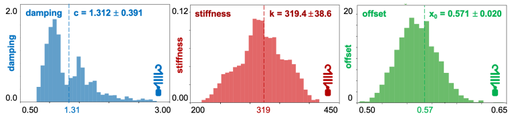
Figure 12 : Bayesian Physics Informed Neural Network. Posterior distributions of physics parameters damping c, stiffness k, and offset x0. Inferred viscous damping coefficient of c = 1.312± 0.391, stiffness of k = 319.4± 38.6, and offset of x0 = 0.571± 0.020. This corresponds to a damping of δ = 0.65, a frequency of ω = 17.87, and a period of T = 0.352 years. Simulation with training window of ntrn = 225 days.
원문 · CC BY 4.0 · Kevin Linka, Amelie Schafer, Xuhui Meng, Zongren Zou, George Em Karniadakis, Ellen Kuhl · Bayesian Physics-Informed Neural Networks for real-world nonlinear dynamical systems · 원문 그림 인용 · 원본 PDF 20쪽에서 그림 영역을 추출했습니다.민감도와 계산 비용의 한계
Physics-Informed Neural Network의 결과는 가중치 계수 ε에 민감합니다. 작은 ε에서는 데이터 적합이 강조되고, 큰 ε에서는 물리 적합이 강조됩니다. Bayesian Physics Informed Neural Network는 고전적 Bayesian Inference보다 계산 비용이 크고, 학습 구간 225일 조건에서 덜 견고하다고 저자들이 보고합니다. 또한 본 연구는 하나의 실제 자료와 단순한 damped harmonic oscillator 모델에 한정되어 있습니다.
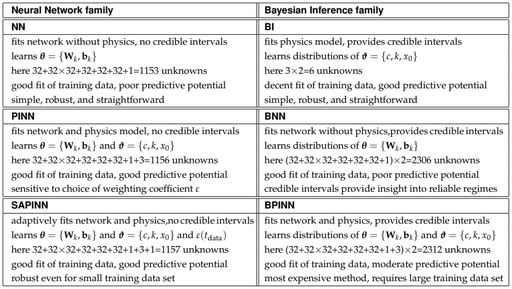
Table 1 : Comparison of Neural Network and Bayesian Inference models.Advantages and disadvantages of Neural Networks, Physics Informed Neural Networks, Self Adaptive Physics Informed Neural Networks, Bayesian Inference, Bayesian Neural Networks, and Bayesian Physics Informed Neural Networks in terms of parameters, data fit, predictive potential, and robustness.
원문 · CC BY 4.0 · Kevin Linka, Amelie Schafer, Xuhui Meng, Zongren Zou, George Em Karniadakis, Ellen Kuhl · Bayesian Physics-Informed Neural Networks for real-world nonlinear dynamical systems · 원문 그림 인용 · 원본 PDF 24쪽에서 그림 영역을 추출했습니다.논문 정보
- 저자
- Kevin Linka, Amelie Schafer, Xuhui Meng, Zongren Zou, George Em Karniadakis, Ellen Kuhl
- 학회·저널
- arXiv · 프리프린트
- 최초 공개일
- 2022년 5월 12일
- 등록일
- 2026년 11월 6일
- 수정일
- 2022년 5월 24일
- 버전
- v2
- arXiv
- 2205.08304
- DOI
- 10.1016/j.cma.2022.115346
- 분류
- cs.LG · math.DS · nlin.CD
- 원문 이용 조건
- CC BY 4.0
- 제공 범위
- 논문 정보, 해설, 허용된 원문 그림
AI 해설은 논문 원문과 별개의 설명이며 오류가 있을 수 있습니다. 원문과 그림은 각 출처의 이용 조건과 따로 표시된 권리를 따릅니다.
초록
Understanding real-world dynamical phenomena remains a challenging task. Across various scientific disciplines, machine learning has advanced as the go-to technology to analyze nonlinear dynamical systems, identify patterns in big data, and make decision around them. Neural networks are now consistently used as universal function approximators for data with underlying mechanisms that are incompletely understood or exceedingly complex. However, neural networks alone ignore the fundamental laws of physics and often fail to make plausible predictions. Here we integrate data, physics, and uncertainties by combining neural networks, physics-informed modeling, and Bayesian inference to improve the predictive potential of traditional neural network models. We embed the physical model of a damped harmonic oscillator into a fully-connected feed-forward neural network to explore a simple and illustrative model system, the outbreak dynamics of COVID-19. Our Physics-Informed Neural Networks can seamlessly integrate data and physics, robustly solve forward and inverse problems, and perform well for both interpolation and extrapolation, even for a small amount of noisy and incomplete data. At only minor additional cost, they can self-adaptively learn the weighting between data and physics. Combined with Bayesian Neural Networks, they can serve as priors in a Bayesian Inference, and provide credible intervals for uncertainty quantification. Our study reveals the inherent advantages and disadvantages of Neural Networks, Bayesian Inference, and a combination of both and provides valuable guidelines for model selection. While we have only demonstrated these approaches for the simple model problem of a seasonal endemic infectious disease, we anticipate that the underlying concepts and trends generalize to more complex disease conditions and, more broadly, to a wide variety of nonlinear dynamical systems.
원문 인용
Kevin Linka, Amelie Schafer, Xuhui Meng, Zongren Zou, George Em Karniadakis, Ellen Kuhl (2022). Bayesian Physics-Informed Neural Networks for real-world nonlinear dynamical systems. arXiv:2205.08304v2. https://doi.org/10.1016/j.cma.2022.115346
BibTeX
@article{linka2022bayesian,
  title = {{Bayesian Physics-Informed Neural Networks for real-world nonlinear dynamical systems}},
  author = {Kevin Linka and Amelie Schafer and Xuhui Meng and Zongren Zou and George Em Karniadakis and Ellen Kuhl},
  year = {2022},
  eprint = {2205.08304},
  archivePrefix = {arXiv},
  doi = {10.1016/j.cma.2022.115346},
  url = {https://arxiv.org/abs/2205.08304v2}
}