논문 해설
Contrastive Activation-Guided Zeroth-Order Preference Optimisation for Memory-Efficient LLM Alignment
메모리 효율적인 LLM 정렬을 위한 Contrastive Activation-Guided Zeroth-Order Preference Optimisation
- 연구 문제 등방성 제로차 섭동은 DPO의 선호 차이와 무관한 방향을 탐색해 갱신이 잡음에 취약합니다.
- 연구 방법 선호 쌍의 활성 차이로 저차원 기저를 만들고 그 부분공간 안에서만 섭동을 샘플링합니다.
ZO 최적화가 DPO에 어려운 이유
DPO는 RLHF의 다단계 파이프라인을 줄여 주지만 여전히 역전파에 의존하므로 중간 활성값과 기울기를 저장해야 합니다. 이 활성 메모리는 모델 크기, 시퀀스 길이, 배치 크기가 커질수록 부담이 됩니다. 제로차 최적화는 순전파 평가만으로 갱신 방향을 추정해 이 비용을 줄이지만, 등방성 무작위 섭동은 선택 응답과 거부 응답의 차이와 거의 무관한 방향을 탐색하므로 DPO 목적함수에서 잡음이 많은 갱신을 만듭니다. 이 논문은 이 문제를 선호 쌍 자체의 구조로 줄이려 합니다.
대비 활성 부분공간과 섭동
CA-ZODPO는 각 선형 레이어에서 선택 응답과 거부 응답의 평균 활성 차이와 토큰별 차이를 이어 붙인 행렬을 만듭니다. 이 행렬의 주 rank-r 부분공간을 power-iteration으로 근사해 정규직교 기저를 얻습니다. 섭동 방향은 이 기저 안에서 표준정규 행렬을 샘플링하고 1/√r로 스케일해 만들며, 비선형 파라미터는 기존처럼 등방성 섭동을 씁니다. 기저를 뽑은 뒤에는 활성 행렬을 해제하고 두 번의 순전파로 중심 차분 기울기를 추정합니다. 모멘텀은 파라미터 크기가 아니라 저차원 계수 공간에 저장하며, 기저가 바뀌면 이전 버퍼를 새 기저로 투영해 누적합니다.
HH-RLHF 쌍별 판정 결과
Qwen2.5-1.5B를 Anthropic HH-RLHF로 학습한 뒤 500개 보류 프롬프트에서 Qwen2.5-32B-Instruct가 두 판정 순서로 쌍별 비교를 했습니다. 두 순서에서 선호가 일치하지 않으면 무승부로 집계했습니다. SFT 대비 MeZO는 승률 25.8%, 패배율 37.4%로 음의 승패 차를 보였고, CA-ZODPO는 승률 34.6%, 패배율 28.6%로 양의 차를 기록했습니다. FO-DPO 대비 CA-ZODPO는 승률 34.2%, 패배율 33.0%로 거의 균형을 이뤘습니다. 같은 비교에서 선호 무관 변형 CA-ZODPO-plain은 SFT 대비 승률 30.6%, 패배율 31.6%로 CA-ZODPO보다 낮았습니다.
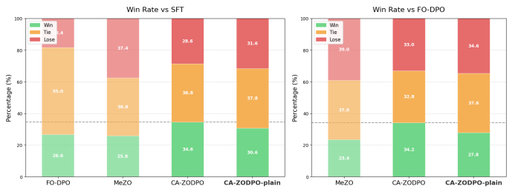
Figure 1 : Pairwise win/tie/loss rates judged by Qwen2.5-32B-Instruct. Left: comparisons against SFT. Right: comparisons against FO-DPO. CA-ZODPO achieves the best win-rate profile among zeroth-order methods and remains close to FO-DPO.
원문 · CC BY 4.0 · Weiyun Huang, Alessio Galatolo · Contrastive Activation-Guided Zeroth-Order Preference Optimisation for Memory-Efficient LLM Alignment · 원문 그림 인용 · 원본 PDF 4쪽에서 그림 영역을 추출했습니다.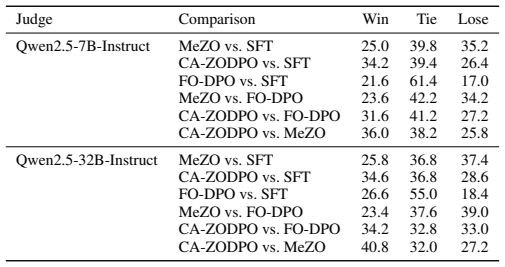
Table 2 : Pairwise win/tie/loss rates (%) on 500 HH-RLHF test prompts. The first method in each comparison is the method being evaluated.
원문 · CC BY 4.0 · Weiyun Huang, Alessio Galatolo · Contrastive Activation-Guided Zeroth-Order Preference Optimisation for Memory-Efficient LLM Alignment · 원문 그림 인용 · 원본 PDF 7쪽에서 그림 영역을 추출했습니다.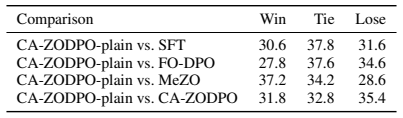
Table 3 : Pairwise results (%) for CA-ZODPO-plain using Qwen2.5-32B-Instruct.
원문 · CC BY 4.0 · Weiyun Huang, Alessio Galatolo · Contrastive Activation-Guided Zeroth-Order Preference Optimisation for Memory-Efficient LLM Alignment · 원문 그림 인용 · 원본 PDF 7쪽에서 그림 영역을 추출했습니다.피크 GPU 메모리와 배치 크기
시퀀스 길이 2048에서 FO-DPO의 피크 GPU 메모리는 26.94 GB였고, MeZO는 약 10.65 GB, CA-ZODPO는 11.08 GB였습니다. FO-DPO는 역전파가 중간 활성을 보존하므로 시퀀스 길이에 따라 메모리가 17.27 GB에서 26.94 GB로 늘었습니다. 두 제로차 방법의 차이는 저장된 저차원 기저, 모멘텀 버퍼, 부분공간 추출용 임시 행렬에서 나온다고 저자들은 봅니다. 시퀀스 길이 256에서 FO-DPO는 배치 16에서 26.18 GB를 쓰고 배치 32에서 메모리 부족이 발생했지만, CA-ZODPO는 같은 조건의 배치 32에서 29.35 GB를 사용했습니다.
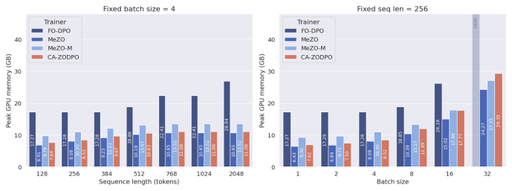
Figure 2 : Peak GPU memory on Qwen2.5-1.5B. ZO methods avoid the sequence-length-dependent activation cache of FO-DPO. At batch size 32 and sequence length 256, FO-DPO is out of memory on a 48 GB A40 while CA-ZODPO uses 29.35 GB.
원문 · CC BY 4.0 · Weiyun Huang, Alessio Galatolo · Contrastive Activation-Guided Zeroth-Order Preference Optimisation for Memory-Efficient LLM Alignment · 원문 그림 인용 · 원본 PDF 4쪽에서 그림 영역을 추출했습니다.랭크와 모멘텀의 학습 안정성
부록 C.2에서 학습 손실 궤적을 통해 모멘텀 계수와 부분공간 랭크를 비교했습니다. µ=0.3은 µ=0.0과 비슷한 궤적을 보였고 후반 손실 변동을 약간 줄였습니다. 랭크 r=1은 가장 불안정했고 r=2는 상승 드리프트를 부분적으로 줄였으며, r=4와 r=8은 관찰된 단계에서 더 안정적이었습니다. 저자들은 모멘텀이 주된 성능 차이의 원인이라기보다 제한적인 안정화 효과를 준다고 해석합니다.
한계
CA-ZODPO는 업데이트마다 순전파를 세 번 사용하므로 메모리가 낮다고 해서 학습이 빨라지지는 않습니다. 평가는 1.5B 모델 하나, 주 선호 데이터셋 하나, LLM 판정기로 제한되었습니다. 또 손실 궤적 비교는 관찰된 학습 단계에서 이뤄졌습니다.
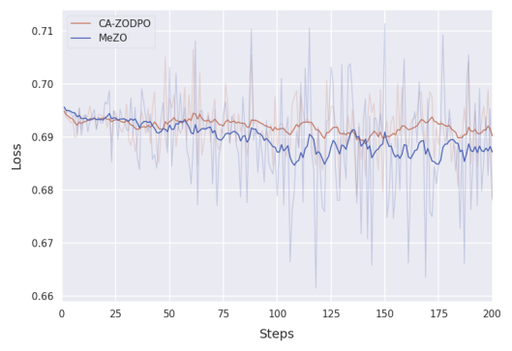
Figure 3 : Training DPO loss trajectories for CA-ZODPO and MeZO.
원문 · CC BY 4.0 · Weiyun Huang, Alessio Galatolo · Contrastive Activation-Guided Zeroth-Order Preference Optimisation for Memory-Efficient LLM Alignment · 원문 그림 인용 · 원본 PDF 8쪽에서 그림 영역을 추출했습니다.논문 정보
- 저자
- Weiyun Huang, Alessio Galatolo
- 학회·저널
- arXiv · 프리프린트
- 최초 공개일
- 2026년 11월 16일
- 등록일
- 2026년 11월 17일
- 수정일
- 2026년 11월 16일
- 버전
- v1
- arXiv
- 2611.20635
- 분류
- cs.LG
- 원문 이용 조건
- CC BY 4.0
- 제공 범위
- 논문 정보, 해설, 허용된 원문 그림
AI 해설은 논문 원문과 별개의 설명이며 오류가 있을 수 있습니다. 원문과 그림은 각 출처의 이용 조건과 따로 표시된 권리를 따릅니다.
초록
Direct Preference Optimisation (DPO) simplifies reinforcement learning from human feedback, but still relies on traditional backpropagation and its associated activation-memory cost. Zeroth-order (ZO) optimisation avoids backpropagation, yet isotropic perturbations can produce noisy updates for preference objectives defined by differences between chosen and rejected responses. We introduce Contrastive Activation-guided Zeroth-Order Direct Preference Optimisation (CA-ZODPO), which constructs a low-rank search subspace from the activation discrepancy between the chosen and rejected responses in each preference pair. Perturbations are restricted to this subspace, while momentum is maintained in low-rank coordinates to preserve the memory advantages of ZO training. On Qwen2.5-1.5B with Anthropic HH-RLHF, CA-ZODPO outperforms common ZO baselines and remains competitive with first-order DPO in pairwise preference evaluation. It also reduces peak GPU memory by about 59\% at a sequence length of 2048 while retaining the sequence-length scaling behaviour of zeroth-order training.
원문 인용
Weiyun Huang, Alessio Galatolo (2026). Contrastive Activation-Guided Zeroth-Order Preference Optimisation for Memory-Efficient LLM Alignment. arXiv:2611.20635v1. https://arxiv.org/abs/2611.20635v1
BibTeX
@misc{huang2026contrastive,
  title = {{Contrastive Activation-Guided Zeroth-Order Preference Optimisation for Memory-Efficient LLM Alignment}},
  author = {Weiyun Huang and Alessio Galatolo},
  year = {2026},
  eprint = {2611.20635},
  archivePrefix = {arXiv},
  url = {https://arxiv.org/abs/2611.20635v1}
}