논문 해설
Accessible Visualization via Natural Language Descriptions: A Four-Level Model of Semantic Content
- 연구 문제 시각화 설명이 실제로 어떤 의미 내용을 전달하는지 알지 못해, 그 유용성을 평가하기 어렵습니다.
- 연구 방법 그라운디드 이론으로 2,147개 문장을 분석해 네 수준의 의미 내용 모델을 만들고, 이를 이용해 블라인드 독자와 시각 독자의 유용성 순위를 비교합니다.
- 주요 결과 두 독자 집단은 네 수준 설명의 평균 순위에서 유의하게 다릅니다. 시각 독자는 3·4수준을, 블라인드 독자는 2·3수준을 더 유용하다고 평가했습니다.
시각화 설명의 의미 내용을 평가하기 어려운 이유
시각화에 붙는 자연어 설명은 차트를 더 잘 전달하고 장애가 있는 독자의 접근성을 높이기 위해 쓰입니다. 그러나 설명이 어떤 의미 내용을 전달하는지에 대한 이해가 부족해, 그 설명이 실제로 얼마나 유용한지 평가하기 어렵습니다. 기존 자동 캡셔닝 연구는 접근성 지침을 충분히 참고하지 않았고, 생성된 캡션을 의도한 독자와 함께 경험적으로 평가하지 않는 경우가 많았습니다. 이 논문은 이 공백에서 설명이 전달하는 의미 내용을 분류하는 개념 모델을 제안하는 것에서 출발합니다.
그라운디드 이론으로 구성한 네 수준 모델
이 논문은 그라운디드 이론 방법으로 네 수준의 의미 내용 모델을 구성합니다. 먼저 학생들이 작성한 330개 설명과 저자들이 쓴 설명을 대상으로 개방 코딩을 수행해 예비 범주를 만들었습니다. 이후 온라인 설문으로 120명의 참가자가 작성한 582개 설명, 2,147개 문장을 모아 범주를 정제했고, 두 저자가 문장을 독립적으로 레이블링한 뒤 논의로 불일치를 해소했습니다. 그 결과 1수준은 차트의 기본 요소와 인코딩, 2수준은 기술 통계량과 관계, 3수준은 지각·인지 현상, 4수준은 맥락과 영역 특화 통찰을 담습니다. 1·2수준은 시각화 명세나 데이터에 근거한 perceiver-independent 내용이고, 3·4수준은 지각자에 의존하는 perceiver-dependent 내용입니다.
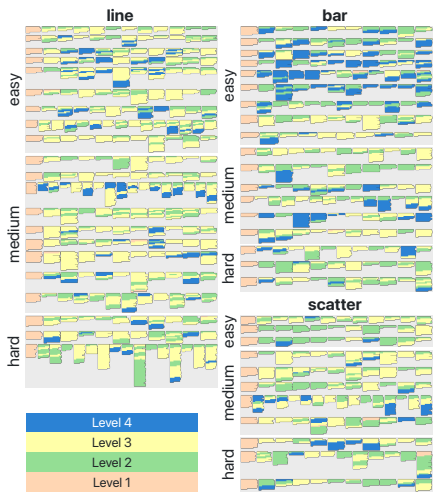
Fig. 2 . A visual “fingerprint” [49] of our corpus, faceted by chart type and difficulty. Each row corresponds to a single chart. Each column shows a participant-authored description for that chart, color coded according to our model. The first column shows the provided Level 1 prompt.
원문 · CC BY 4.0 · Alan Lundgard, Arvind Satyanarayan · Accessible Visualization via Natural Language Descriptions: A Four-Level Model of Semantic Content · 원문 그림 인용 · 원본 PDF 4쪽에서 그림 영역을 추출했습니다.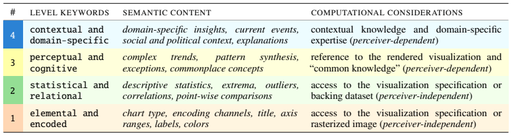
Table 2 . A four-level model of semantic content for accessible visualization. Levels are defined by the semantic content conveyed by natural language descriptions of visualizations. Additionally, we offer computational considerations for generating the semantic content at each level of the model.
원문 · CC BY 4.0 · Alan Lundgard, Arvind Satyanarayan · Accessible Visualization via Natural Language Descriptions: A Four-Level Model of Semantic Content · 원문 그림 인용 · 원본 PDF 5쪽에서 그림 영역을 추출했습니다.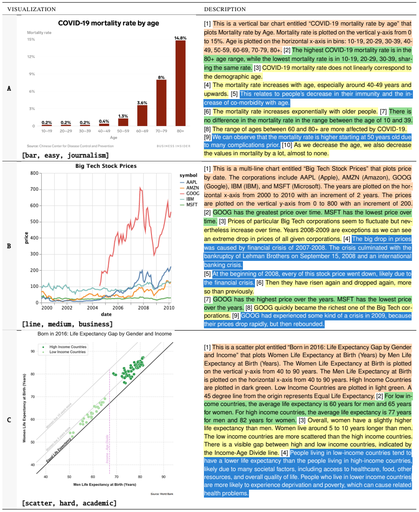
Table 3 . Example visualizations and descriptions from our corpus. Paragraph breaks in rows A and B indicate a description authored by a unique participant from our corpus gathering survey (§ 3.2.1), while row C shows an curated exemplar description from our evaluation (§ 5.1).
원문 · CC BY 4.0 · Alan Lundgard, Arvind Satyanarayan · Accessible Visualization via Natural Language Descriptions: A Four-Level Model of Semantic Content · 원문 그림 인용 · 원본 PDF 6쪽에서 그림 영역을 추출했습니다.블라인드 독자와 시각 독자의 유용성 순위 평가
평가에서는 차트 유형, 주제, 난이도의 세 차원에서 고른 15개 시각화를 사용했습니다. 각 시각화마다 네 수준의 예시 설명을 레이블 없이 무작위 순서로 제시하고, 독자는 1(가장 덜 유용)부터 4(가장 유용)까지 순위를 매겼습니다. 주제와 무관한 문장을 넣은 주의 확인 항목을 최하위로 평가하지 않은 응답은 분석에서 제외했습니다. 이때 '유용함'의 정의는 연구자가 정하지 않고 독자의 해석에 맡겼습니다. 참가자는 블라인드 독자 30명과 시각 독자 90명이며, 시각 독자는 Prolific를 통해 모집하고 블라인드 독자는 지인과 커뮤니티 공고로 모집했습니다.

Table 1 . Breakdown of the 50 curated visualizations, across the three dimensions: type, topic, and difficulty. (N.b., each column sums to 50.)
원문 · CC BY 4.0 · Alan Lundgard, Arvind Satyanarayan · Accessible Visualization via Natural Language Descriptions: A Four-Level Model of Semantic Content · 원문 그림 인용 · 원본 PDF 3쪽에서 그림 영역을 추출했습니다.집단별 유용성 순위의 차이
Friedman’s Test에서 두 독자 집단 모두 p < 0.001로 나타나, 네 수준의 평균 순위가 같다는 귀무가설을 기각했습니다. Nemenyi’s test 기반의 쌍별 비교에서는 집단마다 다른 쌍에서 유의한 차이가 나타났습니다. 시각 독자는 3수준과 4수준을 가장 유용하게, 1수준과 2수준을 가장 덜 유용하게 평가했습니다. 블라인드 독자는 2수준과 3수준을 가장 유용하게 평가했고, 1수준과 4수준을 가장 덜 유용하게 평가했습니다. 1수준 순위 분포는 두 집단 모두에서 양봉형이었으며, 대다수가 최하위로 평가했지만 블라인드 독자 101회, 시각 독자 87회 가장 유용하다고 평가했습니다.
결과의 적용 범위와 남은 질문
이 결과는 제시된 15개 시각화, 블라인드 독자 30명과 시각 독자 90명, 그리고 독자에게 맡긴 '유용함'의 정의라는 조건에서 얻은 것입니다. 저자들은 독자 집단별 차이를 접근성 설명을 설계할 때 독자 선호를 고려해야 한다는 근거로 해석합니다. 다만 평가 과제와 조건이 달라진 경우에도 같은 순위가 나타나는지는 이 연구만으로 확인되지 않습니다. 또한 자동 생성 방법의 실제 성능은 이 평가에서 직접 측정된 대상이 아닙니다.
논문 정보
- 저자
- Alan Lundgard, Arvind Satyanarayan
- 학회·저널
- arXiv · 프리프린트
- 최초 공개일
- 2021년 10월 8일
- 등록일
- 2026년 11월 6일
- 수정일
- 2021년 10월 8일
- 버전
- v1
- arXiv
- 2110.04406
- DOI
- 10.1109/tvcg.2021.3114770/
- 분류
- cs.HC · cs.CL
- 원문 이용 조건
- CC BY 4.0
- 제공 범위
- 논문 정보, 해설, 허용된 원문 그림
AI 해설은 논문 원문과 별개의 설명이며 오류가 있을 수 있습니다. 원문과 그림은 각 출처의 이용 조건과 따로 표시된 권리를 따릅니다.
초록
Natural language descriptions sometimes accompany visualizations to better communicate and contextualize their insights, and to improve their accessibility for readers with disabilities. However, it is difficult to evaluate the usefulness of these descriptions, and how effectively they improve access to meaningful information, because we have little understanding of the semantic content they convey, and how different readers receive this content. In response, we introduce a conceptual model for the semantic content conveyed by natural language descriptions of visualizations. Developed through a grounded theory analysis of 2,147 sentences, our model spans four levels of semantic content: enumerating visualization construction properties (e.g., marks and encodings); reporting statistical concepts and relations (e.g., extrema and correlations); identifying perceptual and cognitive phenomena (e.g., complex trends and patterns); and elucidating domain-specific insights (e.g., social and political context). To demonstrate how our model can be applied to evaluate the effectiveness of visualization descriptions, we conduct a mixed-methods evaluation with 30 blind and 90 sighted readers, and find that these reader groups differ significantly on which semantic content they rank as most useful. Together, our model and findings suggest that access to meaningful information is strongly reader-specific, and that research in automatic visualization captioning should orient toward descriptions that more richly communicate overall trends and statistics, sensitive to reader preferences. Our work further opens a space of research on natural language as a data interface coequal with visualization.
원문 인용
Alan Lundgard, Arvind Satyanarayan (2021). Accessible Visualization via Natural Language Descriptions: A Four-Level Model of Semantic Content. arXiv:2110.04406v1. https://doi.org/10.1109/tvcg.2021.3114770/
BibTeX
@article{lundgard2021accessible,
  title = {{Accessible Visualization via Natural Language Descriptions: A Four-Level Model of Semantic Content}},
  author = {Alan Lundgard and Arvind Satyanarayan},
  year = {2021},
  eprint = {2110.04406},
  archivePrefix = {arXiv},
  doi = {10.1109/tvcg.2021.3114770/},
  url = {https://arxiv.org/abs/2110.04406v1}
}