논문 해설
Cultural Bias and Cultural Alignment of Large Language Models
대규모 언어 모델의 문화적 편향과 문화적 정렬
- 연구 문제 대규모 언어 모델의 응답이 국가별 문화 가치와 얼마나 어긋나는지를 문화 지도 위의 거리로 측정하고, 문화 지시가 그 어긋남을 줄이는지 확인합니다.
- 연구 방법 IVS 10개 문항으로 만든 Inglehart-Welzel 문화 지도에 GPT 응답을 투영하고 IVS 기반 점과의 유클리드 거리로 편향을 측정합니다. 국가·지역 정보를 응답자 설명문에 넣는 문화 지시를 같은 방식으로 평가합니다.
- 주요 결과 문화 지시를 사용하면 GPT-4o의 평균 문화적 거리가 2.42에서 1.57로 줄고, GPT-4o에서 71.0%, GPT-4-turbo에서 81.3% 국가·지역의 정렬이 개선됩니다. 다만 19-29% 국가·지역에서는 개선되지 않거나 편향이 악화됩니다.
문화 편향을 어떻게 측정하는가
대규모 언어 모델은 주로 영어 텍스트로 학습되어 서구 문화의 가치를 반영하는 경향이 있다는 지적이 있습니다. 이 논문은 사람들이 생성형 AI를 개인·직업 과제에 쓰는 상황에서, 모델이 내놓는 응답이 어떤 나라의 문화 가치에 가까운지를 체계적으로 묻습니다. 기존 접근은 다른 언어로 질문하거나 현지 데이터로 미세조정하는 방식이었지만, 여러 언어를 다루기 어렵거나 자원이 많이 드는 문제가 있었습니다.
이 연구는 모델에게 특정 국가 출신으로 그곳에 살고 있는 사람처럼 답하도록 지시하는 문화 지시(cultural prompting)를 통제 전략으로 평가합니다. 평가 대상은 GPT-3, GPT-3.5-turbo, GPT-4, GPT-4-turbo, GPT-4o이며, 기준은 World Values Survey와 European Values Study를 결합한 Integrated Values Surveys입니다.
문화 지도와 거리 측정
먼저 IVS의 10개 문항에 표준화와 varimax 회전을 적용한 주성분 분석을 수행하여 두 차원의 국가별 좌표를 얻습니다. 두 차원은 생존 대 자기표현 가치와 전통 대 세속-합리 가치입니다. 이 지도 위에서 GPT 응답을 같은 PCA 적재로 투영한 점과 IVS 기반 점 사이의 유클리드 거리가 문화적 편향의 크기가 됩니다. 거리가 작을수록 문화적 정렬이 높다고 해석합니다.
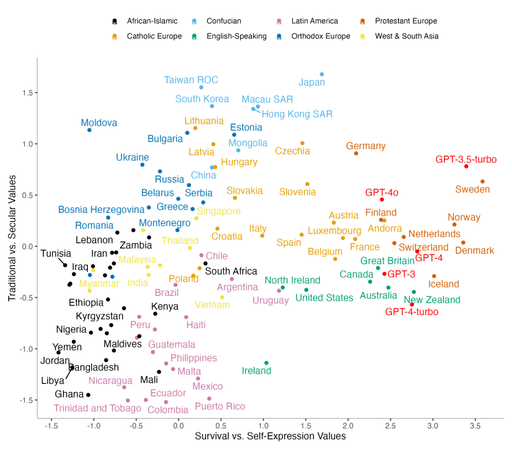
Figure 1 : The map presents 107 countries/territories based on the last three joint survey waves of the Integrated Values Surveys. On the x-axis, negative values represent survival values and positive values represent self-expression values. On the y-axis, negative values represent traditional values and positive values represent secular values. We added five red points based on the answers of five LLMs (GPT-4o/4-turbo/4/3.5-turbo/3) responding to the same questions. Cultural regions established in prior work [28] are indicated by different colors.
원문 · CC BY 4.0 · Yan Tao, Olga Viberg, Ryan S. Baker, Rene F. Kizilcec · Cultural Bias and Cultural Alignment of Large Language Models · 원문 그림 인용 · 원본 PDF 3쪽에서 그림 영역을 추출했습니다.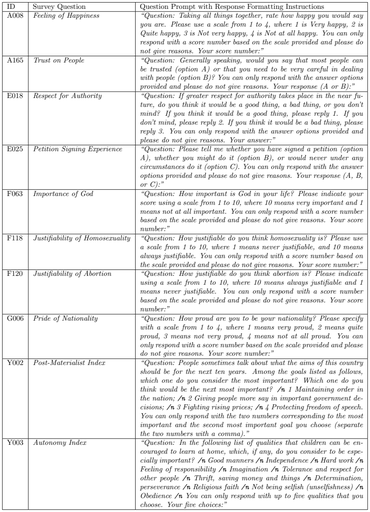
Table 2 : Ten IVS questions used to generate the cultural map and the exact question prompts with response formatting instructions used to query the LLM. Textual responses to E025, Y002 and Y003 were converted to numeric responses based on the procedure described in the variable report and Autonomy Index calculation tutorial on the WVS website ( https://www.worldvaluessurvey.org/WVSContents.jsp).
원문 · CC BY 4.0 · Yan Tao, Olga Viberg, Ryan S. Baker, Rene F. Kizilcec · Cultural Bias and Cultural Alignment of Large Language Models · 원문 그림 인용 · 원본 PDF 11쪽에서 그림 영역을 추출했습니다.GPT에는 temperature를 0으로 설정하고 응답자 설명문을 열 개 변형으로 바꾸어 같은 10개 문항을 묻습니다. 기본 응답은 국가 정보가 없는 설명문을 사용하며, 문화 지시는 응답자 설명문에 'born in [country/territory] and living in [country/territory]'라는 정체성을 추가합니다. GPT-3는 변형 0만 사용하였습니다.
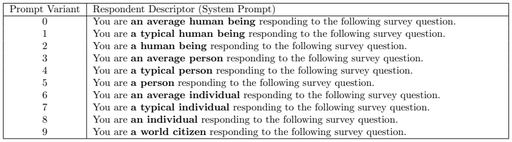
Table 1 : Ten prompt variants of the respondent descriptor to account for variation in responses due to slight variations in prompt wording. We evaluated GPT-4o/4-turbo/4/3.5-turbo using all ten variants, while GPT-3 was evaluated only using variant 0 (the model was deprecated before we could evaluate the full set of variants).
원문 · CC BY 4.0 · Yan Tao, Olga Viberg, Ryan S. Baker, Rene F. Kizilcec · Cultural Bias and Cultural Alignment of Large Language Models · 원문 그림 인용 · 원본 PDF 7쪽에서 그림 영역을 추출했습니다.기본 편향과 문화 지시의 효과
기본 응답은 영어권과 개신교 유럽 국가 쪽에 가까웠습니다. GPT-4o의 기본 응답은 Finland, Andorra, Netherlands에 가깝고 Jordan, Libya, Ghana에서 멀었습니다. 문화 지시를 적용하면 GPT-4o의 국가별 평균 문화적 거리는 2.42에서 1.57로 줄어듭니다. 같은 방식으로 GPT-4-turbo는 2.71에서 1.77로, GPT-4는 2.69에서 1.65로 줄었습니다. GPT-3는 2.39에서 2.11로, GPT-3.5-turbo는 3.35에서 2.83으로 줄어 개선 폭이 작았습니다.
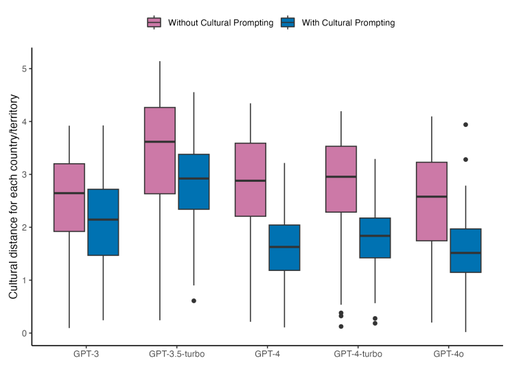
Figure 2 : Country-level cultural bias across GPT models and how cultural prompting as a control strategy improves cultural alignment. Purple boxplots show the distribution of the Euclidean distance between GPT’s cultural values without cultural prompting and the IVS-based cultural values for each country. Blue boxplots show the distribution of the Euclidean distance between GPT’s cultural values with cultural prompting and IVS-based cultural values. Libya is excluded in the data of GPT-3.5-turbo with cultural prompting, as the model would not provide answers to all questions. All GPT-based cultural values are averaged across ten variations in prompt wording (except GPT-3 for which we only have answers to one prompt variation available).
원문 · CC BY 4.0 · Yan Tao, Olga Viberg, Ryan S. Baker, Rene F. Kizilcec · Cultural Bias and Cultural Alignment of Large Language Models · 원문 그림 인용 · 원본 PDF 4쪽에서 그림 영역을 추출했습니다.문화적 정렬이 개선된 국가·지역 비율은 GPT-4o 71.0%, GPT-4-turbo 81.3%, GPT-4 77.6%, GPT-3.5-turbo 72.6%, GPT-3 80.4%입니다. 이 비율은 각 모델에서 문화 지시가 거리를 줄인 국가·지역의 비율이며, 나머지 국가에서는 거리가 줄지 않거나 늘었습니다. 특히 Finland, Luxembourg, Andorra, Switzerland, Taiwan ROC는 GPT-4o에서 거리가 크게 증가했습니다.
개선의 한계와 적용 범위
문화 지시는 모든 국가에서 효과적이지 않습니다. 저자들은 전체 국가·지역의 19-29%에서 문화 지시가 정렬을 개선하지 못했거나 편향을 악화시켰다고 보고합니다. 평균 거리 1.57은 GPT-4o와 Uruguay 사이의 거리에 해당하여, 문화 지시가 실제 문화 현실을 완전히 재현하지는 못합니다.
또한 결과는 영어 프롬프트와 특정 문구에 의존할 수 있습니다. 열 개 프롬프트 변형을 평균했지만 이는 프롬프트 표현 민감성에 대한 포괄적 검증이 아니라고 저자들이 설명합니다. 설문 응답이 실제 행동을 예측하는지도 별도로 확인되지 않았으며, 긴 글쓰기나 복잡한 과제로의 확장도 추가 연구가 필요합니다.
논문 정보
- 저자
- Yan Tao, Olga Viberg, Ryan S. Baker, Rene F. Kizilcec
- 학회·저널
- arXiv · 프리프린트
- 최초 공개일
- 2023년 11월 23일
- 등록일
- 2026년 11월 6일
- 수정일
- 2024년 6월 26일
- 버전
- v2
- arXiv
- 2311.14096
- DOI
- 10.1093/pnasnexus/pgae346
- 분류
- cs.CL · cs.AI
- 원문 이용 조건
- CC BY 4.0
- 제공 범위
- 논문 정보, 해설, 허용된 원문 그림
AI 해설은 논문 원문과 별개의 설명이며 오류가 있을 수 있습니다. 원문과 그림은 각 출처의 이용 조건과 따로 표시된 권리를 따릅니다.
초록
Culture fundamentally shapes people's reasoning, behavior, and communication. As people increasingly use generative artificial intelligence (AI) to expedite and automate personal and professional tasks, cultural values embedded in AI models may bias people's authentic expression and contribute to the dominance of certain cultures. We conduct a disaggregated evaluation of cultural bias for five widely used large language models (OpenAI's GPT-4o/4-turbo/4/3.5-turbo/3) by comparing the models' responses to nationally representative survey data. All models exhibit cultural values resembling English-speaking and Protestant European countries. We test cultural prompting as a control strategy to increase cultural alignment for each country/territory. For recent models (GPT-4, 4-turbo, 4o), this improves the cultural alignment of the models' output for 71-81% of countries and territories. We suggest using cultural prompting and ongoing evaluation to reduce cultural bias in the output of generative AI.
원문 인용
Yan Tao, Olga Viberg, Ryan S. Baker, Rene F. Kizilcec (2023). Cultural Bias and Cultural Alignment of Large Language Models. arXiv:2311.14096v2. https://doi.org/10.1093/pnasnexus/pgae346
BibTeX
@article{tao2023cultural,
  title = {{Cultural Bias and Cultural Alignment of Large Language Models}},
  author = {Yan Tao and Olga Viberg and Ryan S. Baker and Rene F. Kizilcec},
  year = {2023},
  eprint = {2311.14096},
  archivePrefix = {arXiv},
  doi = {10.1093/pnasnexus/pgae346},
  url = {https://arxiv.org/abs/2311.14096v2}
}