논문 해설
ReactBench-AD: Do Driving VLAs and World-Action Models React to Imminent Hazards in Their Path?
ReactBench-AD: 주행 VLA와 World-Action 모델은 경로 위의 임박한 위험에 반응하는가?
- 연구 문제 기존 벤치마크는 평범한 주행 장면이 많아 자율주행 VLA와 WAM이 경로 위 위험 객체에 반응하는지 충분히 검증하지 못합니다.
- 연구 방법 실제 NAVSIM과 PAI-AV 장면에 횡단 보행자, 정지 보행자, 정지 차량을 합성하여 원본과 픽셀 단위로 짝지은 편집 장면을 만들고, 궤적 변화로 반응을 측정합니다.
- 주요 결과 여섯 모델은 대부분 위험 객체에 약하게 반응했습니다.
기존 벤치마크가 놓치는 위험 객체 반응
자율주행 VLA와 WAM은 장기 꼬리 시나리오에서 일반화할 것이라고 기대되지만, 기존 벤치마크는 대부분 평범한 주행 장면으로 구성되어 있습니다. 그래서 경로 위에 갑자기 나타난 객체에 모델이 실제로 반응하는지는 충분히 검증되지 않았습니다. 이 논문은 이 공백을 메우기 위해 실제 주행 장면에 위험 객체를 넣고 모델의 궤적 변화를 측정하는 문제를 다룹니다.
기존 시뮬레이션 기반 평가나 장면 전체를 다시 생성하는 방식은 센서 입력이 실제와 달라 모델의 실패 원인을 분리하기 어렵습니다. 따라서 객체만 바뀐 정확한 반사실적 쌍이 필요합니다.
객체 합성과 원본-편집 쌍 구성
ReactBench-AD는 NAVSIM과 PhysicalAI-Autonomous-Vehicles의 실제 장면에 횡단 보행자, 정지 보행자, 정지 차량을 3D 자산으로 합성합니다. 객체는 주행 기록의 미래 궤적에서 전방 범퍼가 도달할 지점에 놓이며, 모든 카메라 뷰와 과거 프레임에 같은 위치로 렌더링됩니다.
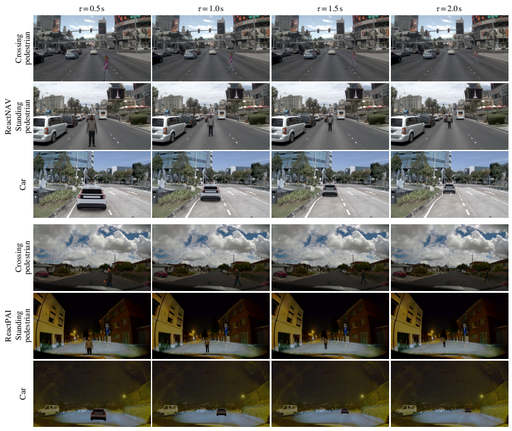
Figure 7 . Randomly selected ReactNA V (top) and ReactPAI (bottom) samples for each inserted object and look-ahead timeτ, shown in the edited front-camera image at the current framet. Each row shows a single scene, whose four look-ahead variants share the same asset.
원문 · CC BY 4.0 · Theodoridis, Nikos, Mohandas, Reenu, Sharma, Sushil, Hogan, Ciarán, Sistu, Ganesh, Scanlan, Anthony, Brophy, Tim, Eising, Ciarán · ReactBench-AD: Do Driving VLAs and World-Action Models React to Imminent Hazards in Their Path? · 원문 그림 인용 · 원본 PDF 14쪽에서 그림 영역을 추출했습니다.지면은 LiDAR로 추정하고, 가림은 깊이 정보와 LiDAR 근거로 처리합니다. 객체와 그림자 외의 픽셀은 바뀌지 않으므로 원본과 편집 장면은 대상 객체의 픽셀 차이만 갖는 쌍이 됩니다.
편집 효과와 안전 지표
평가 지표 M에 대해 편집 효과는 ΔM = M(yE;SE) − M(yO;SE)로 정의됩니다. 두 궤적을 모두 편집 장면에서 평가하기 때문에, 원본 궤적 yO는 모델이 위험을 무시했을 때의 결과를 나타내고 ΔM은 위험에 대한 반응의 효과를 분리합니다.
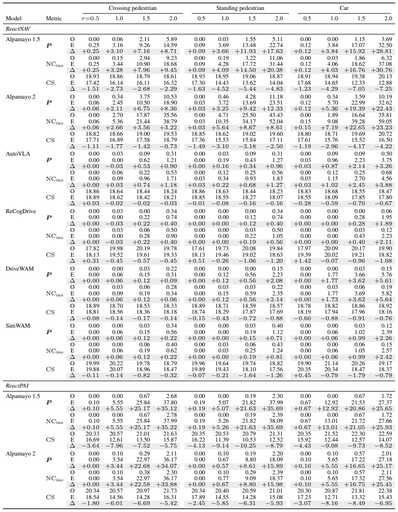
Table 9 . Detailed results on ReactNA V and ReactPAI by model, inserted object, and look-ahead timeτ (s). O and E denote the trajectories predicted from the original and edited scene, respectively, both evaluated in the edited scene, and ∆ = E−O . P and NCins are in percent and their deltas in percentage points (higher is better). CS is the mean contact speed in km/h over the samples for which both trajectories result in an at-fault collision (lower is better). Deltas are computed before rounding.
원문 · CC BY 4.0 · Theodoridis, Nikos, Mohandas, Reenu, Sharma, Sushil, Hogan, Ciarán, Sistu, Ganesh, Scanlan, Anthony, Brophy, Tim, Eising, Ciarán · ReactBench-AD: Do Driving VLAs and World-Action Models React to Imminent Hazards in Their Path? · 원문 그림 인용 · 원본 PDF 18쪽에서 그림 영역을 추출했습니다.주 지표 P는 ReactNAV에서 무사고 비율 NC와 주행 가능 영역 준수율 DAC의 곱이고, ReactPAI에서는 지도 정보가 없어 P를 NC로 둡니다. 객체에 반응하는지 여부는 원본과 편집 궤적의 ADE가 임계값보다 작은 비율인 궤적 불변 비율 TIR로 따로 봅니다.
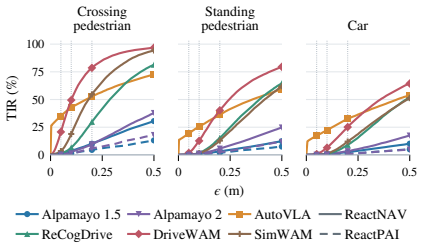
Figure 3 . Trajectory invariance rate, TIRϵ: the percentage of samples whose original and edited trajectories differ by an ADE below ϵ, i.e., for which the model essentially ignores the inserted object (higher means less reactive). Results are aggregated across all four look-ahead timesτ.
원문 · CC BY 4.0 · Theodoridis, Nikos, Mohandas, Reenu, Sharma, Sushil, Hogan, Ciarán, Sistu, Ganesh, Scanlan, Anthony, Brophy, Tim, Eising, Ciarán · ReactBench-AD: Do Driving VLAs and World-Action Models React to Imminent Hazards in Their Path? · 원문 그림 인용 · 원본 PDF 5쪽에서 그림 영역을 추출했습니다.객체 삽입에 대한 약한 반응
네 개의 VLA와 두 개의 WAM을 평가한 결과, 대부분의 경우 삽입된 객체에 대한 안전 지표 P의 개선이 작았습니다. 예외는 두 Alpamayo 모델로, 긴 전방 시간에서 ReactNAV와 ReactPAI 모두에서 큰 개선을 보였습니다.
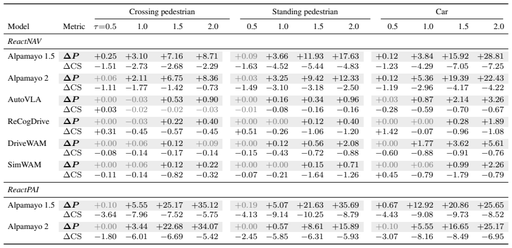
Table 1 . Results on ReactNA V and ReactPAI by model, inserted object, and look-ahead timeτ (s). ∆P is in percentage points (higher is better);∆CSis in km/h (lower is better). Gray: the paired 95% bootstrap CI includes zero.
원문 · CC BY 4.0 · Theodoridis, Nikos, Mohandas, Reenu, Sharma, Sushil, Hogan, Ciarán, Sistu, Ganesh, Scanlan, Anthony, Brophy, Tim, Eising, Ciarán · ReactBench-AD: Do Driving VLAs and World-Action Models React to Imminent Hazards in Their Path? · 원문 그림 인용 · 원본 PDF 5쪽에서 그림 영역을 추출했습니다.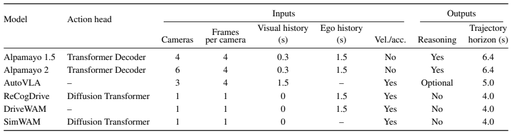
Table 8 . Comparison of the action heads, input configurations, and outputs of the evaluated models. Visual and ego history denote the temporal spans of camera observations and past ego states, respectively; a visual history of 0 s indicates a single current frame.
원문 · CC BY 4.0 · Theodoridis, Nikos, Mohandas, Reenu, Sharma, Sushil, Hogan, Ciarán, Sistu, Ganesh, Scanlan, Anthony, Brophy, Tim, Eising, Ciarán · ReactBench-AD: Do Driving VLAs and World-Action Models React to Imminent Hazards in Their Path? · 원문 그림 인용 · 원본 PDF 17쪽에서 그림 영역을 추출했습니다.그렇더라도 Alpamayo 1.5가 ReactPAI의 정지 보행자 τ=2.0 s 최선 사례에서도 안전하지 않은 궤적이 62.01%를 차지했습니다. ReactNAV에서 ΔP는 횡단 보행자에서 가장 작고 정지 차량에서 가장 컸으며, 이 순서는 거의 모든 모델에서 나타났습니다.
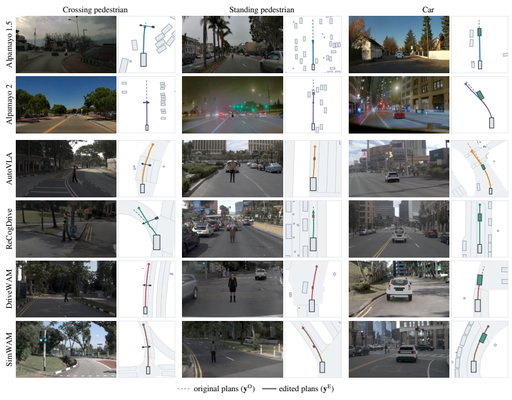
Figure 9 . Example predictions at a look-ahead time of τ= 2.0 s , one for each model and inserted object: Alpamayo 1.5 and Alpamayo 2 on ReactPAI, and the other four models on ReactNA V. Each example shows the edited front-camera image at the current frame, cropped around the inserted object, next to a bird’s-eye view of the edited scene. The arrow marks the crossing pedestrian’s motion over the 4 s horizon. Dashed and solid lines show the model’s plans for the original (yO) and edited (yE) scenes, respectively, as front-bumper paths over the first 4 s. Examples are drawn at random from the samples whose original plan collides with the inserted object.
원문 · CC BY 4.0 · Theodoridis, Nikos, Mohandas, Reenu, Sharma, Sushil, Hogan, Ciarán, Sistu, Ganesh, Scanlan, Anthony, Brophy, Tim, Eising, Ciarán · ReactBench-AD: Do Driving VLAs and World-Action Models React to Imminent Hazards in Their Path? · 원문 그림 인용 · 원본 PDF 19쪽에서 그림 영역을 추출했습니다.CoT와 학습 단계 분석
Alpamayo 모델은 자연어 CoT를 생성하므로 CoT를 분석했습니다. 삽입된 보행자에 대해 CoT는 대부분 감속이나 정지를 지시했지만, 실행된 궤적은 충돌을 피할 만큼 감속하지 않았습니다. 이는 인식과 추론보다 추론과 행동 전문가 사이의 불일치가 실패의 주원인일 수 있다는 저자의 해석입니다.
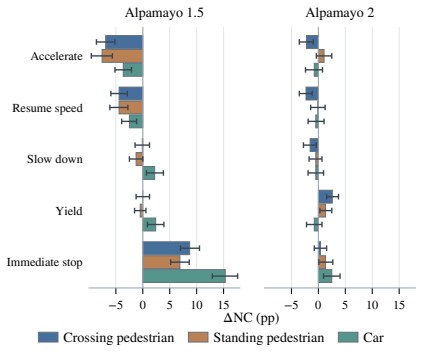
Figure 10 . Change in the no-collision rate, NC, of Alpamayo 1.5 and Alpamayo 2 on edited ReactPAI scenes atτ= 2.0 s when their CoT is replaced by a fixed one, relative to their own generated CoT. Whiskers indicate 95% bootstrap CIs.
원문 · CC BY 4.0 · Theodoridis, Nikos, Mohandas, Reenu, Sharma, Sushil, Hogan, Ciarán, Sistu, Ganesh, Scanlan, Anthony, Brophy, Tim, Eising, Ciarán · ReactBench-AD: Do Driving VLAs and World-Action Models React to Imminent Hazards in Their Path? · 원문 그림 인용 · 원본 PDF 20쪽에서 그림 영역을 추출했습니다.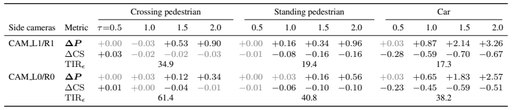
Table 12 . Fixed CoTs used in Fig. 10. Each fixed CoT replaces the model’s generated CoT verbatim, and⟨reason⟩ is filled in according to the inserted object (bottom).
원문 · CC BY 4.0 · Theodoridis, Nikos, Mohandas, Reenu, Sharma, Sushil, Hogan, Ciarán, Sistu, Ganesh, Scanlan, Anthony, Brophy, Tim, Eising, Ciarán · ReactBench-AD: Do Driving VLAs and World-Action Models React to Imminent Hazards in Their Path? · 원문 그림 인용 · 원본 PDF 21쪽에서 그림 영역을 추출했습니다.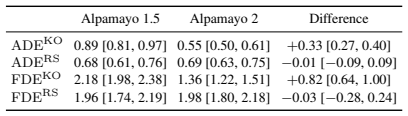
Table 13 . Attention knockout on 300 original ReactPAI samples, measured over the first 4 s. KO: CoT hidden from the action expert, with the same initial noise as the natural rollout. RS: initial noise resampled, CoT unchanged. All values are in meters; means with 95% bootstrap CIs.
원문 · CC BY 4.0 · Theodoridis, Nikos, Mohandas, Reenu, Sharma, Sushil, Hogan, Ciarán, Sistu, Ganesh, Scanlan, Anthony, Brophy, Tim, Eising, Ciarán · ReactBench-AD: Do Driving VLAs and World-Action Models React to Imminent Hazards in Their Path? · 원문 그림 인용 · 원본 PDF 21쪽에서 그림 영역을 추출했습니다.ReCogDrive와 SimWAM의 학습 단계별 체크포인트를 비교했을 때, 모든 객체에서 단계가 넘어갈수록 ΔP는 줄었고 PDMS는 늘었습니다. 특히 VLM SFT에서 IL로 넘어갈 때 정지 차량의 ΔP가 +10.39에서 +4.88로 크게 떨어졌습니다. 이 결과는 속도 20 km/h 미만 샘플과 τ=2.0 s 조건에서 측정했습니다.
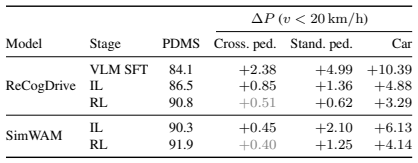
Table 2 . Safety improvement ∆P (in percentage points) on React- NA V atτ= 2.0 s for each training-stage checkpoint of ReCog- Drive and SimW AM, over samples with an initial ego-vehicle speed below 20 km/h (n= 1762 ). Gray: the paired 95% bootstrap CI of the difference to the previous training stage includes zero. PDMS on navtest as reported in [22, 53].
원문 · CC BY 4.0 · Theodoridis, Nikos, Mohandas, Reenu, Sharma, Sushil, Hogan, Ciarán, Sistu, Ganesh, Scanlan, Anthony, Brophy, Tim, Eising, Ciarán · ReactBench-AD: Do Driving VLAs and World-Action Models React to Imminent Hazards in Their Path? · 원문 그림 인용 · 원본 PDF 7쪽에서 그림 영역을 추출했습니다.ReactTrain fine-tuning과 일반화
GRPO로 위험 장면을 직접 학습하는 방법은 탐색 신호가 부족했습니다. G=32에서도 0이 아닌 기울기를 갖는 그룹은 26.3%였고, 안전한 궤적을 강화하는 비율은 1.3%에 그쳤습니다. 그래서 저자들은 위험 장면에 인공 목표 궤적을 만들어 지도 학습으로 ReCogDrive의 행동 헤드만 갱신했습니다. VLM은 고정했습니다.
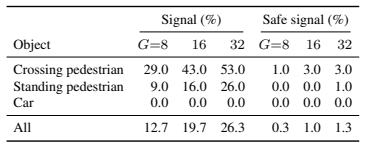
Table 14 . Percentage of GRPO groups with a non-zero gradient (Signal) and with at least one safe trajectory above the group mean reward (Safe signal) for ReCogDrive’s IL checkpoint on 300 haz- ardous scenes, as a function of group sizeG.
원문 · CC BY 4.0 · Theodoridis, Nikos, Mohandas, Reenu, Sharma, Sushil, Hogan, Ciarán, Sistu, Ganesh, Scanlan, Anthony, Brophy, Tim, Eising, Ciarán · ReactBench-AD: Do Driving VLAs and World-Action Models React to Imminent Hazards in Their Path? · 원문 그림 인용 · 원본 PDF 21쪽에서 그림 영역을 추출했습니다.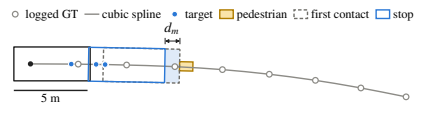
Figure 12 . Artificial target trajectory for a ReactTrain sample with a standing pedestrian (orange box) inserted at τ= 1.0 s . The ego vehicle (black box) decelerates along a cubic spline fitted to the logged ground-truth waypoints and stops (blue box) a margin dm before the pose at which it would first contact the pedestrian (dashed box).
원문 · CC BY 4.0 · Theodoridis, Nikos, Mohandas, Reenu, Sharma, Sushil, Hogan, Ciarán, Sistu, Ganesh, Scanlan, Anthony, Brophy, Tim, Eising, Ciarán · ReactBench-AD: Do Driving VLAs and World-Action Models React to Imminent Hazards in Their Path? · 원문 그림 인용 · 원본 PDF 24쪽에서 그림 영역을 추출했습니다.학습 데이터 ReactTrain은 navtrain 장면에서 만든 위험 샘플과 무해 샘플로 구성되며 총 23,484개입니다. 학습 후 ReactNAV에서 ΔP +41.4를 기록했고, 네비테스트 PDMS는 86.2에서 86.0으로 거의 변하지 않았습니다. 미관측 동물 객체에서도 ΔP +28.1을 보였고, 실제 정지 차량 장면에서는 P가 6.8에서 54.2로 올랐습니다.
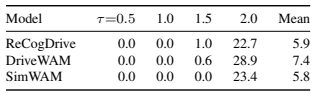
Table 6 . P (in percent) on the 308 real scenes with a stationary vehicle ahead, by look-ahead timeτ(s).
원문 · CC BY 4.0 · Theodoridis, Nikos, Mohandas, Reenu, Sharma, Sushil, Hogan, Ciarán, Sistu, Ganesh, Scanlan, Anthony, Brophy, Tim, Eising, Ciarán · ReactBench-AD: Do Driving VLAs and World-Action Models React to Imminent Hazards in Their Path? · 원문 그림 인용 · 원본 PDF 15쪽에서 그림 영역을 추출했습니다.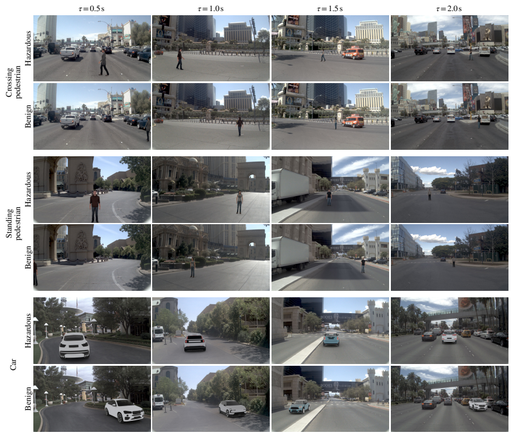
Figure 11 . Randomly selected ReactTrain samples for each inserted object and look-ahead time τ, shown in the edited front-camera image at the current frame t. Each column shows a different source sample, with its hazardous variant in the top row and its benign variant in the bottom row; both use the same asset.
원문 · CC BY 4.0 · Theodoridis, Nikos, Mohandas, Reenu, Sharma, Sushil, Hogan, Ciarán, Sistu, Ganesh, Scanlan, Anthony, Brophy, Tim, Eising, Ciarán · ReactBench-AD: Do Driving VLAs and World-Action Models React to Imminent Hazards in Their Path? · 원문 그림 인용 · 원본 PDF 23쪽에서 그림 영역을 추출했습니다.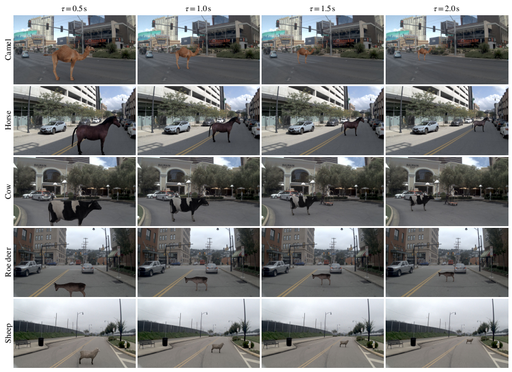
Figure 13 . Randomly selected samples of the unseen-objects test set, one per animal, for each look-ahead time τ, shown in the edited front-camera image at the current framet.
원문 · CC BY 4.0 · Theodoridis, Nikos, Mohandas, Reenu, Sharma, Sushil, Hogan, Ciarán, Sistu, Ganesh, Scanlan, Anthony, Brophy, Tim, Eising, Ciarán · ReactBench-AD: Do Driving VLAs and World-Action Models React to Imminent Hazards in Their Path? · 원문 그림 인용 · 원본 PDF 25쪽에서 그림 영역을 추출했습니다.
Figure 14 . Randomly selected samples of the real-scenes test set, shown in the unedited front-camera image at the current frame t. The target is the nearest vehicle ahead in the ego lane.
원문 · CC BY 4.0 · Theodoridis, Nikos, Mohandas, Reenu, Sharma, Sushil, Hogan, Ciarán, Sistu, Ganesh, Scanlan, Anthony, Brophy, Tim, Eising, Ciarán · ReactBench-AD: Do Driving VLAs and World-Action Models React to Imminent Hazards in Their Path? · 원문 그림 인용 · 원본 PDF 25쪽에서 그림 영역을 추출했습니다.한계
ReactBench-AD는 주로 세 가지 객체 유형과 근거리 장애물이라는 한 가지 시나리오를 다룹니다. 객체도 완전히 사실적이지 않습니다. 평가는 개방 루프로 수행되어 여러 계획 주기에 걸친 지연 반응은 평가하지 않았습니다.
또한 객체 검출 확인에서 삽입 객체는 평균 99.3%의 샘플에서 검출되었지만, 이는 검출기 기준의 확인이며 모든 인간 판단과 같지는 않습니다.
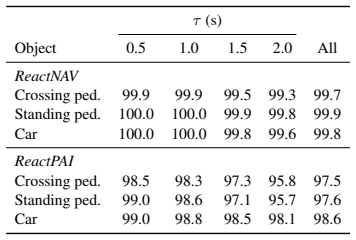
Table 5 . Share of edited samples (%) in which D-FINE-X detects the inserted object at its location, by object and look-ahead time τ.
원문 · CC BY 4.0 · Theodoridis, Nikos, Mohandas, Reenu, Sharma, Sushil, Hogan, Ciarán, Sistu, Ganesh, Scanlan, Anthony, Brophy, Tim, Eising, Ciarán · ReactBench-AD: Do Driving VLAs and World-Action Models React to Imminent Hazards in Their Path? · 원문 그림 인용 · 원본 PDF 15쪽에서 그림 영역을 추출했습니다.논문 정보
- 저자
- Theodoridis, Nikos, Mohandas, Reenu, Sharma, Sushil, Hogan, Ciarán, Sistu, Ganesh, Scanlan, Anthony, Brophy, Tim, Eising, Ciarán
- 학회·저널
- arXiv · 프리프린트
- 최초 공개일
- 2026년 11월 15일
- 등록일
- 2026년 11월 20일
- 수정일
- 2026년 11월 15일
- 버전
- v1
- arXiv
- 2611.20011
- 분류
- cs.CV · cs.AI · cs.RO
- 원문 이용 조건
- CC BY 4.0
- 제공 범위
- 논문 정보, 해설, 허용된 원문 그림
AI 해설은 논문 원문과 별개의 설명이며 오류가 있을 수 있습니다. 원문과 그림은 각 출처의 이용 조건과 따로 표시된 권리를 따릅니다.
초록
Vision-Language-Action models (VLAs) and World-Action Models (WAMs) have emerged in autonomous driving with the promise of strong generalization to long-tail scenarios. Although these models achieve state-of-the-art results on autonomous driving benchmarks, most existing benchmarks are dominated by nominal scenarios and therefore cannot test this promise. To test one such long-tail capability that is critical for safety, we introduce ReactBench-AD, a benchmark that measures how driving models react to objects that appear in the ego vehicle's path. Built on real NAVSIM and PhysicalAI-Autonomous-Vehicles scenes, ReactBench-AD composites a crossing pedestrian, a standing pedestrian, or a stationary car consistently across all camera views and history frames. Each edited scene thus forms an exact, pixel-level counterfactual pair with its original, which allows us to isolate the causal effect of the inserted object on the predicted trajectory. Evaluating four VLAs and two WAMs, we find that they react weakly, often barely at all. Finally, we test how easily one of the evaluated VLAs, ReCogDrive, can be taught to brake hard for imminent hazards: a short fine-tuning stage on edited scenes substantially improves its reactions, with the learned behavior generalizing to unseen objects and fully real scenes, at minimal cost to nominal driving. These results call into question the out-of-the-box long-tail capabilities of these models, but suggest that they can be a strong foundation for acquiring them with little additional training, highlighting the value of real or synthetic data that demonstrates the long-tail behaviors nominal datasets rarely contain. Code and data will be made publicly available.
원문 인용
Theodoridis, Nikos, Mohandas, Reenu, Sharma, Sushil, Hogan, Ciarán, Sistu, Ganesh, Scanlan, Anthony, Brophy, Tim, Eising, Ciarán (2026). ReactBench-AD: Do Driving VLAs and World-Action Models React to Imminent Hazards in Their Path?. arXiv:2611.20011v1. https://arxiv.org/abs/2611.20011v1
BibTeX
@misc{nikos2026reactbench,
  title = {{ReactBench-AD: Do Driving VLAs and World-Action Models React to Imminent Hazards in Their Path?}},
  author = {Theodoridis, Nikos and Mohandas, Reenu and Sharma, Sushil and Hogan, Ciarán and Sistu, Ganesh and Scanlan, Anthony and Brophy, Tim and Eising, Ciarán},
  year = {2026},
  eprint = {2611.20011},
  archivePrefix = {arXiv},
  url = {https://arxiv.org/abs/2611.20011v1}
}