논문 해설
EEGFaceSem: An EEG Benchmark with Paired Generative Latents for Semantic Visual Modeling
EEGFaceSem: 의미적 시각 모델링을 위한 짝지어진 생성 잠재 표현을 갖춘 EEG 벤치마크
- 연구 문제 EEG 기반 시각 의미 연구는 고정 이미지 자극의 한계로 속성 통제가 어려웠으며, EEGFaceSem은 생성 잠재 벡터와 EEG를 짝지은 대규모 데이터셋을 제시합니다.
고정 이미지 자극의 한계와 EEGFaceSem의 설계 목적
EEG 기반 시각 의미 연구는 흔히 고정된 이미지 모음에서 자극을 골라 쓰기 때문에, 특정 의미 속성만 바꾸고 저수준 시각 특성을 통제하기 어렵습니다. EEGFaceSem은 이 문제를 해결하기 위해 progressive GAN을 사용해 얼굴 자극을 생성합니다. 자극은 CelebA로 사전 학습된 progressive GAN의 512차원 잠재 벡터에서 샘플링되며, 데이터셋에는 각 자극을 만든 잠재 벡터가 함께 포함됩니다. 따라서 이 데이터셋은 EEG 기록과 생성 잠재 공간을 직접 짝지어 연구할 수 있는 자원이 됩니다. 이 논문은 30명의 참가자에게서 얻은 67,200개의 시간 고정 EEG 기록을 제공합니다.
다만 이 논문이 다루는 범위는 단일 시행 의미 분류, 의미 방향 편집, 조건부 이미지 생성이며, 그 밖의 시각 처리 과제는 직접 다루지 않습니다.
생성 잠재 벡터 기반 자극과 RSVP 기록 절차
이 논문은 70,000장의 얼굴 이미지를 progressive GAN에서 512차원 다변량 정규분포로부터 샘플링해 생성합니다. 생성된 이미지는 한 연구자가 수동으로 선별해 시각적 결함과 비현실적 특징을 제거한 뒤, 시각 속성에 따라 smiling, not smiling, female, male, young, old, dark hair, blond hair의 여덟 의미 그룹으로 나눕니다. 각 과제에서 참가자는 해당 속성을 기준으로 표적과 비표적 이미지를 구분하며, 실험은 과제마다 4개 블록으로 구성되어 전체 32개 블록이 됩니다. 한 블록은 표적 20개와 비표적 50개, 합계 70개의 이미지를 RSVP 방식으로 500 ms 간격으로 제시합니다.
참가자는 수동 반응 없이 이미지를 관찰하며, 표적 속성과 일치할 때 속으로 표시하도록 지시받습니다. 이 설계는 자극 속성의 통제와 시간 고정 기록을 함께 얻기 위한 것입니다.
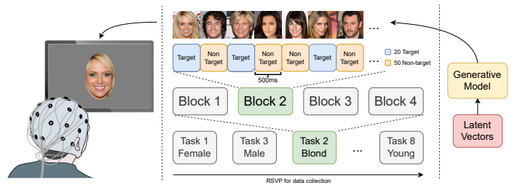
Figure 1 : Overview of the data acquisition pipeline, from generative stimulus creation to neural recording. Central to our paradigm, visual stimuli are synthesized by passing latent vectors through a pre-trained generative model. During the experiment, a participant views a sequence of these generated faces presented in a rapid serial visual presentation (RSVP) stream. For each task (e.g., ’smiling’), each stimulus is contextually defined as a ’target’ or ’non-target’, as shown by the corresponding label sequence. This procedure is repeated across multiple blocks for each of the eight semantic tasks, allowing for the collection of a rich set of time-locked EEG responses.
원문 · CC BY 4.0 · Jun Ma, Michiel M. Spapé, Keith M. Davis, Tuukka Ruotsalo · EEGFaceSem: An EEG Benchmark with Paired Generative Latents for Semantic Visual Modeling · 원문 그림 인용 · 원본 PDF 2쪽에서 그림 영역을 추출했습니다.단일 시행 분류 벤치마크의 세 가지 학습 전략
벤치마크는 target과 non-target을 구분하는 이진 분류를 과제마다 수행하며, 주요 지표로 AUC를 사용합니다. 입력은 자극 시작을 기준으로 -200 ms부터 +900 ms까지의 32채널 EEG 에포크, 즉 32×1101 행렬입니다. 단일 피험자 설정은 한 참가자의 데이터로만 학습과 검증을 수행하고, 교차 피험자 설정은 LOSO 교차 검증으로 학습되지 않은 참가자에 대한 일반화를 평가합니다. 피험자 적응 설정은 교차 피험자 모델을 대상 피험자의 일부 데이터로 미세 조정하여 평가합니다. 교차 피험자 설정에서 EEGNet의 평균 AUC는 0.7715±0.0412로 가장 높았습니다. 피험자 적응 설정에서는 EEGNet이 0.8063±0.0427로 가장 높았고, 단일 피험자 설정에서 EEGNet의 평균은 0.7416±0.0513입니다.
이 결과는 과제와 참가자 평균에서 얻은 값이며, EEGPT는 단순한 MLP와 EEGNet보다 높은 성능을 보이지 않았습니다. 저자들은 그 이유를 큰 파라미터 수가 적응에 더 많은 데이터를 요구하거나 pre-training 데이터와 과제 사이의 차이 때문일 수 있다고 해석합니다.
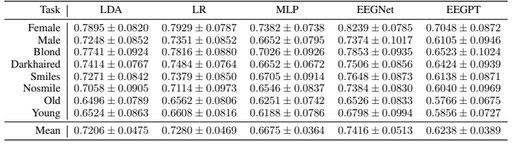
Table 4 : Performance of the single-subject classifier on all tasks, evaluated using 5-fold cross- validation with explicit labels. Values are reported as the mean AUC ± standard deviation calculated across all test folds.
원문 · CC BY 4.0 · Jun Ma, Michiel M. Spapé, Keith M. Davis, Tuukka Ruotsalo · EEGFaceSem: An EEG Benchmark with Paired Generative Latents for Semantic Visual Modeling · 원문 그림 인용 · 원본 PDF 6쪽에서 그림 영역을 추출했습니다.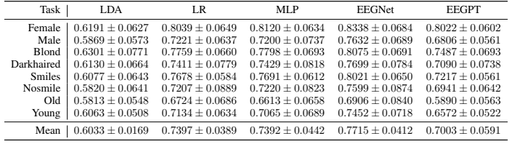
Table 5 : Performance of the cross-subject classifier on all tasks, evaluated using leave-one-subject-out cross-validation with explicit labels. Values are reported as the mean AUC ± standard deviation calculated across all test folds.
원문 · CC BY 4.0 · Jun Ma, Michiel M. Spapé, Keith M. Davis, Tuukka Ruotsalo · EEGFaceSem: An EEG Benchmark with Paired Generative Latents for Semantic Visual Modeling · 원문 그림 인용 · 원본 PDF 7쪽에서 그림 영역을 추출했습니다.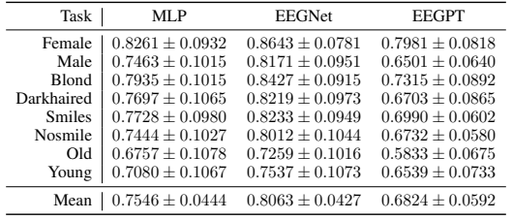
Table 6 : Performance of the subject-adapted classifier on all tasks, evaluated using 5-fold cross- validation with explicit labels. Values are reported as the mean AUC ± standard deviation calculated across all test folds. Models that do not support finetuning are not included.
원문 · CC BY 4.0 · Jun Ma, Michiel M. Spapé, Keith M. Davis, Tuukka Ruotsalo · EEGFaceSem: An EEG Benchmark with Paired Generative Latents for Semantic Visual Modeling · 원문 그림 인용 · 원본 PDF 7쪽에서 그림 영역을 추출했습니다.교차 피험자 다수결 집계의 결과와 해석 범위
이 논문은 각 자극이 모든 30명의 참가자에게 한 번씩 제시된다는 구조를 이용해, 자극마다 LOSO 단일 시행 예측을 모은 뒤 다수결로 결합합니다. 집계 결과의 확신도는 이긴 클래스의 평균 확률로 정의됩니다. EEGNet의 집계 AUC는 0.9539±0.0287이며, 표준편차는 1,000회 부트스트랩으로 추정되었습니다. 이 값은 단일 시행 교차 피험자 결과보다 크게 높지만, 여러 참가자의 예측을 결합한 자극 수준 집계이므로 단일 시행 디코딩 성능과 같은 조건의 결과로 볼 수는 없습니다. 저자들은 이 차이가 개별 시행의 잡음과 개인차를 집단 신호가 상쇄한다는 점을 보여 준다고 해석합니다.
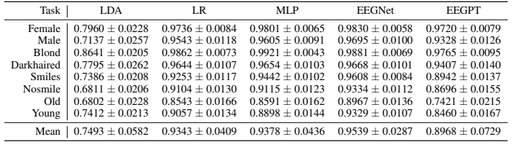
Table 7 : Performance of cross-subject voting under the LOSO strategy: per-stimulus predictions from all participants are combined via majority voting. The reported AUC is computed after combining individual model predictions. The standard deviation is estimated using 1,000 bootstrap resamples.
원문 · CC BY 4.0 · Jun Ma, Michiel M. Spapé, Keith M. Davis, Tuukka Ruotsalo · EEGFaceSem: An EEG Benchmark with Paired Generative Latents for Semantic Visual Modeling · 원문 그림 인용 · 원본 PDF 8쪽에서 그림 영역을 추출했습니다.의미 방향 편집 응용
의미 방향 편집에서는 한 피험자의 EEG 데이터로 LDA 분류기를 학습해 blond와 dark hair를 구분합니다. 이후 선형 SVR이 LDA의 결정 함수를 잠재 벡터로부터 예측하도록 학습되며, 그 가중치 벡터가 잠재 공간의 의미 방향이 됩니다. 새 이미지의 잠재 벡터를 이 방향을 따라 스칼라 α만큼 이동하면, 이미지가 해당 피험자의 blondness 개념 쪽으로 편집됩니다. 논문은 α를 키울 때 dark hair 이미지가 blond 이미지로 바뀌는 시각적 예를 제시합니다. 또한 self-supervised contrastive alignment로 만든 결합 EEG-잠재 임베딩에서도 라벨 없이 표적과 비표적 시행이 분리되는 UMAP 결과를 보여 줍니다.
이 응용의 검증은 대표 예시와 정성적 편집 결과에 기반하므로, 이 결과를 일반 편집 성능의 정량 지표로 해석하지는 않습니다.
뇌 기반 조건부 이미지 생성의 블라인드 평가
조건부 생성에서는 MLP 뇌 디코더가 EEG로부터 binary 과제 라벨을 예측하고, 그 예측이 512차원 잠재 공간의 AAE 조건 라벨로 쓰입니다. 비교군은 수동 주석 라벨을 쓰는 explicit 모델, 무작위로 섞은 라벨을 쓰는 random 모델, 그리고 뇌 기반 라벨을 쓰는 brain 모델입니다. 각 과제에서 소스 잠재 벡터 20개로 40쌍의 이미지를 만들고, 블라인드 주석자가 좌우 순서를 무작위로 바꾼 상태에서 목표 속성을 더 잘 나타내는 이미지를 고릅니다. 8개 과제 평균 정답 선택률은 brain이 0.747, random이 0.516, explicit이 0.825입니다. 이 결과는 뇌 기반 라벨이 명시 라벨에 가까운 의미 정보를 가진다는 증거로 제시되었고, 과제별 세부 수치는 부록의 Table 9에 제시됩니다.
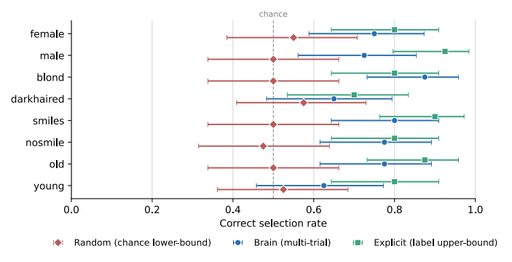
Figure 4 : Per-task correct-selection rate of the AAE-generated paired images under blinded paired annotation. Markers: fraction of 40 pairs whose target image was correctly selected; whiskers: Wilson 95 % binomial CIs; dashed line: chance ( 0.5). Random sits on chance everywhere; brain is well above chance on every task and approaches the explicit upper bound. Means: brain 0.747, random0.516, explicit0.825.
원문 · CC BY 4.0 · Jun Ma, Michiel M. Spapé, Keith M. Davis, Tuukka Ruotsalo · EEGFaceSem: An EEG Benchmark with Paired Generative Latents for Semantic Visual Modeling · 원문 그림 인용 · 원본 PDF 10쪽에서 그림 영역을 추출했습니다.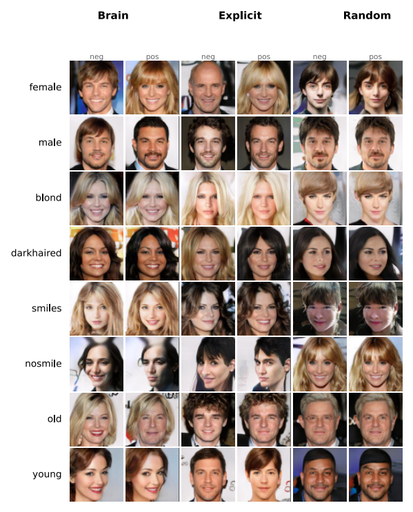
Figure 5 : Paired generations under brain, explicit-label, and random-label conditioning, one example pair per (task, model) at training step 1,000. The brain and explicit columns flip the target attribute (e.g. blond/dark, smiling/not) while preserving identity-level features; the random column does not.
원문 · CC BY 4.0 · Jun Ma, Michiel M. Spapé, Keith M. Davis, Tuukka Ruotsalo · EEGFaceSem: An EEG Benchmark with Paired Generative Latents for Semantic Visual Modeling · 원문 그림 인용 · 원본 PDF 16쪽에서 그림 영역을 추출했습니다.데이터 범위와 자극 검증의 한계
이 데이터셋의 가장 큰 한계는 자극이 CelebA 스타일의 얼굴에 한정된다는 점입니다. 그 결과 데이터셋은 원래 분포의 인구통계적 편향을 상속하며, 통제된 얼굴 벤치마크로 보는 것이 적절합니다. 또한 데이터셋은 시각 자극만 포함하는 단일 모달리티이므로 다중 모달 자극으로의 확장은 향후 과제로 남습니다. 자극 분리 검증은 CLIP ViT-L/14의 제로샷 프로브로 수행되었으며, 네 대비 모두 AUC가 0.816 이상으로 보고되었습니다. 다만 이 검증은 외부 모델 기반 점검이며 인간 지각 판단을 직접 측정한 것이 아닙니다. 잔여 쌍별 phi 결합은 절대값 0.015 이하라고 보고되었지만, 이것이 모든 잠재 속성 혼동을 제거했다는 뜻은 아닙니다.

Table 3 : External attribute audit: per-contrast separation of the screened stimuli under CLIP ViT-L/14 zero-shot probing. Each row reports the CLIP softmax probability of the positive attribute on the target and non-target image sets, together with the AUC.
원문 · CC BY 4.0 · Jun Ma, Michiel M. Spapé, Keith M. Davis, Tuukka Ruotsalo · EEGFaceSem: An EEG Benchmark with Paired Generative Latents for Semantic Visual Modeling · 원문 그림 인용 · 원본 PDF 4쪽에서 그림 영역을 추출했습니다.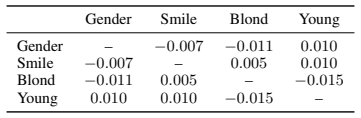
Table 10 : Residual pairwise attribute association introduced by screening: ∆Φ = Φ(screened)− Φ(random). Values close to zero indicate that the screening does not introduce additional attribute confounds beyond those already present in the generator’s output distribution.
원문 · CC BY 4.0 · Jun Ma, Michiel M. Spapé, Keith M. Davis, Tuukka Ruotsalo · EEGFaceSem: An EEG Benchmark with Paired Generative Latents for Semantic Visual Modeling · 원문 그림 인용 · 원본 PDF 17쪽에서 그림 영역을 추출했습니다.논문 정보
- 저자
- Jun Ma, Michiel M. Spapé, Keith M. Davis, Tuukka Ruotsalo
- 학회·저널
- arXiv · 프리프린트
- 최초 공개일
- 2026년 11월 7일
- 등록일
- 2026년 11월 10일
- 수정일
- 2026년 11월 7일
- 버전
- v1
- arXiv
- 2611.10781
- 분류
- cs.LG
- 원문 이용 조건
- CC BY 4.0
- 제공 범위
- 논문 정보, 해설, 허용된 원문 그림
AI 해설은 논문 원문과 별개의 설명이며 오류가 있을 수 있습니다. 원문과 그림은 각 출처의 이용 조건과 따로 표시된 권리를 따릅니다.
초록
Electroencephalography (EEG) is widely used to measure brain activity for brain-computer interface applications for its non-invasive nature and high temporal resolution. However, progress in modeling the neural responses to visual semantics has been limited by a reliance on fixed image collections that lack the fine-grained control needed to isolate fine-grained changes in visual features and their relation to perception. In this work, we present EEGFaceSem, a large-scale dataset pairing high-quality EEG with photorealistic face images synthesized from a generative model. We provide the generative latent vector for each stimulus, enabling research into the continuous mapping between a visual latent space and neural representations. Each participant's brain responses were recorded while they attended to specific semantic features (e.g., smiling, hair color) in a rapid serial visual presentation paradigm. The dataset contains EEG signals from 30 participants, totaling 67,200 time-locked EEG recordings. We present benchmarks for single-trial semantic classification under single-subject, cross-subject, and subject-adapted settings, as well as for cross-subject voting that aggregates per-stimulus predictions across participants. We further demonstrate the dataset's unique utility with two complementary applications: deriving semantic directions in the latent space for brain-supervised image editing, and conditioning a generative model on brain-decoded labels for brain-supervised image generation. Our dataset paves the way for advancing brain-computer interfaces (BCI) for semantic-level visual saliency detection and brain-supervised generative modeling. Our dataset and code are openly released at OSF (https://osf.io/2guk3/) and at HuggingFace https://huggingface.co/datasets/yefllower/EEGFaceSem.
원문 인용
Jun Ma, Michiel M. Spapé, Keith M. Davis, Tuukka Ruotsalo (2026). EEGFaceSem: An EEG Benchmark with Paired Generative Latents for Semantic Visual Modeling. arXiv:2611.10781v1. https://arxiv.org/abs/2611.10781v1
BibTeX
@misc{ma2026eegfacesem,
  title = {{EEGFaceSem: An EEG Benchmark with Paired Generative Latents for Semantic Visual Modeling}},
  author = {Jun Ma and Michiel M. Spapé and Keith M. Davis and Tuukka Ruotsalo},
  year = {2026},
  eprint = {2611.10781},
  archivePrefix = {arXiv},
  url = {https://arxiv.org/abs/2611.10781v1}
}