논문 해설
Rubric Curriculum RL: Exploiting the Generation-Verification Gap in Non-Verifiable Domains
루브릭 커리큘럼 강화학습: 검증 불가능한 영역에서 생성-검증 격차 활용
- 연구 문제 비검증 영역에서는 정답 검증과 보상이 어려워 정책 학습이 쉽게 보상 해킹에 빠집니다. RcRL은 쌍대 선호와 루브릭 기준 커리큘럼을 결합해 이 문제를 다룹니다.
- 연구 방법 RcRL은 동결된 판단 모델의 쌍대 win-rate 보상을 루브릭 기준별 가중 커리큘럼으로 계산하고, 이를 GRPO로 학습합니다.
- 주요 결과 FictionBench에서 RcRL은 기반 모델 대비 73.9% 승률을 얻었고, 인간 평가에서는 전체 선호 70.5%를 얻었습니다. HealthBench에서는 고정 루브릭 설정으로 전체 분할 14.60%, 합의 부분집합 25.38%의 점수 향상을 보고합니다.
비검증 영역에서 강화학습이 어려운 이유
창작 글쓰기나 건강 상담처럼 정답을 자동으로 확인할 수 없는 영역에서는 검증 가능한 보상을 쓰기 어렵습니다. 원문은 인간 주석이 비싸고, 별도의 오프라인 데이터셋은 대규모여야 하며, 학습된 보상 모델은 보상 해킹에 취약하다고 정리합니다. 이 논문은 새로운 데이터나 더 강한 교사 모델 없이 모델이 스스로 생성 결과를 평가하는 방식으로 이 문제를 다룹니다.
저자들은 판단이 생성보다 쉽다는 생성-검증 간극을 출발점으로 삼습니다. 그러나 루브릭 기반 판단은 부정확하고 고정되어 있어 정책이 판단기를 과적합하거나 보상 해킹할 수 있습니다. 따라서 필요한 것은 고정되지 않은 목표와 더 식별력 있는 쌍대 신호를 함께 제공하는 학습 방식입니다.
생성-검증 간극의 정의
논문은 품질 함수 Q(x, y)를 [0, 1] 범위로 두고, 모델이 한 번 생성한 응답의 기대 품질 G와 N개의 독립 응답 중 자기 순위로 고른 응답의 기대 품질 V(N)을 비교합니다. 간극 조건은 어떤 N에서 V(N) − G가 0보다 큰 것입니다. 이는 모델이 한 번 생성할 때보다 더 높은 품질의 응답을 자기 선택으로 고를 수 있다는 뜻입니다.
이 정의는 창작 글쓰기에서 간극이 존재하는지를 실험으로 확인하는 틀입니다. 원문은 Best-of-N 결과와 모델 크기에 따른 차이를 함께 보고하며, 이 실험의 Q는 강한 외부 판단 모델의 정규화된 루브릭 점수로 구현됩니다. 따라서 이 정의는 자기 선택이 기대 품질을 높일 수 있는지에 관한 조건부 정의이며, 모든 영역에서 성립한다는 주장이 아닙니다.
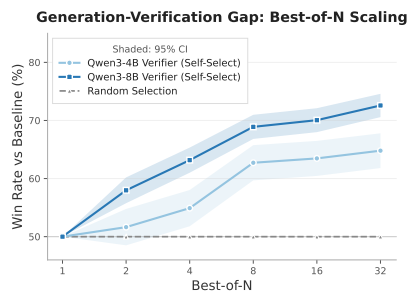
Figure 3 . Best-of-N inference scaling on FictionBench. Win rate of self-selected Best-of-N against the N = 1 baseline, judged by GPT-5.2 as ground truth. Win rates exceed 50% from N = 2 onwards (Claim 1), grow monotonically with N, and are uniformly larger for the 8B model than the 4B model (Claim 2).
원문 · CC BY 4.0 · Sumeet Ramesh Motwani, Tejas Krishnan, Alistair Letcher, Charles London, Suhaas Bhat, Huitian Jiao, Philip Torr, Riashat Islam, Christopher Summerfield, Jakob Foerster, Christian Schroeder de Witt, Qilong Gu, Shital Shah · Rubric Curriculum RL: Exploiting the Generation-Verification Gap in Non-Verifiable Domains · 원문 그림 인용 · 원본 PDF 4쪽에서 그림 영역을 추출했습니다.쌍대 win-rate 보상과 커리큘럼
RcRL은 동결된 초기 스냅샷 판단 모델 π_judge를 사용합니다. 각 루브릭 항목 r(m)에서 판단 모델은 한 롤아웃 o_i가 다른 롤아웃 o_j보다 나은지를 비교합니다. 롤아웃의 보상은 그 항목에서 다른 롤아웃들과의 평균 선호율이며, 식은 R_pair(m)(q, o_i) = 1/(G−1) 곱하기 Σ_{j≠i} y_i≻j(m)입니다. 여기서 G는 같은 질문에 대한 롤아웃 수이고 y는 선호 여부를 나타내는 0 또는 1입니다.
커리큘럼은 활성 기준 인덱스 k(t)를 n 단계마다 올리며 새 기준을 추가합니다. 새로 추가된 기준은 가중치 1/2을 받고, 나머지 1/2은 이전 기준들에 균등하게 나눕니다. 최종 커리큘럼 쌍대 보상은 가중합 Σ_m w(m)_t R_pair(m)으로 계산됩니다. 이 구조는 한 기준을 집중적으로 학습하게 하면서도 이전 기준이 잊히지 않도록 설계되었습니다. 설정에서 창작 글쓰기는 n = 100, HealthBench는 n = 50을 사용합니다.
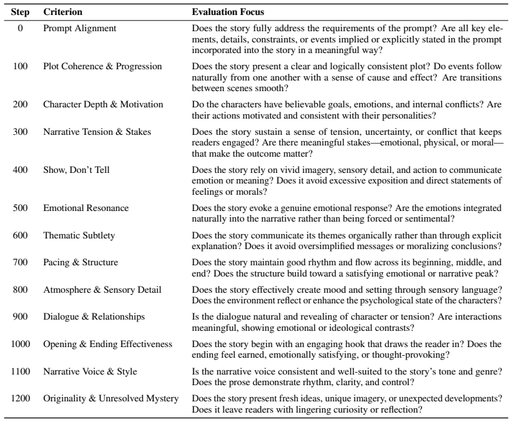
Table 7 .Creative writing rubric criteria in curriculum order.Each criterion is introduced at the indicated training step and remains active for all subsequent steps. The ordering progresses from foundational craft elements (prompt alignment, plot coherence) through character and tension, to stylistic refinement (voice, originality). This progression reflects a pedagogical approach: models first learn to write coherent, on-topic stories before optimizing for subtler qualities like thematic depth and distinctive voice.
원문 · CC BY 4.0 · Sumeet Ramesh Motwani, Tejas Krishnan, Alistair Letcher, Charles London, Suhaas Bhat, Huitian Jiao, Philip Torr, Riashat Islam, Christopher Summerfield, Jakob Foerster, Christian Schroeder de Witt, Qilong Gu, Shital Shah · Rubric Curriculum RL: Exploiting the Generation-Verification Gap in Non-Verifiable Domains · 원문 그림 인용 · 원본 PDF 23쪽에서 그림 영역을 추출했습니다.창작 글쓰기 평가 결과
FictionBench에서는 Qwen3-4B 기반 모델을 기준으로 RcRL의 승률을 73.9%로 보고하며, 이는 RaR의 57.5%보다 높습니다. 같은 벤치마크에서 RcRL의 ELO는 1181이고 RaR는 1052입니다. 이 승률은 프롬프트 20개와 모델당 2개 생성, GPT-5.2 판단의 40쌍과 7배 오버샘플링(280회 비교) 조건에서 얻은 것입니다.
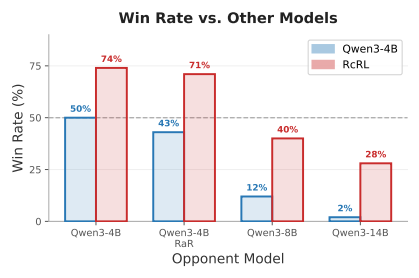
Figure 5 .Head-to-head win rates on FictionBench.RcRL achieves substantial gains over the Qwen3-4B baseline against all opponents: +28% against RaR, +28% against Qwen3-8B, and +26% against Qwen3-14B.
원문 · CC BY 4.0 · Sumeet Ramesh Motwani, Tejas Krishnan, Alistair Letcher, Charles London, Suhaas Bhat, Huitian Jiao, Philip Torr, Riashat Islam, Christopher Summerfield, Jakob Foerster, Christian Schroeder de Witt, Qilong Gu, Shital Shah · Rubric Curriculum RL: Exploiting the Generation-Verification Gap in Non-Verifiable Domains · 원문 그림 인용 · 원본 PDF 6쪽에서 그림 영역을 추출했습니다.인간 평가에서는 500개 프롬프트-응답 쌍을 세 명의 주석자가 비교했고, 전체 선호에서 RcRL이 70.5%를 얻었습니다. Creative Writing V3에서는 GPT-5.2, Claude 4.5 Opus, DeepSeek V3.2 판단을 사용해 각 판단기 안에서 ELO를 비교합니다. 이 ELO 값은 판단기 사이에서 직접 비교할 수 없다고 원문이 밝히므로, 세 판단기 결과를 하나의 순위로 합치지 않습니다.

Table 2 .Creative Writing Bench v3 evaluation results.Three frontier models (GPT-5.2, Claude 4.5 Opus, Deepseek V3.2) serve as independent judges, evaluating outputs from each method via pairwise comparisons. We report ELO ratings (baseline anchored at 1000), rubric scores (0–100 scale), and win rates against the Qwen 3 4B baseline (%). ELO ratings reflect relative rankings within each judge and are not comparable across judges. Best results per metric and judge inbold.
원문 · CC BY 4.0 · Sumeet Ramesh Motwani, Tejas Krishnan, Alistair Letcher, Charles London, Suhaas Bhat, Huitian Jiao, Philip Torr, Riashat Islam, Christopher Summerfield, Jakob Foerster, Christian Schroeder de Witt, Qilong Gu, Shital Shah · Rubric Curriculum RL: Exploiting the Generation-Verification Gap in Non-Verifiable Domains · 원문 그림 인용 · 원본 PDF 7쪽에서 그림 영역을 추출했습니다.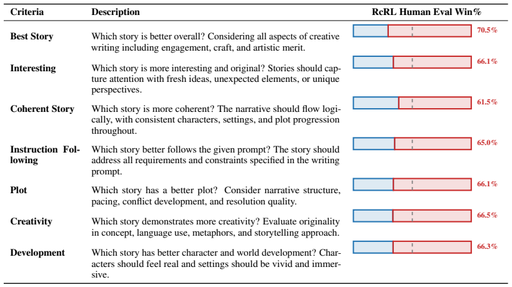
Table 10 .Results from human expert annotations.Preference bars (right) show win rates of RcRL over the baseline Qwen 3 4B model across criteria, based on 500 pairwise comparisons.
원문 · CC BY 4.0 · Sumeet Ramesh Motwani, Tejas Krishnan, Alistair Letcher, Charles London, Suhaas Bhat, Huitian Jiao, Philip Torr, Riashat Islam, Christopher Summerfield, Jakob Foerster, Christian Schroeder de Witt, Qilong Gu, Shital Shah · Rubric Curriculum RL: Exploiting the Generation-Verification Gap in Non-Verifiable Domains · 원문 그림 인용 · 원본 PDF 31쪽에서 그림 영역을 추출했습니다.쌍대 보상과 커리큘럼의 절제 결과
절대 점수를 쓰는 RcRL 변형은 쌍대 보상을 제거한 설정이며, 원문은 이 변형이 FictionBench 승률을 18.2% 낮춘다고 보고합니다. 커리큘럼을 제거한 RaR 계열에서는 엔트로피가 빠르게 줄어 H_ratio가 300 단계 안에 0.83으로 떨어졌다고 기록됩니다. 따라서 이 결과는 쌍대 보상과 커리큘럼 각각이 특정 조건에서 성능과 출력 다양성 보존에 기여함을 보여 주는 증거입니다.
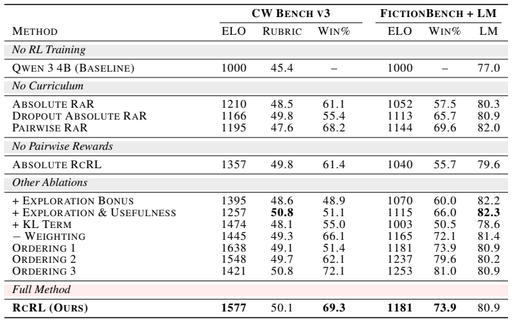
Table 3 .Ablation study and baseline comparisons.We evaluate the contribution of each component of RcRL. “ +” denotes adding a component to the base method, “−” denotes removing from the full method. All models trained from Qwen 3 4B. Win rates computed against the base model. Best results inbold.
원문 · CC BY 4.0 · Sumeet Ramesh Motwani, Tejas Krishnan, Alistair Letcher, Charles London, Suhaas Bhat, Huitian Jiao, Philip Torr, Riashat Islam, Christopher Summerfield, Jakob Foerster, Christian Schroeder de Witt, Qilong Gu, Shital Shah · Rubric Curriculum RL: Exploiting the Generation-Verification Gap in Non-Verifiable Domains · 원문 그림 인용 · 원본 PDF 8쪽에서 그림 영역을 추출했습니다.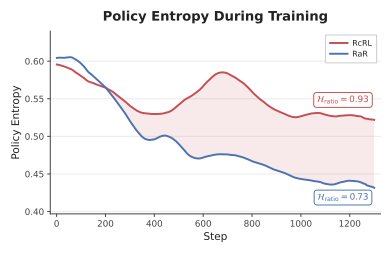
Figure 9 .Policy entropy during training.The static rubric base- line exhibits a steady decline in entropy, indicating mode collapse toward a narrow set of outputs. RcRL maintains consistently higher entropy throughout training.
원문 · CC BY 4.0 · Sumeet Ramesh Motwani, Tejas Krishnan, Alistair Letcher, Charles London, Suhaas Bhat, Huitian Jiao, Philip Torr, Riashat Islam, Christopher Summerfield, Jakob Foerster, Christian Schroeder de Witt, Qilong Gu, Shital Shah · Rubric Curriculum RL: Exploiting the Generation-Verification Gap in Non-Verifiable Domains · 원문 그림 인용 · 원본 PDF 9쪽에서 그림 영역을 추출했습니다.여기서 H_ratio는 최종 엔트로피와 초기 엔트로피의 비율이며, 원문에서 RcRL의 비율은 0.93, RaR의 비율은 0.73으로 보고됩니다. 이 값은 엔트로피 하락 정도를 요약하는 지표이며, 하락량 자체를 다른 대상에 옮겨 쓰면 안 됩니다. 쌍대 보상의 효과는 과제마다 다르게 나타나므로, 같은 설정이 모든 영역에서 같은 크기의 이득을 준다고 일반화하지 않습니다.
HealthBench 교차 도메인 결과
HealthBench에서는 Qwen3-4B에 고정된 13개 일반 기준을 사용하며, 기준은 한 번에 하나씩 50 단계마다 추가됩니다. 원문은 전체 분할에서 RcRL이 기반 모델보다 14.60% 높은 점수를 얻었고 RaR는 8.26%였다고 보고합니다. 합의 부분집합에서는 RcRL이 25.38%, RaR가 7.53%입니다.
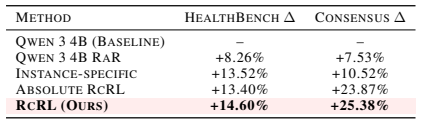
Table 4 .HealthBench cross-domain results.Score improvement over Qwen 3 4B on full HealthBench and the consensus subset (criteria validated by multiple annotators). Best inbold.
원문 · CC BY 4.0 · Sumeet Ramesh Motwani, Tejas Krishnan, Alistair Letcher, Charles London, Suhaas Bhat, Huitian Jiao, Philip Torr, Riashat Islam, Christopher Summerfield, Jakob Foerster, Christian Schroeder de Witt, Qilong Gu, Shital Shah · Rubric Curriculum RL: Exploiting the Generation-Verification Gap in Non-Verifiable Domains · 원문 그림 인용 · 원본 PDF 9쪽에서 그림 영역을 추출했습니다.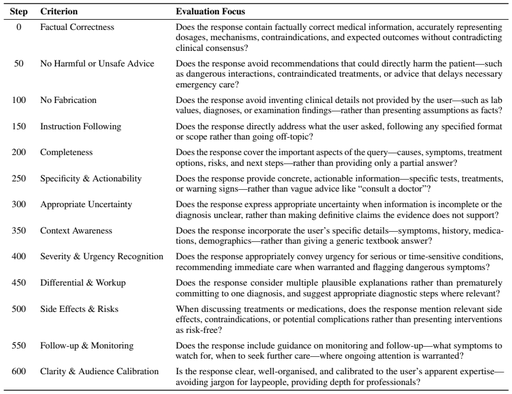
Table 8 .HealthBench rubric criteria in curriculum order.Each criterion is introduced at the indicated training step and remains active for all subsequent steps. Compared to creative writing, there is no ordering justification, with criteria synthesized from both the HealthBench instance-specific rubrics and rubric criteria from Yang et al. (2026).
원문 · CC BY 4.0 · Sumeet Ramesh Motwani, Tejas Krishnan, Alistair Letcher, Charles London, Suhaas Bhat, Huitian Jiao, Philip Torr, Riashat Islam, Christopher Summerfield, Jakob Foerster, Christian Schroeder de Witt, Qilong Gu, Shital Shah · Rubric Curriculum RL: Exploiting the Generation-Verification Gap in Non-Verifiable Domains · 원문 그림 인용 · 원본 PDF 25쪽에서 그림 영역을 추출했습니다.이 결과는 사례별 루브릭 대신 고정된 일반 기준을 쓴 설정에서 얻은 것입니다. 원문은 HealthBench의 사례별 루브릭을 쓴 기준선에서 전체 분할 13.52%, 합의 부분집합 10.52%를 보고하므로, 고정 루브릭 RcRL이 이 기준선보다 높은 값을 얻었다고 읽습니다. 다만 절대 점수 변형은 전체 분할에서 13.40%, 합의 부분집합에서 23.87%로 RcRL과 가까운 값을 보입니다.
판단 비용과 평가 불확실성
원문은 쌍대 보상 커리큘럼이 롤아웃 배치 크기에 대해 이차적으로 확장되고 학습 단계 수에 대해서는 선형으로 확장된다고 밝힙니다. 8개 롤아웃과 13개 기준의 설정은 다룰 수 있다고 보고되지만, 더 큰 G나 더 세밀한 루브릭에서는 토너먼트형 근사가 필요하다고 제안됩니다. 이는 현재 방식의 비용이 제한 요인임을 보여 줍니다.
창작 글쓰기 평가는 본질적으로 주관적입니다. 원문은 전문가 주석자 사이의 일치도가 중간 수준이라고 보고하며, 주석자 간 Fleiss' κ는 0.548입니다. 따라서 승률과 ELO 차이는 상대적 품질의 지표로 읽어야 하며, 정밀한 점 추정으로 읽지 않습니다. 또한 엔트로피 보존이나 반복률 같은 결과가 모든 출력 품질을 직접 측정하는 것은 아닙니다.
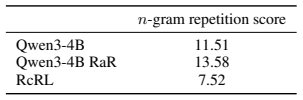
Table 5 .N-gram repetition rates (lower is better).
원문 · CC BY 4.0 · Sumeet Ramesh Motwani, Tejas Krishnan, Alistair Letcher, Charles London, Suhaas Bhat, Huitian Jiao, Philip Torr, Riashat Islam, Christopher Summerfield, Jakob Foerster, Christian Schroeder de Witt, Qilong Gu, Shital Shah · Rubric Curriculum RL: Exploiting the Generation-Verification Gap in Non-Verifiable Domains · 원문 그림 인용 · 원본 PDF 19쪽에서 그림 영역을 추출했습니다.논문 정보
- 저자
- Sumeet Ramesh Motwani, Tejas Krishnan, Alistair Letcher, Charles London, Suhaas Bhat, Huitian Jiao, Philip Torr, Riashat Islam, Christopher Summerfield, Jakob Foerster, Christian Schroeder de Witt, Qilong Gu, Shital Shah
- 학회·저널
- arXiv · 프리프린트
- 최초 공개일
- 2026년 11월 4일
- 등록일
- 2026년 11월 6일
- 수정일
- 2026년 11월 4일
- 버전
- v1
- arXiv
- 2611.06244
- 분류
- cs.LG · cs.AI
- 원문 이용 조건
- CC BY 4.0
- 제공 범위
- 논문 정보, 해설, 허용된 원문 그림
AI 해설은 논문 원문과 별개의 설명이며 오류가 있을 수 있습니다. 원문과 그림은 각 출처의 이용 조건과 따로 표시된 권리를 따릅니다.
초록
Reinforcement learning with verifiable rewards (RLVR) has led to significant gains in math and code generation. Extending these gains to open-ended domains remains challenging: ground-truth verification is unavailable, human annotation is expensive, and learned reward models are prone to reward hacking. The generation-verification gap, where judging good outputs is easier than producing them, offers a potential path to improvement. However, rubric-based judges are often imprecise and stationary, so policies can overfit or reward hack them. We introduce Rubric Curriculum RL (RcRL), which exploits this gap without new data, human annotations, or stronger teacher models. We combine pairwise preferences over rollouts with a curriculum over rubric criteria, yielding a more discriminative signal than absolute scoring and a non-stationary objective. Whereas baselines plateau within a few hundred steps, RcRL preserves output entropy and keeps improving past 1000 steps. On creative writing, RcRL achieves a 70.5% human win rate against the base model, with gains across benchmarks and judges. On HealthBench, RcRL improves over the base model by 14.6% (full set) and 25.4% (consensus subset), outperforming all training baselines, including instance-specific rubrics.
원문 인용
Sumeet Ramesh Motwani, Tejas Krishnan, Alistair Letcher, Charles London, Suhaas Bhat, Huitian Jiao, Philip Torr, Riashat Islam, Christopher Summerfield, Jakob Foerster, Christian Schroeder de Witt, Qilong Gu, Shital Shah (2026). Rubric Curriculum RL: Exploiting the Generation-Verification Gap in Non-Verifiable Domains. arXiv:2611.06244v1. https://arxiv.org/abs/2611.06244v1
BibTeX
@misc{motwani2026rubric,
  title = {{Rubric Curriculum RL: Exploiting the Generation-Verification Gap in Non-Verifiable Domains}},
  author = {Sumeet Ramesh Motwani and Tejas Krishnan and Alistair Letcher and Charles London and Suhaas Bhat and Huitian Jiao and Philip Torr and Riashat Islam and Christopher Summerfield and Jakob Foerster and Christian Schroeder de Witt and Qilong Gu and Shital Shah},
  year = {2026},
  eprint = {2611.06244},
  archivePrefix = {arXiv},
  url = {https://arxiv.org/abs/2611.06244v1}
}