논문 해설
What Entropy-Based View Selection Cannot See: An Audit of Test-Time Adaptation for Vision-Language Models
엔트로피 기반 뷰 선택이 보지 못하는 것: Vision-Language 모델을 위한 테스트 타임 적응 점검
- 연구 문제 테스트 시점 적응에서 view 선택 점수가 실제로 어떤 정보를 쓰는지가 충분히 검증되지 않았습니다.
- 연구 방법 파이프라인 단계별로 기여를 분해하고 엔트로피 점수의 정보량을 AUC로 측정합니다.
기존 view 선택 점수에 대한 질문
CLIP 같은 vision-language 모델은 학습하지 않은 범주도 분류할 수 있지만, 테스트 이미지의 스타일이나 출처가 학습 데이터와 다르면 정확도가 떨어집니다. 이를 줄이기 위해 TPT, ZERO, ADTE 같은 test-time adaptation 방법은 이미지마다 무작위 crop과 flip으로 64개의 view를 만들고, 그중 예측 엔트로피가 낮은 view만 골라 평균 예측에 씁니다. 여기서 view 선택 점수가 실제로 무엇을 보고 있는지는 충분히 검증되지 않았습니다. 이 논문은 파이프라인의 나머지 단계를 고정한 채 점수 자체를 감사합니다.
엔트로피 점수의 실제 역할 분해
논문은 augment, score, select, aggregate, gradient step의 각 단계를 나머지 두 단계를 고정한 채 따로 측정했습니다. 같은 view와 캐시된 임베딩, readout을 써서 차이를 해당 단계의 효과로 귀속시켰습니다. 엔트로피가 쓰는 입력은 모델이 view마다 내는 예측 분포이며, 논문은 reducible error에서 그 점수가 정답 view를 얼마나 잘 가려내는지 AUC로 측정했습니다. 이 AUC 측정은 평균 예측으로 오류 집합을 고른 뒤 생기는 편향을 막기 위해 view를 절반씩 나누는 통제 설계를 사용했습니다.
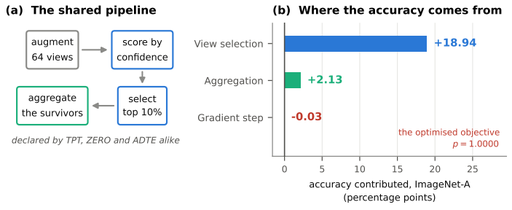
Figure 1 :The pipeline, and which of its stages produces the accuracy. (a)The augment, score, select, aggregate recipe TPT, ZERO and ADTE each declare.(b)Each stage measured with the other two held fixed, on ImageNet-A, inpercentage points: the absolute gap between two accura- cies, so40%to59%is19of them. Selection produces almost all of the gain; the gradient step is indistinguishable from no update under a paired McNemar test [McNemar, 1947]. Concurrent work agrees by different means [Huang et al., 2026]; we claim the decomposition and its mechanism, not the direction.
원문 · CC BY 4.0 · Sivasuthan Sukumar, Uthayasanker Thayasivam · What Entropy-Based View Selection Cannot See: An Audit of Test-Time Adaptation for Vision-Language Models · 원문 그림 인용 · 원본 PDF 2쪽에서 그림 영역을 추출했습니다.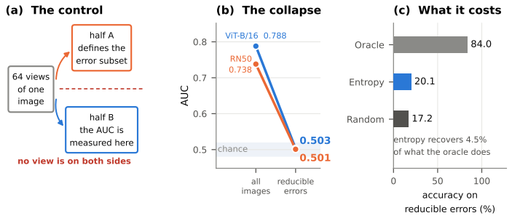
Figure 2 :The entropy score separates useful views from useless ones only where a better choice cannot help. (a)The control: reducible errors are defined on one random half of an image’s views and the score evaluated on the disjoint half, so restricting the population cannot contaminate the measurement.(b)Area under the ROC curve (AUC, Sec. 3), where1.0orders correct views perfectly above incorrect ones and0.5carries no information; on reducible errors it falls to chance on both encoders.(c)The consequence in accuracy on those images.
원문 · CC BY 4.0 · Sivasuthan Sukumar, Uthayasanker Thayasivam · What Entropy-Based View Selection Cannot See: An Audit of Test-Time Adaptation for Vision-Language Models · 원문 그림 인용 · 원본 PDF 3쪽에서 그림 영역을 추출했습니다.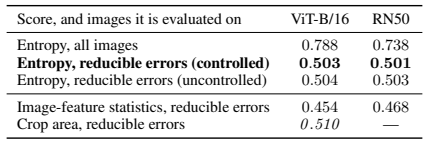
Table 2 :The entropy score is at chance exactly where a better choice would help.Mean AUC over six datasets per encoder, where0.5means the score orders correct and incorrect views no better than chance. Orientation matters: a value below0.5is anti-predictive, and reversing the image- feature row gives0.546and0.532. That row tests statistics computed from the cached embeddings rather than the output distribution, and the crop-area row a quantity that is not a function of the model at all.
원문 · CC BY 4.0 · Sivasuthan Sukumar, Uthayasanker Thayasivam · What Entropy-Based View Selection Cannot See: An Audit of Test-Time Adaptation for Vision-Language Models · 원문 그림 인용 · 원본 PDF 13쪽에서 그림 영역을 추출했습니다.정보 한계와 crop 면적 신호
논문은 점수가 출력 분포의 순서 통계만 보기 때문에 어떤 클래스를 선호하는지 표현하지 못한다고 분석했습니다. 이에 대한 대안으로 augmentation이 이미 샘플링한 crop 면적을 라벨 없이 기록해 view 순위에 결합했습니다. 이는 5-fold cross-fitting으로 두 파라미터를 고른 결과이며, 기준선 엔트로피는 튜닝하지 않았습니다.

Table 1 :Selection rules on the15-dataset benchmark, CLIP ViT-B/16, with identical views, cache and readout so thatonlythe selection rule differs. The baseline is never tuned; our parameters are cross-fitted. ∗ marksp <0.05under paired McNemar [McNemar, 1947]. Crop geometry is positive on14of15datasets and its largest gains are those the label-free measurement flags in advance (Fig. 3).
원문 · CC BY 4.0 · Sivasuthan Sukumar, Uthayasanker Thayasivam · What Entropy-Based View Selection Cannot See: An Audit of Test-Time Adaptation for Vision-Language Models · 원문 그림 인용 · 원본 PDF 7쪽에서 그림 영역을 추출했습니다.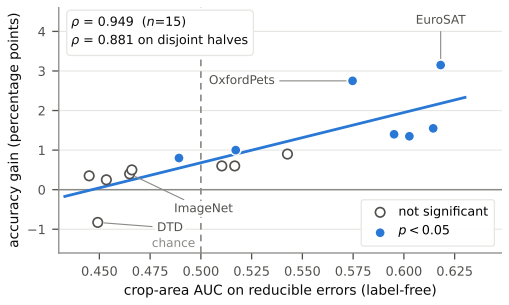
Figure 3 :The gain is predictable before the method is run.One point per dataset; the horizontal axis is how well a view’scrop areaseparates correct from incorrect views on reducible errors, an AUC computed with no method in the loop. Datasets left of the chance line gain nothing, as a real signal rather than a tuning artefact should. Per-dataset gains are in Tab. 1.
원문 · CC BY 4.0 · Sivasuthan Sukumar, Uthayasanker Thayasivam · What Entropy-Based View Selection Cannot See: An Audit of Test-Time Adaptation for Vision-Language Models · 원문 그림 인용 · 원본 PDF 8쪽에서 그림 영역을 추출했습니다.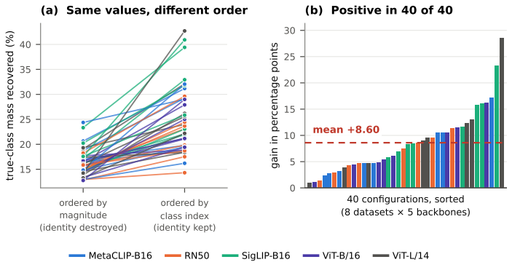
Figure 4 :What the model’s response cannot see.Both arms use the same regressor, the same training rows, and feature sets of identical dimension holding the identical value multiset; only the ordering differs.(a)Every configuration improves when class identity is preserved.(b)The gap, sorted: positive in40/40, mean8.60percentage points. The capacity ladder had saturated in all40, so under-fitting does not explain it. Per-configuration numbers in Tab. 5.
원문 · CC BY 4.0 · Sivasuthan Sukumar, Uthayasanker Thayasivam · What Entropy-Based View Selection Cannot See: An Audit of Test-Time Adaptation for Vision-Language Models · 원문 그림 인용 · 원본 PDF 15쪽에서 그림 영역을 추출했습니다.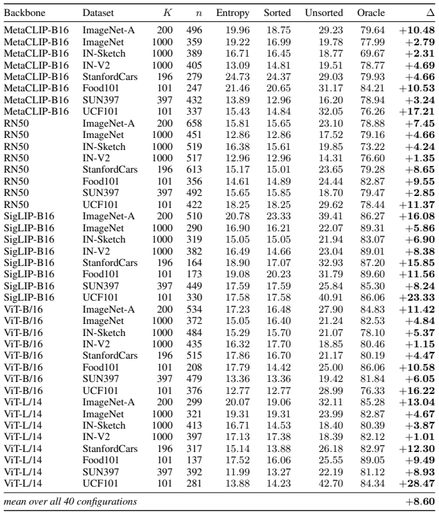
Table 5 :Keeping class identity is worth8.60percentage points, positive in40/40.“Sorted” and “Unsorted” are the two matched feature sets; “Oracle” ranks by the true-class mass directly. Share of the oracle gap:8.4%for the best class-symmetric fit,21.7%for the class-asymmetric one.
원문 · CC BY 4.0 · Sivasuthan Sukumar, Uthayasanker Thayasivam · What Entropy-Based View Selection Cannot See: An Audit of Test-Time Adaptation for Vision-Language Models · 원문 그림 인용 · 원본 PDF 16쪽에서 그림 영역을 추출했습니다.남은 문제
논문은 crop 면적 신호가 더 강한 scoring 함수와 결합될 때 추가 이득이 크지 않았다고 보고했습니다. 두 신호는 가산적이라고 사전 등록했지만 실제 이득은 예측보다 작았습니다. 또한 crop 면적이 정확도를 올리는 기전은 제시하지 못했고, 제안 규칙은 두 파라미터를 cross-fit하므로 튜닝이 없는 방법이라고 주장하지 않습니다. ZERO와 ADTE의 코드는 실행하지 않고 설정 기술에 근거해 적용 범위를 논증했습니다.
논문 정보
- 저자
- Sivasuthan Sukumar, Uthayasanker Thayasivam
- 학회·저널
- arXiv · 프리프린트
- 최초 공개일
- 2026년 11월 10일
- 등록일
- 2026년 11월 13일
- 수정일
- 2026년 11월 10일
- 버전
- v1
- arXiv
- 2611.14686
- 분류
- cs.CV · cs.AI
- 원문 이용 조건
- CC BY 4.0
- 제공 범위
- 논문 정보, 해설, 허용된 원문 그림
AI 해설은 논문 원문과 별개의 설명이며 오류가 있을 수 있습니다. 원문과 그림은 각 출처의 이용 조건과 따로 표시된 권리를 따릅니다.
초록
Vision-language models such as CLIP can classify images into categories they were never explicitly trained to recognize, but accuracy degrades when test images differ in style or source from their training data. A common remedy generates randomly cropped and flipped copies of each test image, called views, and combines their predictions. Since some views miss the object, methods must identify which views to trust. The dominant approach uses prediction entropy to measure confidence and retains the most certain views. Other methods use signals such as embedding typicality. Despite repeated refinements of these scoring functions, the information they rely on, the model's own response to each view, remains largely unexamined. We investigate this choice while holding other pipeline stages fixed. First, we show that view selection, rather than the gradient update, accounts for almost all accuracy gains. We then examine whether entropy identifies useful views when predictions are wrong, despite at least one view predicting the correct class. In these cases, entropy ranks correct views above incorrect ones no better than chance, recovering only about one-twentieth of the accuracy recovered by an oracle over the same views. This finding holds across two image encoders and under a control ruling out an obvious statistical artifact. An exact analysis explains this limitation: entropy measures confidence but not which class a view favors. We identify an unused signal already available in the augmentation pipeline: the fraction of the original image retained by each crop. Ranking views by this quantity improves accuracy on 14 of 15 benchmark datasets over entropy and on 11 of 15 over the strongest scoring function tested. A pre-method measurement also predicts which datasets benefit.
원문 인용
Sivasuthan Sukumar, Uthayasanker Thayasivam (2026). What Entropy-Based View Selection Cannot See: An Audit of Test-Time Adaptation for Vision-Language Models. arXiv:2611.14686v1. https://arxiv.org/abs/2611.14686v1
BibTeX
@misc{sukumar2026what,
  title = {{What Entropy-Based View Selection Cannot See: An Audit of Test-Time Adaptation for Vision-Language Models}},
  author = {Sivasuthan Sukumar and Uthayasanker Thayasivam},
  year = {2026},
  eprint = {2611.14686},
  archivePrefix = {arXiv},
  url = {https://arxiv.org/abs/2611.14686v1}
}