논문 해설
Performance Analysis of Machine Learning Centered Workload Prediction Models for Cloud
클라우드를 위한 머신러닝 중심 워크로드 예측 모델의 성능 분석
- 연구 문제 클라우드 자원 수요는 시간에 따라 크게 변하므로, 미래 워크로드를 미리 예측하는 모델이 필요합니다.
- 연구 방법 다섯 범주의 머신러닝 워크로드 예측 모델을 같은 데이터 전처리와 공통 플랫폼에서 구현하고 비교합니다.
- 주요 결과 원문 보고에 따르면 평균 MSE는 EQNN이 가장 낮고 ENN이 가장 높으며, 학습 시간은 DL이 가장 짧은 순서로 나타납니다.
클라우드 워크로드 예측이 필요한 이유
클라우드 서비스 제공자는 가상화된 물리 자원을 공유하며 수요 변화에 대응해야 합니다. 자원 수요는 시간에 따라 크게 변동하고 버스트성 트래픽이 나타나므로, 과부하나 과잉 할당이 발생하기 쉽습니다. 원문은 워크로드를 미리 예측하면 자원 예약, 응답 시간 단축, SLA 위반 감소에 도움이 된다고 설명합니다. 이 논문은 이러한 예측에 쓰이는 머신러닝 기반 모델을 분류하고 공통 플랫폼에서 비교하는 것을 목표로 합니다.
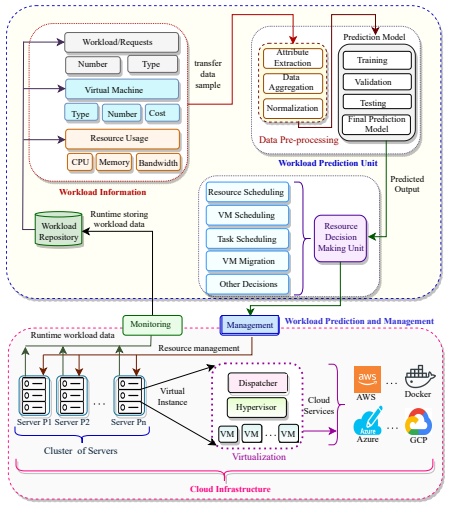
Fig. 1 : Schematic representation and application of Work- load Prediction
원문 · CC BY 4.0 · Deepika Saxena, Jitendra Kumar, Ashutosh Kumar Singh, Stefan Schmid · Performance Analysis of Machine Learning Centered Workload Prediction Models for Cloud · 원문 그림 인용 · 원본 PDF 2쪽에서 그림 영역을 추출했습니다.예측 파이프라인과 정규화
예측 절차는 원시 자원 데이터의 추출, 예측 윈도우 크기에 따른 집계, [xa, xb] 범위로의 정규화, 슬라이딩 윈도우 입력 행렬 구성으로 이루어집니다. 원문은 xa를 0.0001, xb를 0.999로 설정했다고 밝힙니다. 정규화된 값은 훈련, 검증, 테스트 데이터로 나뉘며, 정확도 기준을 만족하면 학습된 모델이 검증을 거쳐 최종 예측 모델로 확정됩니다. 기준을 만족하지 못하면 반복 학습 과정으로 되돌아갑니다.
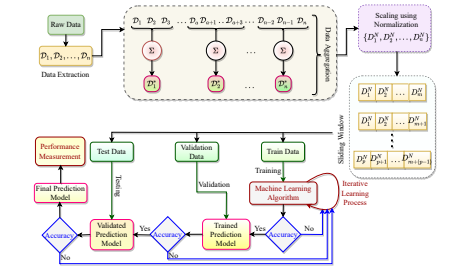
Fig. 2 : Load prediction operational flow
원문 · CC BY 4.0 · Deepika Saxena, Jitendra Kumar, Ashutosh Kumar Singh, Stefan Schmid · Performance Analysis of Machine Learning Centered Workload Prediction Models for Cloud · 원문 그림 인용 · 원본 PDF 3쪽에서 그림 영역을 추출했습니다.다섯 범주의 모델 구조
논문은 진화 신경망, 심층 학습, 하이브리드, 앙상블, 양자 신경망의 다섯 범주로 모델을 나눕니다. 진화 신경망 계열에서는 차분 진화나 블랙홀 최적화가 신경망 가중치를 조정합니다. LSTM은 셀 상태와 게이트를 통해 장기 의존성을 학습하고, 오토인코더와 DBN, DNN은 각각 특징 압축, 제한 볼츠만 머신 층, 다층 신경망 구조를 사용합니다. 앙상블 방법은 여러 Base Prediction 모델의 출력을 가중치 기반 투표로 결합합니다. 양자 신경망은 큐빗 뉴런과 큐빗 가중치를 사용하며, 원문은 이 방향이 아직 초기 단계라고 서술합니다.
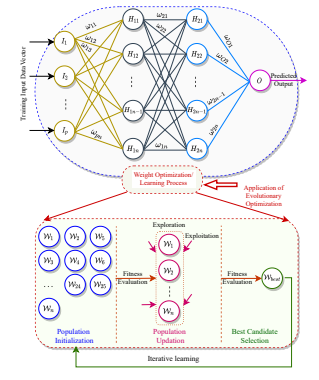
Fig. 4 : ENN based load prediction
원문 · CC BY 4.0 · Deepika Saxena, Jitendra Kumar, Ashutosh Kumar Singh, Stefan Schmid · Performance Analysis of Machine Learning Centered Workload Prediction Models for Cloud · 원문 그림 인용 · 원본 PDF 5쪽에서 그림 영역을 추출했습니다.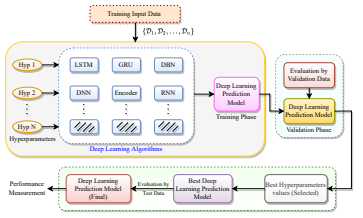
Fig. 5 : Deep Learning based Prediction Operative View
원문 · CC BY 4.0 · Deepika Saxena, Jitendra Kumar, Ashutosh Kumar Singh, Stefan Schmid · Performance Analysis of Machine Learning Centered Workload Prediction Models for Cloud · 원문 그림 인용 · 원본 PDF 6쪽에서 그림 영역을 추출했습니다.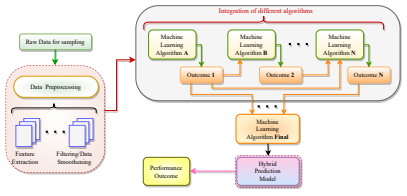
Fig. 6 : Hybrid Prediction Model
원문 · CC BY 4.0 · Deepika Saxena, Jitendra Kumar, Ashutosh Kumar Singh, Stefan Schmid · Performance Analysis of Machine Learning Centered Workload Prediction Models for Cloud · 원문 그림 인용 · 원본 PDF 8쪽에서 그림 영역을 추출했습니다.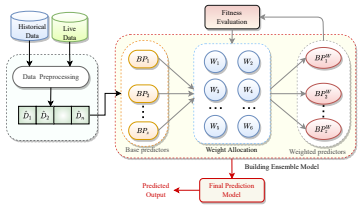
Fig. 7 : Ensemble Prediction Model
원문 · CC BY 4.0 · Deepika Saxena, Jitendra Kumar, Ashutosh Kumar Singh, Stefan Schmid · Performance Analysis of Machine Learning Centered Workload Prediction Models for Cloud · 원문 그림 인용 · 원본 PDF 9쪽에서 그림 영역을 추출했습니다.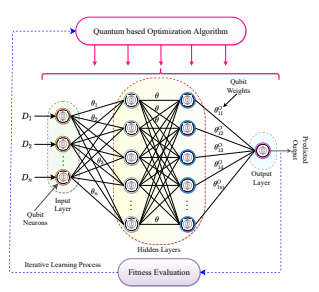
Fig. 8 : Quantum Neural Network
원문 · CC BY 4.0 · Deepika Saxena, Jitendra Kumar, Ashutosh Kumar Singh, Stefan Schmid · Performance Analysis of Machine Learning Centered Workload Prediction Models for Cloud · 원문 그림 인용 · 원본 PDF 11쪽에서 그림 영역을 추출했습니다.공통 플랫폼과 데이터셋
실험은 Intel Xeon Silver 4114 두 개, 40코어, 2.20GHz, 128GB RAM 서버에서 Ubuntu 16.04 LTS와 Python 3.7로 수행되었습니다. 데이터셋은 Google Cluster Data의 CPU와 메모리 사용량, PlanetLab 가상 머신의 CPU 사용률입니다. 예측 구간은 5분에서 60분까지이며, 원문 표에서 훈련 데이터 비율은 70%로 제시됩니다. 평가 지표는 MSE와 MAE이며 절대 오차 빈도와 학습 시간도 함께 비교됩니다.

TABLE 7 : Characteristics of evaluated workloads
원문 · CC BY 4.0 · Deepika Saxena, Jitendra Kumar, Ashutosh Kumar Singh, Stefan Schmid · Performance Analysis of Machine Learning Centered Workload Prediction Models for Cloud · 원문 그림 인용 · 원본 PDF 12쪽에서 그림 영역을 추출했습니다.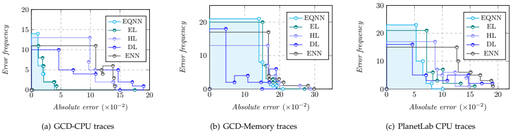
Fig. 12 : Absolute Error Frequency
원문 · CC BY 4.0 · Deepika Saxena, Jitendra Kumar, Ashutosh Kumar Singh, Stefan Schmid · Performance Analysis of Machine Learning Centered Workload Prediction Models for Cloud · 원문 그림 인용 · 원본 PDF 15쪽에서 그림 영역을 추출했습니다.오차 지표에서 나타난 순서
평균 MSE 추세는 EQNN이 가장 낮고 ENN이 가장 높으며, 원문은 EQNN, EL, HL, DL, ENN 순서로 정리합니다. 이 순서는 원문이 보고한 실험 조건에서의 관찰이며, 예측 구간이 길어질수록 모델 간 차이가 커진다고 설명합니다. 학습 시간은 DL, HL, ENN, EQNN, EL 순서로 보고되어 정확도와 비용 사이의 절충이 나타납니다. MAE도 같은 순서를 따른다고 원문은 서술합니다.
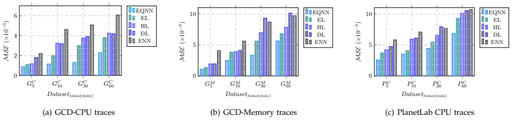
Fig. 9 : Mean Squared Error
원문 · CC BY 4.0 · Deepika Saxena, Jitendra Kumar, Ashutosh Kumar Singh, Stefan Schmid · Performance Analysis of Machine Learning Centered Workload Prediction Models for Cloud · 원문 그림 인용 · 원본 PDF 13쪽에서 그림 영역을 추출했습니다.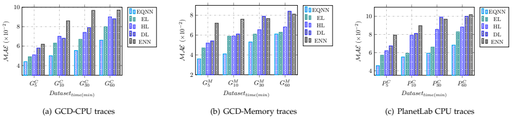
Fig. 10 : Mean Absolute Error
원문 · CC BY 4.0 · Deepika Saxena, Jitendra Kumar, Ashutosh Kumar Singh, Stefan Schmid · Performance Analysis of Machine Learning Centered Workload Prediction Models for Cloud · 원문 그림 인용 · 원본 PDF 14쪽에서 그림 영역을 추출했습니다.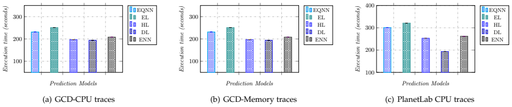
Fig. 11 : Training time consumption
원문 · CC BY 4.0 · Deepika Saxena, Jitendra Kumar, Ashutosh Kumar Singh, Stefan Schmid · Performance Analysis of Machine Learning Centered Workload Prediction Models for Cloud · 원문 그림 인용 · 원본 PDF 14쪽에서 그림 영역을 추출했습니다.결과 해석의 범위
이 결과는 논문이 사용한 세 가지 워크로드 트레이스와 지정된 예측 구간, 70% 훈련 비율에서 얻어진 것입니다. 원문은 ENN의 평가 오차가 큰 이유를 진화 최적화 방식의 특성과 연결해 설명하지만, 이는 저자의 해석입니다. 또한 원문은 QNN 기반 방법이 아직 초기 단계에 있다고 밝히므로 양자 신경망의 일반적 우위를 이 결과만으로 주장할 수 없습니다. 원문 표에 보고된 개별 선행 연구 수치는 각 연구의 데이터와 조건에서 나온 값이므로 이 논문의 통제 실험과 동일하게 취급하지 않습니다.
논문 정보
- 저자
- Deepika Saxena, Jitendra Kumar, Ashutosh Kumar Singh, Stefan Schmid
- 학회·저널
- arXiv · 프리프린트
- 최초 공개일
- 2023년 2월 5일
- 등록일
- 2026년 11월 6일
- 수정일
- 2023년 2월 5일
- 버전
- v1
- arXiv
- 2302.02452
- DOI
- 10.1109/tpds.2023.3240567
- 분류
- cs.DC
- 원문 이용 조건
- CC BY 4.0
- 제공 범위
- 논문 정보, 해설, 허용된 원문 그림
AI 해설은 논문 원문과 별개의 설명이며 오류가 있을 수 있습니다. 원문과 그림은 각 출처의 이용 조건과 따로 표시된 권리를 따릅니다.
초록
The precise estimation of resource usage is a complex and challenging issue due to the high variability and dimensionality of heterogeneous service types and dynamic workloads. Over the last few years, the prediction of resource usage and traffic has received ample attention from the research community. Many machine learning-based workload forecasting models have been developed by exploiting their computational power and learning capabilities. This paper presents the first systematic survey cum performance analysis-based comparative study of diversified machine learning-driven cloud workload prediction models. The discussion initiates with the significance of predictive resource management followed by a schematic description, operational design, motivation, and challenges concerning these workload prediction models. Classification and taxonomy of different prediction approaches into five distinct categories are presented focusing on the theoretical concepts and mathematical functioning of the existing state-of-the-art workload prediction methods. The most prominent prediction approaches belonging to a distinct class of machine learning models are thoroughly surveyed and compared. All five classified machine learning-based workload prediction models are implemented on a common platform for systematic investigation and comparison using three distinct benchmark cloud workload traces via experimental analysis. The essential key performance indicators of state-of-the-art approaches are evaluated for comparison and the paper is concluded by discussing the trade-offs and notable remarks.
원문 인용
Deepika Saxena, Jitendra Kumar, Ashutosh Kumar Singh, Stefan Schmid (2023). Performance Analysis of Machine Learning Centered Workload Prediction Models for Cloud. arXiv:2302.02452v1. https://doi.org/10.1109/tpds.2023.3240567
BibTeX
@article{saxena2023performance,
  title = {{Performance Analysis of Machine Learning Centered Workload Prediction Models for Cloud}},
  author = {Deepika Saxena and Jitendra Kumar and Ashutosh Kumar Singh and Stefan Schmid},
  year = {2023},
  eprint = {2302.02452},
  archivePrefix = {arXiv},
  doi = {10.1109/tpds.2023.3240567},
  url = {https://arxiv.org/abs/2302.02452v1}
}