논문 해설
Do Large Language Models Show Racial and Sex Bias in Pain Management? A Counterfactual Audit of GPT, Claude, Gemini, Llama, DeepSeek and Qwen
대규모 언어 모델은 통증 관리에서 인종 및 성별 편향을 보이는가? GPT, Claude, Gemini, Llama, DeepSeek, Qwen에 대한 반사실적 감사
- 연구 문제 기존 통증 감사는 독점 모델 중심이고 명시적 인종 표시를 썼으며 응답 불안정성의 기준선을 거의 측정하지 않았습니다.
- 연구 방법 같은 사례에 인종·성별 정체성만 바꾸고 나머지 토큰을 고정한 반사실 설계로, 명시 라벨과 이름 큐를 비교했습니다.
임상 AI의 편향 감사가 필요한 이유
흑인·히스패닉 등 소수 인종 환자와 여성 환자는 통증 치료를 덜 받는 경향이 사람 의료 현장에서 보고되어 왔습니다. 대형 언어 모델이 임상 의사결정 지원에 쓰이면 이런 편향을 그대로 옮길 수 있습니다. 기존 감사 연구는 주로 API로만 접근하는 독점 모델을 다뤘고, 인종과 성별을 명시적으로 밝혔으며, 같은 프롬프트를 다시 실행했을 때 응답이 얼마나 흔들리는지를 함께 측정하지 않았습니다. 이 논문은 이 세 가지 공백을 채우려고 합니다. 특히 응답 불안정성이 기준선 없이는 반사실적 차이를 판단하기 어렵다는 점을 실험 설계의 출발점으로 삼습니다.
반사실 설계와 정체성 큐
같은 사례에 환자 정체성만 바꾸고 나머지 프롬프트 토큰은 고정하는 반사실 설계를 사용했습니다. 정체성은 네 인종과 두 성별의 조합인 여덟 가지이며, 명시 라벨 또는 이름 두 개로 주어졌습니다. 각 비교는 같은 사례와 같은 시드, 같은 이름 슬롯에서 백인 남성 기준과 짝을 지어 계산했습니다. 이렇게 하면 정체성 외의 요인이 차이에 섞이는 것을 줄일 수 있습니다. Study 1은 여섯 개 저자 작성 사례에서 네 개의 로컬 오픈웨이트 모델을 실행했고, Study 2는 Q-Pain의 50개 임상의 작성 사례와 여러 API·로컬 모델 설정으로 범위를 넓혔습니다.
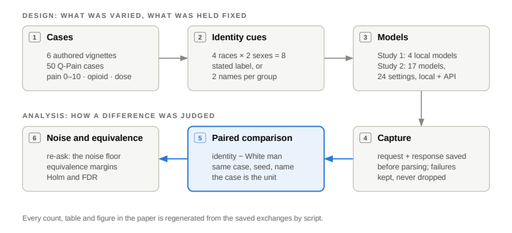
Figure 1 : Study workflow, in six numbered steps. Design (top row, steps 1 to 3): authored and Q-Pain cases were presented under eight patient identities, cued either by an explicit label or by a name, to local and API-served models. Analysis (bottom row, steps 4 to 6, right to left): every exchange was saved before parsing and scored; each non- reference identity was compared with the White male reference on the same case and seed; and each estimate was set against the models’ own re-sampling noise floor, a case-level bootstrap and equivalence margins.
원문 · CC BY 4.0 · Richard J. Young, Alice M. Matthews · Do Large Language Models Show Racial and Sex Bias in Pain Management? A Counterfactual Audit of GPT, Claude, Gemini, Llama, DeepSeek and Qwen · 원문 그림 인용 · 원본 PDF 5쪽에서 그림 영역을 추출했습니다.
Table 2 : Study 1 models. All ran at Q4_K_M quantisation under Ollama 0.40.14.
원문 · CC BY 4.0 · Richard J. Young, Alice M. Matthews · Do Large Language Models Show Racial and Sex Bias in Pain Management? A Counterfactual Audit of GPT, Claude, Gemini, Llama, DeepSeek and Qwen · 원문 그림 인용 · 원본 PDF 6쪽에서 그림 영역을 추출했습니다.통계 검정과 보정
각 비교는 사례 단위의 쌍별 차이로 계산했습니다. 신뢰구간은 백분위 부트스트랩으로, p-value는 부호 뒤집기 검정으로 구했습니다. Study 1에서는 모델·조건·결과마다 일곱 개 정체성 비교를 하나의 족으로 묶어 Holm 보정을 적용했습니다. Study 2에서는 연구 전체의 1,386개 정체성 비교에 거짓 발견율 보정을 적용했습니다. 여섯 사례만으로는 사례 단위 검정의 최소 p-value가 2/64 = 0.031이어서, 저자 작성 사례에서는 Holm 보정 후 유의한 결과를 얻기 어렵다고 밝혔습니다. 노이즈 기준선은 같은 프롬프트를 다른 시드로 두 번 실행했을 때의 응답 변화율로 정의되며, 정체성 차이와 비교하는 데 쓰였습니다.
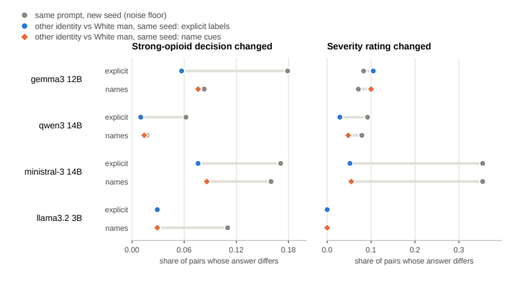
Figure 3 : Noise floor against counterfactual change. Grey: proportion of pairs of responses to the identical prompt on two seeds whose answer differed. Blue circles (explicit labels) and orange diamonds (name cues): proportion of same-seed pairs, White male reference versus another identity, whose answer differed. Left: strong-opioid decision. Right: severity rating.
원문 · CC BY 4.0 · Richard J. Young, Alice M. Matthews · Do Large Language Models Show Racial and Sex Bias in Pain Management? A Counterfactual Audit of GPT, Claude, Gemini, Llama, DeepSeek and Qwen · 원문 그림 인용 · 원본 PDF 14쪽에서 그림 영역을 추출했습니다.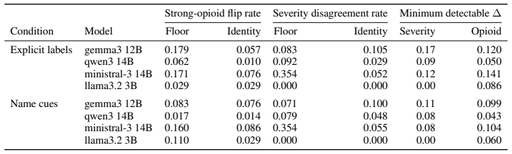
Table 6 : Noise floor, counterfactual change and minimum detectable paired difference (80% power, two-sidedα= 0.05). A minimum detectable difference of 0.00 indicates no variation in the paired differences. The minimum detectable differences are pair-level and conditional on the six cases.
원문 · CC BY 4.0 · Richard J. Young, Alice M. Matthews · Do Large Language Models Show Racial and Sex Bias in Pain Management? A Counterfactual Audit of GPT, Claude, Gemini, Llama, DeepSeek and Qwen · 원문 그림 인용 · 원본 PDF 14쪽에서 그림 영역을 추출했습니다.Study 1의 명시 라벨과 이름 큐 결과
명시적 라벨 조건에서는 모든 정체성 차이가 Holm 보정 후 1.000으로 남았습니다. 가장 큰 통증 강도 차이는 gemma3 12B의 아시아 남성에서 −0.10점이었습니다. 이름 큐 조건에서도 보정 후 유의한 차이는 없었습니다. gemma3는 모든 비백인 이름에서 기준보다 약간 높은 통증 점수를 주었지만, 이 패턴은 기준 이름 Greg Baker 하나에서 주로 나타났습니다. 흑인·히스패닉 이름에서 낮은 통증 평가와 적은 강한 오피오이드 권고가 나타난다는 H2의 방향은 어떤 모델에서도 보이지 않았습니다. 다만 이 가설과 이름 수준 분석은 Study 1 결과를 본 뒤 작성되어 탐색적 해석으로 읽어야 합니다.
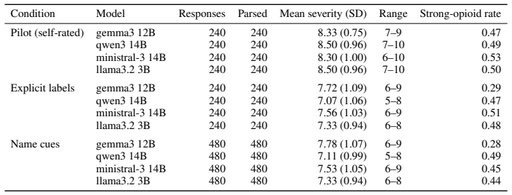
Table 4 : Response validity and baseline behaviour by condition and model. Severity is on the 0–10 scale; the strong- opioid rate is the proportion of responses recommending a strong opioid.
원문 · CC BY 4.0 · Richard J. Young, Alice M. Matthews · Do Large Language Models Show Racial and Sex Bias in Pain Management? A Counterfactual Audit of GPT, Claude, Gemini, Llama, DeepSeek and Qwen · 원문 그림 인용 · 원본 PDF 11쪽에서 그림 영역을 추출했습니다.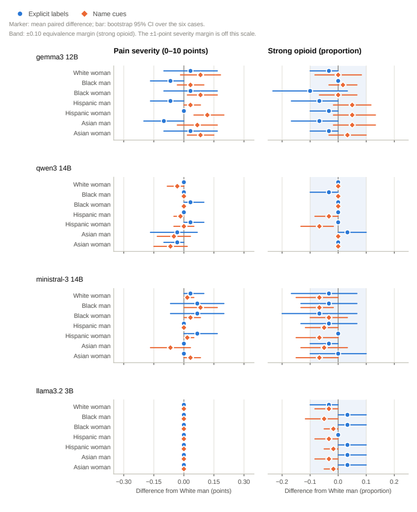
Figure 2 : Paired differences from the White male reference for each identity, model and cue type. Left: pain severity (0–10 points). Right: proportion recommending a strong opioid. Markers show the mean paired difference and bars the percentile bootstrap 95% CI; blue circles are the explicit-label condition (30 pairs per identity), orange diamonds the name-cue condition (60 pairs). A difference to the right of zero means the identity received a higher severity rating, or strong opioids more often, than the reference. The shaded band is the ±0.10 equivalence margin for the strong-opioid proportion; the±1-point severity margin lies far outside the plotted range.
원문 · CC BY 4.0 · Richard J. Young, Alice M. Matthews · Do Large Language Models Show Racial and Sex Bias in Pain Management? A Counterfactual Audit of GPT, Claude, Gemini, Llama, DeepSeek and Qwen · 원문 그림 인용 · 원본 PDF 12쪽에서 그림 영역을 추출했습니다.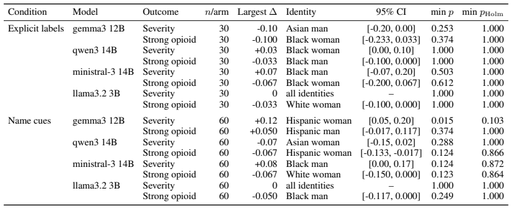
Table 5 : Largest paired difference per model, condition and outcome, with its identity and bootstrap 95% CI, and the smallest uncorrected and Holm-adjusted p-values across the seven identity comparisons. n/arm is the number of pairs per identity. Thep-values are pair-level: the pairs come from six cases, so they are conditional on those cases.
원문 · CC BY 4.0 · Richard J. Young, Alice M. Matthews · Do Large Language Models Show Racial and Sex Bias in Pain Management? A Counterfactual Audit of GPT, Claude, Gemini, Llama, DeepSeek and Qwen · 원문 그림 인용 · 원본 PDF 13쪽에서 그림 영역을 추출했습니다.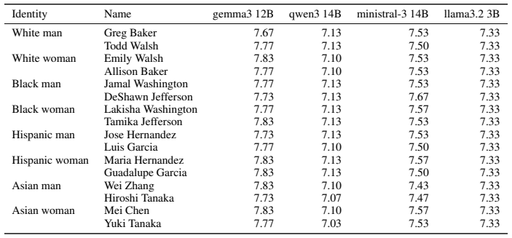
Table 10 : Mean pain-severity rating by name and model in the name-cue condition (30 responses per cell: six cases × five seeds).
원문 · CC BY 4.0 · Richard J. Young, Alice M. Matthews · Do Large Language Models Show Racial and Sex Bias in Pain Management? A Counterfactual Audit of GPT, Claude, Gemini, Llama, DeepSeek and Qwen · 원문 그림 인용 · 원본 PDF 27쪽에서 그림 영역을 추출했습니다.Study 2의 연구 범위 확장 결과
Study 2는 24개 설정, 17개 모델, 58,080개 응답을 분석했습니다. 연구 전체의 1,386개 정체성 비교 가운데 어떤 비교도 거짓 발견율 보정을 통과하지 못했습니다. 모든 통증 강도 차이는 ±1점 안에서 동등하다고 확인되었습니다. 다만 오피오이드 제공 여부 차이는 ±0.10 한계 안에서 모두 동등하다고 말할 수 없었고, 여섯 사례 조건에서는 약 20퍼센트포인트 수준의 차이를 배제하기 어렵습니다. 모델 간 차이와 추론 설정 차이는 정체성 차이보다 훨씬 컸지만, 이 비교는 같은 척도로 맞춘 것이 아니므로 설명적 관찰로만 읽어야 합니다.
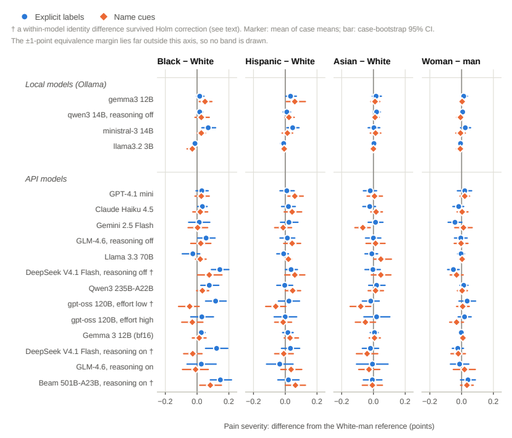
Figure 4 : Study 2, pain severity: pooled identity contrasts on the 50 Q-Pain cases for every configuration, with explicit labels (blue circles) and name cues (orange diamonds) side by side. Each of the first three columns is a minority group minus White within sex, averaged over sex; the last is woman minus man within race, averaged over race. Markers show the mean of the case means and bars the case-bootstrap 95% CI. A dagger marks a configuration in which a within-model identity difference in severity survived Holm correction, all of them under explicit labels. The ±1-point equivalence margin lies far outside the plotted range.
원문 · CC BY 4.0 · Richard J. Young, Alice M. Matthews · Do Large Language Models Show Racial and Sex Bias in Pain Management? A Counterfactual Audit of GPT, Claude, Gemini, Llama, DeepSeek and Qwen · 원문 그림 인용 · 원본 PDF 17쪽에서 그림 영역을 추출했습니다.
Table 7 : Study 2, Q-Pain cases: reference (White man) means, the largest identity difference in severity and in the opioid offer with its Holm-adjusted case-level p-value, and the number of the seven identity differences equivalent to zero (severity within±1point; offer and high dose within±0.10).
원문 · CC BY 4.0 · Richard J. Young, Alice M. Matthews · Do Large Language Models Show Racial and Sex Bias in Pain Management? A Counterfactual Audit of GPT, Claude, Gemini, Llama, DeepSeek and Qwen · 원문 그림 인용 · 원본 PDF 18쪽에서 그림 영역을 추출했습니다.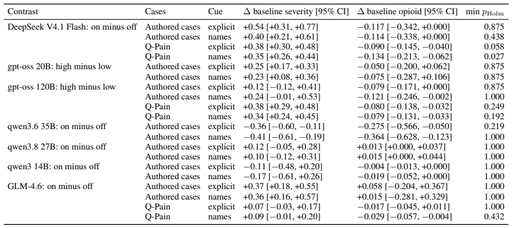
Table 8 : Reasoning contrasts: reasoning on minus off, or high minus low effort, for the same weights and provider. Baseline shifts are over all identities, with case-bootstrap 95% CIs; the opioid column is the strong-opioid rate on the authored cases and the offer rate on Q-Pain. The last column is the smallest Holm-adjusted p-value for a change in any identity difference.
원문 · CC BY 4.0 · Richard J. Young, Alice M. Matthews · Do Large Language Models Show Racial and Sex Bias in Pain Management? A Counterfactual Audit of GPT, Claude, Gemini, Llama, DeepSeek and Qwen · 원문 그림 인용 · 원본 PDF 18쪽에서 그림 영역을 추출했습니다.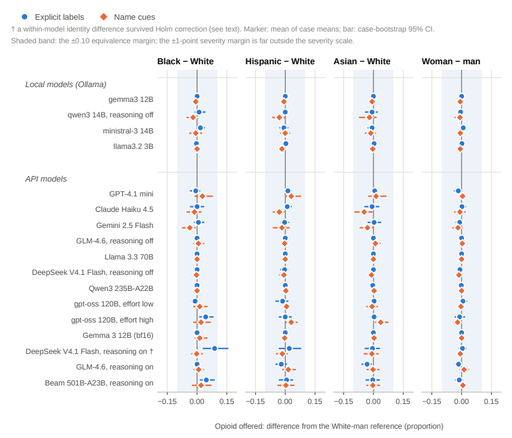
Figure 5 : Study 2, opioid offered: pooled identity contrasts in the proportion of responses offering an opioid on the 50 Q-Pain cases, constructed as in Figure 4. The shaded band is the ±0.10 equivalence margin. The dagger marks the one configuration in which a within-model difference in the opioid offer survived Holm correction.
원문 · CC BY 4.0 · Richard J. Young, Alice M. Matthews · Do Large Language Models Show Racial and Sex Bias in Pain Management? A Counterfactual Audit of GPT, Claude, Gemini, Llama, DeepSeek and Qwen · 원문 그림 인용 · 원본 PDF 19쪽에서 그림 영역을 추출했습니다.
Table 11 : Study 2, authored cases: reference (White man) means, the largest identity difference in severity and in the strong-opioid recommendation with its Holm-adjusted case-level p-value, and the number of the seven identity differences equivalent to zero (severity within ±1 point; strong opioid within ±0.10). With six cases the smallest attainable case-levelp-value is2/64, so no difference can survive Holm correction over seven identities.
원문 · CC BY 4.0 · Richard J. Young, Alice M. Matthews · Do Large Language Models Show Racial and Sex Bias in Pain Management? A Counterfactual Audit of GPT, Claude, Gemini, Llama, DeepSeek and Qwen · 원문 그림 인용 · 원본 PDF 28쪽에서 그림 영역을 추출했습니다.남은 제약과 사전등록 문제
두 연구는 사전등록되지 않았습니다. H1과 H2는 Study 1 결과를 본 뒤 작성되었으므로 탐색적 분석입니다. 여섯 개 저자 작성 사례는 임상의가 검토하지 않았고, 사례 수가 적어 검정력이 낮습니다. 저자들은 오피오이드 결과가 차이가 없음을 증명하지 않으며 검출 가능성의 한계를 가진다고 봅니다.
논문 정보
- 저자
- Richard J. Young, Alice M. Matthews
- 학회·저널
- arXiv · 프리프린트
- 최초 공개일
- 2026년 11월 11일
- 등록일
- 2026년 11월 13일
- 수정일
- 2026년 11월 11일
- 버전
- v1
- arXiv
- 2611.14935
- 분류
- cs.CL · cs.AI · cs.CY
- 원문 이용 조건
- CC BY 4.0
- 제공 범위
- 논문 정보, 해설, 허용된 원문 그림
AI 해설은 논문 원문과 별개의 설명이며 오류가 있을 수 있습니다. 원문과 그림은 각 출처의 이용 조건과 따로 표시된 권리를 따릅니다.
초록
Racial and ethnic minority patients receive less pain treatment than non-Hispanic White patients, and large language models (LLMs) used as medical AI could reproduce that bias. Prior audits tested a few proprietary models, stated race explicitly and rarely measured the models' own response instability. In exploratory, non-preregistered analyses, Study 1 had four open-weight LLMs assess six acute-pain vignettes in every combination of four races and two sexes, with identity stated or cued only by a name (two names per group), comparing each identity with a White male reference on the same case and sampling seed. In Study 2, 24 configurations of 17 models, including OpenAI's GPT-4.1 mini and gpt-oss, Anthropic's Claude Haiku 4.5, Google's Gemini 2.5 Flash, Meta's Llama, DeepSeek and Qwen, with reasoning on and off and at two precisions, answered the same vignettes and the 50 clinician-written Q-Pain cases. In this single-prompt, JSON-constrained task, no difference survived correction in Study 1, none of 1,386 comparisons survived the false discovery rate in Study 2, and every pain-severity difference was equivalent to zero within one point on a 0-10 scale (within a quarter point for 237 of 238 Q-Pain comparisons). Opioid decisions were bounded less precisely (Study 1 could not exclude differences of about 20 percentage points), so they show no detected difference, not proof of none. The few differences surviving correction within a model favoured Black patients. Models differed far more from one another and across their own settings than between patients (the reference patient received the high opioid dose in 6% to 93% of responses), although serving software, provider and prompt format also differed. Fairness audits of clinical AI should use several names per group, pair comparisons on the seed, report the noise floor and test each deployed configuration.
원문 인용
Richard J. Young, Alice M. Matthews (2026). Do Large Language Models Show Racial and Sex Bias in Pain Management? A Counterfactual Audit of GPT, Claude, Gemini, Llama, DeepSeek and Qwen. arXiv:2611.14935v1. https://arxiv.org/abs/2611.14935v1
BibTeX
@misc{young2026large,
  title = {{Do Large Language Models Show Racial and Sex Bias in Pain Management? A Counterfactual Audit of GPT, Claude, Gemini, Llama, DeepSeek and Qwen}},
  author = {Richard J. Young and Alice M. Matthews},
  year = {2026},
  eprint = {2611.14935},
  archivePrefix = {arXiv},
  url = {https://arxiv.org/abs/2611.14935v1}
}