논문 해설
Di-BiLPS: Denoising induced Bidirectional Latent-PDE-Solver under Sparse Observations
Di-BiLPS: 희소 관측 하에서의 잡음 제거 기반 양방향 잠재 PDE solver
- 연구 문제 극도로 희소한 관측에서 기존 PDE 학습 방법은 정확도와 효율이 떨어지며, Di-BiLPS는 잠재 공간에서 정방향과 역방향 문제를 함께 다룹니다.
- 연구 방법 변분 오토인코더로 입력을 잠재 공간에 압축하고, 대조 학습으로 희소 관측 조건을 정렬한 뒤, PDE와 관측 항으로 안내되는 잠재 확산 샘플링으로 해를 복원합니다.
- 주요 결과 Darcy Flow 정방향 과제에서 상대 ℓ2 오차 0.021을 보고하며 DiffusionPDE(0.025)보다 낮습니다. 관측 안내를 제거하면 모든 과제에서 오차가 크게 증가합니다.
극도로 희소한 관측에서 PDE 풀이의 어려움
기존 신경망 PDE 방법은 계수나 상태를 조밀하게 관측한다고 가정하고 연산자를 학습합니다. 그러나 실제 측정은 공간과 시간에서 매우 희소하며, 원문은 관측률이 3% 이하인 극단적 희소성에서는 고전적 수치해법과 최신 신경망 방법이 모두 효과가 떨어진다고 설명합니다. 본 논문은 이 조건에서 정방향 문제와 역방향 문제를 하나의 잠재 공간 프레임워크로 함께 다루는 것을 목표로 합니다.
이를 위해 저자들은 고차원 입력을 압축하는 변분 오토인코더, 잠재 공간의 확산 모델, 그리고 희소 관측과 완전 관측을 정렬하는 대조 학습 모듈을 결합합니다. 세 요소가 맡는 역할을 구분해서 읽는 것이 이후 방법 설명을 이해하는 출발점입니다.
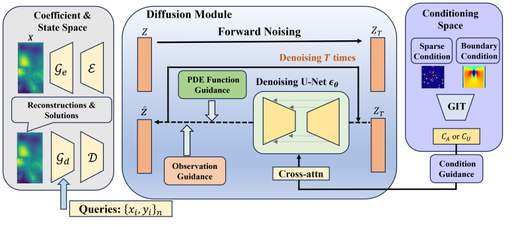
Figure 1 . Overview of the architecture of Di-BiLPS : (a) Compression module via a pre-trained V AE ( left), (b) Diffusion module with proposed PDE-Guided denoising algorithm( middle), and (c) Contrastive learning module ( right). Proposed design leverages module (a) to extract informative and robust representations from extremely sparse inputs and performs high-speed denoising algorithm within the compressed latent space.
원문 · CC BY 4.0 · Zhonghao Li, Chaoyu Liu, Qian Zhang · Di-BiLPS: Denoising induced Bidirectional Latent-PDE-Solver under Sparse Observations · 원문 그림 인용 · 원본 PDF 2쪽에서 그림 영역을 추출했습니다.잠재 공간 압축과 조건 정렬
첫 단계에서 GINO 기반 메시 인코더와 디코더를 U-Net의 좌우에 결합한 변분 오토인코더가 불규칙 격자 입력 V를 잠재 표현 Z로 압축합니다. 이 오토인코더는 MSE, 퍼셉추얼 손실, KL 손실의 합으로 학습됩니다.
두 번째 단계에서 대조 학습 모듈은 3%의 희소 관측 P^A, P^U를 조건 임베딩 c로 인코딩하고, 완전 관측 A, U는 키 k로 인코딩합니다. 두 방향의 코사인 유사도 행렬에 교차 엔트로피 손실을 적용하여 짝이 맞는 조건과 키가 가깝게 정렬되도록 합니다. 이 조건 임베딩은 이후 확산 모델의 조건 입력 C로 쓰입니다.
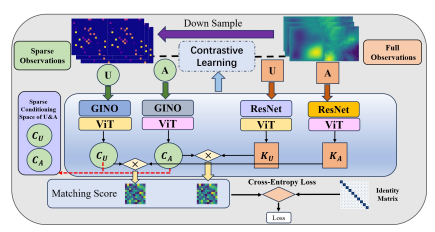
Figure 2 . Illustration of contrastive learning module. Pro- posed GINO-ViT framework encodes both sparse and full observations into a unified latent space. By optimizing the match score within this space, framework is designed to capture informative and robust representations between sparse and full observations. Here, we emphasize that ViT modules with the same color share weights in this figure.
원문 · CC BY 4.0 · Zhonghao Li, Chaoyu Liu, Qian Zhang · Di-BiLPS: Denoising induced Bidirectional Latent-PDE-Solver under Sparse Observations · 원문 그림 인용 · 원본 PDF 5쪽에서 그림 영역을 추출했습니다.PDE 안내 디노이징 샘플링
잠재 확산 모델은 압축된 Z에 노이즈를 더하고, 조건 C를 입력받아 노이즈를 추정하는 U-Net 기반 네트워크 ϵθ를 학습합니다. 추론에서는 DDIM 형식의 결정론적 역확산 단계를 반복하며, 각 단계에서 추정된 Ẑ0를 GINO 디코더에 넣어 관측점과 격자점의 값을 얻습니다.
원문은 PDE 잔차 항 Npde가 관측점과 격자점에서 PDE 연산자 F의 제곱 노름을 줄이도록 잠재 변수를 안내한다고 씁니다. 또 관측 일치 항 Nobs는 디코딩된 값과 희소 관측 Pv의 ℓ2 차이를 줄이도록 Ẑ0를 유도합니다. 이 두 항은 역확산 단계에 더해지며, 최종 해는 GINO 디코더로 질의점에서 복원됩니다.
Darcy Flow와 다섯 벤치마크 비교
주요 실험은 Darcy Flow, Helmholtz, Poisson, Non-Bounded Navier-Stokes, Bounded Navier-Stokes의 다섯 PDE 벤치마크에서 정방향과 역방향 과제를 모두 다룹니다. 학습 설정에서 관측은 500개 점, 즉 3%이며, 측정 지표는 상대 ℓ2 오차입니다.
Darcy Flow 정방향 과제에서 Di-BiLPS의 오차는 0.021이고 DiffusionPDE는 0.025입니다. 본문은 다섯 벤치마크의 10개 과제 중 8개에서 DiffusionPDE를 능가한다고 요약합니다. 다만 이 비교는 저자들이 보고한 표 1 결과이며, 다른 기준선인 PINO, DeepONet, PINNs, FNO와의 차이는 표에서 함께 확인해야 합니다.
구성요소 제거 실험
절제 실험은 PDE 안내(Npde), 관측 안내(Nobs), 조건 안내(C)를 각각 제거한 변형을 비교합니다. 각 변형은 해당 구성요소만 제거한 상태입니다. PDE 안내를 제거하면 대부분 과제에서 오차 변화가 작아 보조적 역할로 해석됩니다.

Table 2 . Relative ℓ2 error for ablation study on Di-BiLPS. This table illustrates the effect of removing key components in both forward and inverse PDE tasks. The best results in each task are highlighted in bold.
원문 · CC BY 4.0 · Zhonghao Li, Chaoyu Liu, Qian Zhang · Di-BiLPS: Denoising induced Bidirectional Latent-PDE-Solver under Sparse Observations · 원문 그림 인용 · 원본 PDF 8쪽에서 그림 영역을 추출했습니다.반면 관측 안내를 제거하면 모든 과제에서 상대 ℓ2 오차가 크게 증가하여, 희소 관측을 활용하는 핵심 항으로 보입니다. 조건 안내를 제거하면 특히 Non-Bounded Navier-Stokes 같은 복잡한 과제에서 성능이 크게 떨어집니다. 이 결과는 각 요소를 유지하는 효용을 보여 주며, 이 실험만으로 모든 구성요소의 기여를 보편적으로 증명하지는 않습니다.
관측 밀도 변화와 적용 범위
저자들은 대조 학습 모듈을 1%와 10% 관측 밀도에서 다시 학습하고, 완전 관측 인코더는 고정했습니다. VAE와 확산 모듈은 재사용했습니다. 부록 표 3에는 Darcy Flow와 Poisson의 정방향 및 역방향 상대 ℓ2 오차가 1%, 3%, 10%별로 보고되어 있습니다.
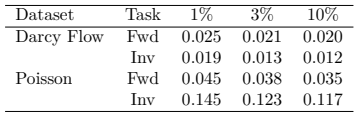
Table 3 . Relative ℓ2 errorRelative ℓ2 error on various observation rate
원문 · CC BY 4.0 · Zhonghao Li, Chaoyu Liu, Qian Zhang · Di-BiLPS: Denoising induced Bidirectional Latent-PDE-Solver under Sparse Observations · 원문 그림 인용 · 원본 PDF 16쪽에서 그림 영역을 추출했습니다.한계로는 관측 비율이 0.1%로 줄면 모델 성능이 크게 악화된다는 점이 보고됩니다. 따라서 본 결과는 3% 근처와 부록에서 다룬 관측 범위에 대한 것이며, 더 극단적인 희소성까지 보장한다고 읽어서는 안 됩니다.
논문 정보
- 저자
- Zhonghao Li, Chaoyu Liu, Qian Zhang
- 학회·저널
- arXiv · 프리프린트
- 최초 공개일
- 2026년 5월 13일
- 등록일
- 2026년 10월 29일
- 수정일
- 2026년 5월 13일
- 버전
- v1
- arXiv
- 2605.13790
- 분류
- cs.LG · cs.AI
- 원문 이용 조건
- CC BY 4.0
- 제공 범위
- 논문 정보, 해설, 허용된 원문 그림
AI 해설은 논문 원문과 별개의 설명이며 오류가 있을 수 있습니다. 원문과 그림은 각 출처의 이용 조건과 따로 표시된 권리를 따릅니다.
초록
Partial differential equations (PDEs) are fundamental for modeling complex natural and physical phenomena. In many real-world applications, however, observational data are extremely sparse, which severely limits the applicability of both classical numerical solvers and existing neural approaches. While neural methods have shown promising results under moderately sparse observations, their inference efficiency at high resolutions is limited, and their accuracy degrades substantially in the extremely sparse regime. In this work, we propose the Di-BiLPS, a unified neural framework that effectively handle both forward and inverse PDE problems under extremely sparse observations. Di-BiLPS combines a variational autoencoder to compress high-dimensional inputs into a compact latent space, a latent diffusion module to model uncertainty, and contrastive learning to align representations. Operating entirely in this latent space, the framework achieves efficient inference while retaining flexible input-output mapping. In addition, we introduce a PDE-informed denoising algorithm based on a variance-preserving diffusion process, which further improves inference efficiency. Extensive experiments on multiple PDE benchmarks demonstrate that Di-BiLPS consistently achieves SOTA performance under extremely sparse inputs (as low as 3%), while substantially reducing computational cost. Moreover, Di-BiLPS enables zero-shot super-resolution, as it allows predictions over continuous spatial-temporal domains.
원문 인용
Zhonghao Li, Chaoyu Liu, Qian Zhang (2026). Di-BiLPS: Denoising induced Bidirectional Latent-PDE-Solver under Sparse Observations. arXiv:2605.13790v1. https://arxiv.org/abs/2605.13790v1
BibTeX
@misc{li2026bilps,
  title = {{Di-BiLPS: Denoising induced Bidirectional Latent-PDE-Solver under Sparse Observations}},
  author = {Zhonghao Li and Chaoyu Liu and Qian Zhang},
  year = {2026},
  eprint = {2605.13790},
  archivePrefix = {arXiv},
  url = {https://arxiv.org/abs/2605.13790v1}
}