논문 해설
What Limits Thermal Infrared Drone Detection? A Cross-Dataset Benchmark Analysis
열화상 드론 탐지의 한계는 무엇인가? 데이터셋 간 벤치마크 분석
- 연구 문제 열적외선 드론 검출은 데이터셋마다 카메라와 주석 조건이 달라 성능 비교와 도메인 일반화 평가가 어렵습니다.
- 연구 방법 YOLOv8과 YOLO11을 LWIR 데이터셋에서 학습하고 교차 데이터셋, 모델 규모, 조건별 실패 모드를 비교합니다.
- 주요 결과 CST 학습 분할에서 데이터 출처별 mAP@0.25가 0.131에서 0.747까지 달랐고 모델 구성 간 차이는 0.648에서 0.759였습니다.
IR 드론 검출의 데이터 문제
열적외선(IR) 영상은 주변 조명에 덜 의존해 드론 검출을 지속적으로 수행할 수 있게 합니다. 그러나 공개 IR 드론 데이터셋마다 카메라 시스템, 처리 파이프라인, 주석 방식이 다르고 상당 부분이 문서화되어 있지 않습니다. 이 때문에 검출 성능을 비교하거나 도메인 간 일반화를 평가하기 어렵습니다.
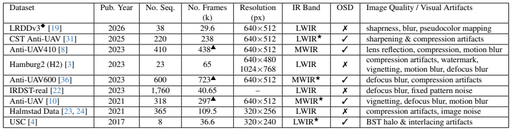
Table 1 . Overview of publicly available IR datasets for drone detection and tracking. Sequence and frame counts refer exclusively to IR data. Unreported IR-bands were inferred by visual inspection.✓/✗denote the presence/absence of on-screen display (OSD).
원문 · CC BY 4.0 · Tamara R. Lenhard, Jan Kels, Tobias Koch · What Limits Thermal Infrared Drone Detection? A Cross-Dataset Benchmark Analysis · 원문 그림 인용 · 원본 PDF 2쪽에서 그림 영역을 추출했습니다.이 논문은 이런 변동 요인이 검출 성능에 어떤 영향을 주는지 확인하려고 합니다. 특히 학습 데이터 구성, 검출기 아키텍처, 모델 용량 중 무엇이 성능을 더 크게 좌우하는지를 묻습니다. 대상은 LWIR 영상으로 한정되며, YOLOv8과 YOLO11을 세 개의 공개 데이터셋에서 비교합니다.
YOLO 계열 검출기와 학습 조건
검출기로는 YOLOv8과 YOLO11을 사용했습니다. YOLOv8은 합성곱 특징 추출만 쓰고, YOLO11은 가장 거친 백본 단계에 위치 민감 자기 주의 모듈인 C2PSA를 넣고 합성곱 블록으로 C3k2를 씁니다. YOLOv8은 n, s, m, l 네 규모를, YOLO11은 s, m, l 세 규모를 평가했으며 x 변형은 단일 GPU 메모리 제약으로 제외했습니다.
모든 모델은 단일 클래스 드론 검출을 위해 처음부터 학습했습니다. 학습은 300 에포크, 배치 크기 64, 입력 해상도 640×640 조건에서 진행했고 나머지 하이퍼파라미터는 Ultralytics 기본 구성을 따랐습니다. 이 설정은 이 논문의 실험 전반에 적용된 조건입니다.
교차 데이터셋 일반화 결과
교차 데이터셋 실험은 YOLOv8l을 가장 큰 용량의 구성으로 골라, 데이터셋 효과가 모델 용량 때문에 가려지지 않도록 설계했습니다. CST, LRDDv3, H2 전체, H2의 FLIR과 InfraTec 부분집합에서 각각 모델을 독립적으로 학습하고 다섯 테스트 분할에 평가했습니다.
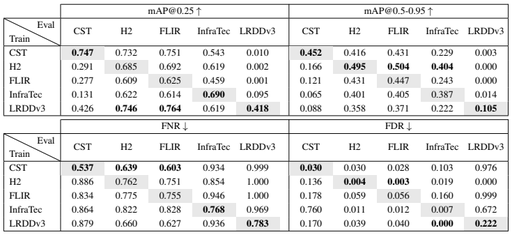
Table 5 . Cross-dataset generalization of YOLOv8l models trained on individual source datasets (rows) and evaluated on all test splits (columns). Shading indicates in-domain evaluations. Per-metric bests for each dataset are highlighted inbold.
원문 · CC BY 4.0 · Tamara R. Lenhard, Jan Kels, Tobias Koch · What Limits Thermal Infrared Drone Detection? A Cross-Dataset Benchmark Analysis · 원문 그림 인용 · 원본 PDF 7쪽에서 그림 영역을 추출했습니다.같은 도메인 성능은 CST, InfraTec, H2에서 mAP@0.25 0.685에서 0.747 범위였고 LRDDv3에서는 0.418이었습니다. 교차 도메인에서는 LRDDv3 학습 모델이 H2와 FLIR에서 CST 학습 모델보다 높은 mAP@0.25를 기록했습니다. 반대로 grayscale 데이터셋에서 학습한 모델은 LRDDv3에서 mAP@0.25가 0.095 이하였습니다. 저자들은 이 비대칭성에 의사 색상과 grayscale 표현 차이가 기여했을 것으로 보지만, 촬영 기하와 장면 차이 때문에 이 효과를 분리하지는 못했다고 적었습니다.
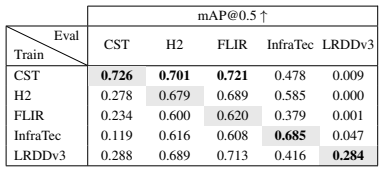
원문 그림 Table II. Cross-dataset generalization of YOLOv8l at mAP@0.25. Rows and columns correspond to training and evaluation datasets, respectively. Shading indicates in-domain evaluations. The high- est score per evaluation dataset is highlighted inbold.
원문 · CC BY 4.0 · Tamara R. Lenhard, Jan Kels, Tobias Koch · What Limits Thermal Infrared Drone Detection? A Cross-Dataset Benchmark Analysis · 원문 그림 인용 · 원본 PDF 9쪽에서 그림 영역을 추출했습니다.데이터 구성과 모델 규모 비교
CST 학습 분할에서 일곱 구성을 평가했을 때 mAP@0.25는 0.648에서 0.759 범위였습니다. 같은 기준으로 학습 데이터 출처를 바꾼 경우에는 0.131에서 0.747까지 차이가 났습니다. 이 비교에서 데이터 구성의 영향이 아키텍처나 용량보다 크다는 것이 저자들의 해석입니다.
YOLOv8은 규모를 키울수록 mAP가 대체로 올랐고 FDR이 줄었습니다. YOLO11은 s에서 l로 갈 때 mAP@0.25가 0.017만 올랐습니다. 같은 규모에서는 YOLO11이 YOLOv8보다 높은 mAP@0.25를 보였으며 차이는 s에서 0.094, l에서 0.012였습니다. YOLO11s는 YOLOv8l보다 파라미터가 22%, FLOPs가 13% 수준이면서 비슷한 mAP@0.25와 낮은 FNR을 보였습니다.
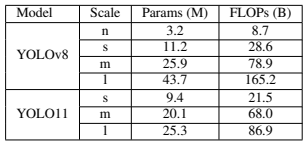
Table 2 . Capacity and computational complexity of evaluated YOLO configurations. Parameter counts and FLOPs refer to CO- CO-pretrained models at an input resolution of 640×640.
원문 · CC BY 4.0 · Tamara R. Lenhard, Jan Kels, Tobias Koch · What Limits Thermal Infrared Drone Detection? A Cross-Dataset Benchmark Analysis · 원문 그림 인용 · 원본 PDF 4쪽에서 그림 영역을 추출했습니다.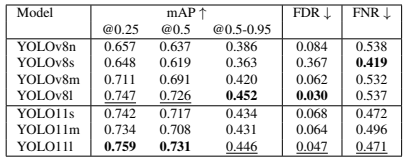
원문 그림 Table III. Comparison of YOLO variants across model generations and architectural scales, trained on the CST training split and eval- uated on the corresponding test split. Best results are highlighted inbold; second-best results are underlined .
원문 · CC BY 4.0 · Tamara R. Lenhard, Jan Kels, Tobias Koch · What Limits Thermal Infrared Drone Detection? A Cross-Dataset Benchmark Analysis · 원문 그림 인용 · 원본 PDF 9쪽에서 그림 영역을 추출했습니다.조건별 실패 모드
CST 테스트 분할에서 YOLOv8l을 기준으로 표적 크기, 배경 범주, 인스턴스 속성별 성능을 나눠 봤습니다. S 크기 표적이 가장 잘 검출되었고 XXS 표적에서는 성능이 크게 떨어졌습니다. 저자들은 XXS 박스가 가장 작은 YOLO 특징 맵 스트라이드보다 작아지는 점을 원인으로 봅니다.
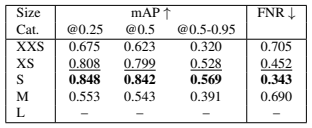
Table 6 . Performance of YOLOv8l on the CST test split by object- size category (defined in Tab. I, Supp.). Per-metric bests are shown inbold, while second-best results are underlined .
원문 · CC BY 4.0 · Tamara R. Lenhard, Jan Kels, Tobias Koch · What Limits Thermal Infrared Drone Detection? A Cross-Dataset Benchmark Analysis · 원문 그림 인용 · 원본 PDF 8쪽에서 그림 영역을 추출했습니다.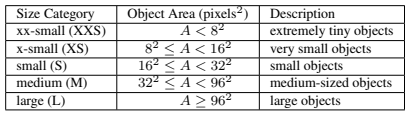
원문 그림 Table I. Object size categories by bounding-box areaA=w×h.
원문 · CC BY 4.0 · Tamara R. Lenhard, Jan Kels, Tobias Koch · What Limits Thermal Infrared Drone Detection? A Cross-Dataset Benchmark Analysis · 원문 그림 인용 · 원본 PDF 9쪽에서 그림 영역을 추출했습니다.배경 범주에서는 water와 sky가 높은 mAP를 보였고 urban과 building이 가장 낮았습니다. 인스턴스 속성에서는 TC가 FNR을 0.377에서 0.653으로 올렸습니다. CDB는 0.494에서 0.718로, DBC는 상대적으로 작은 영향을 보였습니다. 다만 세 속성의 개별 효과는 표적과 환경 특성에서 완전히 분리되지 않았습니다.
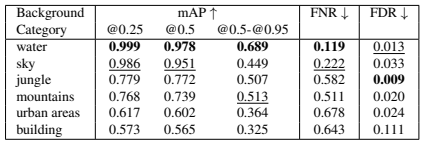
Table 7 . YOLOv8l performance on the CST test split by sequence- level background category (trained on the CST training split). Per- metric bests are shown inbold; second bests are underlined .
원문 · CC BY 4.0 · Tamara R. Lenhard, Jan Kels, Tobias Koch · What Limits Thermal Infrared Drone Detection? A Cross-Dataset Benchmark Analysis · 원문 그림 인용 · 원본 PDF 8쪽에서 그림 영역을 추출했습니다.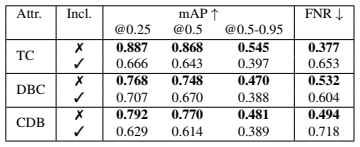
Table 8 . YOLOv8l performance across CST test labels, stratified by the presence (✓) or absence (✗) of each annotated attribute.
원문 · CC BY 4.0 · Tamara R. Lenhard, Jan Kels, Tobias Koch · What Limits Thermal Infrared Drone Detection? A Cross-Dataset Benchmark Analysis · 원문 그림 인용 · 원본 PDF 8쪽에서 그림 영역을 추출했습니다.검출 실패 범위와 주석 한계
저자들은 여러 구성 중 최적 설정도 40%가 넘는 드론을 놓친다고 결론짓고, 이를 기존 데이터셋의 한계로 봅니다. 정성 분석에서는 항공기가 드론으로 잘못 분류되는 경우, OSD에 가려진 표적, 중복 프레임의 주석 불일치가 확인되었습니다.
주 평가 지표인 mAP와 FNR은 TC 주석이 포착하는 저대비 조건을 직접 측정하지 않습니다. 그림 IV 분석에서도 TC 주석이 없는 건물 외벽 영역에서 미검출이 발생했습니다. 따라서 TC 주석만으로는 저대비 조건 전체를 설명하기 어렵다는 점을 남겨 둡니다.
논문 정보
- 저자
- Tamara R. Lenhard, Jan Kels, Tobias Koch
- 학회·저널
- arXiv · 프리프린트
- 최초 공개일
- 2026년 11월 12일
- 등록일
- 2026년 11월 13일
- 수정일
- 2026년 11월 12일
- 버전
- v1
- arXiv
- 2611.16724
- 분류
- cs.CV
- 원문 이용 조건
- CC BY 4.0
- 제공 범위
- 논문 정보, 해설, 허용된 원문 그림
AI 해설은 논문 원문과 별개의 설명이며 오류가 있을 수 있습니다. 원문과 그림은 각 출처의 이용 조건과 따로 표시된 권리를 따릅니다.
초록
Thermal infrared (IR) imaging enables drone detection with reduced dependence on ambient illumination, supporting continuous surveillance beyond the limitations of visible-spectrum sensing. However, substantial and often undocumented variability in camera systems, processing pipelines, and annotation practices across public IR drone datasets complicates the assessment of detector performance and cross-domain generalization. To examine these sources of variability and their implications for drone detection, we systematically characterize existing IR datasets and establish an artifact taxonomy reflecting their origins across the acquisition and processing pipeline, encompassing optical and sensor effects, tone mapping and image enhancement, and recording-related artifacts. Focusing on long-wave IR data, we investigate the impact of training data composition and model characteristics on YOLO-based detection performance, generalization, and condition-dependent failure modes. Our results demonstrate that detection performance is governed more strongly by training data composition than by YOLO generation or model capacity, while cross-dataset generalization exhibits pronounced asymmetries. Even the best-performing configuration fails to detect over 40\% of drones, with elevated miss rates for very small targets, cluttered urban backgrounds, and thermal crossover, highlighting the shortcomings of existing datasets.
원문 인용
Tamara R. Lenhard, Jan Kels, Tobias Koch (2026). What Limits Thermal Infrared Drone Detection? A Cross-Dataset Benchmark Analysis. arXiv:2611.16724v1. https://arxiv.org/abs/2611.16724v1
BibTeX
@misc{lenhard2026what,
  title = {{What Limits Thermal Infrared Drone Detection? A Cross-Dataset Benchmark Analysis}},
  author = {Tamara R. Lenhard and Jan Kels and Tobias Koch},
  year = {2026},
  eprint = {2611.16724},
  archivePrefix = {arXiv},
  url = {https://arxiv.org/abs/2611.16724v1}
}