논문 해설
When Is Tracking Affordable? A Movement-Budget Feasibility Threshold for Dynamic Regret
추적은 감당할 만한가? 동적 후회를 위한 이동 예산 실현 가능성 임계값
- 연구 문제 이동 예산이 있을 때 동적 후회가 sublinear하게 줄 수 있는 조건을 묻는 연구입니다.
- 연구 방법 결정적 square wave 비교자로 예산 부족 장벽을 보이고, 예산 인지 step size의 projected OGD로 임계 이상의 상한을 얻습니다.
- 주요 결과 S≤cPT이면 선형 후회가 강제되고, S=ω(D+PT)이면 예산 인지 projected OGD가 sublinear 후회를 달성합니다.
이동 예산이 있는 동적 후회의 문제
동적 후회는 움직이는 비교자 ut에 대해 학습자의 결정 xt를 평가합니다. 표준 분석은 학습자가 매 라운드 자유롭게 이동할 수 있다고 가정합니다. 이 논문은 학습자의 총 이동량 SC=Σ∥xt−xt−1∥에 hard budget S를 부과했을 때 sublinear 후회가 언제 가능한지를 묻습니다. 여기서 중요한 점은 예산이 환경의 변동성이 아니라 학습자가 이동할 수 있는 양을 제한한다는 것입니다. 저자들은 비교자의 경로 길이 PT가 크더라도 비교자가 좁은 영역에 머무르면 정적인 학습자도 잘 수행할 수 있으므로, 경로 길이 자체가 어려움의 올바른 척도가 아니라고 주장합니다.
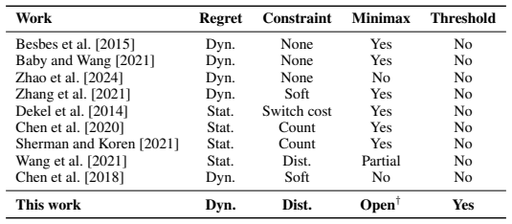
Table 1 : Positioning. “Dyn.” and “Stat.” denote dynamic and static regret; “Dist.” and “Count” denote switching-distance and switching-count constraints.
원문 · CC BY 4.0 · Ridham Patel · When Is Tracking Affordable? A Movement-Budget Feasibility Threshold for Dynamic Regret · 원문 그림 인용 · 원본 PDF 10쪽에서 그림 영역을 추출했습니다.문제 설정과 비제약 기준
결정 집합 K는 지름 D를 가진 compact convex 집합이고, 각 라운드의 손실 ft는 G-Lipschitz 볼록 함수입니다. 비교자 경로 길이는 PT=Σt≥2∥ut−ut−1∥로 정의됩니다. 이동 예산이 없을 때의 최소최대 동적 후회는 Θ(G√(D(D+PT)T))로 알려져 있으며, PT=o(DT)이면 o(GDT)가 됩니다. 저자들은 고정된 D에서 PT=o(T)인 영역을 중요하게 봅니다. 이 영역에서는 비제약 문제가 학습 가능하므로, 예산 때문에 실패한다면 그 원인을 환경이 아니라 예산으로 돌릴 수 있기 때문입니다.
결정적 square wave 비교자와 실현가능성 임계
논문은 K=[0,D]에서 ft(x)=G|x−ut|로 두고, 비교자가 0과 D 사이를 번갈아 가는 결정적 square wave를 구성합니다. 이 비교자는 전체 영역을 횡단하도록 만들어져 있어서, 학습자가 이동 가능 여부만 문제가 됩니다. 정리 1의 불가능성 부분은 S≤cPT인 모든 예산 실현 알고리즘에 대해 Rd≥c0GDT(1−c1S/PT)를 보이며, 따라서 작은 상수 c에 대해 Rd=Ω(GDT)입니다. 달성가능성 부분은 η=S/(GT)로 실행한 projected OGD가 SC≤S를 만족하고 S=ω(D+PT), S=o(DT)일 때 Rd=o(GDT)를 달성한다고 말합니다. 따라서 저자들이 식별한 임계 이동 규모는 D+PT입니다.
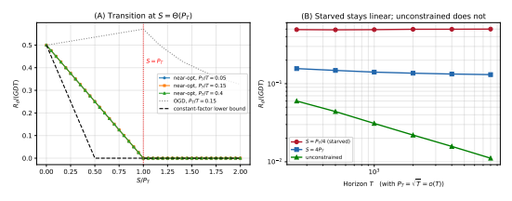
Figure 1 : Square-wave adversary. Left: normalized regret drops as the movement budget approaches the comparator path length; the proved lower bound has only constant-factor precision. Right: with PT = √ T=o(T) , a budget-starved learner has constant normalized regret while the unconstrained learner decays, showing that the barrier is caused by the movement budget rather than by large path length.
원문 · CC BY 4.0 · Ridham Patel · When Is Tracking Affordable? A Movement-Budget Feasibility Threshold for Dynamic Regret · 원문 그림 인용 · 원본 PDF 3쪽에서 그림 영역을 추출했습니다.임계 이상의 예산 의존 상한
임계 이상의 영역에서는 Budget-Controlled OGD가 η=min(√(D(D+2PT)/(G²T)), S/(GT))로 실행됩니다. 두 번째 항은 이동량 상한 ηGT≤S를 보장하는 예산 인지 step size입니다. 정리 2는 이 알고리즘의 후회가 G√(D(D+2PT)T)와 GT√(D(D+2PT))/S 중 작은 쪽의 O로 상한된다고 보입니다. 저자들은 이 상한이 최소최대 최적성을 주장하지 않으며, 1/S 항이 tight인지 여부는 열린 문제로 남긴다고 명시합니다. 따라서 이 절의 결과는 상한이며 임계 이상의 정확한 minimax 비율을 확정하지 않습니다.
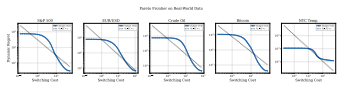
Figure 8 : Budget–regret trade-off on the five real series. The curves follow Rd ∝1/SC over the mid-range of budgets, consistent with the upper bound (6) only.
원문 · CC BY 4.0 · Ridham Patel · When Is Tracking Affordable? A Movement-Budget Feasibility Threshold for Dynamic Regret · 원문 그림 인용 · 원본 PDF 14쪽에서 그림 영역을 추출했습니다.square wave와 실제 시계열 실험
실험은 결정적 square wave에서 near-optimal 예산 추적기를 S/PT에 대해 변화시키며 정규화 후회 Rd/(GDT)를 측정합니다. 원문 Figure 1과 Figure 2는 이 전이를 보여 주며, PT/T가 0.05, 0.15, 0.4인 경우 곡선이 S=PT 근처에서 0으로 수렴하는 형태를 보고합니다. 또한 PT=√T로 두고 T를 키운 실험에서 S=PT/4인 학습자는 정규화 후회가 거의 0.5로 평평하게 유지되는 반면, 비제약 학습자는 감소합니다. 실제 시계열 실험은 S&P 500, EUR/USD, 원유, 비트코인, 뉴욕 기온을 사용하며, 이들은 유한 지평이므로 전이 위치와 1/S 감소만 검증합니다.
점근적 선형성은 square wave 구성에 근거합니다.
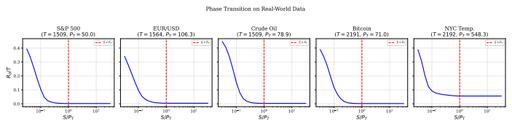
Figure 4 : Transition location on five real series (S&P 500, EUR/USD, crude oil, Bitcoin, NYC temperature). Regret stays elevated for S≪P T and drops near S=P T on all five, placing the transition where Theorem 1 predicts. Finite horizons cannot separate Θ(T) from o(T) , so these panels test thelocationof the transition and the 1/S decay, not asymptotic linearity; that claim rests on Figure 2(B).
원문 · CC BY 4.0 · Ridham Patel · When Is Tracking Affordable? A Movement-Budget Feasibility Threshold for Dynamic Regret · 원문 그림 인용 · 원본 PDF 8쪽에서 그림 영역을 추출했습니다.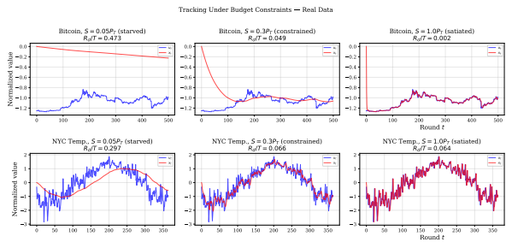
Figure 10 : Learner trajectories on Bitcoin and NYC temperature at three budget levels. At S= 0.05PT the learner barely moves and incurs Rd/T≈0.47 ; at S= 0.3P T tracking improves substantially; atS=P T the learner tracks near-perfectly withR d/T <0.01.
원문 · CC BY 4.0 · Ridham Patel · When Is Tracking Affordable? A Movement-Budget Feasibility Threshold for Dynamic Regret · 원문 그림 인용 · 원본 PDF 14쪽에서 그림 영역을 추출했습니다.남은 한계와 열린 문제
이 논문은 임계 이상의 minimax 비율과 Theorem 2의 1/S 항의 tightness를 확정하지 않습니다. 임계 주변의 정확한 상수도 정리 1에서는 보편 상수 수준으로만 증명됩니다. 실제 데이터와 무작위 보행 실험은 유한 지평에서 Θ(T)와 o(T)를 분리하지 못합니다. 또한 하한은 1차원 구성으로 증명되었고, 차원 의존성은 해결되지 않았습니다. 저자들은 전체 gradient 피드백을 가정하며 bandit 피드백으로의 전이는 검증하지 않았다고 밝힙니다.
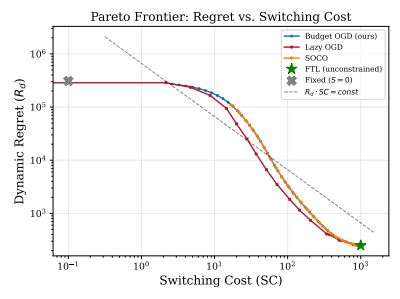
Figure 3 : Empirical budget–regret trade-off on a random-walk comparator. All methods trace a 1/S decay over the mid-range of budgets, with Budget-Controlled OGD attaining the lowest regret at each budget. This is consistency with the upper bound (6) only. The dashed guide line is a 1/S reference and is not evidence of a matched product law; by Remark 3 tightness of the1/Sterm is unproved.
원문 · CC BY 4.0 · Ridham Patel · When Is Tracking Affordable? A Movement-Budget Feasibility Threshold for Dynamic Regret · 원문 그림 인용 · 원본 PDF 8쪽에서 그림 영역을 추출했습니다.논문 정보
- 저자
- Ridham Patel
- 학회·저널
- arXiv · 프리프린트
- 최초 공개일
- 2026년 11월 2일
- 등록일
- 2026년 11월 4일
- 수정일
- 2026년 11월 2일
- 버전
- v1
- arXiv
- 2611.02812
- 분류
- cs.LG · eess.SY · math.OC · stat.ML
- 원문 이용 조건
- CC BY 4.0
- 제공 범위
- 논문 정보, 해설, 허용된 원문 그림
AI 해설은 논문 원문과 별개의 설명이며 오류가 있을 수 있습니다. 원문과 그림은 각 출처의 이용 조건과 따로 표시된 권리를 따릅니다.
초록
Dynamic regret measures an online learner against a moving comparator, and standard analyses assume the learner may move freely at every round. We study what happens when it may not: the learner is given a hard budget $S$ on its total movement $\sum_t \|x_t - x_{t-1}\|$. Our main result is that a movement budget creates a feasibility barrier. On a domain of diameter $D$ with $G$-Lipschitz convex losses, for every comparator path length $P_T \in [D, DT]$ we exhibit a deterministic adversary that forces $R_d = Ω(GDT)$ on every budget-feasible algorithm whenever $S \le c P_T$ for a universal constant $c>0$. This barrier is caused by the budget rather than by a volatile environment: for fixed $D$, it applies when $P_T = o(T)$, where the unconstrained minimax rate $Θ(G\sqrt{D(D+P_T)T})$ is sublinear, so the same instances are learnable with an unbounded budget and unlearnable without one. Conversely, projected online gradient descent with a budget-aware step size is budget-feasible and attains $o(GDT)$ once $S = ω(D + P_T)$. Thus the critical movement scale is $D+P_T$: linear regret is unavoidable below a sufficiently small constant multiple of $P_T$, while sublinear regret is achievable when $S/(D+P_T)\to\infty$ in the learnable regime. The construction rests on a distinction we make explicit: what makes a comparator expensive to track under a movement budget is the distance it forces the learner to travel, not its path length. Above the threshold we give a budget-dependent upper bound and identify the tight minimax rate in this region as an open problem rather than claiming a product law. Experiments support the predicted transition location and the $1/S$ decay.
원문 인용
Ridham Patel (2026). When Is Tracking Affordable? A Movement-Budget Feasibility Threshold for Dynamic Regret. arXiv:2611.02812v1. https://arxiv.org/abs/2611.02812v1
BibTeX
@misc{patel2026when,
  title = {{When Is Tracking Affordable? A Movement-Budget Feasibility Threshold for Dynamic Regret}},
  author = {Ridham Patel},
  year = {2026},
  eprint = {2611.02812},
  archivePrefix = {arXiv},
  url = {https://arxiv.org/abs/2611.02812v1}
}