논문 해설
Understanding Model Reprogramming for CLIP via Decoupling Visual Prompts
시각 프롬프트 분리를 통한 CLIP의 모델 재프로그래밍 이해
- 연구 문제 단일 시각 프롬프트는 설명의 여러 측면을 포착하지 못하고 덜 정보적인 설명에 치우칠 수 있습니다.
- 연구 방법 DVP는 설명을 명시적 원인 또는 군집으로 나누어 분리된 시각 프롬프트를 학습하고, 확률적 재가중치 행렬로 그 출력을 통합합니다.
- 주요 결과 ViT-B16 기반 CLIP의 16-shot 11개 데이터셋 평균에서 DVP-cse는 AttrVR보다 1.6%, DVP-cls는 1.2% 높게 보고됩니다.
단일 시각 프롬프트의 한계
CLIP을 하위 분류 과제에 적응시키는 Visual Reprogramming(VR)은 입력 이미지에 학습 가능한 노이즈 패턴인 시각 프롬프트(VP)를 더해 pre-training 모델의 구조는 그대로 둔 채 입력만 바꿉니다. 기존 VR 방법은 모든 클래스의 설명을 하나의 VP로 함께 학습합니다. 본문은 이 단일 VP의 학습 용량이 제한되어 설명의 다양한 측면, 예를 들어 모양, 색, 질감을 모두 포착하지 못할 수 있다고 제기합니다. 또한 이미지와 유사도가 높아 쉽게 맞는 덜 정보적인 설명에 편향될 수 있다고 지적합니다. 저자들은 OxfordFlowers 예시에서 이러한 현상을 보여 주며, 꽃의 줄기나 잎 설명은 유사도가 떨어지는 반면 모양 설명은 유사도가 높아 학습이 모양 쪽으로 기울어진다고 설명합니다.
분리와 재가중치를 결합한 DVP
DVP는 설명 집합을 v개의 분할로 나누고, 분할마다 별도의 시각 프롬프트 δi를 학습합니다. 분할은 DVP-cse에서는 LLM이 생성한 명시적 원인별로, DVP-cls에서는 설명 임베딩을 K-means로 군집화하여 만듭니다. 각 프롬프트의 출력은 확률적 재가중치 행렬(PRM) ωprm으로 통합됩니다. PRM은 설명 ap가 클래스 yq에 기여하는 정도를 학습 데이터의 co-occurrence 횟수로 최대우도추정하며, 조건부 확률 형태로 ωprm_p,q = N_D(a_p, y_q) / Σ N_D(a′, y_q)로 정의됩니다. 여기서 분모는 같은 클래스 yq에 속한 설명 전체의 합입니다. 학습은 에포크마다 PRM을 먼저 갱신하고, 이어서 각 δi를 자기 분할 Ai에 대한 음의 로그우도로 갱신하는 교대 최적화입니다.
소수 샷 설정에서는 이 횟수를 k개 가까운 설명으로 평활화하며, 논문은 k=3을 선택했습니다.
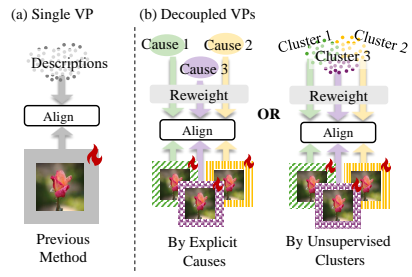
Figure 1 . Difference between (a) existing VR methods that train a single VP for all descriptions, and (b) our DVP that trains decoupled-and-reweighted VPs that are optimized using descrip- tions grouped by explicit causes or unsupervised clusters. Learn- able parameters are marked with ‘fire’s.
원문 · CC BY 4.0 · Chengyi Cai, Zesheng Ye, Lei Feng, Jianzhong Qi, Feng Liu · Understanding Model Reprogramming for CLIP via Decoupling Visual Prompts · 원문 그림 인용 · 원본 PDF 1쪽에서 그림 영역을 추출했습니다.
Table 7 . Choosing Appropriate Hyper-parameter k with the zero-shot accuracy
원문 · CC BY 4.0 · Chengyi Cai, Zesheng Ye, Lei Feng, Jianzhong Qi, Feng Liu · Understanding Model Reprogramming for CLIP via Decoupling Visual Prompts · 원문 그림 인용 · 원본 PDF 16쪽에서 그림 영역을 추출했습니다.
Table 8 . Choosing Appropriate Hyper-parameter v
원문 · CC BY 4.0 · Chengyi Cai, Zesheng Ye, Lei Feng, Jianzhong Qi, Feng Liu · Understanding Model Reprogramming for CLIP via Decoupling Visual Prompts · 원문 그림 인용 · 원본 PDF 17쪽에서 그림 영역을 추출했습니다.경험 위험 상한에 대한 논증
저자들은 경험 위험을 학습 데이터에 대한 평균 음의 로그우도로 정의하고, DVP가 표준 VR보다 낮거나 같은 경험 위험을 가질 수 있음을 논증합니다. Lemma 4.4는 같은 고정 재가중치 행렬 ωfix를 사용하는 표준 VR과 DVP 사이에서, 분리된 프롬프트의 최적 경험 위험이 단일 프롬프트보다 낮거나 같다는 결과입니다. Lemma 4.5는 고정된 DVP 파라미터에서 최적 PRM이 고정 가중치보다 경험 위험을 낮춘다는 결과입니다. Corollary 4.6은 두 효과를 합쳐 DVP의 공동 최적화 파라미터가 표준 VR의 최적 프롬프트보다 낮거나 같은 경험 위험을 가진다고 논증합니다. 이 결과들은 학습 데이터에 대한 위험을 다루며, 일반화 성능이나 모든 설정에서의 우월성을 직접 보이는 것은 아닙니다.
16-shot 분류 결과와 적용 범위
주요 검증은 ViT-B16 기반 CLIP에서 16-shot 하위 분류 과제 11개 데이터셋으로 수행되었으며, 세 시드의 평균을 사용했습니다. 비교 기준은 VP, AR, AttrVR이며 모두 단일 비분리 VP를 학습합니다. 저자들이 보고한 11개 데이터셋 평균 정확도에서 DVP-cse는 AttrVR보다 1.6%, DVP-cls는 1.2% 높습니다. 개선 폭은 Cars, Aircraft, Flowers에서 DVP-cse가, UCF와 같은 데이터셋에서 DVP-cls가 특히 크게 나타납니다. 반면 Food 데이터셋에서는 DVP의 개선이 나타나지 않습니다. 백본을 RN50, RN101, ViT-B32로 바꾼 실험에서도 DVP의 평균 개선이 보고되며, 특히 더 단순한 인코더에서 개선이 두드러집니다.

Table 1 . Accuracy comparison of different methods trained on 16-shot downstream classification tasks, using ViT-B16-based CLIP as the pretrained model (Mean % ± Std %, ours are highlighted and the highest is in bold). See Appendix C.7 for parameter numbers.
원문 · CC BY 4.0 · Chengyi Cai, Zesheng Ye, Lei Feng, Jianzhong Qi, Feng Liu · Understanding Model Reprogramming for CLIP via Decoupling Visual Prompts · 원문 그림 인용 · 원본 PDF 6쪽에서 그림 영역을 추출했습니다.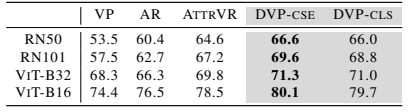
Table 3 . Average accuracy of different VR methods on 11 datasets, using different backbones as CLIP visual encoders (Mean Accu- racy %, ours are highlighted and the highest is inbold, RN stands for ResNet).
원문 · CC BY 4.0 · Chengyi Cai, Zesheng Ye, Lei Feng, Jianzhong Qi, Feng Liu · Understanding Model Reprogramming for CLIP via Decoupling Visual Prompts · 원문 그림 인용 · 원본 PDF 8쪽에서 그림 영역을 추출했습니다.
Table 9 . Accuracy comparison of different methods trained on 16-shot downstream classification tasks, using RN50-based CLIP as the pretrained model (Mean %, ours are highlighted and the highest is in bold).
원문 · CC BY 4.0 · Chengyi Cai, Zesheng Ye, Lei Feng, Jianzhong Qi, Feng Liu · Understanding Model Reprogramming for CLIP via Decoupling Visual Prompts · 원문 그림 인용 · 원본 PDF 19쪽에서 그림 영역을 추출했습니다.
Table 10 . Accuracy comparison of different methods trained on 16-shot downstream classification tasks, using RN101-based CLIP as the pretrained model (Mean %, ours are highlighted and the highest is in bold).
원문 · CC BY 4.0 · Chengyi Cai, Zesheng Ye, Lei Feng, Jianzhong Qi, Feng Liu · Understanding Model Reprogramming for CLIP via Decoupling Visual Prompts · 원문 그림 인용 · 원본 PDF 20쪽에서 그림 영역을 추출했습니다.
Table 11 . Accuracy comparison of different methods trained on 16-shot downstream classification tasks, using ViT-B32-based CLIP as the pretrained model (Mean %, ours are highlighted and the highest is in bold).
원문 · CC BY 4.0 · Chengyi Cai, Zesheng Ye, Lei Feng, Jianzhong Qi, Feng Liu · Understanding Model Reprogramming for CLIP via Decoupling Visual Prompts · 원문 그림 인용 · 원본 PDF 20쪽에서 그림 영역을 추출했습니다.절제와 독립성 분석
절제 실험은 분리를 제거한 변형(W/O CSE, W/O CLS)과 PRM을 제거한 변형(W/O ωprm)을 비교합니다. 분리를 제거하면 단일 VP가 되어 Aircraft, Cars, Flowers 같은 세밀한 분류에서 성능이 떨어진다고 보고됩니다. 독립성 분석에서는 Texture 과제와 ViT-16 기반 CLIP에서 HSIC를 γ=3으로 계산했습니다. HSIC는 값이 작을수록 독립성이 크며, 분리된 VP가 적용된 임베딩은 AttrVR의 비분리 VP보다 VP 사이의 통계적 의존성이 낮다고 보고됩니다. 저자들은 이것이 성능 향상의 한 요인일 수 있다고 해석하지만, 이 분석만으로 인과를 증명하지는 않습니다.
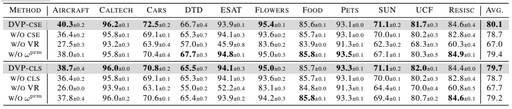
Table 2 . Ablation studies of DVP-cse and DVP-cls, using ViT-B16-based CLIP as the pretrained model (Mean % ± Std %, ours are highlighted and the highest is in bold).
원문 · CC BY 4.0 · Chengyi Cai, Zesheng Ye, Lei Feng, Jianzhong Qi, Feng Liu · Understanding Model Reprogramming for CLIP via Decoupling Visual Prompts · 원문 그림 인용 · 원본 PDF 7쪽에서 그림 영역을 추출했습니다.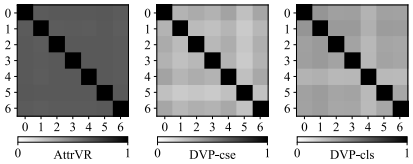
Figure 7 . Pairwise HSIC between sets of image embeddings apply- ing non-decoupled (i.e., AttrVR) or decoupled VPs (i.e., our DVP). Experiments are done on the Texture task with ViT-16-based CLIP.
원문 · CC BY 4.0 · Chengyi Cai, Zesheng Ye, Lei Feng, Jianzhong Qi, Feng Liu · Understanding Model Reprogramming for CLIP via Decoupling Visual Prompts · 원문 그림 인용 · 원본 PDF 9쪽에서 그림 영역을 추출했습니다.
Table 12 . Accuracy comparison of AttrVR with DesAttr and our methods with only one VP trained, using ViT-B16-based CLIP as the pretrained model (Mean %, ours are highlighted and the highest is in bold).
원문 · CC BY 4.0 · Chengyi Cai, Zesheng Ye, Lei Feng, Jianzhong Qi, Feng Liu · Understanding Model Reprogramming for CLIP via Decoupling Visual Prompts · 원문 그림 인용 · 원본 PDF 20쪽에서 그림 영역을 추출했습니다.적은 샷과 학습 비용의 한계
Aircraft 과제의 샷 수 실험에서 1-shot과 4-shot 설정에서는 DVP가 기준 방법보다 낮은 성능을 보입니다. 원문은 이를 PRM의 최대우도추정이 데이터가 적을 때 덜 신뢰적이기 때문이라고 설명합니다. 8-shot 이상에서는 DVP의 개선이 나타나며 32-shot에서 특히 두드러집니다. 또한 분리된 VP가 여러 개이므로 학습 시간이 늘어날 수 있으나, 각 VP는 독립적으로 학습할 수 있어 병렬화가 가능하다고 설명됩니다. DVPlite는 VR 패턴을 네 부분으로 나누어 파라미터 수를 AttrVR과 같게 유지한 변형이며, 파라미터 수가 같은 조건에서도 AttrVR보다 높은 평균 정확도를 보고합니다.

Table 13 . Training cost of different VR methods, using the ViT-B16-based CLIP as the pretrained model and the Flowers task as an example (ours are highlighted ).
원문 · CC BY 4.0 · Chengyi Cai, Zesheng Ye, Lei Feng, Jianzhong Qi, Feng Liu · Understanding Model Reprogramming for CLIP via Decoupling Visual Prompts · 원문 그림 인용 · 원본 PDF 20쪽에서 그림 영역을 추출했습니다.
Table 14 . Accuracy comparison of our DVPlite and the best-performing baseline method AttrVR trained on 16-shot downstream classification task, using ViT-B16-based CLIP as the pretrained model (Mean %, ours is highlighted and the highest is in bold).
원문 · CC BY 4.0 · Chengyi Cai, Zesheng Ye, Lei Feng, Jianzhong Qi, Feng Liu · Understanding Model Reprogramming for CLIP via Decoupling Visual Prompts · 원문 그림 인용 · 원본 PDF 22쪽에서 그림 영역을 추출했습니다.
Table 15 . A comparison of parameter numbers for different methods and their average accuracy across 11 datasets, using ViT-B16-based CLIP as the pretrained model (Mean %, ours are highlighted .
원문 · CC BY 4.0 · Chengyi Cai, Zesheng Ye, Lei Feng, Jianzhong Qi, Feng Liu · Understanding Model Reprogramming for CLIP via Decoupling Visual Prompts · 원문 그림 인용 · 원본 PDF 22쪽에서 그림 영역을 추출했습니다.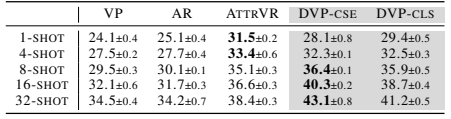
Table 17 . Accuracy comparison of different VR methods with fewer or more training samples (i.e., 1-, 4-, 8-, and 32-shot tasks), using ViT-B16-based CLIP as the pretrained model and the Aircraft task as an example (Mean %±Std %, ours are highlighted and the highest is in bold).
원문 · CC BY 4.0 · Chengyi Cai, Zesheng Ye, Lei Feng, Jianzhong Qi, Feng Liu · Understanding Model Reprogramming for CLIP via Decoupling Visual Prompts · 원문 그림 인용 · 원본 PDF 23쪽에서 그림 영역을 추출했습니다.논문 정보
- 저자
- Chengyi Cai, Zesheng Ye, Lei Feng, Jianzhong Qi, Feng Liu
- 학회·저널
- arXiv · 프리프린트
- 최초 공개일
- 2025년 6월 1일
- 등록일
- 2026년 10월 29일
- 수정일
- 2025년 6월 1일
- 버전
- v1
- arXiv
- 2506.01000
- 분류
- cs.LG · cs.CV
- 원문 이용 조건
- CC BY 4.0
- 제공 범위
- 논문 정보, 해설, 허용된 원문 그림
AI 해설은 논문 원문과 별개의 설명이며 오류가 있을 수 있습니다. 원문과 그림은 각 출처의 이용 조건과 따로 표시된 권리를 따릅니다.
초록
Model reprogramming adapts pretrained models to downstream tasks by modifying only the input and output spaces. Visual reprogramming (VR) is one instance for vision tasks that adds a trainable noise pattern (i.e., a visual prompt) to input images to facilitate downstream classification. The existing VR approaches for CLIP train a single visual prompt using all descriptions of different downstream classes. However, the limited learning capacity may result in (1) a failure to capture diverse aspects of the descriptions (e.g., shape, color, and texture), and (2) a possible bias toward less informative attributes that do not help distinguish between classes. In this paper, we introduce a decoupling-and-reweighting framework. Our decoupled visual prompts (DVP) are optimized using descriptions grouped by explicit causes (DVP-cse) or unsupervised clusters (DVP-cls). Then, we integrate the outputs of these visual prompts with a probabilistic reweighting matrix (PRM) that measures their contributions to each downstream class. Theoretically, DVP lowers the empirical risk bound. Experimentally, DVP outperforms baselines on average across 11 downstream datasets. Notably, the DVP-PRM integration enables insights into how individual visual prompts influence classification decisions, providing a probabilistic framework for understanding reprogramming. Our code is available at https://github.com/tmlr-group/DecoupledVP.
원문 인용
Chengyi Cai, Zesheng Ye, Lei Feng, Jianzhong Qi, Feng Liu (2025). Understanding Model Reprogramming for CLIP via Decoupling Visual Prompts. arXiv:2506.01000v1. https://arxiv.org/abs/2506.01000v1
BibTeX
@misc{cai2025understanding,
  title = {{Understanding Model Reprogramming for CLIP via Decoupling Visual Prompts}},
  author = {Chengyi Cai and Zesheng Ye and Lei Feng and Jianzhong Qi and Feng Liu},
  year = {2025},
  eprint = {2506.01000},
  archivePrefix = {arXiv},
  url = {https://arxiv.org/abs/2506.01000v1}
}