논문 해설
Learning-Order Autoregressive Models with Application to Molecular Graph Generation
학습 순서 자기회귀 모델과 분자 그래프 생성에의 응용
- 연구 문제 기존 자기회귀 모델은 생성 순서를 고정하거나 균등한 임의 순서로 가정하여, 순서가 분명하지 않은 분자 그래프 같은 데이터에서 성능과 유연성에 한계가 있습니다.
- 연구 방법 LO-ARM은 AO-ARM의 균등 순서 분포를 문맥 의존적인 학습 가능한 order-policy로 대체하고, 증거 하한을 RLOO 기울기로 최적화합니다.
- 주요 결과 QM9와 ZINC250k에서 LO-ARM-st-sep는 AO-ARM 기준선보다 낮은 FCD를 보고하며, 학습된 생성 순서는 대부분 엣지 우선 패턴을 보였습니다.
순서가 정해지지 않은 데이터의 자기회귀 생성 문제
자기회귀 모델(ARM)은 텍스트처럼 자연스러운 왼쪽에서 오른쪽 순서가 있는 데이터에서 다음 원소를 차례로 예측하는 방식으로 널리 쓰입니다. 그러나 이미지나 분자 그래프처럼 생성 순서가 분명하지 않은 데이터에서는 고정된 순서를 가정하면 데이터에 맞지 않는 귀납 편향이 들어갈 수 있습니다. 기존의 임의 순서 모델(AO-ARM)은 모든 순열을 균등하게 다루기 때문에 특정 순서에 대한 선호를 학습하지 못하고, 그 결과 우도 성능이 자연 순서 모델보다 떨어지는 경우가 보고됩니다. 이 논문은 생성 순서 자체를 문맥에 따라 학습되는 잠재 변수로 다루는 LO-ARM을 제안하며, 이를 분자 그래프 생성에 적용해 평가합니다.
order-policy를 학습하는 LO-ARM의 구조
LO-ARM은 AO-ARM에서 순서 분포를 균등 분포로 두던 부분을 학습 가능한 order-policy로 대체합니다. order-policy는 이미 생성된 차원의 값 xz<i에 조건부로 다음에 채울 차원의 인덱스 zi를 고르는 범주형 분포입니다. 학습에서는 정확한 로그우도를 직접 계산하기 어려우므로, 순서 분포를 데이터 x에 조건부인 변분 분포 qθ(z|x)로 근사하고 증거 하한(ELBO)을 최대화합니다. 변분 분포의 로짓은 신경망 gθ(x)에서 나오며 Plackett-Luce 모델과 Gumbel-top-k 기법으로 한 번에 순서 경로를 샘플링합니다. 이산 샘플링을 거치는 목적함수의 기울기는 두 샘플을 쓰는 RLOO 추정기로 불편하게 계산합니다.
생성 단계에서는 학습된 order-policy와 분류기만 사용하며, 변분 분포는 필요하지 않습니다.
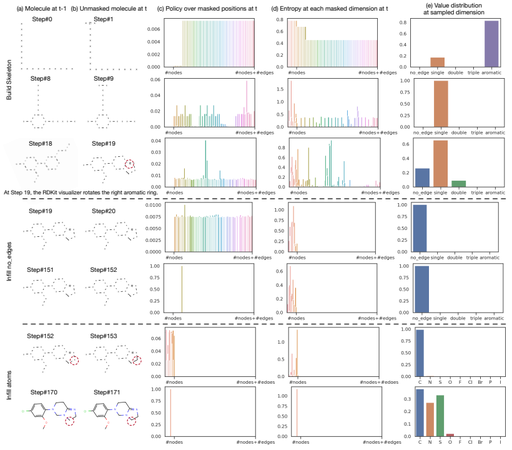
Figure 1 . An example of molecule generation with our best LO-ARM model trained on ZINC250k. Our model generates molecules step-by-step, commencing with all nodes and edges masked (in the figures masked nodes are labeled as x) and adding one node or edge at a time. First, an order-policy selects which dimension (node or edge) to fill, and then a classifier determines its value. Each step is illustrated in the provided figures: Columns (a) and (b) illustrate the (partially) generated molecular structures at two successive generation steps. Columns (c), (d), and (e) provide detailed insights: (c) the order-policy’s probability distribution over dimensions, (d) the classifier’s entropy for each dimension, and (e) the classifier’s prediction at the selected dimension. Note that, the order-policy and classifier entropy are zeroed for unmasked dimensions. The generation proceeds through three phases: bond skeleton construction, “no-edge” state population (representing “imaginery” bonds in the dense adjacency matrix), and atom type assignment. In particular, the order-policy learns to favor dimensions with high classifier certainty, demonstrated by an inverse relationship between policy probability and classifier entropy. For example, at Step 1, dimensions with higher probabilities in (c) correspond to lower entropies in (d). This trend is especially evident during the “no-edge” infilling phase, where masked edge dimensions at Step 20 and 152 exhibit high order-policy probabilities and near-zero classifier entropies, while masked node dimensions show the inverse. Importantly, the classifier assigns probabilities to potential values, enabling valid molecular variations. For instance, at Step 171, as shown in (e), the final masked atom has a near-equal chance of being Carbon, Nitrogen, or Sulfur, resulting in three different yet valid molecules. Step 19 also demonstrates this, with each possible edge value offering a different, yet feasible, molecular structure. We provide the full generation path in Appendix B.2.
원문 · CC BY 4.0 · Zhe Wang, Jiaxin Shi, Nicolas Heess, Arthur Gretton, Michalis K. Titsias · Learning-Order Autoregressive Models with Application to Molecular Graph Generation · 원문 그림 인용 · 원본 PDF 2쪽에서 그림 영역을 추출했습니다.order-policy와 변분 분포의 파라미터화 선택
order-policy 로짓 hθ,k는 두 가지 방식으로 정의됩니다. 하나는 각 차원 분포의 엔트로피를 이용하는 엔트로피 기반 방식으로, 값이 더 확실한 차원을 먼저 고르도록 유도합니다. 다른 하나는 shared-torso 방식으로, 분류기 신경망 본체에 최종 선형층을 더해 L개의 값을 출력합니다. 변분 분포의 로짓 gθ(x)도 본체를 공유하는 방식과 별도 신경망을 쓰는 방식이 있습니다. 분자 실험에서 이 선택은 LO-ARM-st-st(두 정책 모두 shared torso)와 LO-ARM-st-sep(pθ는 shared torso, qθ는 별도 신경망)처럼 구분되어 비교됩니다.
QM9와 ZINC250k 분자 생성 실험 설정
분자 실험에서 각 모델은 16384개의 샘플을 생성해 평가합니다. 평가 지표는 분자의 유효성과 고유성, 그리고 생성 분포와 실제 분포의 거리를 나타내는 FCD입니다. QM9에서는 NLL도 테스트 세트 기준으로 함께 보고됩니다. ZINC250k는 더 큰 약물 유사 분자를 포함하므로 더 어려운 데이터셋으로 소개되며, AO-ARM과 Biased-AO-ARM을 p=1.0 기준선으로 두고 Top-p 샘플링을 추론 시에만 적용한 변형을 함께 평가합니다. 분자 그래프는 밀집 노드 벡터와 인접 행렬로 표현되며, 실제 결합이 없는 칸은 no-edge 상태로 포함됩니다. DiGress, GraphARM, CatFlow 등의 비교 수치는 원문 표에서 인용된 값입니다.

Table 6 . Statistics of QM9 and ZINK250k datasets used in our molecule generation tasks.
원문 · CC BY 4.0 · Zhe Wang, Jiaxin Shi, Nicolas Heess, Arthur Gretton, Michalis K. Titsias · Learning-Order Autoregressive Models with Application to Molecular Graph Generation · 원문 그림 인용 · 원본 PDF 17쪽에서 그림 영역을 추출했습니다.분자 생성 결과와 Top-p 샘플링의 영향
QM9에서 LO-ARM-st-sep는 FCD 0.240을 보고하며, 표에 인용된 방법 중 가장 낮은 FCD를 보입니다. 유효성은 99.85%, 고유성은 98.85%입니다. LO-ARM 변형은 모두 AO-ARM보다 우수하게 보고됩니다. ZINC250k에서는 AO-ARM의 FCD 6.541과 Biased-AO-ARM의 5.026보다 낮은 LO-ARM-st-sep의 FCD 3.229가 보고됩니다. 다만 이 모델의 유효성은 96.26%로 CatFlow의 99.21%보다 낮습니다. Top-p 샘플링을 적용하면 유효성은 높아지지만 FCD는 나빠지며, LO-ARM-st-sep는 p=0.3에서도 FCD가 3.859로 크게 악화되지 않는다고 보고됩니다.
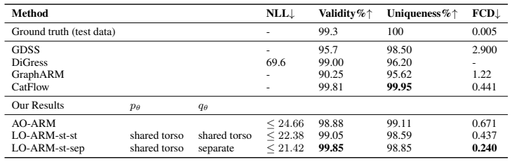
Table 1 . Molecule generation on QM9. We directly cite the results of other methods. The negative loglikelihoods (NLLs) of our methods are evaluated against the test set, and other metrics are calculated with the generated samples with the corresponding methods.
원문 · CC BY 4.0 · Zhe Wang, Jiaxin Shi, Nicolas Heess, Arthur Gretton, Michalis K. Titsias · Learning-Order Autoregressive Models with Application to Molecular Graph Generation · 원문 그림 인용 · 원본 PDF 7쪽에서 그림 영역을 추출했습니다.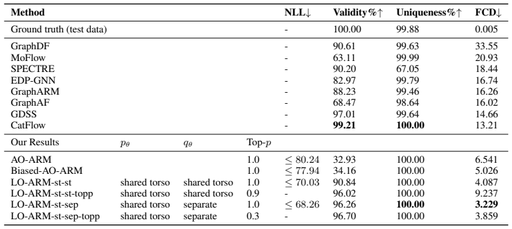
Table 2 . Molecule generation on ZINC250K. In particular, the NLLs of the LO-ARMs with the Top-p sampling are omitted as the sampler is only used in inference time and does not change the training-time metrics.
원문 · CC BY 4.0 · Zhe Wang, Jiaxin Shi, Nicolas Heess, Arthur Gretton, Michalis K. Titsias · Learning-Order Autoregressive Models with Application to Molecular Graph Generation · 원문 그림 인용 · 원본 PDF 8쪽에서 그림 영역을 추출했습니다.화학 특이 지표와 학습된 생성 순서
ZINC250k에서 LO-ARM-st-sep는 QED 0.75, SAS 3.08, 쌍별 유사도 0.34를 보고합니다. 쌍별 유사도는 값이 낮을수록 샘플 다양성이 높다는 뜻입니다. 원문은 이 지표의 분포가 실제 데이터와 잘 맞는다고 보고하며, 다른 방법의 수치는 Mazuz et al. (2023)에서 인용되었습니다. 생성 순서에 대해서는 학습된 LO-ARM-st-sep 모델 3개를 서로 다른 시드로 학습하고 모델당 10000개 분자를 생성하여 분석했습니다. 유효하지 않은 분자도 필터링하지 않았으며, 엣지 우선 템플릿과 정확히 일치하는 시퀀스는 30000개 중 29973개로 99.9%입니다. 이는 학습된 순서가 엣지 우선 경향을 보였다는 관찰이며, 모든 분자 데이터에 대한 보편적 증명은 아닙니다.
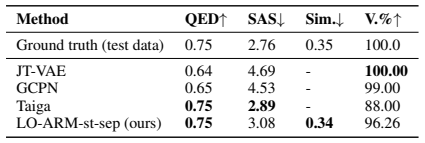
Table 3 . LO-ARM’s perforamance on chemistry-specific metrics on ZINC250k. Specifically, lower similarity indicates higher diver- sity for molecules in the dataset. On all these metrics, LO-ARM exceeds or matches the performance of the state-of-the-art results of the models. The results of other methods are cited from (Mazuz et al., 2023). V .is short for Validity.
원문 · CC BY 4.0 · Zhe Wang, Jiaxin Shi, Nicolas Heess, Arthur Gretton, Michalis K. Titsias · Learning-Order Autoregressive Models with Application to Molecular Graph Generation · 원문 그림 인용 · 원본 PDF 8쪽에서 그림 영역을 추출했습니다.한계와 적용 범위
저자들은 LO-ARM이 확산 기반 방법에 비해 개별 분자의 유효성에서 개선할 여지가 있다고 밝힙니다. Top-p 샘플링은 샘플링 편향을 도입하여 분포를 실제 데이터 분포에서 벗어나게 하며, 유효성을 높이는 대가로 FCD가 나빠집니다. 또한 분자 실험의 결과는 QM9와 ZINC250k, 그리고 Graph Transformer 기반 분류기에서 얻은 것입니다. 이미지 예시는 MNIST에 대한 정성적 분석이며, 고해상도 이미지나 단백질 설계 등 다른 영역으로의 확장은 이 논문에서 검증되지 않았습니다.
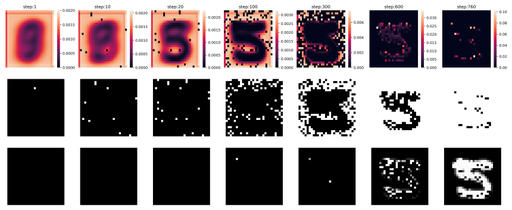
Figure 3 . An example of data generation in MNIST using LO-ARM with shared torso parametrization of the order-policy distribution. Each column visualizes a step of the sampling process (steps shown are i = 1, 10, 20, 100, 300, 600, 760). The panels in the first row show the order-policy values pθ(zi|z<i, xz<i ) at step i depicted as an 28 × 28 image where dark colour indicates small probability value and light colour higher value. The plot in the second row shows all sampled pixel locations (immediately after having determined the current value for zi) depicted as binary masks. Third row shows the progression of generating the actual digit. The figure highlights that the learned order-policy prioritizes unmasking pixels with higher certainty. The boundary-to-center infilling strategy, shown in both the prioritization via the order-policy (first row) and the unmasking sequence (second row), illustrates this. The rough generation order — borders, background, then digit — indicates a clear preference for areas of increasing certainty. Initially, the model confidently fills in the black boundaries and background (third row), leading to the gradual, confident clarification of the digit into “5”.
원문 · CC BY 4.0 · Zhe Wang, Jiaxin Shi, Nicolas Heess, Arthur Gretton, Michalis K. Titsias · Learning-Order Autoregressive Models with Application to Molecular Graph Generation · 원문 그림 인용 · 원본 PDF 12쪽에서 그림 영역을 추출했습니다.논문 정보
- 저자
- Zhe Wang, Jiaxin Shi, Nicolas Heess, Arthur Gretton, Michalis K. Titsias
- 학회·저널
- arXiv · 프리프린트
- 최초 공개일
- 2025년 3월 7일
- 등록일
- 2026년 10월 31일
- 수정일
- 2025년 7월 13일
- 버전
- v2
- arXiv
- 2503.05979
- 분류
- cs.LG · cs.AI · stat.ML
- 원문 이용 조건
- CC BY 4.0
- 제공 범위
- 논문 정보, 해설, 허용된 원문 그림
AI 해설은 논문 원문과 별개의 설명이며 오류가 있을 수 있습니다. 원문과 그림은 각 출처의 이용 조건과 따로 표시된 권리를 따릅니다.
초록
Autoregressive models (ARMs) have become the workhorse for sequence generation tasks, since many problems can be modeled as next-token prediction. While there appears to be a natural ordering for text (i.e., left-to-right), for many data types, such as graphs, the canonical ordering is less obvious. To address this problem, we introduce a variant of ARM that generates high-dimensional data using a probabilistic ordering that is sequentially inferred from data. This model incorporates a trainable probability distribution, referred to as an order-policy, that dynamically decides the autoregressive order in a state-dependent manner. To train the model, we introduce a variational lower bound on the log-likelihood, which we optimize with stochastic gradient estimation. We demonstrate experimentally that our method can learn meaningful autoregressive orderings in image and graph generation. On the challenging domain of molecular graph generation, we achieve state-of-the-art results on the QM9 and ZINC250k benchmarks, evaluated across key metrics for distribution similarity and drug-likeless.
원문 인용
Zhe Wang, Jiaxin Shi, Nicolas Heess, Arthur Gretton, Michalis K. Titsias (2025). Learning-Order Autoregressive Models with Application to Molecular Graph Generation. arXiv:2503.05979v2. https://arxiv.org/abs/2503.05979v2
BibTeX
@misc{wang2025learning,
  title = {{Learning-Order Autoregressive Models with Application to Molecular Graph Generation}},
  author = {Zhe Wang and Jiaxin Shi and Nicolas Heess and Arthur Gretton and Michalis K. Titsias},
  year = {2025},
  eprint = {2503.05979},
  archivePrefix = {arXiv},
  url = {https://arxiv.org/abs/2503.05979v2}
}