논문 해설
Beyond the Training Cameras: Coverage-Controlled Probes of Viewing Direction in Frozen Vision Models
학습 카메라를 넘어서: 고정된 비전 모델의 시선 방향에 대한 커버리지 제어 프로브
- 연구 문제 비전 모델이 2D 이미지 학습으로 카메라의 상대 시점 방향을 내부 표현에 담는지는, 이미지 측정값과 구분하기 어려워 기존 프로브 평가로는 답하기 어렵습니다.
- 연구 방법 두 물체의 투영 위치를 고정한 렌더링 데이터에서 장면 간 공유 선형 평면을 맞추고, 학습 카메라 범위 밖에서 판독기를 평가합니다.
- 주요 결과 여덟 동결 모델 중 일곱 모델의 단일 이미지 판독기가 범위 밖에서 6–8° 수준의 오차를 보였고, PixArt-α에서는 블록 6 평면을 개입해도 생성 시점은 최대 7° 정도만 움직였습니다.
시점 방향을 2D 이미지 학습 모델이 알고 있는가
비전 모델은 2D 이미지로 학습하지만 이미지 속 장면은 3D입니다. 이 논문은 카메라가 두 물체를 어느 방향에서 보는지를 나타내는 상대 시점 방향 α가 동결된 모델의 은닉 특징에 어떤 형태로 들어 있는지 묻습니다.
기존 프로브는 학습 때와 같은 카메라 범위에서 평가되는 경우가 많습니다. 이 범위 안에서는 물체의 겉보기 크기나 그림자 위치 같은 이미지 측정값만으로도 방향을 맞힐 수 있어, 모델이 방향을 따로 표현하는지 구분하기 어렵습니다.
고정 투영 데이터와 공유 평면 프로브
논문은 두 구의 중심이 카메라가 움직여도 같은 두 픽셀에 투영되도록 초점거리와 카메라 방향을 풀어 렌더링했습니다. 그래서 투영된 배치는 변하지 않고, 시점 변화는 원근, 음영, 그림자, 바닥 외형에서만 드러납니다.
핵심 프로브는 장면 평균을 뺀 차이 특징 h=a−b에 대해 하나의 선형 맵 W를 모든 장면에서 공유하도록 맞춥니다. 이때 ˜h(α)≈W·u(α)이며 u(α)=(cosα, sinα)입니다. 열 공간이 평면이 되고, 이 평면이 얼마나 설명하는지를 held-out R²로 잽니다.
coverage 분할로 외삽 능력 검사
학습 카메라는 여섯 개의 원 궤적에 놓이고, 테스트는 네 개의 타원 궤적에서 수행합니다. 테스트 뷰는 가까운 학습 카메라와의 거리에 따라 coverage 안(거리 0.25 미만)과 밖(0.5 이상)으로 나눕니다.
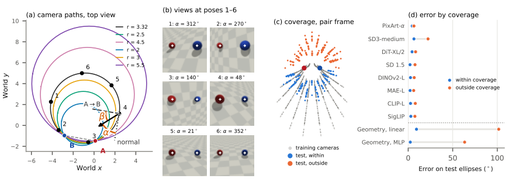
Figure 2 .Fixed-projection camera trajectories and coverage.(a) Top view of the six circular camera paths around spheres A and B in one scene (r: radius). At pose 4, the arrow is the ground projection of the camera’s optical axis, the dashed line the direction A→B and the dotted line the normal of the pair; β is the angle from A→B to the axis and α= 90 ◦ −β the angle between the axis and the normal. (b) Rendered views at the numbered poses; white crosses mark the projected object centres, which are the same pixels in every image. (c) Camera positions of all scenes in the object-pair frame; red and blue discs: objects A and B; grey: training cameras; blue: test views within coverage (200 of 448); orange: test views outside coverage (203). (d) Mean single-image error on test ellipse views of spheres within (blue) and outside (orange) coverage, for the readout of each model and for the geometric decoders.
원문 · CC BY 4.0 · Peize Ding · Beyond the Training Cameras: Coverage-Controlled Probes of Viewing Direction in Frozen Vision Models · 원문 그림 인용 · 원본 PDF 4쪽에서 그림 영역을 추출했습니다.이 분할은 프로브가 학습 카메라 범위를 벗어나 방향을 읽을 수 있는지를 봅니다.
여덟 모델의 공유 평면과 외삽 결과
여덟 개의 동결 모델은 모두 학습 경로에서 held-out 장면의 α를 몇 도 이내로 디코딩했습니다. 범위 밖에서는 여덟 모델 중 일곱 개의 판독기가 6–8° 수준의 오차를 보였고, SD3는 22°로 외삽이 덜 좋았습니다.
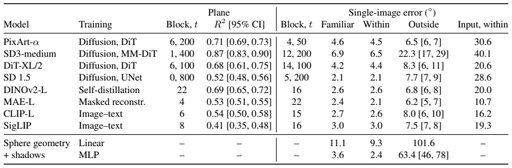
Table 1 .Eight frozen models(Tier A spheres, 8 test scenes). Plane: shared-plane model on difference features at the validation-selected block and timestep, held-out R2. Single image: linear readout at the validation-selected block and timestep; mean angular error ( ◦) on the training paths (familiar) and on test ellipse views within and outside the coverage of training cameras (95% scene-bootstrap interval), and for the same readout at the model input within the coverage.
원문 · CC BY 4.0 · Peize Ding · Beyond the Training Cameras: Coverage-Controlled Probes of Viewing Direction in Frozen Vision Models · 원문 그림 인용 · 원본 PDF 6쪽에서 그림 영역을 추출했습니다.평면의 강도는 모델마다 달랐습니다. SD3의 held-out R²가 가장 높았고 PixArt-α, DINOv2, DiT-XL/2는 0.7 가까이였으며, SigLIP은 가장 낮았습니다. 판독 정확도와 평면 강도가 같은 순서를 따르지 않아, 정확한 디코딩이 공유 평면을 전제하지는 않았습니다.
PixArt-α의 블록 6 평면 개입
PixArt-α에서는 블록 6에서 평면이 갑자기 형성되었습니다. 블록 6의 평면을 평균 제거하면 블록 7에서 디코딩한 α의 오차가 7°에서 37°로 올랐고, 최종 블록에서도 약 두 배 수준으로 남았습니다.
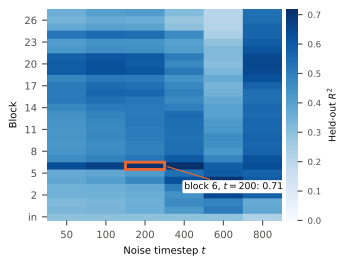
Figure 3 .Where the plane forms.Held-out R2 of the shared-plane probe of PixArt-α (difference features, test scenes) at the input (in) and at every block, for each diffusion timestep t. Outlined: the block and timestep selected on validation scenes.
원문 · CC BY 4.0 · Peize Ding · Beyond the Training Cameras: Coverage-Controlled Probes of Viewing Direction in Frozen Vision Models · 원문 그림 인용 · 원본 PDF 5쪽에서 그림 영역을 추출했습니다.평면을 180° 회전시키면 블록 7의 디코딩값은 원래 방향과 새 방향 모두에서 약 90° 떨어졌고, 이후 블록에서 원래 방향이 일부 회복되었습니다. 생성 단계에서는 clamping과 gradient guidance를 써도 생성된 시점은 최대 7° 정도만 움직였고, 요청한 90°와 180° 회전과 크게 달랐습니다. 저자들은 이를 평면이 정보를 전달하지만 생성 시점을 전역으로 제어하지는 않는다고 해석합니다.
공유 평면과 외삽의 한계
공유 평면이 있다고 외삽이 보장되지는 않았습니다. 실린더와 pair-aligned 큐브는 평면이 부분적으로 공유되었지만, 카메라 고도 변화에 따라 보이는 면이 바뀌어 coverage 밖에서 판독기가 실패했습니다.
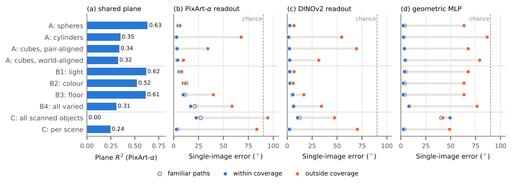
Figure 5 .Shape and appearance(Tier A shapes, Tiers B1–B4 and Tier C; 8 test scenes; numbers in Sec. S9). (a) Held-out R2 of the dataset’s own shared plane in PixArt-α (difference features, block 6, t= 50 ). (b–d) Single-image angular error of the validation-selected readout of PixArt-α and DINOv2 and of the geometric MLP, on training paths (grey rings) and on test ellipse views within (blue) and outside (orange) the coverage; dashed line: chance. Tier C uses 8-pixel pooling windows (other windows and models in Sec. S9). C, per scene: plane and decoders fitted within each test scene on its own circles (R2 and familiar error on a held-out circle; coverage relative to the scene’s own cameras).
원문 · CC BY 4.0 · Peize Ding · Beyond the Training Cameras: Coverage-Controlled Probes of Viewing Direction in Frozen Vision Models · 원문 그림 인용 · 원본 PDF 7쪽에서 그림 영역을 추출했습니다.또한 평면은 α의 첫 푸리에 조화성분으로 쉽게 생길 수 있어, 평면의 존재만으로 모델이 추상적 기하 각도를 계산한다고 결론짓지는 않습니다. 실제 사진과 더 큰 장면 집합에 대한 검증은 남은 과제입니다.
논문 정보
- 저자
- Peize Ding
- 학회·저널
- arXiv · 프리프린트
- 최초 공개일
- 2026년 11월 14일
- 등록일
- 2026년 11월 17일
- 수정일
- 2026년 11월 14일
- 버전
- v1
- arXiv
- 2611.19642
- 분류
- cs.CV
- 원문 이용 조건
- CC BY 4.0
- 제공 범위
- 논문 정보, 해설, 허용된 원문 그림
AI 해설은 논문 원문과 별개의 설명이며 오류가 있을 수 있습니다. 원문과 그림은 각 출처의 이용 조건과 따로 표시된 권리를 따릅니다.
초록
Vision models are trained on 2D images of a 3D world. Do their hidden features encode the direction from which the camera views a scene, and if so, in what form? We study the relative viewing direction $α$ of two objects in rendered scenes where both object centres stay at fixed pixels while the camera moves, so that perspective, shading and shadows change but the projected layout does not. In eight pretrained models, from diffusion models to self-supervised and image-text encoders, $α$ is encoded in a strikingly simple form: a single two-dimensional plane in the hidden space, shared across scenes, in which the difference between the two objects' features traces $(\cosα, \sinα)$. The plane keeps its orientation when lighting, colours, floors and object shapes change. This encoding is more than a summary of a few visible measurements: readouts fitted on one set of camera paths stay accurate at camera positions outside their range in seven of the eight models, whereas decoders of the measured object and shadow geometry, equally accurate within that range, fail there. In the diffusion transformer PixArt-$α$, the plane forms abruptly at a single block and carries direction information to later blocks, yet editing it changes the objects rather than the generated viewpoint. We also examine how this encoding carries over to scanned real objects.
원문 인용
Peize Ding (2026). Beyond the Training Cameras: Coverage-Controlled Probes of Viewing Direction in Frozen Vision Models. arXiv:2611.19642v1. https://arxiv.org/abs/2611.19642v1
BibTeX
@misc{ding2026beyond,
  title = {{Beyond the Training Cameras: Coverage-Controlled Probes of Viewing Direction in Frozen Vision Models}},
  author = {Peize Ding},
  year = {2026},
  eprint = {2611.19642},
  archivePrefix = {arXiv},
  url = {https://arxiv.org/abs/2611.19642v1}
}