논문 해설
TQL: Scaling Q-Functions with Transformers by Preventing Attention Collapse
TQL: 어텐션 붕괴를 방지하여 트랜스포머로 Q-함수 확장하기
- 연구 문제 트랜스포머를 강화학습 가치 함수에 그대로 키우면 어텐션 붕괴로 성능이 떨어지는 문제를 다룹니다.
- 연구 방법 TQL은 어텐션 엔트로피를 목표값으로 조절하는 손실과 층별 온도 파라미터로 어텐션 붕괴를 막습니다.
- 주요 결과 OGBench 실험에서 TQL은 모델 크기 확장 시 성능이 개선되고 25개 과제 평균에서 최고 성능을 보였다고 원문은 보고합니다.
트랜스포머를 가치 함수에 키우면 생기는 문제
강화학습의 가치 함수(Q-함수)는 지금까지 대체로 작은 네트워크로 학습되어 왔습니다. 지도학습에서는 트랜스포머가 규모를 키울수록 성능이 좋아지지만, 같은 구조를 가치 함수 학습에 그대로 옮기면 학습이 불안정해지고 성능이 오히려 떨어집니다. 원문은 한 실험에서 평균 성공률이 46%에서 6%로 떨어지는 예를 보고합니다.
저자들은 이 실패의 핵심 원인을 어텐션 붕괴로 봅니다. 모델 용량이 커질수록 어텐션 분포가 소수의 토큰에 집중되고, 그 결과 나머지 입력 정보를 충분히 쓰지 못합니다. 이 연구는 이 붕괴를 막아 트랜스포머 가치 함수를 안정적으로 키우는 방법을 다룹니다.
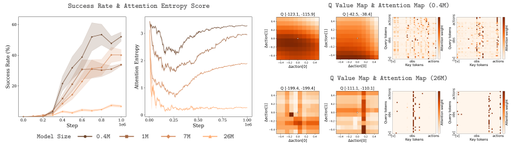
Figure 3 .Scaling transformers for value functions results in entropy collapse and worse performance.Left: Visualizations of the success rate and attention entropy of the transformer model without TQL across five cube-double tasks under different model sizes. Right: Q-value landscapes and attention maps for the smallest (0.4M) and largest (26M) models. The larger transformer learns highly non-smooth value surfaces and exhibits high-frequency oscillations and discontinuities that are absent in its smaller counterpart.
원문 · CC BY 4.0 · Dong, Perry, Hung, Kuo-Han, Swerdlow, Alexander, Sadigh, Dorsa, Finn, Chelsea · TQL: Scaling Q-Functions with Transformers by Preventing Attention Collapse · 원문 그림 인용 · 원본 PDF 6쪽에서 그림 영역을 추출했습니다.어텐션 엔트로피를 목표값으로 조절하는 TQL
TQL은 상태와 행동의 각 스칼라 차원을 토큰으로 바꾸고, 학습 가능한 [VALUE] 토큰을 앞에 붙인 트랜스포머 디코더로 Q-값을 예측합니다. 상태 토큰과 행동 토큰은 학습 가능한 모달리티 임베딩으로 구별됩니다. 기본 학습 목적은 지연된 타깃 네트워크를 쓰는 표준 TD 손실이며, TQL은 여기에 어텐션 엔트로피 항을 더합니다.
각 어텐션 층의 엔트로피는 어텐션 행렬의 행별 엔트로피를 평균해 계산합니다. 원문은 목표 엔트로피 ¯H를 두고, 온도 파라미터 α를 조정해 엔트로피를 이 목표값 근처로 유지하도록 합니다. 온도는 층마다 별도로 두며, [VALUE] 토큰의 어텐션에는 따로 온도를 둡니다. 이렇게 하면 각 층과 [VALUE] 토큰이 자신의 적절한 엔트로피를 유지할 수 있습니다. 이 방식은 최대 엔트로피 강화학습의 온도 조절 아이디어에서 영감을 받은 것으로 소개됩니다.
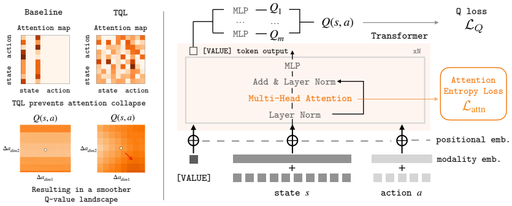
Figure 2 .Scaling value networks with TQL.TQL prevents attention collapse in larger networks by controlling the target entropy of attention scores (right). Compared to an unregularized model, TQL exhibits a more uniform attention distribution and a smoother value landscape (left).
원문 · CC BY 4.0 · Dong, Perry, Hung, Kuo-Han, Swerdlow, Alexander, Sadigh, Dorsa, Finn, Chelsea · TQL: Scaling Q-Functions with Transformers by Preventing Attention Collapse · 원문 그림 인용 · 원본 PDF 3쪽에서 그림 영역을 추출했습니다.정책 추출은 FQL의 일단계 플로우 정책 절차를 따르며, 행동 복제 정책으로의 증류 제약 아래에서 Q-값을 최대화합니다.
모델 크기 확장에서의 결과
원문은 0.4M부터 26M 파라미터까지의 비평자 크기에서 FQL, floq, PAC, 트랜스포머 기준선과 TQL을 비교합니다. 결과는 가장 작은 모델 대비 상대 개선으로 보고되며, 시드와 25개 과제에 걸쳐 평균됩니다. 이 설정에서 기존 방법들은 가장 작은 설정에서 가장 큰 설정으로 갈 때 평균 10.6% 성능이 감소한다고 보고됩니다.
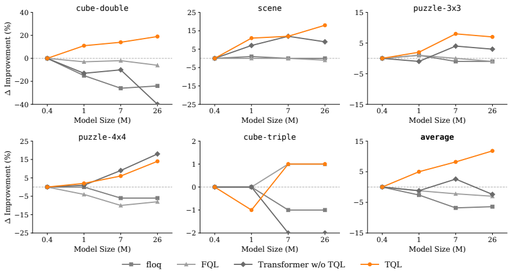
Figure 4 .Scaling results.We compare TQL against prior offline RL methods across critic sizes from 0.4M to 26M parameters. The plot reports the average success rate difference compared to the smallest model (0.4M) for each method. While baselines suffer from perfor- mance degradation at larger scales, TQL consistently scales well across all environments, outperforming prior methods by a large margin.
원문 · CC BY 4.0 · Dong, Perry, Hung, Kuo-Han, Swerdlow, Alexander, Sadigh, Dorsa, Finn, Chelsea · TQL: Scaling Q-Functions with Transformers by Preventing Attention Collapse · 원문 그림 인용 · 원본 PDF 7쪽에서 그림 영역을 추출했습니다.반면 TQL은 크기가 커질수록 성능이 개선되며, 가장 작은 모델에서 가장 큰 모델까지 43% 성능 향상을 보입니다. 다만 이 수치는 원문이 보고한 평균 상대 개선이며, 다른 과제 부분집합이나 다른 기준선의 조건으로 옮겨 해석하지 않아야 합니다. 트랜스포머 기준선은 7M에서는 일부 과제에서 개선되지만 26M에서는 나빠집니다.
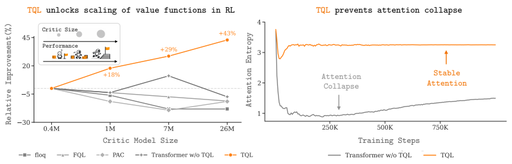
Figure 1 .TQL unlocks scaling of value functions in RL by preventing attention collapse.Left: Scaling results of TQL compared with prior approaches with different generative model backbones. The results are reported as relative improvement over the smallest model size, averaged across seeds and all 25 tasks in our evaluation suite. TQL increases in performance as network size increases, while prior approaches are not able to effectively use the extra capacity and drop in performance. Right: Attention entropy with and without TQL, averaged across 25 tasks. TQL scales effectively by preventing attention collapse that occurs with scaling up the transformer architecture for value function training.
원문 · CC BY 4.0 · Dong, Perry, Hung, Kuo-Han, Swerdlow, Alexander, Sadigh, Dorsa, Finn, Chelsea · TQL: Scaling Q-Functions with Transformers by Preventing Attention Collapse · 원문 그림 인용 · 원본 PDF 2쪽에서 그림 영역을 추출했습니다.OGBench 단일 과제 비교
OGBench의 단일 과제 변형에서 TQL은 BC, IQL, ReBRAC, FBRAC, IFQL, FQL, floq, Q-Transformer, PAC와 비교됩니다. 결과는 3개 시드의 평균이며, 성공률은 800k, 900k, 1M 학습 체크포인트의 평균으로 보고됩니다.
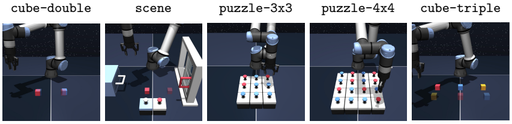
Figure 14 .Visualizations of the domains we evaluate on.Each of the 5 domains from OGBench has 5 tasks, for a total of 25 tasks.
원문 · CC BY 4.0 · Dong, Perry, Hung, Kuo-Han, Swerdlow, Alexander, Sadigh, Dorsa, Finn, Chelsea · TQL: Scaling Q-Functions with Transformers by Preventing Attention Collapse · 원문 그림 인용 · 원본 PDF 19쪽에서 그림 영역을 추출했습니다.표 1에서 TQL은 다섯 개 영역 중 네 개에서 가장 높은 평균 성능을 보이고, 25개 과제 전체 평균에서도 가장 높습니다. 표의 굵은 값은 과제별 최고 결과의 95% 이내 성능을 뜻합니다. 이 결과는 원문이 사용한 OGBench 단일 과제 조건에 대한 것이며, 다른 벤치마크의 성능을 보장하지는 않습니다.
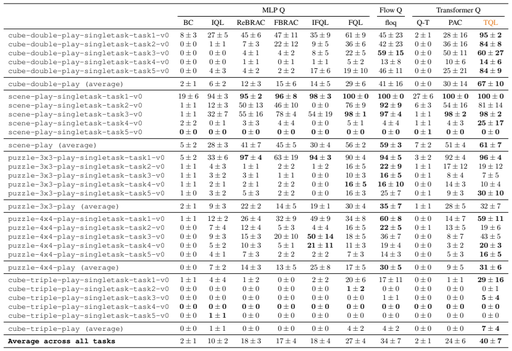
Table 1 .OGBench evaluation results.TQL achieves the highest average performance on 4 out of 5 domains, as well as the best average performance across all 25 tasks. The reported scores are averaged over 3 seeds, where bold values indicate performance within 95% of the best result per task.
원문 · CC BY 4.0 · Dong, Perry, Hung, Kuo-Han, Swerdlow, Alexander, Sadigh, Dorsa, Finn, Chelsea · TQL: Scaling Q-Functions with Transformers by Preventing Attention Collapse · 원문 그림 인용 · 원본 PDF 6쪽에서 그림 영역을 추출했습니다.구성요소 절제 실험
cube-double의 다섯 과제에서 26M 모델을 사용해 TQL의 구성요소를 절제했습니다. 엔트로피 손실을 제거한 변형은 성공률 6±3%, 고정 엔트로피 패널티를 쓴 변형은 38±8%, 단일 온도 α를 쓴 변형은 41±12%였고, TQL은 67±6%였습니다. 값은 5개 과제와 3개 시드의 평균입니다.
이 결과가 보여주는 것은 목표 엔트로피 지도, 고정 벌점이 아닌 목표 기반 조절, 층별 및 토큰별 온도가 각각 성능 유지에 기여한다는 점입니다. 원문은 엔트로피 지도를 제거하면 어텐션 붕괴로 성능이 크게 떨어진다고 보고합니다. 또한 최대 엔트로피 손실을 고정 벌점으로 쓰는 방식은 목표값 지도보다 성능이 크게 낮다고 보고합니다. 이 실험은 cube-double과 26M 설정에 한정됩니다.
깊이 확장과 기존 안정화 기법 비교
부록 실험에서는 총 파라미터를 약 26M으로 고정하고 깊이를 4계층까지 늘렸습니다. 이 설정에서 TQL은 2계층과 4계층에서 각각 67%와 66%의 성능을 보여, 깊이가 달라도 비슷한 결과를 냅니다. 저자들은 이를 전체 네트워크 크기가 성능의 좋은 지표가 될 수 있다는 근거로 해석합니다.
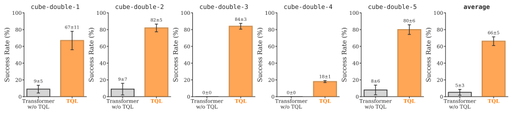
Figure 10 .Performance of TQL with more layers.A transformer without TQL results in the same attention collapse as in the setting with fewer layers and TQL addresses this to improve performance. We find that the increased depth results in similar performance in both cases.
원문 · CC BY 4.0 · Dong, Perry, Hung, Kuo-Han, Swerdlow, Alexander, Sadigh, Dorsa, Finn, Chelsea · TQL: Scaling Q-Functions with Transformers by Preventing Attention Collapse · 원문 그림 인용 · 원본 PDF 16쪽에서 그림 영역을 추출했습니다.또 다른 부록 비교에서는 지도학습에서 제안된 σReparam, QK Norm, 현대적 트랜스포머 구성과 TQL을 cube-double에서 비교합니다. 이 기법들은 엔트로피를 어느 정도 높이지만 일관되게 붕괴를 막지 못하며, 전반적으로 TQL보다 낮은 성능을 보입니다.
한계와 적용 범위
원문은 TQL이 추가 손실 항과 목표 엔트로피 하이퍼파라미터를 필요로 하여 구현과 튜닝의 복잡도를 늘린다고 밝힙니다. 목표 엔트로피는 환경마다 조정해야 하며, 저자들은 모델 크기에는 대체로 독립적이라고 보고합니다. 다만 TQL은 아키텍처를 바꾸지 않으므로 사전학습된 백본에도 적용할 수 있다고 설명합니다.
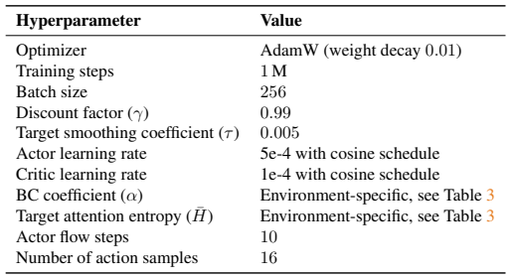
Table 2 .Default training hyperparameters for TQL.
원문 · CC BY 4.0 · Dong, Perry, Hung, Kuo-Han, Swerdlow, Alexander, Sadigh, Dorsa, Finn, Chelsea · TQL: Scaling Q-Functions with Transformers by Preventing Attention Collapse · 원문 그림 인용 · 원본 PDF 19쪽에서 그림 영역을 추출했습니다.이 결과의 평가 범위는 OGBench 단일 과제 설정과 제한된 모델 크기 범위입니다. 어텐션 엔트로피 분석은 cube-double 등 일부 환경에서 수행되었고, 다른 도메인이나 실제 로봇 환경에서 같은 효과가 있는지는 이 원문의 실험만으로 확인되지 않습니다.
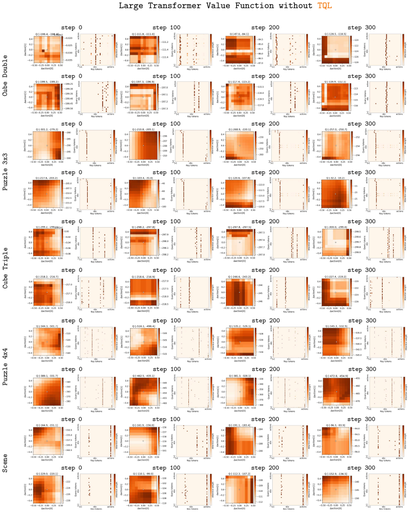
Figure 8 .Attention maps and Q-value landscapes of a Transformer without TQL across all five environments. The learned Q-value functions exhibit non-smooth landscapes, accompanied by overfitted attention patterns, which hinder effective value learning.
원문 · CC BY 4.0 · Dong, Perry, Hung, Kuo-Han, Swerdlow, Alexander, Sadigh, Dorsa, Finn, Chelsea · TQL: Scaling Q-Functions with Transformers by Preventing Attention Collapse · 원문 그림 인용 · 원본 PDF 14쪽에서 그림 영역을 추출했습니다.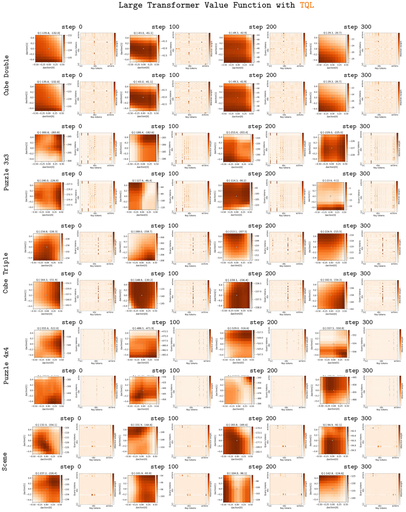
Figure 9 .Attention maps and Q-value maps of TQL across all five environments. The learned Q-value functions exhibit smooth landscapes, accompanied by more distributed attention patterns, which facilitate stable and effective value learning.
원문 · CC BY 4.0 · Dong, Perry, Hung, Kuo-Han, Swerdlow, Alexander, Sadigh, Dorsa, Finn, Chelsea · TQL: Scaling Q-Functions with Transformers by Preventing Attention Collapse · 원문 그림 인용 · 원본 PDF 15쪽에서 그림 영역을 추출했습니다.논문 정보
- 저자
- Dong, Perry, Hung, Kuo-Han, Swerdlow, Alexander, Sadigh, Dorsa, Finn, Chelsea
- 학회·저널
- arXiv · 프리프린트
- 최초 공개일
- 2026년 2월 1일
- 등록일
- 2026년 10월 30일
- 수정일
- 2026년 2월 1일
- 버전
- v1
- arXiv
- 2602.01439
- 원문 이용 조건
- CC BY 4.0
- 제공 범위
- 논문 정보, 해설, 허용된 원문 그림
AI 해설은 논문 원문과 별개의 설명이며 오류가 있을 수 있습니다. 원문과 그림은 각 출처의 이용 조건과 따로 표시된 권리를 따릅니다.
초록
Despite scale driving substantial recent advancements in machine learning, reinforcement learning (RL) methods still primarily use small value functions. Naively scaling value functions -- including with a transformer architecture, which is known to be highly scalable -- often results in learning instability and worse performance. In this work, we ask what prevents transformers from scaling effectively for value functions? Through empirical analysis, we identify the critical failure mode in this scaling: attention scores collapse as capacity increases. Our key insight is that we can effectively prevent this collapse and stabilize training by controlling the entropy of the attention scores, thereby enabling the use of larger models. To this end, we propose Transformer Q-Learning (TQL), a method that unlocks the scaling potential of transformers in learning value functions in RL. Our approach yields up to a 43% improvement in performance when scaling from the smallest to the largest network sizes, while prior methods suffer from performance degradation.
원문 인용
Dong, Perry, Hung, Kuo-Han, Swerdlow, Alexander, Sadigh, Dorsa, Finn, Chelsea (2026). TQL: Scaling Q-Functions with Transformers by Preventing Attention Collapse. arXiv:2602.01439v1. https://arxiv.org/abs/2602.01439v1
BibTeX
@misc{perry2026scaling,
  title = {{TQL: Scaling Q-Functions with Transformers by Preventing Attention Collapse}},
  author = {Dong, Perry and Hung, Kuo-Han and Swerdlow, Alexander and Sadigh, Dorsa and Finn, Chelsea},
  year = {2026},
  eprint = {2602.01439},
  archivePrefix = {arXiv},
  url = {https://arxiv.org/abs/2602.01439v1}
}