논문 해설
RoboScope Kit: Unified Interfaces for Fast and Scalable Embodied-AI Evaluation
RoboScope Kit: 빠르고 확장 가능한 구현체 AI 평가를 위한 통합 인터페이스
- 연구 문제 시뮬레이션 벤치마크 평가는 벤치마크마다 평가기와 관측·행동 규약이 달라 정책과의 통합이 반복되고, 실행 시간도 길어 비교 비용이 큽니다.
- 연구 방법 모델은 Policy 클래스로, 벤치마크는 어댑터로 한 번씩 연결하고, 시뮬레이터 워커와 Policy 레플리카를 분리해 스케줄링하며, 정책이 읽지 않는 청크 내부 관찰의 렌더링을 건너뜁니다.
- 주요 결과 LIBERO-Long에서 공식 StarVLA 평가와 동등한 성공 결과를 유지하면서 RoboScope Kit (Search)는 4.45배, CUDA MPS를 켠 설정은 6.16배 빨랐습니다. RoboTwin Easy는 4개 GPU와 런타임 최적화로 25.04배 빨라졌습니다.
여러 벤치마크를 반복 통합하고 평가를 기다리는 비용
시뮬레이션 벤치마크는 로봇 정책을 비교하는 표준 방식이지만, 벤치마크마다 자체 평가기, 관측 구성, 행동 규약을 가지고 있어 정책과 벤치마크의 조합마다 통합 작업이 반복됩니다. 또한 평가 자체가 느립니다. 원문은 StarVLA 체크포인트로 LIBERO-Long 500개 에피소드를 평가하는 데 한 GPU에서 약 50분이 걸리고, RoboTwin Easy 500개 에피소드를 한 시뮬레이터와 한 모델로 한 GPU에서 실행하면 359.7분이 걸린다고 보고합니다. 체크포인트, 시드, 학습 단계를 비교하면 이 비용이 배로 늘어납니다.
원문의 프로파일링에 따르면 공식 StarVLA 평가기에서 시뮬레이션과 프레임별 처리가 CPU 시간의 55%를 차지하고, GPU는 평균 14.3%만 사용됩니다. 이 관찰은 시뮬레이터와 모델을 따로 확장해야 한다는 설계 근거가 됩니다. RoboScope Kit은 이 문제를 하나의 인터페이스와 두 가지 가속 방식, 즉 스케줄링과 런타임 최적화로 다룹니다.
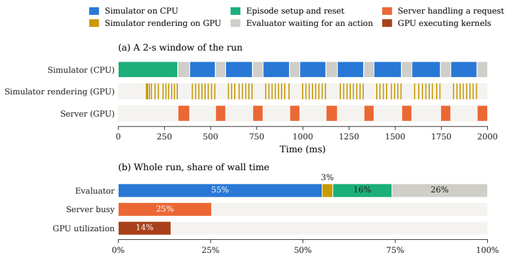
Figure 2 :The official StarVLA LIBERO evaluator and its policy server on 50 LIBERO-Long episodes (five per task) on one RTX 4090. (a) Execution timeline over a 2-s window. The simulator runs in the evaluator process: physics and control on CPU cores, camera rendering on the GPU (each tick is one render of about 0.4ms); the policy server runs on the GPU. (b) Over the whole run: evaluator time, the share of time the policy server is handling a request, and mean GPU utilization (the share of time a GPU kernel is executing).
원문 · CC BY 4.0 · Deng-Ke Wu, Yifan Jin, Yida Yang, Lei Qian, Zhaoye Zhou, Hongru Zhang, Kai Ye, Shuyuan Hu, Yiran Mao, Zewei Ye, Bo Zhao · RoboScope Kit: Unified Interfaces for Fast and Scalable Embodied-AI Evaluation · 원문 그림 인용 · 원본 PDF 4쪽에서 그림 영역을 추출했습니다.Policy 래퍼와 어댑터로 나눈 인터페이스
RoboScope Kit은 각 모델을 체크포인트를 로드하고 모델 측 전처리를 유지하는 Policy 클래스로 한 번 감쌉니다. 각 벤치마크는 자체 평가기를 감싸는 어댑터로 한 번 연결됩니다. Policy는 읽는 관측, 반환하는 청크 길이, 새 관측이 필요한 빈도인 관측 스트라이드를 선언하며, 에피소드별 상태를 분리해 한 모델이 여러 시뮬레이터에 동시에 응답할 수 있습니다. 실행 중에는 시뮬레이터 워커와 Policy 레플리카가 서로 다른 프로세스 풀로 분리되어 K와 g를 독립적으로 정합니다.
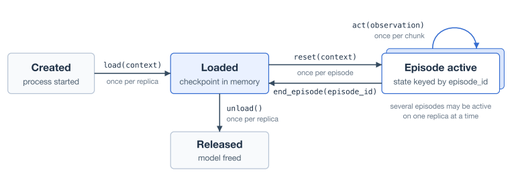
Figure 8 :Policy lifecycle within one replica. The checkpoint is loaded once; each episode adds and later removes its own state, and several episodes may be active at a time.
원문 · CC BY 4.0 · Deng-Ke Wu, Yifan Jin, Yida Yang, Lei Qian, Zhaoye Zhou, Hongru Zhang, Kai Ye, Shuyuan Hu, Yiran Mao, Zewei Ye, Bo Zhao · RoboScope Kit: Unified Interfaces for Fast and Scalable Embodied-AI Evaluation · 원문 그림 인용 · 원본 PDF 19쪽에서 그림 영역을 추출했습니다.제어 런타임은 매니페스트를 만들고, 동시성 탐색으로 K와 g를 고르며, 작업 항목을 워커에 나누고, 결과를 집계합니다. 시뮬레이션 런타임은 각 워커 안에서 네이티브 평가기를 실행하면서 관측을 렌더링해 레플리카로 보냅니다. 실제 롤아웃 전에 인터페이스 검증이 정책의 선언과 벤치마크 계약을 대조합니다.
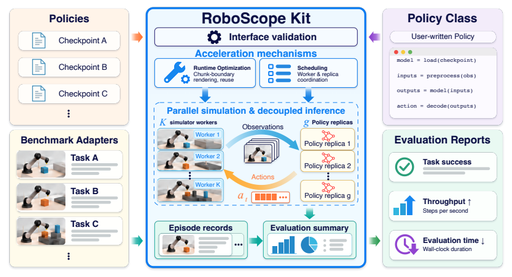
Figure 1 :RoboScope Kit connects Policies and benchmark adapters. After interface validation, acceleration has two parts: runtime optimization removes unconsumed simulation work inside each worker, and scheduling coordinatesK simulator workers that exchange observations and actions withg Policy replicas. Each episode yields one episode record. The Policy class holds the model-side processing.
원문 · CC BY 4.0 · Deng-Ke Wu, Yifan Jin, Yida Yang, Lei Qian, Zhaoye Zhou, Hongru Zhang, Kai Ye, Shuyuan Hu, Yiran Mao, Zewei Ye, Bo Zhao · RoboScope Kit: Unified Interfaces for Fast and Scalable Embodied-AI Evaluation · 원문 그림 인용 · 원본 PDF 2쪽에서 그림 영역을 추출했습니다.동시성 탐색과 샤딩
동시성 탐색은 실제 정책과 워커·레플리카 구성으로 짧은 프로브를 실행해 처리량, CPU 코어, GPU 사용률, 실패 여부를 측정합니다. 워커 단계에서는 레플리카를 GPU당 하나로 두고 K를 두 배씩 늘리며, 처리량이 최소 25% 이상 늘지 않는 첫 지점을 무릎으로 봅니다. 이후 레플리카 단계에서 g를 한 개씩 늘리고 K를 함께 키우며, 처리량 이득이 3% 미만이면 탐색을 멈춥니다. 원문의 상한 식은 WorkerCap과 ReplicaCap처럼 CPU 코어와 GPU 메모리에 의해 정해집니다.
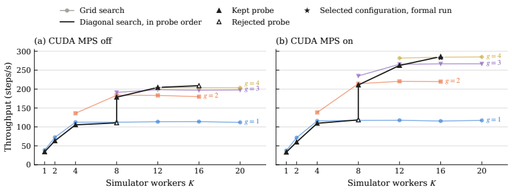
Figure 7 :Grid search and diagonal concurrency search on LIBERO-Long, one RTX 4090. Grid lines are full evaluations at fixedK/g, one launch per configuration, one line per replica countg, labelled at its end; the search path joins the steady-state probes in the order the search ran them, mean of three launches, withg marked where no grid line has that replica count; filled triangles are probes the search kept and hollow triangles probes it rejected; the star is the formal run at the selected configuration (median of three). (a) CUDA MPS off, on the sweep host with a 20-core quota: the grid takes eighteen launches and 5.4h of evaluation, the search seven probes and 8.4min (median) and selectsK12/g3, within 1.2% of the fastest grid configuration,K16/g4. (b) CUDA MPS on, on the cross-system host with 12 pinned cores: the grid takes eighteen launches and 5.0h of evaluation, the search seven probes and 8.4min (median) and selectsK16/g4, the fastest grid configuration;K20/g5is skipped because its predicted memory exceeds the GPU. GPU utilization of the grid configurations is in Tables 18 and 14.
원문 · CC BY 4.0 · Deng-Ke Wu, Yifan Jin, Yida Yang, Lei Qian, Zhaoye Zhou, Hongru Zhang, Kai Ye, Shuyuan Hu, Yiran Mao, Zewei Ye, Bo Zhao · RoboScope Kit: Unified Interfaces for Fast and Scalable Embodied-AI Evaluation · 원문 그림 인용 · 원본 PDF 15쪽에서 그림 영역을 추출했습니다.샤딩은 여러 인스턴스에 걸친 작업 분배입니다. 순서가 있는 작업 항목 W에서 샤드 i는 j mod N = i인 항목을 받습니다. 각 샤드는 자신의 큐, 워커, 레플리카를 가지며 결과를 병합할 때 에피소드 기록이 모든 항목을 정확히 한 번씩 덮는지 확인합니다. 이 방식은 한 호스트의 제약을 넘는 평가를 가능하게 하지만, 원문은 교차 인스턴스 실행의 결과를 MetaWorld MT50 한 사례로만 보고합니다.
청크 경계 관찰과 런타임 최적화
액션 청크 정책은 한 번의 추론으로 H개의 행동을 반환하므로, 공식 RoboTwin 평가기가 매 제어 스텝마다 렌더링하는 관측 중 대부분은 읽히지 않습니다. 원문은 StarVLA RoboTwin 체크포인트의 H가 16이고, 16스텝 중 15개의 렌더링 관측이 사용되지 않는다고 설명합니다. RoboScope Kit은 Policy가 선언한 스트라이드 s에 따라 추론이 일어나는 시점에만 관측을 렌더링합니다. s가 H와 같으면 청크당 한 번 렌더링합니다. 기본 스트라이드는 1이며, 무작위 조명, 대화형 뷰어, 비디오 기록, 포인트 클라우드 관측은 스트라이드와 무관하게 매 스텝 렌더링을 유지합니다.
그 밖의 최적화로 엔진과 렌더러 재사용, cuRobo 초기화 생략, 중복 수동력 계산 제거, 두 에피소드 작업 항목, 정적 클러터 메타데이터 캐시가 있습니다. 원문은 이 최적화가 정책 입력이나 점수를 바꾸지 않는 작업만 제거한다고 설명합니다.
성공 결과 일치와 LIBERO-Long 비교 결과
LIBERO-Long에서 고정된 K1/g1 RoboScope Kit 실행은 공식 StarVLA 평가의 세 번 실행 각각과 500개 성공 결과가 모두 일치합니다. 교차 시스템 비교에서 공식 평가는 90.2%, RoboScope Kit (Search)는 89.9%를 기록했고, 차이는 −0.3퍼센트포인트(95% 구간 −0.8~0.0)입니다. 같은 에피소드 결과를 공유한 비율은 97.9%입니다. 이 차이는 ±2포인트 동등성 기준 안에 있습니다.
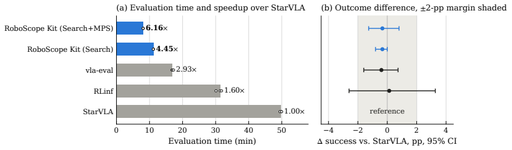
Figure 4 :LIBERO-Long on one RTX 4090 with RoboScope Kit (Search), which selectsK12/g3, and RoboScope Kit (Search+MPS), which selectsK16/g4under CUDA MPS. (a) Evaluation time of each system: bars are medians and circles the launches; labels give the speedup over the official StarVLA evaluation. (b) Success rate minus that of the official StarVLA evaluation, with a 95% paired task-cluster bootstrap interval; the shaded band is the±2-point equivalence margin. Table 8 lists the values.
원문 · CC BY 4.0 · Deng-Ke Wu, Yifan Jin, Yida Yang, Lei Qian, Zhaoye Zhou, Hongru Zhang, Kai Ye, Shuyuan Hu, Yiran Mao, Zewei Ye, Bo Zhao · RoboScope Kit: Unified Interfaces for Fast and Scalable Embodied-AI Evaluation · 원문 그림 인용 · 원본 PDF 12쪽에서 그림 영역을 추출했습니다.평가 시간은 공식 StarVLA의 2,990초에 비해 RoboScope Kit (Search)가 671초의 중앙값으로 4.45배 빠르고, CUDA MPS를 켠 RoboScope Kit (Search+MPS)는 485초로 6.16배 빠릅니다. 원문은 이 값들이 정식 평가 시간을 기준으로 하며 탐색 시간을 포함하지 않는다고 구분합니다. 탐색을 포함한 end-to-end 비교는 별도로 2.42배와 3.02배로 보고됩니다.
RoboTwin Easy의 다중 GPU와 최적화 결과
RoboTwin Easy에서 단일 GPU 기준선 K1/g1은 500개 에피소드를 21,582초에 평가합니다. 4개 GPU에 K16/g4, 관찰 스트라이드 16, 두 에피소드 작업 항목, 클러터 캐시를 적용한 구성은 862초에 평가를 마쳐 25.04배 빠릅니다. 원문은 이 구성의 500개 성공 결과와 종료 스텝이 세 개의 기준선 실행 각각과 모두 일치한다고 보고합니다. 다중 GPU만 적용한 K4/g4는 3.64배, 워커 증가는 추가로 1.50배, 스트라이드와 실행 설정은 4.58배를 더합니다.
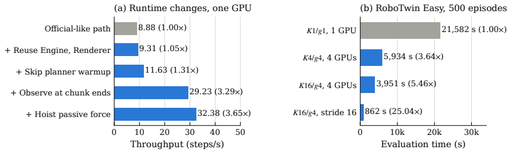
Figure 5 :RoboTwin Easy ablations. (a) Throughput of the Simulation Runtime ladder on one RTX 4090; each row adds one change to the row above. (b) Evaluation time of the 500 episodes along the measured configurations. Labels give each value and, in parentheses, the cumulative speedup over the first row. Tables 15 and 16 list the values.
원문 · CC BY 4.0 · Deng-Ke Wu, Yifan Jin, Yida Yang, Lei Qian, Zhaoye Zhou, Hongru Zhang, Kai Ye, Shuyuan Hu, Yiran Mao, Zewei Ye, Bo Zhao · RoboScope Kit: Unified Interfaces for Fast and Scalable Embodied-AI Evaluation · 원문 그림 인용 · 원본 PDF 13쪽에서 그림 영역을 추출했습니다.스트라이드 16의 4개 GPU 실행은 정책 입력과 점수를 바꾸지 않는 렌더링 제거에 의존하므로, 이 결과는 RoboTwin Easy의 StarVLA 체크포인트 조건에 묶여 있습니다. 다른 모델의 정책이 매 스텝 관측을 읽는다면 같은 이득은 적용되지 않습니다.
워커와 레플리카의 확장성
LIBERO-Long을 한 RTX 4090과 20코어 제한에서 측정한 K와 g 스윕에서, 레플리카 하나의 경우 처리량은 K1에서 38.4 스텝/초, K4에서 112.5 스텝/초로 오르고 이후 112~114 부근에 머뭅니다. 이때 GPU 사용률은 45.6~46.8%이므로 레플리카가 병목입니다. 두 번째 레플리카를 추가하면 K12/g2의 평가 시간은 1,216초에서 748초로 줄어 1.63배 빨라지고, 평균 GPU 사용률은 46.3%에서 87.7%로 올라갑니다. 워커 12개가 모델 복사본 2개를 공유하며, 피크 GPU 메모리는 25.0GiB입니다.
원문은 워커를 늘리면 병목이 추론으로, 레플리카를 늘리면 GPU로 옮겨 간다고 설명합니다. 따라서 워커와 레플리카의 적정값은 서로에게 의존하며 워크로드와 호스트에 따라 달라집니다.
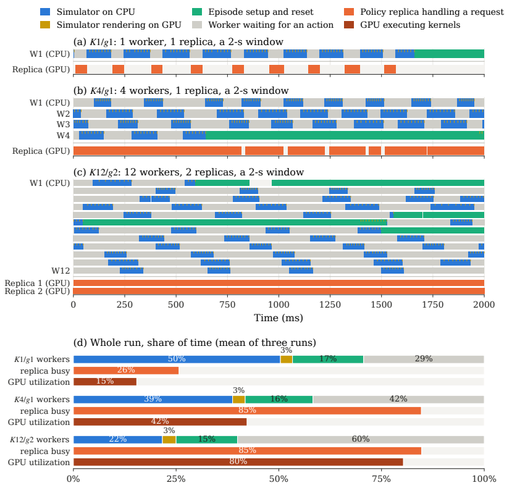
Figure 6 :Execution timeline of RoboScope Kit simulator workers (W) and Policy replicas on the 50 LIBERO- Long episodes of Figure 2, one RTX 4090, with the categories of that figure. (a)–(c) A 2-s window of one run per configuration; rendering ticks mark the end of each simulation step. (d) Worker time, replica busy time, and GPU utilization over the whole run, mean of three runs.
원문 · CC BY 4.0 · Deng-Ke Wu, Yifan Jin, Yida Yang, Lei Qian, Zhaoye Zhou, Hongru Zhang, Kai Ye, Shuyuan Hu, Yiran Mao, Zewei Ye, Bo Zhao · RoboScope Kit: Unified Interfaces for Fast and Scalable Embodied-AI Evaluation · 원문 그림 인용 · 원본 PDF 14쪽에서 그림 영역을 추출했습니다.비교 한계와 RLinf 샘플링 문제
교차 시스템 비교에서 RLinf는 StarVLA 평가에서 행동을 샘플링하는 것으로 관찰됩니다. 원문에 따르면 평가 모드가 StarVLA 정책에 전달되지 않아 기본 학습 모드가 샘플링을 켭니다. 그 결과 RLinf의 반복 실행 간 일치율은 86.2~88.4%로, RoboScope Kit (Search)의 97.8~99.0%보다 낮습니다. 저자들은 이를 RLinf의 StarVLA 통합 버그일 가능성이 높다고 해석합니다. RoboTwin 비교에서만 평가 모드 전달 변경을 적용했고, LIBERO-Long 실행은 원래 상태로 두었습니다.
또한 RLinf와 vla-eval의 튜닝 시간과 탐색 시간은 각 기준선에 따로 보고되며, 공식 평가 실행과 같은 조건으로 묶이지 않습니다. 원문의 결과는 특정 호스트와 체크포인트에 대한 측정이며 다른 하드웨어로의 일반화는 보고되지 않습니다.
탐색 비용과 적용 범위
원문은 탐색 시간을 평가 시간과 분리해 보고합니다. LIBERO-Long에서 506초의 탐색은 평가 시간을 75% 늘리지만, 탐색 포함 end-to-end 시간은 여전히 공식 평가보다 2.42배 빠릅니다. 짧은 워크로드에서는 탐색이 더 큰 비중을 차지합니다. 100개 에피소드 RoboTwin Easy 부분집합에서는 각 실행의 약 60%를 탐색이 차지한다고 보고됩니다.
현재 결과는 StarVLA 체크포인트와 특정 RTX 4090 호스트, 그리고 제시된 여섯 벤치마크 계열 중 측정된 두 워크로드에 기반합니다. 정책 종류가 다르거나 관찰 입력이 다르면 청크 경계 관찰의 이득과 탐색 결과는 같다고 볼 수 없습니다.
논문 정보
- 저자
- Deng-Ke Wu, Yifan Jin, Yida Yang, Lei Qian, Zhaoye Zhou, Hongru Zhang, Kai Ye, Shuyuan Hu, Yiran Mao, Zewei Ye, Bo Zhao
- 학회·저널
- arXiv · 프리프린트
- 최초 공개일
- 2026년 11월 2일
- 등록일
- 2026년 11월 5일
- 수정일
- 2026년 11월 2일
- 버전
- v1
- arXiv
- 2611.03850
- 분류
- cs.RO · cs.AI
- 원문 이용 조건
- CC BY 4.0
- 제공 범위
- 논문 정보, 해설, 허용된 원문 그림
AI 해설은 논문 원문과 별개의 설명이며 오류가 있을 수 있습니다. 원문과 그림은 각 출처의 이용 조건과 따로 표시된 권리를 따릅니다.
초록
Simulation benchmarks are the standard way to compare robot policies, but each benchmark brings its own evaluator, observation layout, and action convention, and evaluation is slow: 500 RoboTwin Easy episodes with one simulator and one model on one GPU take 359.7 minutes. Profiling the official StarVLA evaluator shows that simulation occupies CPU cores while the GPU averages 14.3% utilization. RoboScope Kit wraps each model once in a Python class called a Policy, and each benchmark once in an adapter around the benchmark's own evaluator, so the benchmark's rules and scoring stay unchanged. Scheduling runs simulator workers and Policy replicas as separate pools, sizes both from measured probes, and shards work deterministically across GPU instances; runtime optimization renders only the observations an action-chunk Policy reads. Adapters cover six benchmark families. On LIBERO-Long with a StarVLA checkpoint on one 48 GiB RTX 4090, the concurrency search selects twelve simulator workers sharing three Policy replicas, which evaluate 500 episodes 4.45$\times$ faster than the official StarVLA evaluation with equivalent success rates, 2.78$\times$ faster than RLinf, and 1.52$\times$ faster than vla-eval at its tuned configuration. With CUDA MPS, which lets the replicas run their kernels concurrently, the search selects sixteen workers sharing four replicas, 6.16$\times$ faster than StarVLA, 3.85$\times$ faster than RLinf, and 2.10$\times$ faster than vla-eval. On RoboTwin Easy, four GPUs with chunk-boundary observation complete the 500 episodes in 14.4 minutes, 25.04$\times$ faster than the single-GPU baseline, with identical success outcomes and terminal steps.
원문 인용
Deng-Ke Wu, Yifan Jin, Yida Yang, Lei Qian, Zhaoye Zhou, Hongru Zhang, Kai Ye, Shuyuan Hu, Yiran Mao, Zewei Ye, Bo Zhao (2026). RoboScope Kit: Unified Interfaces for Fast and Scalable Embodied-AI Evaluation. arXiv:2611.03850v1. https://arxiv.org/abs/2611.03850v1
BibTeX
@misc{wu2026roboscope,
  title = {{RoboScope Kit: Unified Interfaces for Fast and Scalable Embodied-AI Evaluation}},
  author = {Deng-Ke Wu and Yifan Jin and Yida Yang and Lei Qian and Zhaoye Zhou and Hongru Zhang and Kai Ye and Shuyuan Hu and Yiran Mao and Zewei Ye and Bo Zhao},
  year = {2026},
  eprint = {2611.03850},
  archivePrefix = {arXiv},
  url = {https://arxiv.org/abs/2611.03850v1}
}