논문 해설
Deep Latents, Long Memory: Latent persistence explains temporal correlations in transformer activations
깊은 잠재 표현, 긴 메모리: 잠재 지속성이 transformer 활성값의 시간적 상관을 설명한다
- 연구 문제 트랜스포머 층이 깊어질수록 활성값의 자기상관 꼬리가 길어지는 현상과 그 원인이 명확하지 않습니다.
- 연구 방법 위치 간 활성값 내적으로 자기상관을 정의하고, 잠재 변수 지속 인코딩으로 분해해 합성 및 자연어 데이터에서 검증합니다.
- 주요 결과 Gemma 2 9B 등 여러 모델에서 깊은 층일수록 SAE 특징 지속 시간과 적분 자기상관이 함께 커졌고, 지속 특징 제거는 자기상관을 줄였습니다.
층 깊이에 따른 자기상관 증가 문제
이 논문은 트랜스포머 은닉층이 깊어질수록 추상적 표현을 담는다는 믿음을 정량적으로 검증하려고 합니다. 추상화의 작동 정의가 없으면 이 주장을 시험하기 어렵기 때문에, 저자들은 활성값 자체의 위치 간 상관을 관찰 대상으로 삼았습니다. 자기상관 함수는 층의 활성값에서 시간 지연 τ만큼 떨어진 두 문맥 위치의 평균 내적으로 정의되며, 깊은 층일수록 긴 지연에서도 천천히 줄어드는 꼬리가 커지는 것을 관찰했습니다. 이 꼬리가 왜 생기는지가 이후 논의의 출발점입니다.
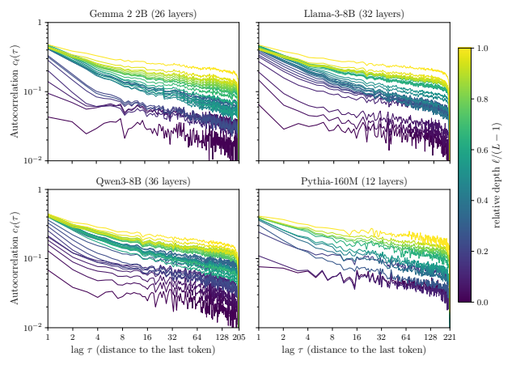
Figure 18 : Autocorrelationc ℓ(τ)against the lagτfor every layer of Gemma 2 2B, Llama-3-8B, Qwen3-8B and Pythia-160M on The Pile, one curve per layer colored by relative depthℓ/(L−1)(a shared color scale, as the layer counts differ), same vertical range in all panels. The corresponding panel for Gemma 2 9B is Fig. 1b.
원문 · CC BY 4.0 · Francesco Cagnetta, Santiago Acevedo · Deep Latents, Long Memory: Latent persistence explains temporal correlations in transformer activations · 원문 그림 인용 · 원본 PDF 32쪽에서 그림 영역을 추출했습니다.자기상관과 잠재 변수 지속성의 연결
저자들은 활성값을 표준화한 뒤 위치 t와 t−τ의 내적 평균으로 자기상관 cℓ(τ)를 정의합니다. 원-핫 토큰 표현에서는 이 값이 토큰 동시발생 확률의 중심화 형태가 되고, 선형 표현 가설 아래에서는 같은 잠재 변수가 두 위치에서 같은 방향으로 인코딩될 때 그 변수가 기여합니다. 활성값을 잠재 변수 코드와 잔차의 합으로 최소제곱 회귀하면, 자기상관은 같은 노드가 두 위치에서 유지되는 항과 노드 사이 교차 항, 잔차 항으로 나뉩니다. 여기서 동일 노드 항이 지속성을 뜻합니다.
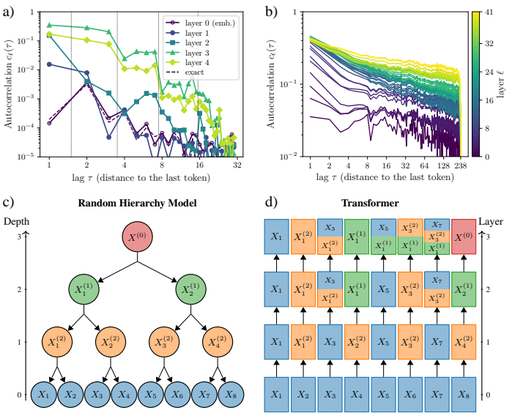
Figure 1 :Neural autocorrelationsc ℓ(τ)(Eq. 1) develop with depth due to persistently encoded abstract latent features. a) 5-block transformer trained on the Random Hierarchy Model (RHM)and evaluated on RHM sentences (dashed: exact token-level curve; dotted: span ends of the latents governing the next token, cf. panel d).b) Pre-trained Gemma 2 9B(Gemma Team et al., 2024) evaluated on The Pile. In both a) and b), deep layers show a slower decay with the lag. c), d)illustrate the relationship between long-range autocorrelations and the persistent encoding of abstract latent features.c)shows our idealised representation of the latent hierarchical structure of natural language data: pairs of adjacent input tokens (blue) are generated by a single, latent parent variable (orange); pairs of adjacent parent variables are generated by a single latent grandparent (green), and so on. Deep latent variables correspond to abstract concepts and influence large portions of the input.d)Deep learning methods reconstruct the data structure layer by layer (Cagnetta et al., 2024; Cagnetta & Wyart, 2024), here illustrated schematically in a deep autoregressive transformer. Each row represents the variables encoded by the activations in a given layer, assuming that layerℓ can only compute latent variables of depthℓ—see the main text for a detailed breakdown. Deeper latent variables emerge in later layers, and persist for longer across context positions: E.g., depth-1 (orange) variables persist for two slots in layers2and3, whereas depth-2variables (green) persist for4slots, but only in layer3. This scheme implies a specific pattern of decay ofc ℓ(τ), highlighted with dotted lines in panel a) and approximately respected by the measured autocorrelations.
원문 · CC BY 4.0 · Francesco Cagnetta, Santiago Acevedo · Deep Latents, Long Memory: Latent persistence explains temporal correlations in transformer activations · 원문 그림 인용 · 원본 PDF 2쪽에서 그림 영역을 추출했습니다.RHM에서의 분해와 학습 단계
합성 데이터로 쓴 무작위 계층 모델에서는 잠재 변수가 모두 알려져 있어 분해를 직접 검증할 수 있습니다. 5블록 GPT-2 형식 트랜스포머를 v=32, m=8, 깊이 5 조건으로 학습했고, 시퀀스 길이 T=32에서 측정했습니다. 4층의 자기상관은 깊이 3과 4 부근 잠재 변수의 동일 노드 항으로 대부분 설명되었으며, 학습 손실이 단계별 평탄 구간을 지날 때마다 자기상관의 계단이 하나씩 생겼습니다. 이는 잠재 변수를 학습한 시점에 해당 지연 구간의 상관이 나타난다는 해석과 맞습니다.
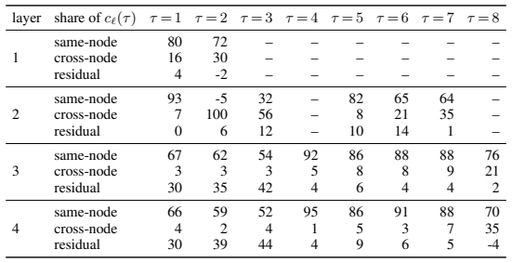
Table 6 :Composition of the autocorrelations of layers 1–4 at lags 1–8.Same-node, cross-node and residual parts of Eq. 7, in percent of the measuredc ℓ(τ)(the three rows of each layer sum to 100). Cells are left blank where the measured value lies within 20 noise floors (Appendix A), as at lag4of layer2, where the terms cancel. The code part is computed from the regression atP= 2 18 and the measurement atP= 2 25.
원문 · CC BY 4.0 · Francesco Cagnetta, Santiago Acevedo · Deep Latents, Long Memory: Latent persistence explains temporal correlations in transformer activations · 원문 그림 인용 · 원본 PDF 30쪽에서 그림 영역을 추출했습니다.자연어 SAE 지속 시간과 상관
자연어에서는 잠재 변수를 직접 알 수 없으므로 희소 자기부호화기(SAE) 특징을 대리 변수로 썼습니다. Gemma 2 2B와 9B, Pythia-160M, Llama-3-8B, Qwen3-8B를 WikiText와 The Pile에서 측정했고, 특징의 발화 에피소드 길이 ψ의 중앙값과 적분 자기상관 χℓ 사이의 피어슨 상관은 모델별로 0.67에서 0.93 사이였습니다. 깊이에 따라 두 값이 대체로 함께 증가했지만, 빈도 효과를 배제하기 위해 저자들은 시퀀스 셔플과 평균 토큰 제거 실험도 수행했습니다.
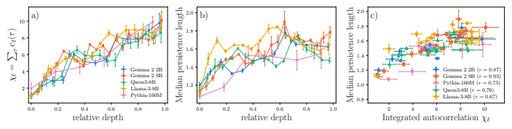
Figure 4 :Panel a): Layer dependence of the integrated autocorrelation for different models (see Eq. 8).Panel b): Layer dependence of the median of the distribution of per-latent persistenciesψ (see Sec. 4).Panel c): Median persistence against the integrated autocorrelationχ ℓ, one point per layer;ris the per-model Pearson correlation. In all panels, error bars show one standard deviation computed from results on the Wikitext and The Pile datasets.
원문 · CC BY 4.0 · Francesco Cagnetta, Santiago Acevedo · Deep Latents, Long Memory: Latent persistence explains temporal correlations in transformer activations · 원문 그림 인용 · 원본 PDF 8쪽에서 그림 영역을 추출했습니다.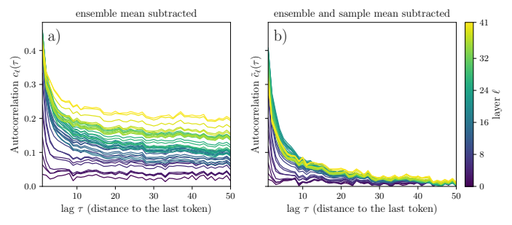
Figure 19 : Autocorrelation of every layer of Gemma 2 9B on The Pile over the first 50 lags, on linear axes, with the position-wise mean over samples subtracted as in Eq. 1 (a) and with the mean token of each sample subtracted as well (b). One curve per layer, same vertical range in both panels, with the vertical axis starting at zero for readability.
원문 · CC BY 4.0 · Francesco Cagnetta, Santiago Acevedo · Deep Latents, Long Memory: Latent persistence explains temporal correlations in transformer activations · 원문 그림 인용 · 원본 PDF 33쪽에서 그림 영역을 추출했습니다.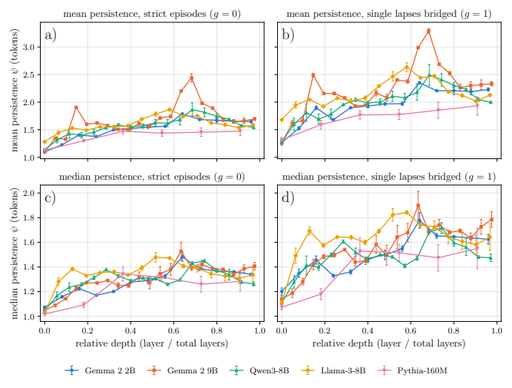
Figure 22 : SAE-latent persistenceψas a function of relative depth for the five models: mean (a, b) and median (c, d) over the 1000 most active latents of each layer, for strict firing episodes (g= 0; a, c) and with single inactive tokens bridged (g= 1; b, d). Markers are the average of The Pile and WikiText, error bars half the difference between the two corpora.
원문 · CC BY 4.0 · Francesco Cagnetta, Santiago Acevedo · Deep Latents, Long Memory: Latent persistence explains temporal correlations in transformer activations · 원문 그림 인용 · 원본 PDF 36쪽에서 그림 영역을 추출했습니다.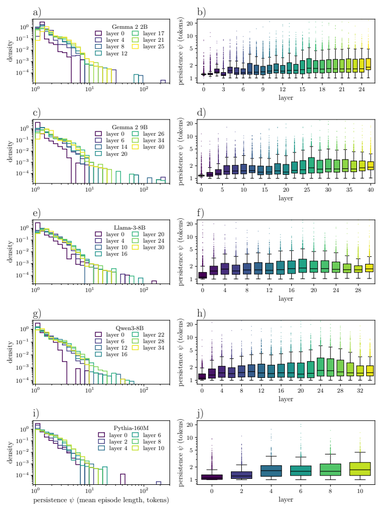
Figure 23 : Distribution of the per-latent persistenceψon The Pile with single inactive tokens bridged (g= 1), over the 1000 most active latents of each layer of Gemma 2 2B (a, b), Gemma 2 9B (c, d), Llama-3-8B (e, f), Qwen3-8B (g, h) and Pythia-160M (i, j). Left column: density on log-log axes at seven layers spread over the depth of each model (layers in the legend). Right column: box plots at every layer of the sweep (median line, interquartile box, whiskers at1.5interquartile ranges, individual dots beyond), with a logarithmic vertical axis cut at 25 tokens. Layers are colored by relative depth on the same scale in both columns.
원문 · CC BY 4.0 · Francesco Cagnetta, Santiago Acevedo · Deep Latents, Long Memory: Latent persistence explains temporal correlations in transformer activations · 원문 그림 인용 · 원본 PDF 37쪽에서 그림 영역을 추출했습니다.지속 특징 제거 실험
저자들은 지속적인 SAE 특징의 디코더 방향을 활성값에서 투영 제거한 뒤, 발화 에피소드 안에서 자기상관의 평균 변화 Δ를 측정했습니다. 모든 활성 특징을 제거해도 기준 상관이 완전히 사라지지는 않았는데, 저자들은 이를 SAE 재구성의 불완전성 때문이라고 설명합니다.
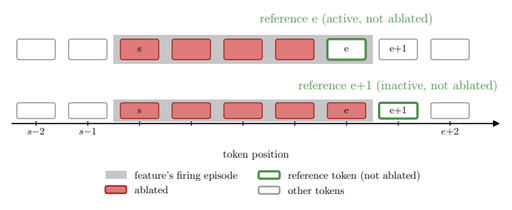
Figure 5 : Scheme of the intervention experiment: In the gray areas, a given SAE-feature of interest is firing.sandedenote the starting and ending token positions of the firing episode. In the upper row, we measure the mean autocorrelations inside the feature’s firing episode, taking as reference the last token of the firing episode, signaled with a green box. Then, we ablate SAE-features of the tokens colored in red using different protocols, and recompute the mean autocorrelation, to quantify how the ablation of SAE-features influences the autocorrelation. Results are reported in Table 1. In the bottom row, we show an example of a control experiment in which the reference token is outside the firing episode, for which the decrease in autocorrelations generated by ablating SAE-features is smaller, since the feature is not active in it.
원문 · CC BY 4.0 · Francesco Cagnetta, Santiago Acevedo · Deep Latents, Long Memory: Latent persistence explains temporal correlations in transformer activations · 원문 그림 인용 · 원본 PDF 9쪽에서 그림 영역을 추출했습니다.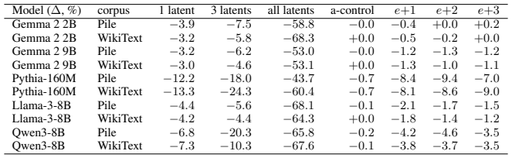
Table 1 : Change∆(Eq. 10) of the mean integrated autocorrelations generated by the ablation of SAE-features, across models and two different corpora, and expressed as a percentage of the value of the baseline correlations in each model. See Fig. 5 for a scheme of the ablation setup, and Sec. 4.2 for the full discussion about the experiment. Columns: the chosen persistent latent; it plus its two most persistent co-active latents; every active feature latent using the SAE’s intermediate representation; an active but non-persistent latent (a-control); and the latent itself with the reference moved toe+1,e+2ande+3token positions, where the latent of interest was not found to be active.
원문 · CC BY 4.0 · Francesco Cagnetta, Santiago Acevedo · Deep Latents, Long Memory: Latent persistence explains temporal correlations in transformer activations · 원문 그림 인용 · 원본 PDF 10쪽에서 그림 영역을 추출했습니다.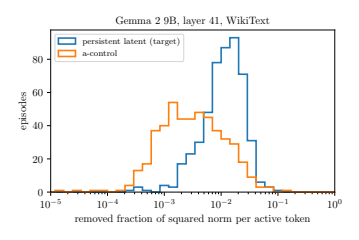
Figure 26 : Removed fraction of squared norm, Eq. 24, averaged over the ablated positions at which the latent is active, for the persistent latent and the a-control of Table 1. Gemma 2 9B, layer 41, WikiText, 500 episodes; activations centred by the layer mean, as in the ablation experiment.
원문 · CC BY 4.0 · Francesco Cagnetta, Santiago Acevedo · Deep Latents, Long Memory: Latent persistence explains temporal correlations in transformer activations · 원문 그림 인용 · 원본 PDF 39쪽에서 그림 영역을 추출했습니다.남은 문제
논문이 밝힌 대로 자기상관은 활성값의 기하 관측이며 출력 기능을 직접 측정하지 않습니다. 또한 SAE 특징은 잠재 변수의 불완전한 대리이고, 재구성 설명 분산은 0.7 이상이지만 완전하지 않습니다. 합성 실험은 단일 문법과 단일 학습 실행에서 얻은 결과이며, 자연어 실험은 SAE가 제공된 다섯 모델로 제한됩니다. 저자들은 자기상관과 입력 섭동에 대한 선형 응답의 관계는 아직 확립되지 않았다고 봅니다.
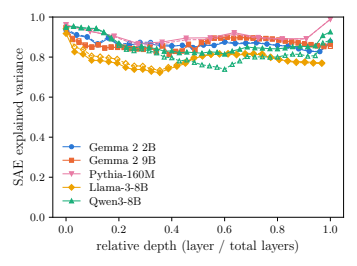
Figure 24 : SAE explained variance, Eq. 23, as a function of relative depth for the five models, on The Pile (filled markers, solid lines) and WikiText (hollow markers, dashed lines), 300 samples per corpus, massive-activation tokens excluded as described in the text.
원문 · CC BY 4.0 · Francesco Cagnetta, Santiago Acevedo · Deep Latents, Long Memory: Latent persistence explains temporal correlations in transformer activations · 원문 그림 인용 · 원본 PDF 38쪽에서 그림 영역을 추출했습니다.논문 정보
- 저자
- Francesco Cagnetta, Santiago Acevedo
- 학회·저널
- arXiv · 프리프린트
- 최초 공개일
- 2026년 11월 13일
- 등록일
- 2026년 11월 16일
- 수정일
- 2026년 11월 13일
- 버전
- v1
- arXiv
- 2611.18089
- 분류
- cs.LG · cs.CL
- 원문 이용 조건
- CC BY 4.0
- 제공 범위
- 논문 정보, 해설, 허용된 원문 그림
AI 해설은 논문 원문과 별개의 설명이며 오류가 있을 수 있습니다. 원문과 그림은 각 출처의 이용 조건과 따로 표시된 권리를 따릅니다.
초록
The hidden layers of Large Language Models (LLMs) are believed to encode representations of the data whose abstraction increases with depth. However, in the absence of an operational notion of abstraction, this statement is hard to test quantitatively. Here, we propose an alternative view, building on the principle that the correlations of a sequence reflect the structure of the process that generated it. We define the autocorrelation function of a layer as the average dot product between its activations at two context positions separated by a lag. Latent variables encoded persistently along the context create slowly decaying tails in the autocorrelation, and we find these tails to grow across layers in both synthetic and natural data. In synthetic data with controlled hierarchical latent structure, this growth stems from the encoding of abstract latent variables, which govern long stretches of the input. Indeed, the persistence of latent codes predicts the qualitative structure of autocorrelations and accounts for most of the empirical measures. In real text, we take sparse-autoencoder features as proxies for latent variables, and find that their persistence correlates strongly with the magnitude of autocorrelations across datasets and LLMs. In particular, the persistence time increases with depth, as do autocorrelations, implying that deeper latent features persist for longer context spans. We complement this analysis by explicitly ablating the persistent sparse-autoencoder features and observing a consequent decrease in the autocorrelations.
원문 인용
Francesco Cagnetta, Santiago Acevedo (2026). Deep Latents, Long Memory: Latent persistence explains temporal correlations in transformer activations. arXiv:2611.18089v1. https://arxiv.org/abs/2611.18089v1
BibTeX
@misc{cagnetta2026deep,
  title = {{Deep Latents, Long Memory: Latent persistence explains temporal correlations in transformer activations}},
  author = {Francesco Cagnetta and Santiago Acevedo},
  year = {2026},
  eprint = {2611.18089},
  archivePrefix = {arXiv},
  url = {https://arxiv.org/abs/2611.18089v1}
}