논문 해설
Language Knowledge-Assisted Representation Learning for Skeleton-Based Action Recognition
언어 지식 기반 스켈레톤 기반 행동 인식을 위한 표현 학습
- 연구 문제 골격 기반 행동 인식에서 LLM의 사전 지식을 GCN 표현 학습에 활용할 수 있는지, 그리고 다중 홉 정보 전달이 깊은 GCN의 지연 문제를 줄일 수 있는지를 다룹니다.
- 연구 방법 LA-GCN은 BERT로 만든 클래스 중심 거리에서 GPR Graph를 만들어 골격 입력을 가중하고, MHA-GC로 다중 홉 어텐션을 계산하며, 학습 중에만 CPR Graph 기반 PC-AC 보조 분류 손실을 더합니다.
- 주요 결과 NTU RGB+D 60 X-Sub/X-View, NTU RGB+D 120 X-Sub, NW-UCLA의 제시된 설정에서 LA-GCN은 비교표의 정확도를 보고합니다. 절제 실험은 X-Sub 조건에서 보조 손실과 다중 홉 어텐션이 정확도를 높인다는 결과를 제시합니다.
골격 기반 행동 인식의 문제와 연구 동기
골격 기반 행동 인식은 관절 좌표의 시퀀스로 사람의 행동을 분류하는 과제이며, 배경의 잡음에 강하고 표현이 간결하다는 장점이 있습니다. 기존 GCN 계열 방법들은 관절 간 관계를 인코딩하는 토폴로지 모델링에서 큰 발전을 이뤘지만, 대부분 사전 지식을 명시적으로 활용하지 않은 채 데이터로부터 관계를 학습합니다. 이 논문은 대규모 언어 모델의 텍스트 지식을 사전 지식으로 끌어들여 GCN의 표현 학습과 토폴로지 모델링을 보조할 수 있는지를 묻습니다. 또한 깊은 GCN에서 한 홉 메시지 전달이 누적되며 생기는 정보 지연과 과평활화 문제를 함께 다룹니다.
LA-GCN의 GPR 그래프와 골격 표현 생성
LA-GCN은 BERT의 텍스트 인코더로 각 클래스 이름과 관절 이름을 포함한 문장의 특징을 얻습니다. 각 관절 노드에 대해 모든 클래스에 걸친 특징의 평균인 클래스 중심을 구하고, 노드 사이의 Euclidean 거리로 전역 사전 관계인 GPR Graph를 만듭니다. 이 그래프는 골격 표현을 생성하는 데 쓰입니다. 원문은 기존 bone 벡터를 확장하여 임의의 두 관절 차이를 후보로 두고, 각 관절에 하나의 bone을 연결하는 정렬 조건 아래에서 표준편차 합이 가장 작은 링크를 고르는 방식을 설명합니다. 선택된 새 bone 표현 B̃은 GPR Graph의 거리로 가중되어 인코더 입력 X_GPR을 만듭니다.
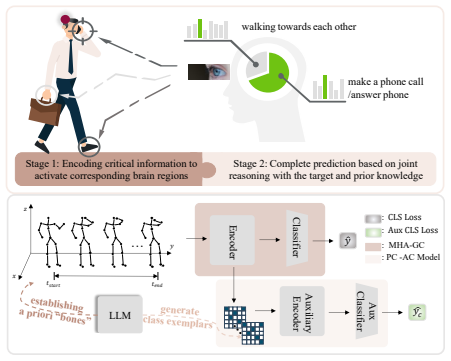
Fig. 1 : Schematic of LA-GCN concept. The top half of this figure shows two brain activity processes when humans perform action recognition. The bottom half shows the proposed multi-task learning process. The knowledge of the language model is divided into global information and category information to simulate the a priori knowledge used in human reasoning to aid the model. The encoder infers the correlation between joints and thus refines the topology using contextual information.
원문 · CC BY 4.0 · Xu, Haojun, Gao, Yan, Hui, Zheng, Li, Jie, Gao, Xinbo · Language Knowledge-Assisted Representation Learning for Skeleton-Based Action Recognition · 원문 그림 인용 · 원본 PDF 1쪽에서 그림 영역을 추출했습니다.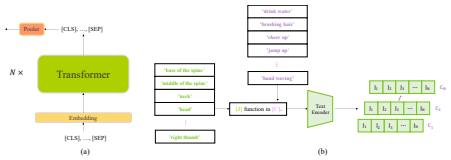
Fig. 2 : Extraction of text features. Subfigure (a) is Bert’s architec- ture. (b) Our method uses the learned text encoder to extract text features by embedding the names of classes [C] and the names of all joints [J] of the target dataset.
원문 · CC BY 4.0 · Xu, Haojun, Gao, Yan, Hui, Zheng, Li, Jie, Gao, Xinbo · Language Knowledge-Assisted Representation Learning for Skeleton-Based Action Recognition · 원문 그림 인용 · 원본 PDF 3쪽에서 그림 영역을 추출했습니다.다중 홉 어텐션 GC와 PC-AC 보조 분기
인코더의 MHA-GC 블록은 두 분기의 Pool과 1×1 Conv를 거쳐 노드 특징 M과 N을 만들고, 각 노드 쌍에 대해 σ(M_i − N_j)로 1차 이웃 어텐션을 계산합니다. 이를 공유 토폴로지와 결합해 Ā_l = A˙_l + γÃ_l W_3를 얻습니다. 다중 홉 어텐션은 Ā = Σ_{i=0}^{k} ω_i Ā^i 로 정의되며, 여기서 ω_i = β(1−β)^i이고 β는 (0, 1] 범위의 감쇠 인자입니다. 학습 시 PC-AC 모듈은 CPR Graph를 클래스별 토폴로지 템플릿 T-C로 만들어 보조 분기의 분류 손실 L_aug를 추가합니다. 테스트 시에는 이 보조 분기를 제거하고 메인 분기로만 예측합니다.
따라서 PC-AC는 학습 중 정규화 신호를 주는 구성요소이며 추론 경로의 일부가 아닙니다.
주요 벤치마크 결과와 비교 조건
NTU RGB+D 60, NTU RGB+D 120, NW-UCLA에서 LA-GCN은 제시된 비교표에서 정확도 결과를 보고합니다. NTU RGB+D의 X-Sub와 X-View에서 LA-GCN은 93.5와 97.2를 기록하며, 같은 표의 InfoGCN 93.0과 97.1보다 높게 나타납니다. NTU RGB+D 120 X-Sub와 X-Set에서 단일 joint 스트림은 86.5와 88.0이며, 6s 앙상블은 90.7과 91.8입니다. NW-UCLA에서는 4s 방식의 Top-1이 97.6으로 보고됩니다. 이 수치들은 각 표에 표시된 스트림 구성과 평가 프로토콜에 따른 결과이므로, 다른 입력 스트림의 점수와 같은 조건으로 묶지 않아야 합니다.
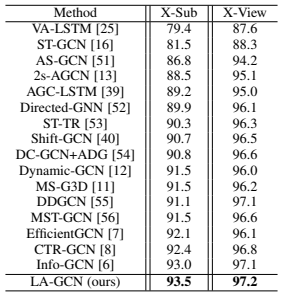
TABLE 1 : The comparison of Top-1 accuracy (%) on the NTU RGB+D [31] benchmark.
원문 · CC BY 4.0 · Xu, Haojun, Gao, Yan, Hui, Zheng, Li, Jie, Gao, Xinbo · Language Knowledge-Assisted Representation Learning for Skeleton-Based Action Recognition · 원문 그림 인용 · 원본 PDF 7쪽에서 그림 영역을 추출했습니다.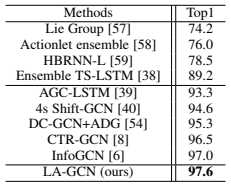
TABLE 3 : The comparison of Top-1 accuracy (%) on the NW- UCLA [33] benchmark.
원문 · CC BY 4.0 · Xu, Haojun, Gao, Yan, Hui, Zheng, Li, Jie, Gao, Xinbo · Language Knowledge-Assisted Representation Learning for Skeleton-Based Action Recognition · 원문 그림 인용 · 원본 PDF 7쪽에서 그림 영역을 추출했습니다.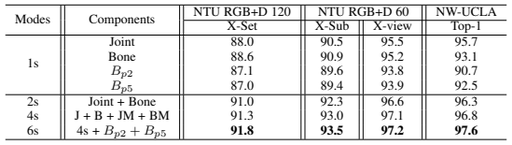
TABLE 10 : Accuracies (%) of the six streams ensemble on NTU RGB+D 120 X-Set split, NTU RGB+D 60 X-Sub and X-view split, and NW-UCLA
원문 · CC BY 4.0 · Xu, Haojun, Gao, Yan, Hui, Zheng, Li, Jie, Gao, Xinbo · Language Knowledge-Assisted Representation Learning for Skeleton-Based Action Recognition · 원문 그림 인용 · 원본 PDF 12쪽에서 그림 영역을 추출했습니다.절제 실험: PC-AC와 다중 홉 어텐션
NTU RGB+D 120 X-Sub를 기준으로 한 절제 실험에서, 보조 손실 L_aug를 넣은 경우의 Top-1은 w/o L_aug의 84.9에서 86.1로 높아집니다. 텍스트 프롬프트에 따른 변화도 별도로 보고되며, 최적 프롬프트 p3에서 1.2의 향상이 나타납니다. 다중 홉 어텐션 절제에서는 1-hop 대비 2-hop, 4-hop 등의 결과가 비교되며 4-hop 1st 설정에서 86.5가 보고됩니다. 3-hop 전체 교체는 메모리 초과가 발생했다고 기록되어 있습니다. 이 결과들은 X-Sub 프로토콜과 해당 절제 설정에 한정되며, 각 구성요소가 항상 유익하다는 일반 결론으로 읽을 수 없습니다.
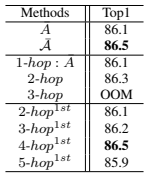
TABLE 5 : (i) The comparison of accuracy without and with PC- AC, where theλ ofLaug is 0.2. (ii) Contribution of different text prompts.
원문 · CC BY 4.0 · Xu, Haojun, Gao, Yan, Hui, Zheng, Li, Jie, Gao, Xinbo · Language Knowledge-Assisted Representation Learning for Skeleton-Based Action Recognition · 원문 그림 인용 · 원본 PDF 8쪽에서 그림 영역을 추출했습니다.한계와 적용 범위
저자들은 LLM 사전 지식의 획득과 적용이 아직 수작업 설계에 많이 의존한다고 밝힙니다. 또한 골격 표현 생성에 쓰인 bone 선택은 기존 데이터셋의 통계에 기반하므로, 새 데이터셋이나 더 많은 범주에서 같은 관찰이 나타나는지는 원문에서 확인되지 않은 과제로 남습니다. 방법은 야생 환경으로의 확장을 향후 과제로 제시합니다. 이 논문의 결과는 제시된 골격 데이터셋과 평가 프로토콜에 한정됩니다.
논문 정보
- 저자
- Xu, Haojun, Gao, Yan, Hui, Zheng, Li, Jie, Gao, Xinbo
- 학회·저널
- arXiv · 프리프린트
- 최초 공개일
- 2023년 5월 21일
- 등록일
- 2026년 11월 6일
- 수정일
- 2023년 5월 21일
- 버전
- v1
- arXiv
- 2305.12398
- 분류
- cs.CV
- 원문 이용 조건
- CC BY 4.0
- 제공 범위
- 논문 정보, 해설, 허용된 원문 그림
AI 해설은 논문 원문과 별개의 설명이며 오류가 있을 수 있습니다. 원문과 그림은 각 출처의 이용 조건과 따로 표시된 권리를 따릅니다.
초록
How humans understand and recognize the actions of others is a complex neuroscientific problem that involves a combination of cognitive mechanisms and neural networks. Research has shown that humans have brain areas that recognize actions that process top-down attentional information, such as the temporoparietal association area. Also, humans have brain regions dedicated to understanding the minds of others and analyzing their intentions, such as the medial prefrontal cortex of the temporal lobe. Skeleton-based action recognition creates mappings for the complex connections between the human skeleton movement patterns and behaviors. Although existing studies encoded meaningful node relationships and synthesized action representations for classification with good results, few of them considered incorporating a priori knowledge to aid potential representation learning for better performance. LA-GCN proposes a graph convolution network using large-scale language models (LLM) knowledge assistance. First, the LLM knowledge is mapped into a priori global relationship (GPR) topology and a priori category relationship (CPR) topology between nodes. The GPR guides the generation of new "bone" representations, aiming to emphasize essential node information from the data level. The CPR mapping simulates category prior knowledge in human brain regions, encoded by the PC-AC module and used to add additional supervision-forcing the model to learn class-distinguishable features. In addition, to improve information transfer efficiency in topology modeling, we propose multi-hop attention graph convolution. It aggregates each node's k-order neighbor simultaneously to speed up model convergence. LA-GCN reaches state-of-the-art on NTU RGB+D, NTU RGB+D 120, and NW-UCLA datasets.
원문 인용
Xu, Haojun, Gao, Yan, Hui, Zheng, Li, Jie, Gao, Xinbo (2023). Language Knowledge-Assisted Representation Learning for Skeleton-Based Action Recognition. arXiv:2305.12398v1. https://arxiv.org/abs/2305.12398v1
BibTeX
@misc{haojun2023language,
  title = {{Language Knowledge-Assisted Representation Learning for Skeleton-Based Action Recognition}},
  author = {Xu, Haojun and Gao, Yan and Hui, Zheng and Li, Jie and Gao, Xinbo},
  year = {2023},
  eprint = {2305.12398},
  archivePrefix = {arXiv},
  url = {https://arxiv.org/abs/2305.12398v1}
}