논문 해설
Quantum error correction for the toric code using deep reinforcement learning
심층 강화학습을 이용한 토릭 코드의 양자 오류 정정
- 연구 문제 토릭 코드의 비트플립 오류를 강화학습 에이전트가 MWPM에 근접하게 디코딩할 수 있는지 다룹니다.
- 연구 방법 신드롬의 각 결함을 중심에 둔 perspective로 나누어 심층 Q-network에 입력하고, 결함을 이웃 플라케트로 옮기는 행동을 단계별로 선택합니다.
- 주요 결과 d = 3, 5, 7에서 수렴한 에이전트의 성공률은 MWPM 결과에 근접하며, 작은 오류율에서는 MWPM의 점근 실패율 거동과 일치하는 것으로 보고됩니다.
토릭 코드 오류 정정의 어려움
토릭 코드는 주기 경계 조건을 가진 정사각 격자 위에서 물리 큐빗을 배치하고, 플라케트와 꼭짓점 안정자를 측정하여 논리 큐빗을 보호하는 위상 양자 오류 정정 코드입니다. 이 논문이 다루는 상황에서는 비트플립 오류가 플라케트에 짝을 이루는 결함을 만들고, 디코더는 측정된 신드롬만 보고 결함을 짝지어 정정 사슬을 찾아야 합니다.
신드롬은 실제 오류를 유일하게 결정하지 않으므로, 같은 신드롬에 대응하는 여러 오류 사슬 중 논리 비트플립을 만들지 않는 정정을 골라야 합니다. 표준 디코더인 Minimum Weight Perfect Matching(MWPM)은 결함 쌍의 전체 거리를 최소화하여 이 문제를 풀지만, 이 논문은 결함 짝짓기 결과만 제공하고 단계별 정정 행동을 주지 않는 점을 강화학습 접근의 동기로 제시합니다.
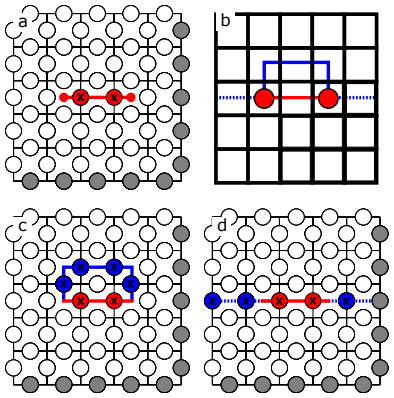
Figure 2 : Bit-flip errors (red ’X’) and possible error correction bit-flips (blue ’X’). (a) Two neighboring errors and the corre- sponding error chain (red line) and syndrome (red dots). (b) Visualized in terms of the syndrome with error chain and two possible correction chains (blue) as expressed explicitly in (c) and (d). The error chain plus the correction chain in (d) con- stitutes a non-trivial loop and a logical bit-flip operation (as in Figure 1d), thus a failed error correction, in contrast to the trivial loop in (c).
원문 · CC BY 4.0 · Philip Andreasson, Joel Johansson, Simon Liljestrand, Mats Granath · Quantum error correction for the toric code using deep reinforcement learning · 원문 그림 인용 · 원본 PDF 4쪽에서 그림 영역을 추출했습니다.이 논문의 범위는 완벽한 신드롬에서 무상관 비트플립 오류만 고려하는 경우입니다. 강화학습 에이전트는 MWPM과 비교 가능한 성능을 목표로 하며, 디코더를 더 일반적인 오류 모델로 확장하는 가능성은 향후 과제로 남겨 둡니다.
결함 중심 perspective와 observation 표현
이 논문은 신드롬을 하나의 큰 이미지로 입력하지 않고, 각 결함을 중심에 둔 perspective로 나눕니다. 토릭 코드는 주기 경계 조건을 가지므로 어떤 플라케트든 중심으로 옮길 수 있고, 한 결함에 대해 나머지 결함들의 상대 위치만 남길 수 있습니다.
모든 결함의 perspective 집합을 observation이라고 부르며, 이는 신드롬과 같은 정보를 다른 방식으로 표현한 것입니다. 행동 공간은 결함 하나를 상, 하, 좌, 우 이웃 플라케트로 옮기는 네 가지이므로, 결함 수가 바뀌어도 출력 크기를 고정하기 위해 각 perspective를 Q 네트워크에 개별적으로 전달합니다. 중심 결함의 행동 가치 Q(P,a,θ)가 계산되며, 신드롬 전체의 행동 가치는 모든 perspective에 대한 Q 값의 집합입니다.
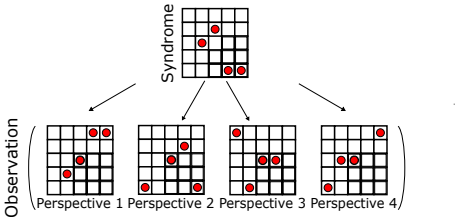
Figure 4 : State formulation. The toric code syndrome, defines an ”observation” that contains the centralized ”perspectives” for each defect.
원문 · CC BY 4.0 · Philip Andreasson, Joel Johansson, Simon Liljestrand, Mats Granath · Quantum error correction for the toric code using deep reinforcement learning · 원문 그림 인용 · 원본 PDF 6쪽에서 그림 영역을 추출했습니다.심층 Q-learning과 학습 절차
에이전트는 신드롬에 대한 행동 가치 함수를 저장하는 대신 합성곱 신경망으로 근사합니다. 학습 중에는 ϵ-greedy 정책으로 결함 perspective와 행동을 선택하여 수행하고, 전이 (P, a, r, O′)를 메모리 버퍼에 저장합니다. 보상은 각 단계마다 r = −1이며, 할인율 γ = 0.95가 사용됩니다. 따라서 최적 정책은 행동 수를 최소화하는 방향으로 학습됩니다.
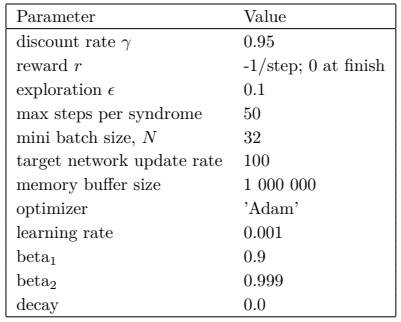
Table 3 : Hyperparameters
원문 · CC BY 4.0 · Philip Andreasson, Joel Johansson, Simon Liljestrand, Mats Granath · Quantum error correction for the toric code using deep reinforcement learning · 원문 그림 인용 · 원본 PDF 12쪽에서 그림 영역을 추출했습니다.학습 단계에서는 메모리 버퍼에서 무작위 미니배치를 뽑아 목표 값 y = r + γ max Q(P′,a′,θT)를 계산하고, 그 목표를 따르도록 Q 네트워크 파라미터 θ를 경사하강 방식으로 갱신합니다. 목표 네트워크 θT는 주기적으로 Q 네트워크와 동기화되며, 이 구조는 시간적 상관을 줄이기 위한 경험 재현과 함께 사용됩니다. 저자들은 성공과 실패 정보를 보상에 직접 쓰면 같은 신드롬이 서로 다른 결과를 낼 수 있어 수렴이 어려웠다고 설명합니다.
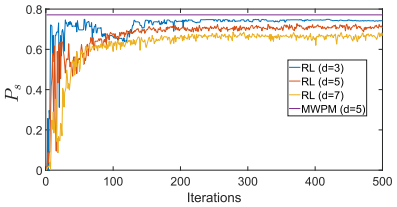
Figure 9 : Early training convergence of the Q network agent. Success rate Ps versus number of iterations. One iteration corresponds to annihilating all the defects of a single syndrome. (The very early below 1/4 success rate is an artifact of using a max count for the number of error correcting steps for the validation.)
원문 · CC BY 4.0 · Philip Andreasson, Joel Johansson, Simon Liljestrand, Mats Granath · Quantum error correction for the toric code using deep reinforcement learning · 원문 그림 인용 · 원본 PDF 12쪽에서 그림 영역을 추출했습니다.MWPM과의 성공률 비교
수렴한 에이전트의 성공률은 d = 3, 5, 7 시스템에서 MWPM 결과와 비교되었습니다. 이 결과는 오류율 p 범위에서 얻은 것이며, 원문은 이 에이전트의 성능이 MWPM에 가까운 수준이라고 보고합니다.
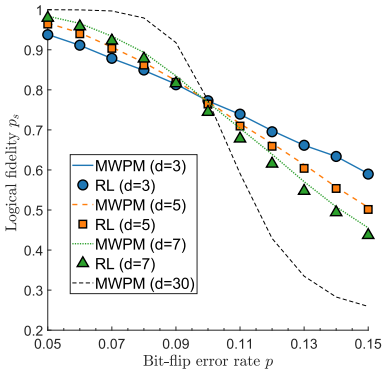
Figure 6 : Error correction success rate ps of the converged agents versus bit-flip error rate p, for system size d = 3, 5, 7, and compared to the corresponding results using MWPM (lines). (The MWPM decoder for d = 30 is included as a reference for the approach to large d.)
원문 · CC BY 4.0 · Philip Andreasson, Joel Johansson, Simon Liljestrand, Mats Granath · Quantum error correction for the toric code using deep reinforcement learning · 원문 그림 인용 · 원본 PDF 8쪽에서 그림 영역을 추출했습니다.에이전트는 MWPM보다 높은 성능을 보이지 않으며, 저자들은 이를 MWPM과 근접한 성능을 보인 결과로 해석합니다. 이 비교는 10% 오류율로 생성한 데이터와 무상관 비트플립 설정에서 확인된 결과입니다.
작은 오류율에서의 실패율 거동
작은 오류율 극한에서 MWPM의 논리 실패율은 점근식으로 주어지며, 부록에서 이 식이 유도됩니다. 원문은 RL 에이전트가 이 점근 거동과 일치하는 것으로 보고하며, 그 확인은 d = 3, 5, 7에서 가장 낮은 p 데이터 점에 맞춘 거듭제곱 적합에 근거합니다.
이 결과는 작은 오류율 영역에 대한 것이며, 큰 오류율의 성능을 뒷받침하지 않습니다.
대규모 격자와 적용 범위
d = 9에서는 작은 오류율에서 좋은 성능을 보이지만, 큰 오류율에서는 MWPM보다 낮은 성능을 보입니다. 저자들은 상태 공간이 지수적으로 커지는 점을 이 결과의 원인으로 해석합니다.
따라서 현재 결과는 d = 7까지의 토릭 코드, 무상관 비트플립 오류, 완벽한 신드롬이라는 범위에 한정됩니다. 복합 잡음, 측정 오류, 더 일반적인 코드에 대한 적용은 이 논문에서 검증하지 않았습니다.
논문 정보
- 저자
- Philip Andreasson, Joel Johansson, Simon Liljestrand, Mats Granath
- 학회·저널
- arXiv · 프리프린트
- 최초 공개일
- 2018년 11월 29일
- 등록일
- 2026년 11월 6일
- 수정일
- 2019년 8월 25일
- 버전
- v3
- arXiv
- 1811.12338
- DOI
- 10.22331/q-2019-09-02-183
- 분류
- quant-ph · cond-mat.dis-nn
- 원문 이용 조건
- CC BY 4.0
- 제공 범위
- 논문 정보, 해설, 허용된 원문 그림
AI 해설은 논문 원문과 별개의 설명이며 오류가 있을 수 있습니다. 원문과 그림은 각 출처의 이용 조건과 따로 표시된 권리를 따릅니다.
초록
We implement a quantum error correction algorithm for bit-flip errors on the topological toric code using deep reinforcement learning. An action-value Q-function encodes the discounted value of moving a defect to a neighboring site on the square grid (the action) depending on the full set of defects on the torus (the syndrome or state). The Q-function is represented by a deep convolutional neural network. Using the translational invariance on the torus allows for viewing each defect from a central perspective which significantly simplifies the state space representation independently of the number of defect pairs. The training is done using experience replay, where data from the algorithm being played out is stored and used for mini-batch upgrade of the Q-network. We find performance which is close to, and for small error rates asymptotically equivalent to, that achieved by the Minimum Weight Perfect Matching algorithm for code distances up to $d=7$. Our results show that it is possible for a self-trained agent without supervision or support algorithms to find a decoding scheme that performs on par with hand-made algorithms, opening up for future machine engineered decoders for more general error models and error correcting codes.
원문 인용
Philip Andreasson, Joel Johansson, Simon Liljestrand, Mats Granath (2018). Quantum error correction for the toric code using deep reinforcement learning. arXiv:1811.12338v3. https://doi.org/10.22331/q-2019-09-02-183
BibTeX
@article{andreasson2018quantum,
  title = {{Quantum error correction for the toric code using deep reinforcement learning}},
  author = {Philip Andreasson and Joel Johansson and Simon Liljestrand and Mats Granath},
  year = {2018},
  eprint = {1811.12338},
  archivePrefix = {arXiv},
  doi = {10.22331/q-2019-09-02-183},
  url = {https://arxiv.org/abs/1811.12338v3}
}