논문 해설
ESTRA: Enabling Extreme Attention Sparsity for Training-Free Video Diffusion Acceleration
ESTRA: 학습이 필요 없는 비디오 디퓨전 가속을 위한 극단적 어텐션 희소성 구현
- 연구 문제 비디오 확산 트랜스포머의 어텐션은 긴 시퀀스에서 비용이 커, 극단적 희소도에서도 품질을 유지하는 학습 없는 가속이 필요합니다.
- 연구 방법 ESTRA는 쿼리 중심점으로 개별 키를 점수화해 정확 계산할 토큰을 고르고, 나머지 기여는 VCM으로 보정한 클러스터 대표로 근사합니다.
- 주요 결과 Wan2.1-14B와 HunyuanVideo-13B에서 5% 밀도의 ESTRA는 Sol-Attn와 SVG-EAR보다 높은 충실도를 보이며, 1% 밀도에서도 3.55배와 5.39배의 종단 간 속도 향상을 보고합니다.
극단적 희소도에서 생기는 어려움
비디오 확산 트랜스포머는 긴 시공간 시퀀스에 대해 어텐션을 계산하며, 이 연산은 샘플링 단계마다 반복되어 생성 비용의 상당 부분을 차지합니다. 기존 희소 어텐션은 일부 쿼리-키 상호작용만 정확히 계산하고 나머지를 근사하여 비용을 줄이지만, 희소도가 높아질수록 생성 품질이 빠르게 떨어집니다. 원문은 90%에서 99%로 희소도를 높이면 정확 계산되는 상호작용이 10%에서 1%로 줄어든다고 설명합니다. 이 논문은 이처럼 정확 계산 예산이 매우 작아진 상황에서도 학습 없이 품질을 유지하는 방법을 다룹니다.
ESTRA의 선택과 보상 구조
ESTRA는 쿼리와 키를 각각 k-means로 클러스터링하고, 쿼리 클러스터의 중심점이 개별 키를 점수화하여 정확 계산할 토큰을 고릅니다. 이 점수는 같은 쿼리 클러스터 안에서 공유되므로, 클러스터 전체가 아니라 높은 점수의 키들이 여러 클러스터에 걸쳐 선택될 수 있습니다. 선택되지 않은 나머지 키는 K/V 클러스터 평균으로 근사하며, 이때 대표의 로짓에 토큰 수의 로그를 더하는 log-count bias가 적용됩니다. 원문은 이 대표 항이 비정규화 가중치에 클러스터가 대표하는 토큰 수를 곱하는 효과를 준다고 설명합니다.
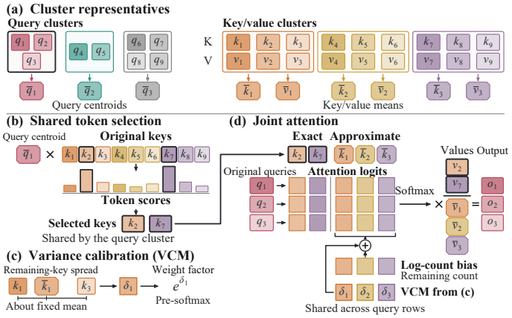
Figure 2 : ESTRA overview.(a)Independent query and key clusters provide query centroids and K/V means.(b)Each centroid scores individual keys for selection shared by its query cluster.(c) VCM uses remaining-key spread and query norms to calibrate representative weights.(d)Original queries attend jointly to selected tokens and fixed cluster means, with log-count and VCM biases on representative logits. Colors identify clusters. Attention scaling is omitted.
원문 · CC0 1.0 · Enhuai Liu, Yunke Wang, Yutong Wang, Changming Sun · ESTRA: Enabling Extreme Attention Sparsity for Training-Free Video Diffusion Acceleration · 원문 그림 인용 · 원본 PDF 4쪽에서 그림 영역을 추출했습니다.분산 기반 보정 VCM
기존 평균 기반 보상은 클러스터 평균 키의 로짓이 구성원 로짓의 평균과 같다는 점을 이용하지만, 실제 클러스터의 비정규화 가중치는 개별 로짓 지수의 합입니다. VCM은 남은 키의 분산에 대한 2차 전개로 이 차이를 보정합니다. 원문은 로그 기대값의 2차 근사에서 평균 이동 항은 버리고 분산 항을 스칼라 프록시 m2로 근사하며, 등방성 근사와 스케일 α, 상한 δmax를 사용해 대표 가중치를 최대 e^δmax배까지 키운다고 설명합니다. 여기서 δmax는 보정이 대표 가중치를 늘리는 배율의 상한을 정하며, 보정은 K/V 평균을 다시 계산하지 않고 클러스터 쌍마다 두 개의 스칼라만 갱신합니다.
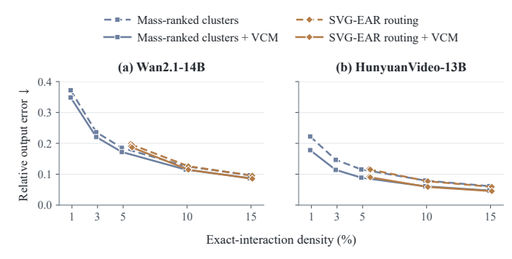
Figure 6 :Cluster selection and VCM.Mass-ranked selection and SVG-EAR routing are each evaluated with and without VCM on identical inputs. Each VCM pair retains the same selected clusters. Curves use measured densities and cover all requested budgets, including SVG-EAR’s overlapping low-budget points. Errors average 10 prompts per backbone.
원문 · CC0 1.0 · Enhuai Liu, Yunke Wang, Yutong Wang, Changming Sun · ESTRA: Enabling Extreme Attention Sparsity for Training-Free Video Diffusion Acceleration · 원문 그림 인용 · 원본 PDF 15쪽에서 그림 영역을 추출했습니다.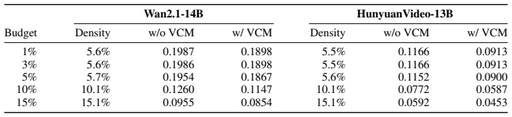
Table 6 :SVG-EAR routing with and without VCM.The two variants use the same selected clusters. Budget is the requested density; density is measured. Errors average 10 prompts per backbone. All requested budgets are retained, including those with the same rounded measured density.
원문 · CC0 1.0 · Enhuai Liu, Yunke Wang, Yutong Wang, Changming Sun · ESTRA: Enabling Extreme Attention Sparsity for Training-Free Video Diffusion Acceleration · 원문 그림 인용 · 원본 PDF 15쪽에서 그림 영역을 추출했습니다.출력 오차와 구성요소 효과
원문은 오프라인 어텐션 출력 평가에서 VCM과 토큰 수준 선택의 효과를 분리해 보고합니다. VCM을 추가하면 5% 목표 밀도에서 Wan의 상대 오차 감소율은 7.2%이고 HunyuanVideo의 감소율은 23.1%입니다. 토큰 수준 선택을 적용하면 5% 목표 밀도에서 상대 오차가 Wan에서 55.3%, HunyuanVideo에서 39.4% 줄어듭니다. 이 수치는 같은 클러스터 기반 기준선에서 보정과 선택을 단계적으로 추가한 결과이며, 생성 품질 결과와는 구분해 읽어야 합니다.
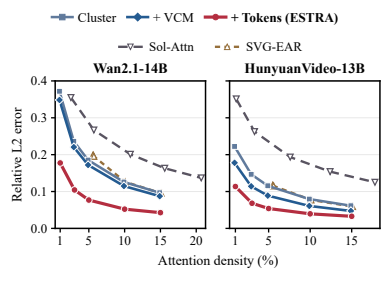
Figure 3 : Adding VCM and then token-level selection lowers attention-output error on both backbones.
원문 · CC0 1.0 · Enhuai Liu, Yunke Wang, Yutong Wang, Changming Sun · ESTRA: Enabling Extreme Attention Sparsity for Training-Free Video Diffusion Acceleration · 원문 그림 인용 · 원본 PDF 5쪽에서 그림 영역을 추출했습니다.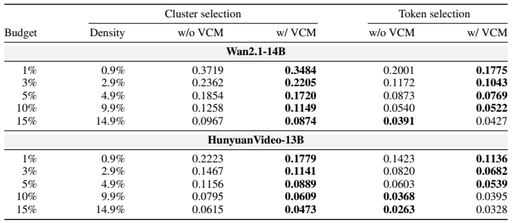
Table 5 :Complete component ablation.Attention-output errors average 10 prompts per backbone. Token selection uses target density labels; whole-cluster selection uses measured densities. Bold marks the lower error within each VCM pair.
원문 · CC0 1.0 · Enhuai Liu, Yunke Wang, Yutong Wang, Changming Sun · ESTRA: Enabling Extreme Attention Sparsity for Training-Free Video Diffusion Acceleration · 원문 그림 인용 · 원본 PDF 14쪽에서 그림 영역을 추출했습니다.생성 품질과 속도 비교
Wan2.1-14B와 HunyuanVideo-13B에서 ESTRA는 Dense warmup 없이 첫 디노이징 단계부터 희소 방법을 적용한 주 실험으로 평가되었습니다. Wan2.1-14B에서 5% 목표 밀도의 ESTRA는 PSNR 14.67 dB, SSIM 0.489, LPIPS 0.467을 기록하며 3.26배의 종단 간 속도 향상을 보입니다. 1% 밀도에서는 3.55배의 속도 향상과 PSNR 12.25 dB를 보고합니다. HunyuanVideo-13B에서는 1% 밀도에서 5.39배의 속도 향상과 PSNR 16.58 dB를 기록합니다. 기준선은 측정된 밀도를 사용하며, Sol-Attn와 SVG-EAR의 밀도가 ESTRA의 목표 밀도보다 높다는 점을 함께 고려해야 합니다.
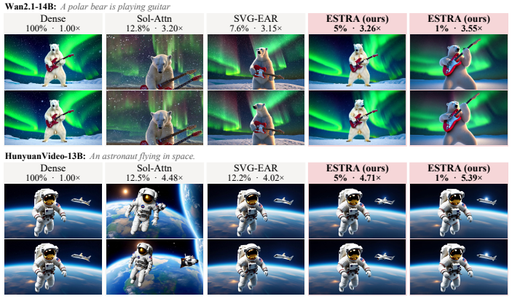
Figure 1 :High-quality video generation at up to 99% attention sparsity.At 5% exact-interaction density, ESTRA more closely preserves the composition and appearance of the dense references than the baselines shown, while using higher sparsity and achieving greater end-to-end speedups. At 1%, the videos remain visually coherent, with particularly small changes in the HunyuanVideo example. Density denotes the fraction of video query–key interactions evaluated exactly; speedups are end to end on an NVIDIA H20. Additional examples are provided in Appendix D.
원문 · CC0 1.0 · Enhuai Liu, Yunke Wang, Yutong Wang, Changming Sun · ESTRA: Enabling Extreme Attention Sparsity for Training-Free Video Diffusion Acceleration · 원문 그림 인용 · 원본 PDF 2쪽에서 그림 영역을 추출했습니다.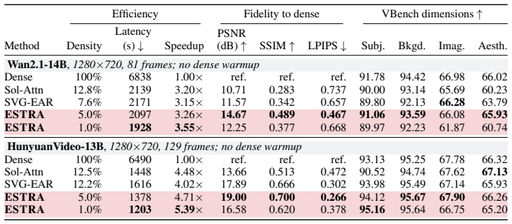
Table 1 :Video quality, fidelity, and speed at 720p.Fidelity metrics average 251 sparse–dense pairs per backbone; VBench scores use designated prompt subsets. Latency is the median H20 time per video, including V AE decoding and export. Bold marks the best sparse result per backbone. Subj., Bkgd., Imag., and Aesth. denote subject consistency, background consistency, imaging quality, and aesthetic quality.
원문 · CC0 1.0 · Enhuai Liu, Yunke Wang, Yutong Wang, Changming Sun · ESTRA: Enabling Extreme Attention Sparsity for Training-Free Video Diffusion Acceleration · 원문 그림 인용 · 원본 PDF 8쪽에서 그림 영역을 추출했습니다.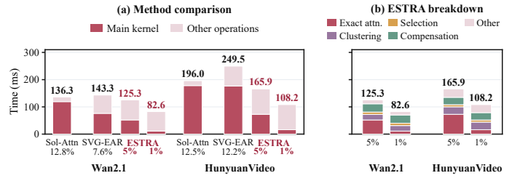
Figure 4 :Attention runtime on NVIDIA H20.Panel (a) compares ESTRA with Sol-Attn and SVG-EAR on both backbones. Panel (b) breaks down ESTRA’s runtime at 5% and 1% density.
원문 · CC0 1.0 · Enhuai Liu, Yunke Wang, Yutong Wang, Changming Sun · ESTRA: Enabling Extreme Attention Sparsity for Training-Free Video Diffusion Acceleration · 원문 그림 인용 · 원본 PDF 8쪽에서 그림 영역을 추출했습니다.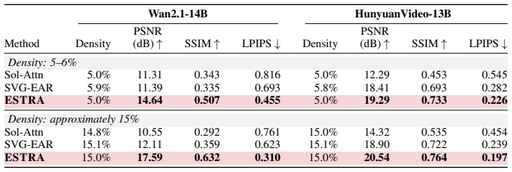
Table 2 :Fidelity at comparable attention budgets.Results average 10 prompts per backbone at the densities shown. Bold marks the best score within each density group and backbone.
원문 · CC0 1.0 · Enhuai Liu, Yunke Wang, Yutong Wang, Changming Sun · ESTRA: Enabling Extreme Attention Sparsity for Training-Free Video Diffusion Acceleration · 원문 그림 인용 · 원본 PDF 8쪽에서 그림 영역을 추출했습니다.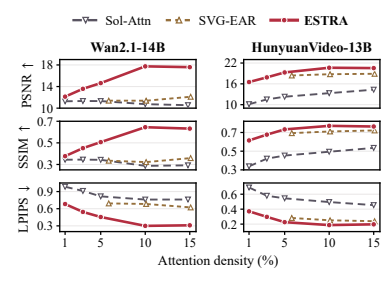
Figure 5 : Fidelity to dense generation across attention densities. Results average 10 prompts per backbone.
원문 · CC0 1.0 · Enhuai Liu, Yunke Wang, Yutong Wang, Changming Sun · ESTRA: Enabling Extreme Attention Sparsity for Training-Free Video Diffusion Acceleration · 원문 그림 인용 · 원본 PDF 9쪽에서 그림 영역을 추출했습니다.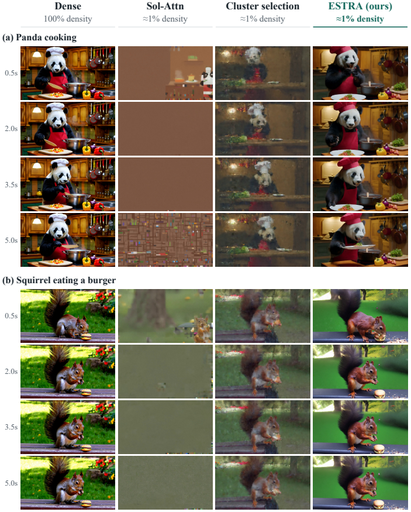
Figure 14 :Generation at approximately 1% density on Wan2.1-14B.ESTRA preserves clear subjects and coherent scenes, whereas Sol-Attn exhibits severe block artifacts and the cluster-level variant loses substantial visual detail. Rows show aligned frames at the indicated times.
원문 · CC0 1.0 · Enhuai Liu, Yunke Wang, Yutong Wang, Changming Sun · ESTRA: Enabling Extreme Attention Sparsity for Training-Free Video Diffusion Acceleration · 원문 그림 인용 · 원본 PDF 24쪽에서 그림 영역을 추출했습니다.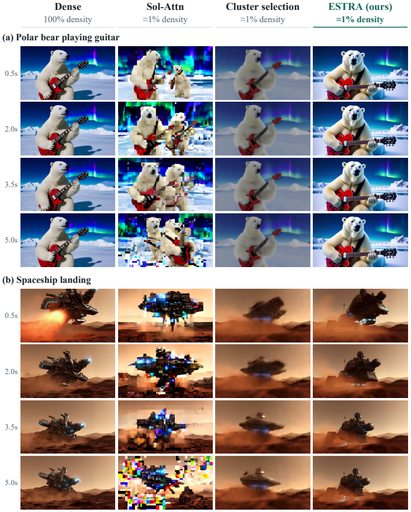
Figure 15 :Generation at approximately 1% density on HunyuanVideo-13B.ESTRA retains detailed subjects and coherent scenes, while Sol-Attn and the cluster-level variant produce block artifacts and substantial blur, respectively. Rows show aligned frames at the indicated times.
원문 · CC0 1.0 · Enhuai Liu, Yunke Wang, Yutong Wang, Changming Sun · ESTRA: Enabling Extreme Attention Sparsity for Training-Free Video Diffusion Acceleration · 원문 그림 인용 · 원본 PDF 25쪽에서 그림 영역을 추출했습니다.적용 범위와 남은 한계
원문은 Wan이 HunyuanVideo보다 민감하여 영상 품질과 미적 품질 점수가 밀집 생성보다 약 5점 낮다고 보고합니다. 또한 VCM은 등방성 근사를 가정하며, 그 보정의 효과는 밀도와 선택 방식에 따라 달라집니다. 이 결과는 Wan2.1-14B와 HunyuanVideo-13B, 제시된 720p 설정과 주 실험의 Dense warmup 없는 조건에서 얻은 것입니다. 다른 모델과 해상도로 확장한 결과는 이 논문의 근거에 포함되지 않습니다.
논문 정보
- 저자
- Enhuai Liu, Yunke Wang, Yutong Wang, Changming Sun
- 학회·저널
- arXiv · 프리프린트
- 최초 공개일
- 2026년 11월 7일
- 등록일
- 2026년 11월 10일
- 수정일
- 2026년 11월 7일
- 버전
- v1
- arXiv
- 2611.10448
- 분류
- cs.CV
- 원문 이용 조건
- CC0 1.0
- 제공 범위
- 논문 정보, 해설, 허용된 원문 그림
AI 해설은 논문 원문과 별개의 설명이며 오류가 있을 수 있습니다. 원문과 그림은 각 출처의 이용 조건과 따로 표시된 권리를 따릅니다.
초록
Video diffusion transformers generate high-quality videos, but attention over long spatiotemporal sequences makes inference computationally expensive. Sparse attention reduces this cost by computing only a subset of query-key interactions exactly, and recent training-free methods further approximate the remaining interactions. These methods, however, degrade quickly at high sparsity, which limits the achievable speedup. We present ESTRA (Extreme Sparsity Through Refined Attention), a training-free acceleration method that preserves generation quality even at extreme sparsity. ESTRA concentrates exact attention computation on a small set of important key-value tokens and approximates the remaining contributions with cluster representatives. To identify these tokens efficiently, it groups similar queries and uses their representatives to score individual keys. A variance-based correction further refines the attention weights of the cluster representatives, improving the accuracy of the approximation. Experiments on Wan2.1-14B and HunyuanVideo-13B show that ESTRA establishes a new quality-efficiency frontier for training-free sparse attention, achieving $3.26\times$ and $4.71\times$ end-to-end speedups at 5% attention density while surpassing Sol-Attn and SVG-EAR in fidelity to dense generation and on most VBench dimensions. Even at 1% density, ESTRA remains more faithful to dense generation than Sol-Attn at 12.5%, while reaching up to $5.39\times$ speedup.
원문 인용
Enhuai Liu, Yunke Wang, Yutong Wang, Changming Sun (2026). ESTRA: Enabling Extreme Attention Sparsity for Training-Free Video Diffusion Acceleration. arXiv:2611.10448v1. https://arxiv.org/abs/2611.10448v1
BibTeX
@misc{liu2026estra,
  title = {{ESTRA: Enabling Extreme Attention Sparsity for Training-Free Video Diffusion Acceleration}},
  author = {Enhuai Liu and Yunke Wang and Yutong Wang and Changming Sun},
  year = {2026},
  eprint = {2611.10448},
  archivePrefix = {arXiv},
  url = {https://arxiv.org/abs/2611.10448v1}
}