논문 해설
Shaping Useful Noise: Energy Distributions Predict Visual Pretraining Quality
유용한 노이즈 설계하기: 에너지 분포가 시각 pre-training 품질을 예측한다
- 연구 문제 합성 데이터의 pre-training 효용을 평가할 때 샘플 사실감과 특징 공간 유사도만으로는 부족하며, 실제 이미지의 우도 수준 분포를 맞추는지가 중요하다고 제안합니다.
- 연구 방법 정규화된 실제 이미지 밀도 모델로 샘플의 에너지를 계산하고, 실제와 합성 에너지 분포의 Wasserstein-1 거리를 ELD로 정의합니다. 백분위 변형 pELD와 이를 이용한 큐레이션을 함께 제시합니다.
- 주요 결과 DINO/ViT-S 설정에서 ELD는 frozen ImageNet-1K linear 정확도와 음의 상관을 보이며(ρ=−0.87), 잡음형 데이터셋을 제외한 leave-one-dataset-out 예측 MAE에서 FID보다 낮은 오차를 보고합니다. 큐레이션은 고정 특징 기반 오프라인 진단에서 개선을 보였습니다.
합성 데이터 선택 기준의 한계
합성 데이터로 시각 pre-training을 확장할 때 현재 선택 기준은 샘플의 사실감이나 특징 공간 유사도에 주로 의존합니다. 이 방식은 데이터셋을 거리, 이웃 구조, 낮은 차수의 특징 요약으로 압축하므로 샘플이 실제 이미지의 확률 지형 어디에 놓이는지는 묻지 않습니다. 저자들은 실제 이미지가 하나의 전형적인 우도 수준에 몰려 있지 않고 넓고 내용 의존적인 에너지 분포를 가진다는 점에서 이 축이 빠져 있다고 짚습니다. 따라서 질문은 합성 데이터가 실제 이미지가 차지하는 우도 수준의 분포를 맞춰야 하는가입니다.
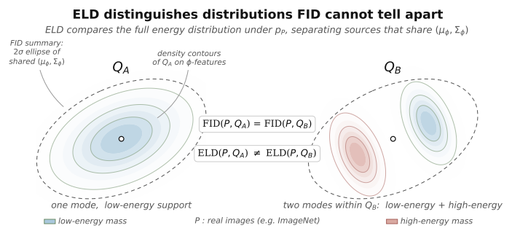
Figure 1 :ELD distinguishes synthetic pretraining datasets FID cannot.Self-supervised pretraining benefits when synthetic data spans the full likelihood spectrum of real images; sources with identical FID can carry very different energy distributions, which ELD detects.
원문 · CC BY 4.0 · Choi, Ching Lam, Torralba, Antonio, Isola, Phillip, Jegelka, Stefanie · Shaping Useful Noise: Energy Distributions Predict Visual Pretraining Quality · 원문 그림 인용 · 원본 PDF 2쪽에서 그림 영역을 추출했습니다.
Table 7 :Simple surrogate energies do not reproduce ELD.Feature- and DCT-based density surrogates fail to recover the ranking induced by the learned ImageNet density model, indicating that ELDis not reducible to generic feature novelty or low-level image-statistics mismatch.
원문 · CC BY 4.0 · Choi, Ching Lam, Torralba, Antonio, Isola, Phillip, Jegelka, Stefanie · Shaping Useful Noise: Energy Distributions Predict Visual Pretraining Quality · 원문 그림 인용 · 원본 PDF 15쪽에서 그림 영역을 추출했습니다.ELD와 백분위 변형의 계산
ELD는 정규화된 실제 이미지 밀도 모델 pP가 정의하는 에너지 EP(x)=−log pP(x)를 이용해 실제 데이터 P와 합성 데이터 Q의 에너지 분포를 비교합니다. 두 일차원 분포 (EP)#P와 (EP)#Q 사이의 Wasserstein-1 거리가 ELD이며, 일차원에서는 경험적 CDF 사이의 적분 거리로 계산됩니다. 원래 에너지 척도는 밀도 모델의 보정에 따라 달라지므로, 저자들은 실제 에너지의 CDF FP로 각 에너지를 순위 백분위로 바꾼 pELD를 함께 사용합니다. 실제 기준 분포의 백분위는 Unif(0, 1)이 되며, pELD는 [0, 1/2] 범위에 있고 엄격히 증가하는 재보정에 불변입니다. 다만 유한 표본에서는 보정 집합으로 추정한 FP를 쓰기 때문에 실제 표본의 균일성은 근사적으로만 성립합니다.
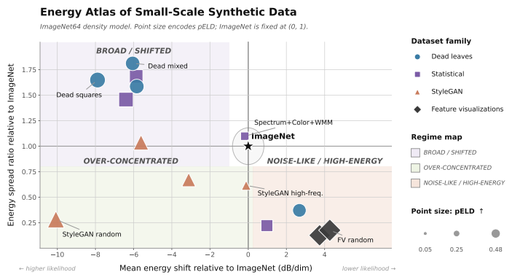
Figure 2 :Small-scale energy audit.Synthetic datasets scored under a grayscale ImageNet64 density model. Axes show mean energy shift and spread relative to ImageNet, while point size denotesPELD. The atlas provides a coarse diagnostic view of the regimes expanded in Figure 3: noise-like sources are shifted toward high-energy regions, over-concentrated sources occupy too narrow a likelihood band, and broad/shifted sources cover a wider range but remain displaced from the real energy profile.
원문 · CC BY 4.0 · Choi, Ching Lam, Torralba, Antonio, Isola, Phillip, Jegelka, Stefanie · Shaping Useful Noise: Energy Distributions Predict Visual Pretraining Quality · 원문 그림 인용 · 원본 PDF 3쪽에서 그림 영역을 추출했습니다.ELD와 기존 지표의 pre-training 예측력
DINO와 ViT-S를 고정 하이퍼파라미터로 각 합성 데이터셋에서 사전학습한 설정에서, 저자들은 ELD가 낮을수록 frozen ImageNet-1K linear 정확도가 높은 경향을 보고합니다. 이때 Spearman 상관은 ρ=−0.87, p=0.002로 보고되며 fine-tuning과 ImageNet-C/A 강건성에서도 음의 상관이 나타납니다. 이 결과는 DINO 설정과 이 suite의 데이터셋 집합에 대한 것입니다. 또한 한 데이터셋을 빼고 예측하는 leave-one-dataset-out 회귀에서 잡음형 데이터셋을 제외한 조건의 MAE는 ELD 0.99, FID 1.66, LPIPS 1.47, recall 3.27 포인트로 보고됩니다.
이는 이 소규모 suite의 예측 오차 비교이며, 모든 합성 데이터셋이나 다른 아키텍처로 일반화된 결과로 읽을 수 없습니다.
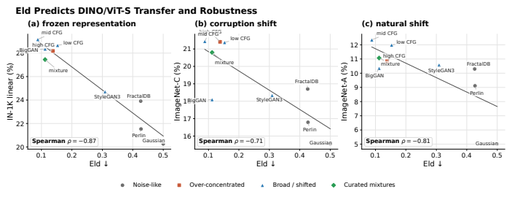
Figure 4 :ELDpredicts DINO/ViT-S downstream quality.Across the self-supervised synthetic pretraining suite, lower ELDis associated with stronger frozen ImageNet-1K linear-probe accuracy and better robustness on ImageNet-C and ImageNet-A. Points are colored by the energy-regime taxonomy, showing that high-ELDnoise-like sources occupy the weak-transfer end of the trend, while lower-ELDdiffusion and mixture sources cluster among the strongest representations.
원문 · CC BY 4.0 · Choi, Ching Lam, Torralba, Antonio, Isola, Phillip, Jegelka, Stefanie · Shaping Useful Noise: Energy Distributions Predict Visual Pretraining Quality · 원문 그림 인용 · 원본 PDF 6쪽에서 그림 영역을 추출했습니다.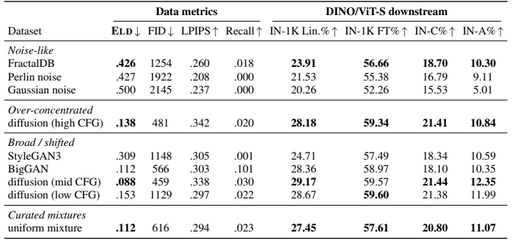
Table 1 :Self-supervised setting.Dataset metrics and DINO/ViT-S accuracy; metrics are computed against ImageNet, and evaluation reports ImageNet-1K linear/FT plus ImageNet-C/A robustness.
원문 · CC BY 4.0 · Choi, Ching Lam, Torralba, Antonio, Isola, Phillip, Jegelka, Stefanie · Shaping Useful Noise: Energy Distributions Predict Visual Pretraining Quality · 원문 그림 인용 · 원본 PDF 7쪽에서 그림 영역을 추출했습니다.
Table 2 : Leave-one-dataset-out DINO prediction MAE (percentage points↓).
원문 · CC BY 4.0 · Choi, Ching Lam, Torralba, Antonio, Isola, Phillip, Jegelka, Stefanie · Shaping Useful Noise: Energy Distributions Predict Visual Pretraining Quality · 원문 그림 인용 · 원본 PDF 7쪽에서 그림 영역을 추출했습니다.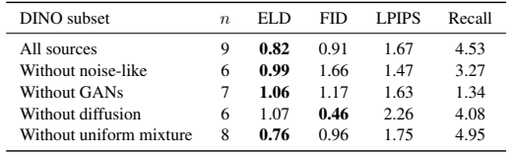
Table 8 : Sensitivity of DINO linear prediction to source exclusion. Each row repeats leave-one- dataset-out fitting within the retained subset. It does not evaluate transfer to the omitted family.
원문 · CC BY 4.0 · Choi, Ching Lam, Torralba, Antonio, Isola, Phillip, Jegelka, Stefanie · Shaping Useful Noise: Energy Distributions Predict Visual Pretraining Quality · 원문 그림 인용 · 원본 PDF 15쪽에서 그림 영역을 추출했습니다.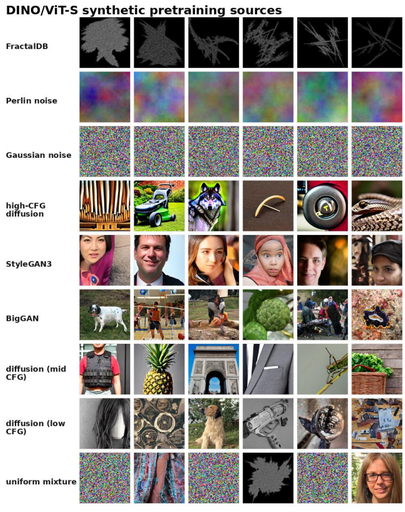
Figure 6 :DINO/ViT-S synthetic pretraining sources.This grid highlights the range from noise and procedural structure to generator samples; ELDmeasures how these sources populate ImageNet likelihood levels.
원문 · CC BY 4.0 · Choi, Ching Lam, Torralba, Antonio, Isola, Phillip, Jegelka, Stefanie · Shaping Useful Noise: Energy Distributions Predict Visual Pretraining Quality · 원문 그림 인용 · 원본 PDF 16쪽에서 그림 영역을 추출했습니다.Learning to See 설정과 한계적 상관
Learning-to-See 설정은 Baradad Jurjo et al. (2021)의 소규모 합성 데이터 계열을 CNN 기반 대조 학습 프로토콜로 사전학습한 실험입니다. 이 설정은 이질적인 생성 방식을 포함하므로, 저자들은 pooled 상관이 방향상 일관적이지만 약하다고 보고합니다. 구체적으로 ImageNet-A에서는 ρ=−0.26, ImageNet-C에서는 ρ=−0.15입니다. 같은 계열 안의 비교에서는 더 강한 신호가 나타나며, dead-leaves 변형 내에서 ELD가 낮을수록 ImageNet 선형 정확도가 높다는 결과가 보고됩니다. ImageNet-A 정확도는 학습된 ImageNet100 클래스와의 교집합에서 계산되고 그 밖의 예제는 분모에서 제외됩니다.
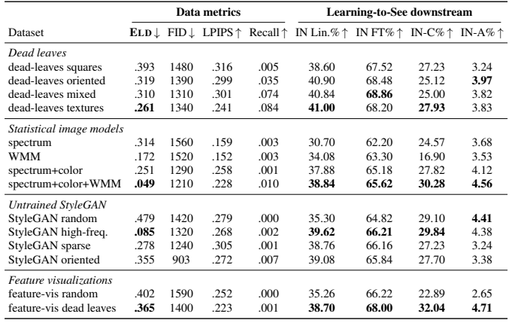
Table 3 :Learning-to-See synthetic-pretraining setting.Dataset metrics and downstream accuracy for the small-scale families from Baradad Jurjo et al. (2021). Evaluation follows the original ImageNet protocol and adds ImageNet-C/A robustness with the same representations.
원문 · CC BY 4.0 · Choi, Ching Lam, Torralba, Antonio, Isola, Phillip, Jegelka, Stefanie · Shaping Useful Noise: Energy Distributions Predict Visual Pretraining Quality · 원문 그림 인용 · 원본 PDF 8쪽에서 그림 영역을 추출했습니다.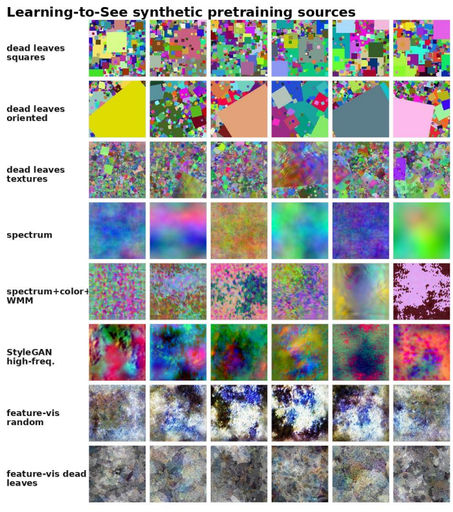
Figure 7 :Learning-to-See synthetic pretraining sources.This grid visualises the range from dead-leaves and statistical textures to untrained StyleGAN and feature-visualization samples; ELD measures how these families populate ImageNet likelihood levels.
원문 · CC BY 4.0 · Choi, Ching Lam, Torralba, Antonio, Isola, Phillip, Jegelka, Stefanie · Shaping Useful Noise: Energy Distributions Predict Visual Pretraining Quality · 원문 그림 인용 · 원본 PDF 17쪽에서 그림 영역을 추출했습니다.추정 선택과 scorer 민감도
또한 수천 개의 채점 샘플 이후 추정치가 안정화된다고 보고합니다. 신경 scorer 민감도 분석에서는 DINO 소스 9개를 각 scorer의 자체 ImageNet 기준으로 다시 보정하여, Guth 기준 순위와 Spearman 0.89에서 0.91로 일치하며 낮은 pELD가 여전히 더 강한 전이와 연관된다고 보고합니다. 이 결과는 시험한 신경 scorer 구성에 대한 안정성 근거이며 임의의 밀도 모델 일반에 대한 증명은 아닙니다.
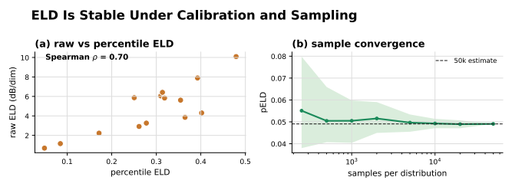
Figure 5 :ELDis robust to estimation choices.Raw and percentile distances agree with a Spearman coefficient of0.7; subsampling shows stable estimates after a few thousand scored samples.
원문 · CC BY 4.0 · Choi, Ching Lam, Torralba, Antonio, Isola, Phillip, Jegelka, Stefanie · Shaping Useful Noise: Energy Distributions Predict Visual Pretraining Quality · 원문 그림 인용 · 원본 PDF 8쪽에서 그림 영역을 추출했습니다.
Table 4 : Neural-scorer sensitivity on the DINO suite. The first column compares dataset rankings; the remaining columns correlate pELD with ImageNet-1K accuracy.
원문 · CC BY 4.0 · Choi, Ching Lam, Torralba, Antonio, Isola, Phillip, Jegelka, Stefanie · Shaping Useful Noise: Energy Distributions Predict Visual Pretraining Quality · 원문 그림 인용 · 원본 PDF 9쪽에서 그림 영역을 추출했습니다.ELD 기반 오프라인 큐레이션
큐레이션 실험은 ELD를 평가 지표에서 샘플 선택 기준으로 바꿉니다. 후보 풀의 샘플을 실제 에너지 백분위로 나누고, 실제 이미지의 에너지 백분위 히스토그램에 맞도록 선택 예산을 배분합니다. 이 방식은 상위 우도 필터링과 같은 예산에서 비교되며, 상위 우도 필터링은 가장 낮은 에너지 후보만 남깁니다. 저자들은 고정된 ImageNet pre-training ResNet 특징으로 평가한 결과, ELD 기준 선택이 균일 선택보다 최근접 거리 진단을 개선하고 효과적 클래스 수와 특징 rank를 높인다고 보고합니다. 다만 이는 matched pretraining 학습이 아닌 오프라인 proxy 진단이며, 전이 성능 향상을 직접 입증하지는 않습니다.
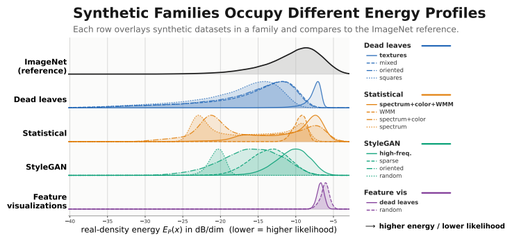
Figure 3 :Energy mismatch is structured.Synthetic sources differ in how they depart from ImageNet: some collapse into narrow high-likelihood bands, others extend into low-likelihood tails, and others remain broad but displaced. Effective synthetic pretraining may require matching the full probability-level profile of natural images, not simply maximising likelihood or feature realism.
원문 · CC BY 4.0 · Choi, Ching Lam, Torralba, Antonio, Isola, Phillip, Jegelka, Stefanie · Shaping Useful Noise: Energy Distributions Predict Visual Pretraining Quality · 원문 그림 인용 · 원본 PDF 4쪽에서 그림 영역을 추출했습니다.
Table 5 : Controlled offline curation from a common source pool at equal selected-set budget. Frozen- feature diagnostics favour ELD-guided selection over uniform and top-likelihood selection. NN denotes the cosine-distance nearest-neighbour diagnostic.
원문 · CC BY 4.0 · Choi, Ching Lam, Torralba, Antonio, Isola, Phillip, Jegelka, Stefanie · Shaping Useful Noise: Energy Distributions Predict Visual Pretraining Quality · 원문 그림 인용 · 원본 PDF 10쪽에서 그림 영역을 추출했습니다.적용 범위와 남은 질문
ELD는 실제 이미지 밀도 모델과 참조 데이터에 의존하므로, 보고 시에는 scorer를 함께 명시해야 합니다. 이 연구는 시각 pre-training에 집중하며, 지도 라벨 효율, 미적 충실도, 사람의 선호, 의미적 coverage와 label 품질을 직접 대체하지 않습니다. 저자들도 ELD를 feature 기반 지표와 함께 쓰는 보완 지표로 제시합니다. 큐레이션 결과는 고정된 특징 기반 proxy이므로 matched pretraining으로 전이 이득을 확인하는 작업이 남아 있습니다.
논문 정보
- 저자
- Choi, Ching Lam, Torralba, Antonio, Isola, Phillip, Jegelka, Stefanie
- 학회·저널
- arXiv · 프리프린트
- 최초 공개일
- 2026년 11월 9일
- 등록일
- 2026년 11월 10일
- 수정일
- 2026년 11월 9일
- 버전
- v1
- arXiv
- 2611.11962
- 분류
- cs.LG · cs.AI · cs.CV
- 원문 이용 조건
- CC BY 4.0
- 제공 범위
- 논문 정보, 해설, 허용된 원문 그림
AI 해설은 논문 원문과 별개의 설명이며 오류가 있을 수 있습니다. 원문과 그림은 각 출처의 이용 조건과 따로 표시된 권리를 따릅니다.
초록
Synthetic data can scale visual pretraining, but current selection criteria only partially explain which datasets train strong representations. We propose using the energy profile of a dataset--the distribution of log-probability levels it occupies under a normalised real-image density model--as an audit and curation principle for synthetic data. To operationalise this view, we introduce Energy-Level Distribution Distance (ELD), which compares real and synthetic energy distributions. Real images span sparse high-likelihood scenes and dense low-likelihood textures, so useful synthetic data should cover this energy range rather than collapse to likely but low-variation samples. Across diverse synthetic datasets, ELD exposes mismatches missed by FID and predicts pretraining performance beyond FID, LPIPS variation, and feature-space recall, including across CNN and ViT self-supervised settings. We then use ELD to resample and mix synthetic sources, matching the real-image energy histogram while preserving diversity and improving downstream transfer.
원문 인용
Choi, Ching Lam, Torralba, Antonio, Isola, Phillip, Jegelka, Stefanie (2026). Shaping Useful Noise: Energy Distributions Predict Visual Pretraining Quality. arXiv:2611.11962v1. https://arxiv.org/abs/2611.11962v1
BibTeX
@misc{lam2026shaping,
  title = {{Shaping Useful Noise: Energy Distributions Predict Visual Pretraining Quality}},
  author = {Choi, Ching Lam and Torralba, Antonio and Isola, Phillip and Jegelka, Stefanie},
  year = {2026},
  eprint = {2611.11962},
  archivePrefix = {arXiv},
  url = {https://arxiv.org/abs/2611.11962v1}
}