논문 해설
Adaptive Protein Tokenization
적응형 단백질 토큰화
- 연구 문제 국소 이웃을 토큰으로 묶는 기존 구조 토크나이저는 생성 오류 누적과 토큰 수의 선형 증가라는 한계를 가집니다.
- 연구 방법 APT는 각 토큰이 전역 구조 정보를 coarse-to-fine으로 더하도록 nested dropout과 확산 디코더를 결합한 적응형 토크나이저입니다.
- 주요 결과 논문은 재구성·생성·표현 과제에서 기존 국소 토크나이저 기반 모델과 대등하거나 나은 결과를 보고하며, 자체 설정의 Table 4에서 설계성 0.871을 보고합니다.
국소 토큰화의 두 가지 한계
단백질 구조를 언어 모델처럼 다루려면 구조를 이산 토큰 시퀀스로 바꾸는 토크나이저가 필요합니다. 기존 구조 토크나이저는 각 토큰이 공간적으로 가까운 국소 이웃의 정보를 풀링하여 만들어지며, 이 방식은 두 가지 문제를 드러냅니다. 첫째, 이런 토큰으로 학습한 생성 모델은 비토큰화 모델보다 크게 뒤처지는데, 이는 한 토큰의 잘못된 샘플링이 예측 구조에 큰 변화를 일으키는 오류 누적 때문이라고 원문은 제시합니다. 둘째, 토큰 수가 단백질 길이에 선형으로 비례하므로 큰 단백질 복합체를 다루는 계산 비용이 커집니다. 이 논문은 이러한 국소성 대신 각 토큰이 전역 문맥을 추가로 담는 전역 토큰화를 제안합니다.
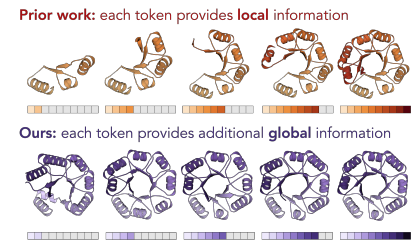
Figure 1 .Prior work uses a single token to represent a local neighborhood around each residue. In our approach, every token provides additional global information, allowing large proteins to be compressed using fewer tokens
원문 · CC BY 4.0 · Rohit Dilip, Ayush Varshney, David Van Valen · Adaptive Protein Tokenization · 원문 그림 인용 · 원본 PDF 1쪽에서 그림 영역을 추출했습니다.APT의 전역 토큰과 확산 디코더
APT는 길이 L의 원시 Cα 좌표를 제로 질량으로 정규화한 뒤 양방향 어텐션 트랜스포머로 잠재 시퀀스 c로 매핑합니다. 이 잠재 값은 레벨 (8,5,5,5)의 유한 스칼라 양자화(FSQ)로 이산화되며, 이산 토큰이 확산 디코더의 조건으로 작동합니다. 디코더는 flow matching 목적으로 학습되어 노이즈가 섞인 좌표의 벡터장을 근사합니다. 적응성을 얻기 위해 상한 컷오프 U(1,...,min(L,k_max))를 무작위로 뽑고 nested dropout을 적용하여, 앞쪽 토큰에 중요한 전역 정보가, 뒤쪽 토큰에 고주파 세부 정보가 놓이도록 유도합니다. 단백질 크기는 첫 토큰에서 회귀되며, 전체 손실은 흐름 손실에 λ_size를 곱한 크기 교차엔트로피 항을 더한 형태입니다.
원문은 λ_size≈0.01을 사용했다고 보고합니다.
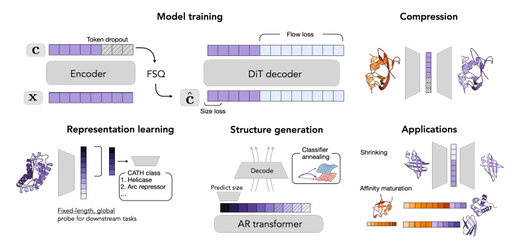
Figure 2 .Overview of our approach.Model training:Raw input coordinates pass through a transformer encoder to create a 1D sequence of conditioning latents. These are discretized and pass condition a diffusion decoder. The noised coordinates are used in a flow loss objective, and the protein size is regressed from the first few latents.Compression:To compress a protein, we encode it and drop tokens from the tail up to a desired reconstruction.Representation learning:Our approach freely provides fixed size, global representations of proteins for downstream tasks, in contrast with most tokenizers that require a mean-pooling operation.Structure generation:During structure generation, we regress the protein size from the first 1-4 tokens, then use the size and conditioning tokens to decode the atomic coordinates. We optionally perform classifier annealing and drop out the tail based on entropy heuristics, providing a scaled method to balance representation fidelity and faithfulness to natural sequences.Applications:Decoupling protein size from conditioning leads to several immediate applications, such as protein miniaturization and affinity maturation.
원문 · CC BY 4.0 · Rohit Dilip, Ayush Varshney, David Van Valen · Adaptive Protein Tokenization · 원문 그림 인용 · 원본 PDF 4쪽에서 그림 영역을 추출했습니다.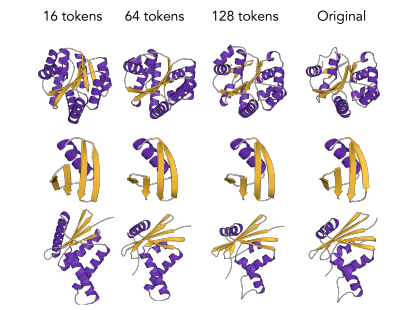
Figure 3 .Reconstructions at varying conditioning strengths, col- ored by secondary structure content. The number of conditioning tokens increases from left to right and by hue. As the number of to- kens increases, more disordered secondary structure emerges. For particularly simple details, 16-32 tokens often captures much of the required resolution. Additional visualizations in Appendix H.
원문 · CC BY 4.0 · Rohit Dilip, Ayush Varshney, David Van Valen · Adaptive Protein Tokenization · 원문 그림 인용 · 원본 PDF 4쪽에서 그림 영역을 추출했습니다.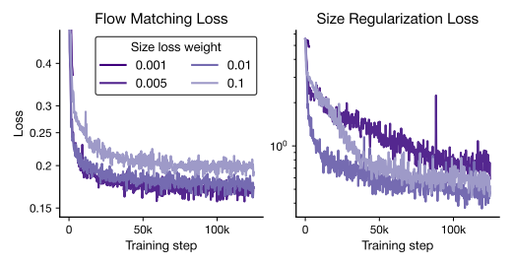
Figure 13 .Flow/size loss for various values of λsize. Setting λsize = 0.1 harms flow loss significantly, but the remaining parameter settings all eventually perform equivalently. ALthough λsize has a large apparent gap in size loss, this generally does not significantly impact performance (e.g., predicting a size of 102 instead of 100).
원문 · CC BY 4.0 · Rohit Dilip, Ayush Varshney, David Van Valen · Adaptive Protein Tokenization · 원문 그림 인용 · 원본 PDF 17쪽에서 그림 영역을 추출했습니다.토큰 절단과 classifier annealing을 이용한 생성
생성에서는 자기회귀 모델이 APT 토큰을 생성하고, 확산 디코더가 그 토큰을 조건으로 구조를 복원합니다. 적응성 덕분에 생성된 시퀀스의 연속된 접두부는 모두 유효한 근사로 쓰일 수 있으므로, 꼬리 토큰을 버리고 고주파 세부 정보를 디코더에 맡길 수 있습니다. 토큰 절단 기준으로는 고정 개수, 토큰별 엔트로피 임계값, 엔트로피 곡선 스플라인의 첫 극소점이 비교됩니다. classifier annealing은 조건부와 비조건부 벡터장을 시간에 따라 보간하는 방식으로, 분자의 노이즈 민감성 때문에 분포 이탈을 줄이려는 목적을 갖습니다. Table 2에서 classifier annealing 설정은 α=0.8로 기술됩니다.
원문은 16개 토큰에서 tail을 버리면 설계성이 0.48이 된다고 보고하고, classifier annealing을 더하면 0.8 이상으로 오른다고 기술합니다.
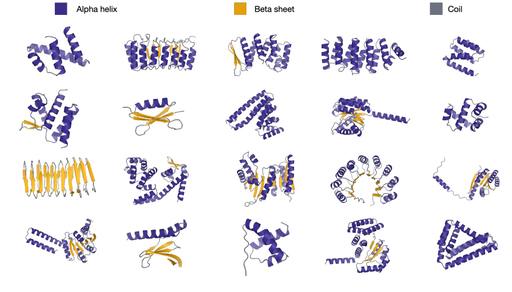
Figure 8 .Samples from APT-AR colored by secondary structure. These visualizations are from finite-entropy based sampling with score annealing (η= 0.3 , max entropy= 2.0). We find that unconditional sampling in this setting replicates known folds (e.g., repeated betas, partial TIM barrels). All samples are designable.
원문 · CC BY 4.0 · Rohit Dilip, Ayush Varshney, David Van Valen · Adaptive Protein Tokenization · 원문 그림 인용 · 원본 PDF 14쪽에서 그림 영역을 추출했습니다.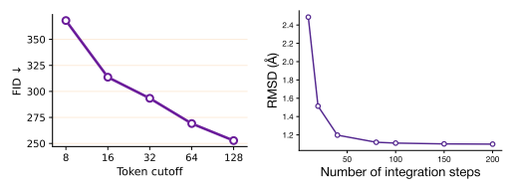
Figure 11 .(Left) gFID vs number of retained tokens. (Right) Reconstruction performance vs number of integration steps.
원문 · CC BY 4.0 · Rohit Dilip, Ayush Varshney, David Van Valen · Adaptive Protein Tokenization · 원문 그림 인용 · 원본 PDF 16쪽에서 그림 영역을 추출했습니다.재구성과 생성 평가의 범위
재구성 평가는 CATH, CAMEO, AFDB의 보류 테스트 세트에서 RMSD, TM-score, rFID로 측정되며 각 세트는 512개 샘플로 계산됩니다. 비교 대상은 DPLM2, ESM3, Kanzi, IST, FoldToken입니다. 원문은 전체 tail을 쓴 경우 최상위 모델과의 차이가 RMSD 0.1 Å 미만, TM-score 0.01 미만이라고 보고하고, 128 토큰 설정은 전체 tail보다 재구성이 약하다고 기술합니다. 생성 평가에서는 설계성(scRMSD<2 Å 샘플 비율)과 분포 지표를 사용하며, 자기회귀 모델은 Table 4에서 설계성 0.871, scRMSD 1.352를 보고합니다. 같은 표에서 Kanzi는 0.562, DPLM2는 0.486으로 기술됩니다.
이 수치는 저자가 자체 설정으로 얻은 결과이며, 다른 비교 모델의 조건과 일치하는지는 해당 실험 조건을 함께 확인해야 합니다.
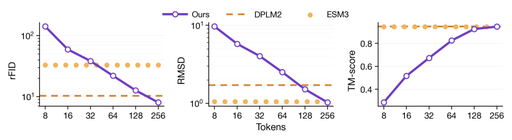
Figure 4 .Impact of the number of tokens on reconstruction quality. We compare against DPLM-2 and ESM-3, the two other tokenized models that demonstrate generative capabilities. Across rFID (left), RMSD (center), and TMscore (right), all metrics improve with additional tokens. The x-axis is the maximum number of tokens used; e.g., for 32 tokens, APT uses at most 20 tokens to encode a protein of length 20.
원문 · CC BY 4.0 · Rohit Dilip, Ayush Varshney, David Van Valen · Adaptive Protein Tokenization · 원문 그림 인용 · 원본 PDF 6쪽에서 그림 영역을 추출했습니다.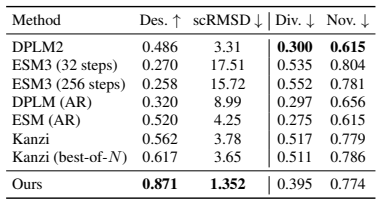
Table 4 .Generative metrics. An autoregressive model trained on APT tokens outperforms other discrete sequence models and approaches the performance of state-of-the-art diffusion models. We compare against discrete diffusion models (DPLM2, ESM3), third-party autoregressive checkpoints trained using the structure tokenizers, and autoregressive models trained using local diffusion decoders (Kanzi). We also compare against best-of-N performance (k=4) to demonstrate the upper limit in autoregressive performance. See Appendix M for details.
원문 · CC BY 4.0 · Rohit Dilip, Ayush Varshney, David Van Valen · Adaptive Protein Tokenization · 원문 그림 인용 · 원본 PDF 7쪽에서 그림 영역을 추출했습니다.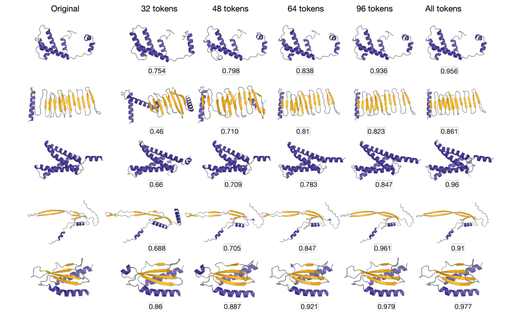
Figure 10 .Reconstructions with ground truths on the far left and increasing number of conditioning tokens from left to right. We list TMscores against the original below each reconstruction.
원문 · CC BY 4.0 · Rohit Dilip, Ayush Varshney, David Van Valen · Adaptive Protein Tokenization · 원문 그림 인용 · 원본 PDF 15쪽에서 그림 영역을 추출했습니다.고정 크기 표현과 CATH 프로빙
APT는 토큰 수를 고정하면 어떤 길이의 단백질도 고정 크기 표현으로 바꿀 수 있어, 평균 풀링 없이 표현을 얻습니다. 최대 128 토큰과 5개 층 설정에서 표현 차원은 640으로 보고됩니다. CATH 토폴로지 분류에서 선형 프로브는 ESM3와 DPLM2보다 약하지만, MLP 프로브는 두 모델보다 강한 성능을 보입니다. 저자들은 비등변 자동인코더가 자세와 구조를 얽어 놓아 선형 분리가 어렵다고 해석하며, 비선형성이 전역 임베딩을 추출하는 데 충분하다고 설명합니다. 이 결과는 CATH 토폴로지 과제에 한정되며, 국소 프로빙에 대한 성능은 원문에서 평가되지 않았다고 저자들이 밝힙니다.
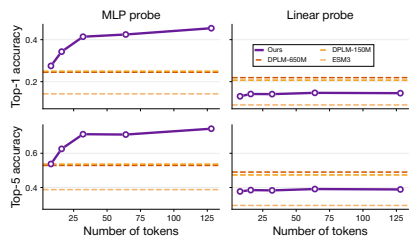
Figure 5 .MLP (left) and linear probing (right) results on the CATH-T classification task. We plot top-1 (top) and top-5 (bottom) accuracy. An MLP probe outperforms probing using DPLM2 and ESM3. A linear probe results in weak performance. Our approach provides a convenient way to acquire fixed size representations without squashing information through a mean-pool.
원문 · CC BY 4.0 · Rohit Dilip, Ayush Varshney, David Van Valen · Adaptive Protein Tokenization · 원문 그림 인용 · 원본 PDF 7쪽에서 그림 영역을 추출했습니다.한계와 조건부 결과
저자들은 APT 토큰이 전역 과제에는 유용하지만 motif scaffolding 같은 국소 과제에는 효과가 없다고 명시합니다. 또한 학습 목적인 flow loss가 감소해도 RMSD가 증가하는 구간이 관찰되었으며, 이는 노이즈 스케줄이 재구성에 최적이 아닐 가능성으로 해석됩니다. 재구성 성능은 목표로 최적화되지 않으며 하위 생성 성능의 필요조건으로만 취급됩니다. 생성 결과에서는 α를 낮추고 토큰을 과도하게 버리면 분포가 붕괴하거나 설계성이 인위적으로 높아질 수 있다는 점이 원문에서 지적됩니다.
논문 정보
- 저자
- Rohit Dilip, Ayush Varshney, David Van Valen
- 학회·저널
- arXiv · 프리프린트
- 최초 공개일
- 2026년 2월 6일
- 등록일
- 2026년 10월 30일
- 수정일
- 2026년 2월 6일
- 버전
- v1
- arXiv
- 2602.06418
- 분류
- cs.LG · q-bio.BM
- 원문 이용 조건
- CC BY 4.0
- 제공 범위
- 논문 정보, 해설, 허용된 원문 그림
AI 해설은 논문 원문과 별개의 설명이며 오류가 있을 수 있습니다. 원문과 그림은 각 출처의 이용 조건과 따로 표시된 권리를 따릅니다.
초록
Tokenization is a promising path to multi-modal models capable of jointly understanding protein sequences, structure, and function. Existing protein structure tokenizers create tokens by pooling information from local neighborhoods, an approach that limits their performance on generative and representation tasks. In this work, we present a method for global tokenization of protein structures in which successive tokens contribute increasing levels of detail to a global representation. This change resolves several issues with generative models based on local protein tokenization: it mitigates error accumulation, provides embeddings without sequence-reduction operations, and allows task-specific adaptation of a tokenized sequence's information content. We validate our method on reconstruction, generative, and representation tasks and demonstrate that it matches or outperforms existing models based on local protein structure tokenizers. We show how adaptive tokens enable inference criteria based on information content, which boosts designability. We validate representations generated from our tokenizer on CATH classification tasks and demonstrate that non-linear probing on our tokenized sequences outperforms equivalent probing on representations from other tokenizers. Finally, we demonstrate how our method supports zero-shot protein shrinking and affinity maturation.
원문 인용
Rohit Dilip, Ayush Varshney, David Van Valen (2026). Adaptive Protein Tokenization. arXiv:2602.06418v1. https://arxiv.org/abs/2602.06418v1
BibTeX
@misc{dilip2026adaptive,
  title = {{Adaptive Protein Tokenization}},
  author = {Rohit Dilip and Ayush Varshney and David Van Valen},
  year = {2026},
  eprint = {2602.06418},
  archivePrefix = {arXiv},
  url = {https://arxiv.org/abs/2602.06418v1}
}