논문 해설
Neural sentence embedding models for semantic similarity estimation in the biomedical domain
생의학 분야에서 의미 유사도 추정을 위한 신경망 문장 임베딩 모델
- 연구 문제 생의학 문장 유사도 추정에서 온톨로지 없이 대규모 텍스트로 학습한 신경망 문장 임베딩이 기존 최신 방법과 견줄 만한지 검토합니다.
- 연구 방법 fastText, Sent2Vec, Skip-thoughts, Paragraph Vector를 PMC Open Access 말뭉치로 학습하고 BIOSSES 문장 쌍에서 코사인 유사도와 Pearson 상관으로 평가합니다.
- 주요 결과 비지도 PV-DM은 r = 0.819, 문자열 지표와 임베딩을 결합한 감독 모델은 r = 0.871을 보였습니다. 모순 예비 실험에서는 부정과 반의어 쌍의 평균 유사도가 고유사도 쌍보다 높게 나타났습니다.
온톨로지 없이 문장 유사도를 추정할 수 있는가
생의학 문장 쌍의 의미 유사도를 추정하는 기존 강력한 방법들은 사람이 공들여 만든 온톨로지 같은 지식 자원에 의존해 왔습니다. 이런 자원은 만드는 데 시간이 많이 들고 오류가 생기기 쉽습니다. 이 연구는 대규모 텍스트만으로 학습하는 신경망 문장 임베딩이 이런 온톨로지 기반 최신 방법과 견줄 만한지를 BIOSSES 벤치마크에서 확인합니다. 이어서 같은 임베딩이 의미상 모순되는 문장 쌍을 구별할 수 있는지도 작은 예비 실험으로 살펴봅니다.
벤치마크와 학습 말뭉치
BIOSSES는 생의학 문장 쌍 100개로 구성됩니다. 각 쌍은 다섯 명의 전문가가 0부터 4까지 평가한 점수를 평균한 값을 가집니다. 임베딩 학습에는 2017년 11월 기준 PMC Open Access 하위 집합이 사용되며, 이 말뭉치는 170만 편을 넘는 논문을 포함합니다. 학습 전에 말뭉치는 한 줄에 한 문장이 되도록 나뉘고, 표 내용 등으로 생긴 과도하게 긴 줄을 걸러 내며, 하이픈으로 연결된 복합어를 분리하는 후처리를 거칩니다.
임베딩 모델과 코사인 유사도 계산
연구는 fastText, Sent2Vec, Skip-thoughts, Paragraph Vector를 같은 말뭉치로 학습해 비교합니다. fastText는 단어 벡터를 skip-gram 또는 C-BOW로 학습한 뒤, 문장 안 단어 벡터들을 max, min, sum 또는 average 풀링으로 묶어 문장 벡터를 만듭니다. Sent2Vec은 C-BOW를 문장 단위로 확장한 모델이며, Skip-thoughts는 RNN으로 현재 문장에서 앞뒤 문장을 예측하도록 학습합니다. Paragraph Vector의 PV-DM은 문단 벡터와 앞선 단어 벡터들의 연결로 다음 단어를 예측하며, 이 논문에서는 100차원 PV-DM을 학습했습니다.
두 문장 벡터의 Cosine similarity는 벡터 사이 각도의 코사인 값으로 계산되며, 이것이 문장 쌍의 예측 유사도가 됩니다.
문자열 유사도와 감독 결합 모델
Jaccard index는 두 문장의 고유 단어 집합에서 교집합 크기를 합집합 크기로 나눈 값입니다. Q-gram similarity는 두 문자열이 공유하는 q-gram의 수를 기준으로 계산합니다. 감독 모델은 이런 문자열 유사도와 임베딩 기반 유사도를 입력 특성으로 삼아 linear regression으로 평균 사람 평가 점수를 예측합니다. 따라서 감독 모델의 출력은 임베딩 자체가 아니라 여러 유사도 점수를 학습한 결합 결과입니다.
BIOSSES에서의 상관 결과
비지도 모델 가운데 PV-DM은 Pearson correlation 기준 r = 0.819를 얻었으며, 이는 BIOSSES에서 이전에 보고된 최고 결과를 넘습니다. 이 PV-DM은 200자 미만 줄로 필터링한 말뭉치로 학습되었습니다. Sent2Vec은 r = 0.798, PV-DBOW는 r = 0.804를 보였습니다. fastText는 skip-gram에서 0.766, C-BOW에서 0.253으로 큰 차이를 보였고, 저자들은 이 차이를 희소 단어를 다루는 방식의 차이로 해석합니다. 감독 결합 모델은 Jaccard, Q-gram, Sent2Vec, PV-DM, Skip-thoughts, fastText를 결합해 r = 0.871을 기록했습니다.
이 수치들은 모두 BIOSSES 100쌍에서 측정한 값입니다.
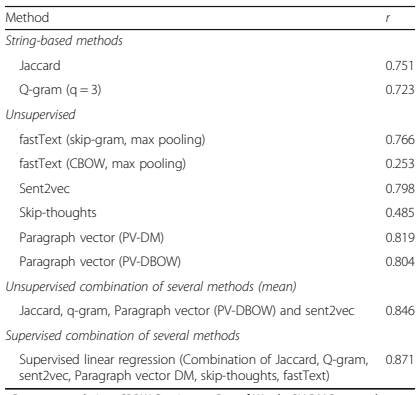
Table 1 Highest correlation coefficients obtained with different methods
원문 · CC BY 4.0 · Kathrin Blagec, Hong Xu, Asan Agibetov, Matthias Samwald · Neural sentence embedding models for semantic similarity estimation in the biomedical domain · 원문 그림 인용 · 원본 PDF 2쪽에서 그림 영역을 추출했습니다.모순 부분집합에서의 예비 결과
모순 검토는 수작업으로 만든 작은 부분집합으로 진행되었습니다. 부정 부분집합은 13쌍이며 두 번째 문장이 첫 번째 문장을 부정합니다. 반의어 부분집합은 7쌍이며 핵심 단어를 반의어로 바꾸었습니다. 비교 기준은 사람 점수가 3.5 이상인 고유사도 문장 11쌍입니다. 모든 모델에서 부정 쌍과 반의어 쌍의 평균 코사인 유사도가 고유사도 쌍보다 높게 나타났습니다. 예를 들어 PV-DM은 고유사도 쌍에서 0.652, 부정 쌍에서 0.930, 반의어 쌍에서 0.968을 보였습니다. 표본이 작아 통계 검정은 수행하지 않았습니다.

Table 3 Average estimated cosine similarities for sentence pairs included in the negation and antonym subset and a reference set of highly similar sentences per model. Lower values indicate lower estimated semantic similarity; higher values indicate higher estimated semantic similarities
원문 · CC BY 4.0 · Kathrin Blagec, Hong Xu, Asan Agibetov, Matthias Samwald · Neural sentence embedding models for semantic similarity estimation in the biomedical domain · 원문 그림 인용 · 원본 PDF 4쪽에서 그림 영역을 추출했습니다.적용 범위와 남은 질문
BIOSSES 결과는 100쌍과 다섯 전문가 평균 점수에 기반합니다. 모순 부분집합은 작고 간단한 구문의 문장만 골라 만든 예비 실험이므로, 최고 모델들이 이 부분집합에서 낮은 성능을 보였다는 결과도 넓게 일반화하기 어렵습니다. 연구는 생의학 질의응답 같은 외부 과제에서의 평가를 다루지 않았으며, 저자들은 이 평가가 다음 단계라고 제안합니다.
논문 정보
- 저자
- Kathrin Blagec, Hong Xu, Asan Agibetov, Matthias Samwald
- 학회·저널
- arXiv · 프리프린트
- 최초 공개일
- 2021년 10월 1일
- 등록일
- 2026년 11월 6일
- 수정일
- 2021년 10월 1일
- 버전
- v1
- arXiv
- 2110.15708
- DOI
- 10.1186/s12859-019-2789-2
- 분류
- cs.CL
- 원문 이용 조건
- CC BY 4.0
- 제공 범위
- 논문 정보, 해설, 허용된 원문 그림
AI 해설은 논문 원문과 별개의 설명이며 오류가 있을 수 있습니다. 원문과 그림은 각 출처의 이용 조건과 따로 표시된 권리를 따릅니다.
초록
BACKGROUND: In this study, we investigated the efficacy of current state-of-the-art neural sentence embedding models for semantic similarity estimation of sentences from biomedical literature. We trained different neural embedding models on 1.7 million articles from the PubMed Open Access dataset, and evaluated them based on a biomedical benchmark set containing 100 sentence pairs annotated by human experts and a smaller contradiction subset derived from the original benchmark set. RESULTS: With a Pearson correlation of 0.819, our best unsupervised model based on the Paragraph Vector Distributed Memory algorithm outperforms previous state-of-the-art results achieved on the BIOSSES biomedical benchmark set. Moreover, our proposed supervised model that combines different string-based similarity metrics with a neural embedding model surpasses previous ontology-dependent supervised state-of-the-art approaches in terms of Pearson's r (r=0.871) on the biomedical benchmark set. In contrast to the promising results for the original benchmark, we found our best models' performance on the smaller contradiction subset to be poor. CONCLUSIONS: In this study we highlighted the value of neural network-based models for semantic similarity estimation in the biomedical domain by showing that they can keep up with and even surpass previous state-of-the-art approaches for semantic similarity estimation that depend on the availability of laboriously curated ontologies when evaluated on a biomedical benchmark set. Capturing contradictions and negations in biomedical sentences, however, emerged as an essential area for further work.
원문 인용
Kathrin Blagec, Hong Xu, Asan Agibetov, Matthias Samwald (2021). Neural sentence embedding models for semantic similarity estimation in the biomedical domain. arXiv:2110.15708v1. https://doi.org/10.1186/s12859-019-2789-2
BibTeX
@article{blagec2021neural,
  title = {{Neural sentence embedding models for semantic similarity estimation in the biomedical domain}},
  author = {Kathrin Blagec and Hong Xu and Asan Agibetov and Matthias Samwald},
  year = {2021},
  eprint = {2110.15708},
  archivePrefix = {arXiv},
  doi = {10.1186/s12859-019-2789-2},
  url = {https://arxiv.org/abs/2110.15708v1}
}