논문 해설
Black-Box Combinatorial Optimization with Order-Invariant Reinforcement Learning
순서 불변 강화학습을 이용한 블랙박스 조합 최적화
- 연구 문제 기존 다변량 EDA는 변수 간 의존성을 담는 DAG를 반복 학습해야 하므로 비용이 크고 복잡한 상호작용을 효율적으로 담기 어렵습니다. 이 논문은 이산 블랙박스 조합 최적화에서 순서 불변 신경 생성 모델을 강화학습으로 학습하는 방법을 다룹니다.
- 연구 방법 생성 순서와 학습 순서를 무작위로 샘플링하는 순서 불변 강화학습 EDA를 제안합니다. 학습 단계의 순서 무작위화는 구조적 입력 드롭아웃으로 작동하며, 모집단 내 순위에서 계산한 스케일 불변 이점과 KL 벌점 PPO 형태의 갱신을 사용합니다.
- 주요 결과 NK(N=256, K=4) 변형 비교에서 생성·학습 순서를 모두 무작위로 한 (σ, σ)-RL-EDA가 가장 높은 점수를 보였습니다. 큰 인스턴스의 QUBO, NK, NK3 및 NAS-Bench-101 비교에서 여러 설정의 최고 성능이 보고되었으며, 짧은 예산에서는 한계가 확인되었습니다.
문제 설정: 블랙박스 조합 최적화와 EDA의 한계
이 논문은 구조 정보 없이 평가만 가능한 이산 블랙박스 조합 최적화 문제를 다룹니다. 목적함수 f는 각 평가가 비용이 크고 변수 간 상호작용이 주어지지 않으므로, 탐색 과정에서 변수 간 의존성을 얼마나 효율적으로 포착하느냐가 중요합니다. 기존 다변량 추정 분포 알고리즘(EDA)은 변수 의존성을 나타내는 방향 비순환 그래프(DAG)를 반복적으로 학습해야 하며, 이는 구조 학습 비용이 크고 복잡한 상호작용을 효율적으로 담기 어렵다는 문제를 가집니다. 저자들은 이 지점에서 그래프를 명시적으로 학습하지 않고 신경망 자기회귀 모델로 결합 분포를 직접 매개변수화하는 접근을 제안합니다.
순서 불변 강화학습 기반 EDA의 구성
제안 방법은 해 x를 변수들의 생성 순서 σ에 따라 한 변수씩 샘플링하는 에피소드형 MDP로 봅니다. 각 단계의 정책은 이미 생성된 변수들만 입력으로 받는 신경망이며, 이를 위해 아직 생성되지 않은 변수는 인과 마스크로 가립니다. 핵심은 생성 순서를 고정하지 않고 매 개체마다 균등 분포에서 무작위로 뽑고, 학습 단계에서는 다른 학습 순서 σT를 다시 샘플링해 같은 개체를 다른 조건부 문맥으로 학습시키는 점입니다. 이 과정은 입력의 구조적 드롭아웃으로 해석되며, 저자들은 이를 정칙화와 결합 분포 정보 보존의 근거로 제시합니다. 정책 갱신은 PPO의 KL 벌점 형태를 따르며, 이점(advantage)은 평가값의 절댓값 대신 모집단 내 순위에 utility 함수 U를 적용해 계산합니다.
이 순위 기반 이점은 목적함수의 단조 변환에 불변인 성질을 가진다고 저자들이 설명하며, 이 연결을 IGO 프레임워크와 함께 논의합니다.
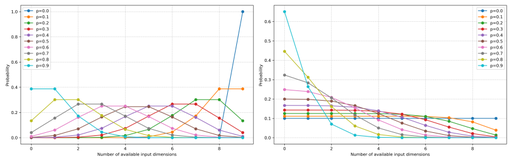
Figure 4 .Probability of having exactly k available (non-masked) input variables during neural inference of the generation probabilities of values for any dimension. Left: input dropout without order permutations. Right: input dropout combined with order permutations.
원문 · CC BY 4.0 · Goudet, Olivier, Suire, Quentin, Goëffon, Adrien, Saubion, Frédéric, Lamprier, Sylvain · Black-Box Combinatorial Optimization with Order-Invariant Reinforcement Learning · 원문 그림 인용 · 원본 PDF 20쪽에서 그림 영역을 추출했습니다.변형 비교와 NK 인스턴스에서의 검증
저자들은 생성 순서와 학습 순서를 각각 고정하거나 무작위로 바꾼 네 가지 변형, 그리고 학습된 Plackett-Luce 순서 변형을 비교합니다. 이 비교는 N=256, K=4인 NK 인스턴스에서 100회 독립 실행의 평균 점수로 수행되었습니다. 결과에서 생성 순서와 학습 순서를 모두 무작위로 바꾼 (σ, σ)-RL-EDA가 가장 높은 수렴 점수를 보였고, 학습 순서만 무작위화한 변형과 비교해 학습 단계의 순서 무작위화가 중요하다고 해석됩니다. 학습된 순서 분포 변형은 할당된 예산 안에서 수렴하지 못했습니다. 부록의 구조적 드롭아웃 실험에서도 (σ, σ)-RL-EDA의 평균 점수 0.753이 다른 최선의 드롭아웃 변형 0.747보다 통계적으로 유의하게 높다고 보고됩니다.
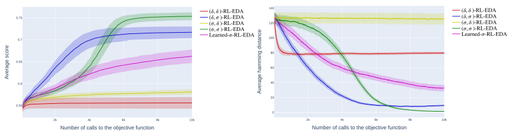
Figure 1 .X-axis: number of calls to the objective function. Y-axis: Evolution of average scores (a) and average distances (b) obtained by the different variants of multivariate RL EDA for 100 independent runs on instances of the NK problem withN= 256andK= 4.
원문 · CC BY 4.0 · Goudet, Olivier, Suire, Quentin, Goëffon, Adrien, Saubion, Frédéric, Lamprier, Sylvain · Black-Box Combinatorial Optimization with Order-Invariant Reinforcement Learning · 원문 그림 인용 · 원본 PDF 7쪽에서 그림 영역을 추출했습니다.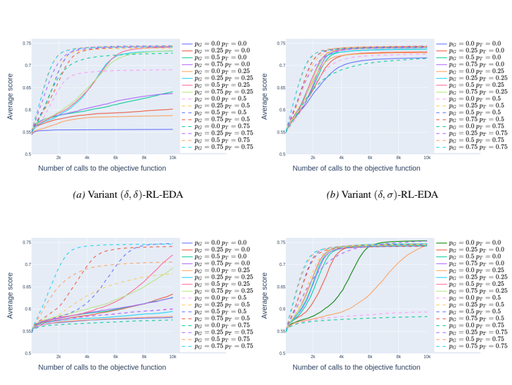
Figure 8 .Evolution of the average scores w.r.t. the number of calls to the objective function, obtained by the four different versions of the multivariate RL EDA with additional structural dropout for sampling and training for the instances of the NK landscape problem with N= 256andK= 4.
원문 · CC BY 4.0 · Goudet, Olivier, Suire, Quentin, Goëffon, Adrien, Saubion, Frédéric, Lamprier, Sylvain · Black-Box Combinatorial Optimization with Order-Invariant Reinforcement Learning · 원문 그림 인용 · 원본 PDF 33쪽에서 그림 영역을 추출했습니다.QUBO, NK3, NAS-Bench-101에서의 벤치마크 결과
대규모 비교에서 (σ, σ)-RL-EDA는 Nevergrad의 알고리즘과 PBIL, MIMIC, BOA를 포함한 503개 알고리즘과 비교되었습니다. 평가 예산은 목적함수 10,000회이며, 인스턴스 크기 n=128과 n=256의 결과에서 여러 문제에 걸쳐 자주 최고 성능을 얻는다고 보고됩니다. 같은 비교에서 PBIL은 EDA 중 가장 좋은 결과를 보였으며, (σ, σ)-RL-EDA는 세 EDA보다 큰 인스턴스에서 일관되게 우수했습니다. NAS-Bench-101 평가에서는 1,000회와 10,000회 예산 모두에서 최고 평균 정확도를 얻었다고 보고됩니다. 다만 이 결과들은 각 실험의 예산·인스턴스 설정 안에서 측정된 것이며, 다른 과제로 확대된 결과가 아닙니다.
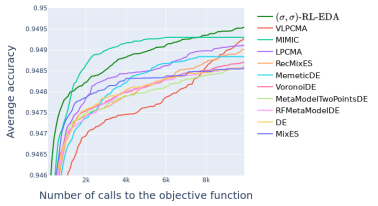
Figure 3 .NAS-Bench-101 benchmark. X-axis: number of calls to the objective function. Y-axis: Evolution of the average accuracy of the architectures.
원문 · CC BY 4.0 · Goudet, Olivier, Suire, Quentin, Goëffon, Adrien, Saubion, Frédéric, Lamprier, Sylvain · Black-Box Combinatorial Optimization with Order-Invariant Reinforcement Learning · 원문 그림 인용 · 원본 PDF 8쪽에서 그림 영역을 추출했습니다.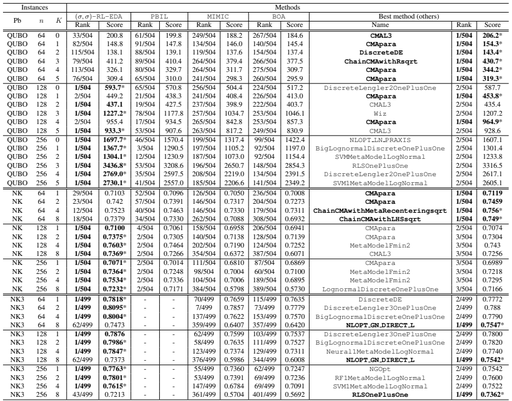
Table 4 .Global rankings and average scores obtained by (σ, σ)-RL-EDAand the other EDAs (PBIL, MIMIC, and BOA) are reported. The last columns present the ranking and average score of the best-performing method among the 500 additional algorithms considered (496 for NK3 problems). Rankings are computed over all 504 algorithms (499 for NK3 problems) by comparing the best score achieved after 10,000 objective function evaluations, averaged across 100 independent runs. Bold values highlight the best results among all competing methods. A star associated the results obtain by (σ, σ)-RL-EDAindicates that it is significantly better in average (over 100 runs) than the best other competitor. A star associated with a result obtain by an other algorithm indicates that it is significantly better in average (over 100 runs) than (σ, σ)-RL-EDA. A difference on the average scores is said statistically significant according to a t-test with p-value 0.001.
원문 · CC BY 4.0 · Goudet, Olivier, Suire, Quentin, Goëffon, Adrien, Saubion, Frédéric, Lamprier, Sylvain · Black-Box Combinatorial Optimization with Order-Invariant Reinforcement Learning · 원문 그림 인용 · 원본 PDF 30쪽에서 그림 영역을 추출했습니다.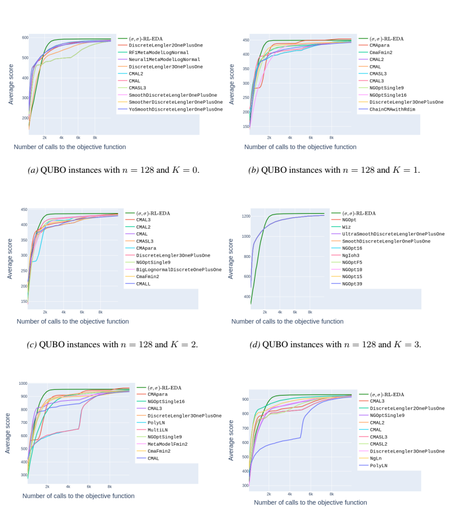
Figure 6 .Evolution of the average scores w.r.t. the number of calls to the objective function obtained by (σ, σ)-RL-EDAand the best 10 other competitors for the different type of QUBO instances withn= 128.
원문 · CC BY 4.0 · Goudet, Olivier, Suire, Quentin, Goëffon, Adrien, Saubion, Frédéric, Lamprier, Sylvain · Black-Box Combinatorial Optimization with Order-Invariant Reinforcement Learning · 원문 그림 인용 · 원본 PDF 31쪽에서 그림 영역을 추출했습니다.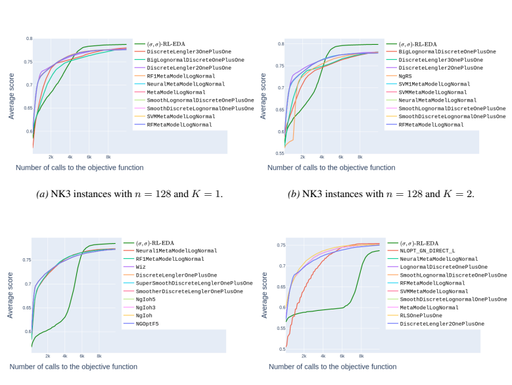
Figure 7 .Evolution of the average scores w.r.t. the number of calls to the objective function obtained by (σ, σ)-RL-EDAand the best 10 other competitors for the different type of NK3 instances withn= 128.
원문 · CC BY 4.0 · Goudet, Olivier, Suire, Quentin, Goëffon, Adrien, Saubion, Frédéric, Lamprier, Sylvain · Black-Box Combinatorial Optimization with Order-Invariant Reinforcement Learning · 원문 그림 인용 · 원본 PDF 32쪽에서 그림 영역을 추출했습니다.수렴 속도와 높은 상호작용 인스턴스에서의 한계
제안 방법은 짧은 예산에서 약점을 보입니다. 목적함수 1,000회 평가 이후의 결과에서는 다른 알고리즘에 뒤처지며, 이는 다양성을 유지하려는 설계 때문에 수렴이 느린 것으로 저자들이 설명합니다. NK3 인스턴스에서 K=8인 경우에는 할당된 예산 안에서 수렴하지 못해 해당 분포의 성능이 낮습니다. 학습 가능한 Plackett-Luce 순서 변형도 같은 예산에서 수렴하지 못했습니다. 저자들은 후속 과제로 짧은 예산에 맞춘 커리큘럼 적응을 부록에서 다루며, 초기 예산 실험에서 Fast 변형이 일부 인스턴스에서 좋은 결과를 보였다고 보고합니다.
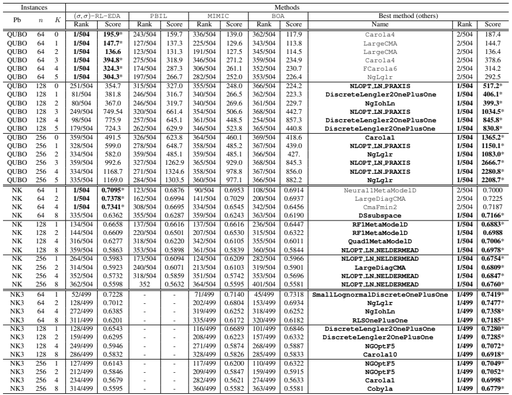
Table 5 .Global rankings and average scores obtained by (σ, σ)-RL-EDAand the other EDAs (PBIL, MIMIC, and BOA) are reported. The last columns present the ranking and average score of the best-performing method among the 500 additional algorithms considered (496 for NK3 problems). Rankings are computed over all 504 algorithms (499 for NK3 problems) by comparing the best score achieved with short budget after 1,000 objective function evaluations, averaged across 100 independent runs. Bold values highlight the best results among all competing methods. A star associated with the results obtained by (σ, σ)-RL-EDAindicates that it is significantly better in average (over 100 runs) than the best other competitor. A star associated with a result obtained by an other algorithm indicates that it is significantly better in average (over 100 runs) than (σ, σ)-RL-EDA. A difference on the average scores is said statistically significant according to a t-test with p-value 0.001.
원문 · CC BY 4.0 · Goudet, Olivier, Suire, Quentin, Goëffon, Adrien, Saubion, Frédéric, Lamprier, Sylvain · Black-Box Combinatorial Optimization with Order-Invariant Reinforcement Learning · 원문 그림 인용 · 원본 PDF 39쪽에서 그림 영역을 추출했습니다.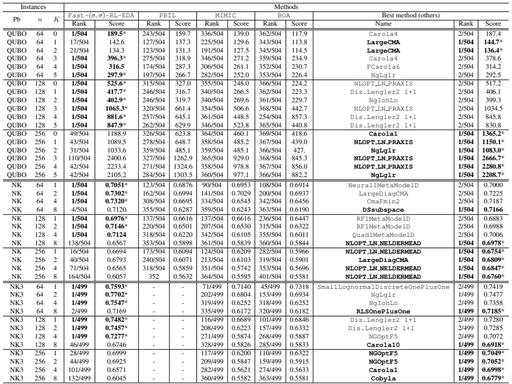
Table 6 .Global rankings and average scores obtained by Fast-(σ, σ)-RL-EDAand the other EDAs (PBIL, MIMIC, and BOA) are reported. The last columns present the ranking and average score of the best-performing method among the 500 additional algorithms considered (496 for NK3 problems). Rankings are computed over all 504 algorithms (499 for NK3 problems) by comparing the best score achievedwith short budget after 1,000 objective function evaluations, averaged across 100 independent runs. Bold values highlight the best results among all competing methods. A star associated the results obtain by Fast-(σ, σ)-RL-EDAindicates that it is significantly better in average (over 100 runs) than the best other competitor. A star associated with a result obtained by an other algorithm indicates that it is significantly better in average (over 100 runs) thanFast-(σ, σ)-RL-EDA. A difference on the average scores is said statistically significant according to a t-test with p-value 0.001.
원문 · CC BY 4.0 · Goudet, Olivier, Suire, Quentin, Goëffon, Adrien, Saubion, Frédéric, Lamprier, Sylvain · Black-Box Combinatorial Optimization with Order-Invariant Reinforcement Learning · 원문 그림 인용 · 원본 PDF 41쪽에서 그림 영역을 추출했습니다.논문 정보
- 저자
- Goudet, Olivier, Suire, Quentin, Goëffon, Adrien, Saubion, Frédéric, Lamprier, Sylvain
- 학회·저널
- arXiv · 프리프린트
- 최초 공개일
- 2025년 10월 2일
- 등록일
- 2026년 10월 30일
- 수정일
- 2026년 1월 29일
- 버전
- v2
- arXiv
- 2510.01824
- 원문 이용 조건
- CC BY 4.0
- 제공 범위
- 논문 정보, 해설, 허용된 원문 그림
AI 해설은 논문 원문과 별개의 설명이며 오류가 있을 수 있습니다. 원문과 그림은 각 출처의 이용 조건과 따로 표시된 권리를 따릅니다.
초록
We introduce an order-invariant reinforcement learning framework for black-box combinatorial optimization. Classical estimation-of-distribution algorithms (EDAs) often rely on learning explicit variable dependency graphs, which can be costly and fail to capture complex interactions efficiently. In contrast, we parameterize a multivariate autoregressive generative model trained without a fixed variable ordering. By sampling random generation orders during training, a form of information-preserving dropout, the model is encouraged to be invariant to variable order, promoting search-space diversity, and shaping the model to focus on the most relevant variable dependencies, improving sample efficiency. We adapt Group Relative Policy Optimization (GRPO) to this setting, providing stable policy-gradient updates from scale-invariant advantages. Across a wide range of benchmark algorithms and problem instances of varying sizes, our method frequently achieves the best performance and consistently avoids catastrophic failures.
원문 인용
Goudet, Olivier, Suire, Quentin, Goëffon, Adrien, Saubion, Frédéric, Lamprier, Sylvain (2025). Black-Box Combinatorial Optimization with Order-Invariant Reinforcement Learning. arXiv:2510.01824v2. https://arxiv.org/abs/2510.01824v2
BibTeX
@misc{olivier2025black,
  title = {{Black-Box Combinatorial Optimization with Order-Invariant Reinforcement Learning}},
  author = {Goudet, Olivier and Suire, Quentin and Goëffon, Adrien and Saubion, Frédéric and Lamprier, Sylvain},
  year = {2025},
  eprint = {2510.01824},
  archivePrefix = {arXiv},
  url = {https://arxiv.org/abs/2510.01824v2}
}