논문 해설
Equivariant Neural Networks for General Linear Symmetries on Lie Algebras
리 대수 위의 일반 선형 대칭을 위한 등변 신경망
- 연구 문제 많은 과학·기하 문제가 GL(n) 같은 비컴팩트 선형 대칭을 갖지만, 기존 등변 신경망은 주로 컴팩트 군에 맞춰져 있습니다.
- 연구 방법 gl(n) 위에서 비퇴화 Ad-불변 쌍선형 형식을 구성하고, 이를 이용한 선형·비선형·풀링 층으로 수반 등변 백본을 만듭니다.
- 주요 결과 플라톤 분류, sp(4) 회귀, 드론 상태 추정, 3DGS, 이중 진자 벤치마크에서 기준선과 비교한 결과가 보고됩니다.
풀려는 문제: 비가환 선형 대칭과 비퇴화 불변 형식
많은 과학·기하 문제는 GL(n) 같은 비컴팩트 선형 대칭을 가지지만, 기존 등변 신경망은 주로 컴팩트 군이나 단순한 벡터 특징에 맞춰져 있습니다. 이 논문은 공분산, 관성, 형상 텐서처럼 행렬 값 데이터를 직접 다루는 등변 구조를 목표로 합니다. 핵심 장애는 gl(n)이 리 대수로서 reductive이지만 semisimple이 아니라는 점입니다. gl(n)=RI⊕sl(n)에서 중심 RI 위의 Killing form이 퇴화하므로, 반단순 대수에서 쓰던 불변 스칼라와 비선형 연산의 기반이 사라집니다.
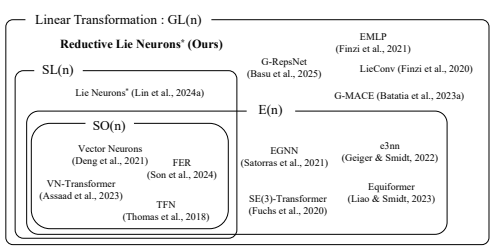
Figure 2 : A taxonomy of selected representative equivariant neural architectures, categorized by the symmetries to which they are equivariant. This diagram situates our work, ReLNs, among other notable methods that are often specialized for subgroups such as SL(n), SO(n), or the Euclidean group E(n). An asterisk (∗) denotes methods equivariant to the group’s adjoint action.
원문 · CC BY 4.0 · Kim, Chankyo, Zhao, Sicheng, Zhu, Minghan, Lin, Tzu-Yuan, Ghaffari, Maani · Equivariant Neural Networks for General Linear Symmetries on Lie Algebras · 원문 그림 인용 · 원본 PDF 3쪽에서 그림 영역을 추출했습니다.또한 속도 벡터는 좌측 작용 v↦Av를 따르고 공분산은 합동 변환 Σ↦AΣA⊤를 따르므로, 두 종류를 하나의 등변 구조에서 함께 처리하기 어렵습니다. 이 논문은 이 두 문제를 gl(n) 위의 수반 작용으로 묶는 것을 연구 범위로 삼습니다.
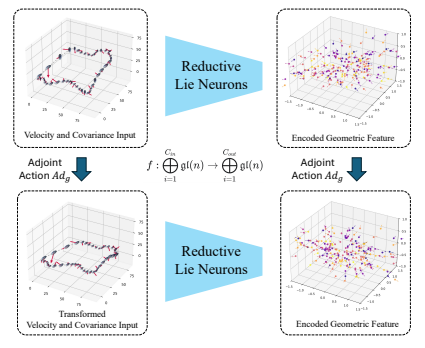
Figure 3 : Adjoint equivariance using a unified representation for diverse geometric inputs. Our framework embeds inputs with different transformation rules, such as velocity (v7→Rv ) and covariance (Σ7→RΣR T ), into a common Lie algebra. Therefore, they transform under the same adjoint action Adg, with which our networkfcommutes as shown in the diagram.
원문 · CC BY 4.0 · Kim, Chankyo, Zhao, Sicheng, Zhu, Minghan, Lin, Tzu-Yuan, Ghaffari, Maani · Equivariant Neural Networks for General Linear Symmetries on Lie Algebras · 원문 그림 인용 · 원본 PDF 5쪽에서 그림 영역을 추출했습니다.비퇴화 Ad-불변 쌍선형 형식과 ReLN 층
ReLN은 reductive 리 대수 g=z(g)⊕[g,g]에서 반단순 이상 위의 Killing form B를 그대로 쓰고, 중심 z(g) 위에는 Ad-불변 내적 ⟨·,·⟩_z를 더하여 비퇴화 형식 B̃를 정의합니다. gl(n)의 경우 논문은 B̃(X,Y)=2n·Tr(XY)−Tr(X)Tr(Y)를 사용합니다. 이 식은 X=X0+(1/n)tr(X)I로 분해하면 sl(n) 부분의 2n·tr(X0Y0)과 RI 부분의 tr(X)tr(Y)로 직교 분해됩니다. 따라서 B̃는 반단순 부분에서는 Lie Neurons가 쓰는 Killing form과 같고, 중심 부분에서는 Vector Neurons의 내적 역할을 합니다.
층 구성은 세 가지로 나뉩니다. ReLN-Linear는 채널 차원에 우측 가중치 W를 곱하며, 기하 차원에 작용하는 좌측 수반 작용과 교환하므로 등변성을 유지합니다. ReLN-ReLU는 B̃(x,d)로 불변 스칼라 게이트를 만들고, 등변 방향 d에 그 게이트를 곱해 x를 갱신합니다. ReLN-Bracket은 두 선형 변환 뒤 리 괄호 [u,v]를 계산해 잔차로 더합니다. 풀링 단계에서는 Max-Killing Pooling이 B̃ 점수의 arg max로 채널별 원소를 고르고, 불변 층은 y_c=B̃(X_c,X_c)를 출력합니다.
검증 과제와 기준선
ReLN은 여러 과제에서 검증됩니다. 첫째, sl(3) 기반 플라톤 입체 분류는 카메라 회전이 호모그래피에 켤레 작용을 주는 설정입니다. 둘째, sp(4, R) 위의 Sp(4)-불변 스칼라 회귀는 10k 학습과 10k 테스트 쌍으로 평가합니다. 셋째, 드론 상태 추정은 잡음 있는 속도와 시변 공분산에서 3D 궤적을 재구성하며 ATE와 RTE로 측정합니다. 넷째, 3D 가우시안 표현 학습은 ShapeSplat pre-training 뒤 ModelNet10에서 정렬 및 무작위 회전 조건의 정확도를 비교합니다. 다섯째, EMLP 이중 진자 벤치마크는 O(2), SO(2), D6의 롤아웃 오차와 HNN의 FLOPs·지연을 측정합니다.

Table 2 : Regression performance and invariance error on sp(4). “Tr. Aug.” indicates training augmentation.
원문 · CC BY 4.0 · Kim, Chankyo, Zhao, Sicheng, Zhu, Minghan, Lin, Tzu-Yuan, Ghaffari, Maani · Equivariant Neural Networks for General Linear Symmetries on Lie Algebras · 원문 그림 인용 · 원본 PDF 7쪽에서 그림 영역을 추출했습니다.기준선은 과제마다 다릅니다. 플라톤 분류와 sp(4) 회귀에서는 MLP와 Lie Neurons, 드론 실험에서는 ResNet, VN, TFN, SE(3)-Transformer, 3DGS에서는 Gaussian-MAE, 이중 진자에서는 EMLP를 비교합니다. 이 비교들은 과제와 입력 형태에 맞춘 설정이므로, 한 과제의 결과를 다른 과제의 결과로 일반화하지 않습니다.
주요 결과와 해석 범위
플라톤 입체 분류에서 ReLN의 RC 정확도는 99.78%±0.04%이고, Lie Neurons는 99.61%±0.14%입니다. 이 값은 5회 실행의 평균과 표준편차이며, 같은 설정에서 MLP 계열은 회전된 카메라 조건에서 크게 낮은 정확도를 보입니다. 드론 상태 추정에서는 속도와 log-공분산을 입력한 ReLN(v,logC)의 ID ATE가 13.92미터이고 RTE가 11.04미터입니다. 같은 표에서 Lie Neurons(v,logC)는 ATE 15.65미터로 보고됩니다. 제거 실험에서 반단순 부분만 남긴 변형은 ATE 16.27미터로 전체 ReLN보다 높습니다.

Table 1 : Platonic solid classification (mean ± std over 5 runs). ID = in-distribution; RC = rotated-camera (10 random SO(3) test rotations). “+Aug” denotes training with random SO(3) augmentation of input homographies. Higher is better (↑).
원문 · CC BY 4.0 · Kim, Chankyo, Zhao, Sicheng, Zhu, Minghan, Lin, Tzu-Yuan, Ghaffari, Maani · Equivariant Neural Networks for General Linear Symmetries on Lie Algebras · 원문 그림 인용 · 원본 PDF 6쪽에서 그림 영역을 추출했습니다.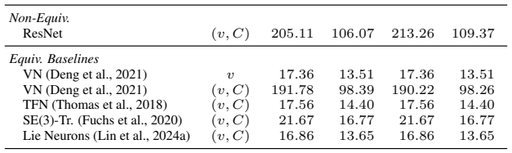
Table 3 : Drone state estimation performance (ATE and RTE in meters). v, C,logC denote velocity, covariance, and log-covariance inputs. Refer to Appendix I.6 for the exhaustive performance report including all variants and metrics.
원문 · CC BY 4.0 · Kim, Chankyo, Zhao, Sicheng, Zhu, Minghan, Lin, Tzu-Yuan, Ghaffari, Maani · Equivariant Neural Networks for General Linear Symmetries on Lie Algebras · 원문 그림 인용 · 원본 PDF 8쪽에서 그림 영역을 추출했습니다.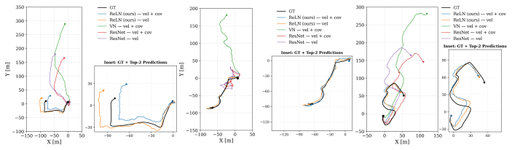
Figure 4 : Trajectory reconstruction across flight difficulties: high (left), best-case (middle), and medium (right). ReLN models consistently track the ground truth (black) with high fidelity, especially when leveraging covariance. Insets provide a magnified view of the two best-performing variants (ReLN) to highlight their accuracy.
원문 · CC BY 4.0 · Kim, Chankyo, Zhao, Sicheng, Zhu, Minghan, Lin, Tzu-Yuan, Ghaffari, Maani · Equivariant Neural Networks for General Linear Symmetries on Lie Algebras · 원문 그림 인용 · 원본 PDF 9쪽에서 그림 영역을 추출했습니다.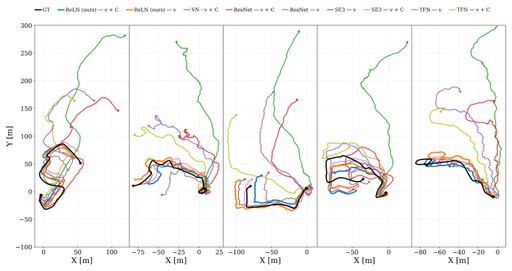
Figure 7 : Qualitative comparison of reconstructed trajectories ReLN variants maintain superior tracking fidelity and stability compared to non-equivariant and standard equivariant baselines.
원문 · CC BY 4.0 · Kim, Chankyo, Zhao, Sicheng, Zhu, Minghan, Lin, Tzu-Yuan, Ghaffari, Maani · Equivariant Neural Networks for General Linear Symmetries on Lie Algebras · 원문 그림 인용 · 원본 PDF 31쪽에서 그림 영역을 추출했습니다.3D 가우시안 표현 분류에서는 Gaussian-MAE 기준선이 정렬 조건 93.39%에서 회전 조건 18.28%로 떨어지는 반면, ReLN은 정렬 94.82%와 회전 95.15%를 보고합니다. EMLP 이중 진자에서는 SO(2)의 롤아웃 오차가 ReLN 0.010, EMLP 0.015입니다. HNN 실험에서 ReLN-HNN의 FLOPs/step은 142,190이고 EMLP-HNN은 1,589,909입니다. 이 계산량 비교는 같은 모델 크기 조건에서 측정된 것이며, 정확도 향상과는 별도로 읽어야 합니다.
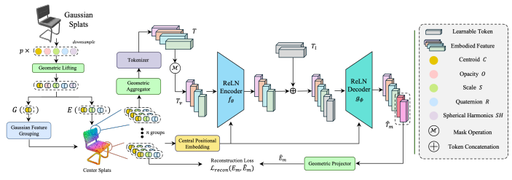
Figure 5 :The ReLN-integrated Gaussian-MAE Framework.Our architecture pipelines raw 3D Gaussian splats through aGeometric Liftingstage to map them into the gl(3) Lie algebra. The model explicitly bifurcates the data flow: (1)Active Geometry(position µ, covariance Σ) is processed via theReLN EncoderandDecoder to maintain GL(3)-equivariance, while (2)Invariant Attributes(color c, opacity α) are integrated as Type-0 features. A dedicatedCentral Positional Embeddingensures stable spatial context. Finally, theGeometric Projectorutilizes the Vee map and Killing form to reconstruct the physical Gaussian parameters while preserving holistic symmetry.
원문 · CC BY 4.0 · Kim, Chankyo, Zhao, Sicheng, Zhu, Minghan, Lin, Tzu-Yuan, Ghaffari, Maani · Equivariant Neural Networks for General Linear Symmetries on Lie Algebras · 원문 그림 인용 · 원본 PDF 10쪽에서 그림 영역을 추출했습니다.
Table 5 : Test rollout error on the EMLP Double-Pendulum Benchmark. ReLN matches or improves upon EMLP across different symmetry groups (O(2), SO(2), D6). Values represent the geometric mean of relative errors, with the standard deviation over 3 trials in parentheses; e.g., the notation0.012(2)denotes0.012±0.002.
원문 · CC BY 4.0 · Kim, Chankyo, Zhao, Sicheng, Zhu, Minghan, Lin, Tzu-Yuan, Ghaffari, Maani · Equivariant Neural Networks for General Linear Symmetries on Lie Algebras · 원문 그림 인용 · 원본 PDF 11쪽에서 그림 영역을 추출했습니다.
Table 6 : Computational cost on the HNN task. ReLN-HNN reduces FLOPs/step and inference latency relative to EMLP-HNN.
원문 · CC BY 4.0 · Kim, Chankyo, Zhao, Sicheng, Zhu, Minghan, Lin, Tzu-Yuan, Ghaffari, Maani · Equivariant Neural Networks for General Linear Symmetries on Lie Algebras · 원문 그림 인용 · 원본 PDF 11쪽에서 그림 영역을 추출했습니다.적용 범위와 한계
저자들은 covariance의 물리적 변환이 AΣA⊤이며, 이것이 수반 켤레 X↦AXA⁻¹와 일치하는 것은 직교 변환(A⁻¹=A⊤)에서뿐이라고 밝힙니다. 따라서 일반 GL(n) 좌표 변화로 같은 공분산 결합을 확장하려면 추가적인 기하학적 정당화나 다른 리프팅이 필요합니다. 적용 범위도 reductive 리 대수로 제한되며, 비reductive 경우에는 추가적인 비정준 완성이 필요하다고 설명됩니다.
또한 드론 실험의 속도 추정은 네트워크 행렬 출력의 skew-symmetric 성분을 vee 연산으로 옮긴 값이며, 3DGS 실험은 ShapeSplat pre-training과 ModelNet10 미세 조정이라는 특정 프로토콜에서 얻은 결과입니다. 이 결과들이 다른 데이터나 모델 구조에서도 같은 크기로 나타난다고 결론내리지는 않습니다.
논문 정보
- 저자
- Kim, Chankyo, Zhao, Sicheng, Zhu, Minghan, Lin, Tzu-Yuan, Ghaffari, Maani
- 학회·저널
- arXiv · 프리프린트
- 최초 공개일
- 2025년 10월 27일
- 등록일
- 2026년 10월 30일
- 수정일
- 2026년 1월 30일
- 버전
- v2
- arXiv
- 2510.22984
- 원문 이용 조건
- CC BY 4.0
- 제공 범위
- 논문 정보, 해설, 허용된 원문 그림
AI 해설은 논문 원문과 별개의 설명이며 오류가 있을 수 있습니다. 원문과 그림은 각 출처의 이용 조건과 따로 표시된 권리를 따릅니다.
초록
Many scientific and geometric problems exhibit general linear symmetries, yet most equivariant neural networks are built for compact groups or simple vector features, limiting their reuse on matrix-valued data such as covariances, inertias, or shape tensors. We introduce Reductive Lie Neurons (ReLNs), an exactly GL(n)-equivariant architecture that natively supports matrix-valued and Lie-algebraic features. ReLNs resolve a central stability issue for reductive Lie algebras by introducing a non-degenerate adjoint (conjugation)-invariant bilinear form, enabling principled nonlinear interactions and invariant feature construction in a single architecture that transfers across subgroups without redesign. We demonstrate ReLNs on algebraic tasks with sl(3) and sp(4) symmetries, Lorentz-equivariant particle physics, uncertainty-aware drone state estimation via joint velocity-covariance processing, learning from 3D Gaussian-splat representations, and EMLP double-pendulum benchmark spanning multiple symmetry groups. ReLNs consistently match or outperform strong equivariant and self-supervised baselines while using substantially fewer parameters and compute, improving the accuracy-efficiency trade-off and providing a practical, reusable backbone for learning with broad linear symmetries. Project page: https://reductive-lie-neuron.github.io/
원문 인용
Kim, Chankyo, Zhao, Sicheng, Zhu, Minghan, Lin, Tzu-Yuan, Ghaffari, Maani (2025). Equivariant Neural Networks for General Linear Symmetries on Lie Algebras. arXiv:2510.22984v2. https://arxiv.org/abs/2510.22984v2
BibTeX
@misc{chankyo2025equivariant,
  title = {{Equivariant Neural Networks for General Linear Symmetries on Lie Algebras}},
  author = {Kim, Chankyo and Zhao, Sicheng and Zhu, Minghan and Lin, Tzu-Yuan and Ghaffari, Maani},
  year = {2025},
  eprint = {2510.22984},
  archivePrefix = {arXiv},
  url = {https://arxiv.org/abs/2510.22984v2}
}