논문 해설
Understanding Mixture-of-Experts Language Models Beyond Expert Boundaries
전문가 경계를 넘어서 이해하는 Mixture-of-Experts 언어 모델
- 연구 문제 MoE 모델에서 전문가가 도메인에 특화되어 있는지에 대해 상반된 주장이 있으며, 이 논문은 뉴런 수준에서 도메인 특화 계산이 어떻게 조직되는지 살펴봅니다.
- 연구 방법 RAMP로 전문가-뉴런 좌표의 도메인별 중요도를 계산하고, 이를 결합해 여러 전문가에 걸친 공유 뉴런 집합을 선택하는 RAMPr 가지치기를 제안합니다.
- 주요 결과 도메인 특화 뉴런 집합은 같은 도메인 내에서 더 많이 겹치며, 75% 뉴런 유지 시 평균 성능의 91.12–97.63%를 유지하고 50% 유지 시 메모리를 36–43% 줄입니다.
전문가 경계를 넘어 보는 이유
MoE 언어 모델에서 전문가가 도메인에 특화되어 있는지는 논쟁적인 문제입니다. 일부 연구는 도메인과 연관된 전문가 선호를 보고하지만, 다른 연구는 라우팅이 주로 토큰 정체성이나 구문 패턴에 의해 결정된다고 분석합니다. 이 논문은 이 두 입장의 차이를 전문가 수준이 아니라 뉴런 수준에서 살펴봅니다. 전문가 단위로 보면 도메인 특화가 보이지 않을 수 있지만, 뉴런 단위에서는 도메인에 따라 선택되는 뉴런 집합이 달라지는지를 확인할 수 있다는 것이 출발점입니다.
RAMP 중요도 계산
저자들은 RAMP(Routing-Aware Magnitude Profiling)를 도입합니다. 뉴런의 활성화 크기만으로는 기여 크기를 충분히 나타내지 못하므로, 출력 투영 열의 노름과 전문가의 라우팅 가중치를 함께 고려합니다. 전문가 e의 뉴런 i에 대해 토큰 t의 라우팅 가중 활성화 p_e(t)a_e,i(t)를 도메인 텍스트 전체에서 제곱하여 누적한 뒤 제곱근을 취하고, 출력 투영 열 노름을 곱합니다. 이렇게 얻은 점수를 도메인별 중요도로 사용하며, 각 도메인에서 상위 r 비율의 전문가-뉴런 좌표를 선택해 도메인 특화 뉴런 집합을 만듭니다.
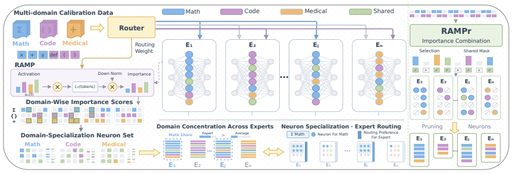
Figure 1 .Routing-weighted activation magnitudes and output projection norms quantify domain-wise neuron importance, revealing domain-specialized sets that span mixed experts. Their enrichment correlates with domain routing preferences. Aggregating these important scores guides multi-domain neuron pruning across experts, retaining different numbers of neurons in each expert.
원문 · CC BY 4.0 · Zhenhong Zhou, Mao Zheng, Mingyang Song, Qiankun Li, Kun Wang, Junfeng Fang · Understanding Mixture-of-Experts Language Models Beyond Expert Boundaries · 원문 그림 인용 · 원본 PDF 2쪽에서 그림 영역을 추출했습니다.도메인 내외 뉴런 집합 중첩
도메인 특화 여부는 같은 도메인의 판별 샘플과 검증 샘플에서 뽑은 뉴런 집합이 얼마나 겹치는지, 그리고 서로 다른 도메인의 집합이 얼마나 겹치는지로 확인합니다. 1% 선택에서 RAMP의 중첩은 같은 도메인 내 50.79–68.07%, 도메인 간 8.47–12.64%였고, 6.25% 선택에서는 같은 도메인 내 57.77–74.33%, 도메인 간 15.23–23.68%였습니다. 같은 도메인 중첩은 24개의 모델-예산 조합 모두에서 도메인 간 중첩보다 컸습니다. 이 결과는 선택된 뉴런이 개별 텍스트 샘플을 넘어 도메인과 연관되어 있음을 보여 주는 관찰입니다.
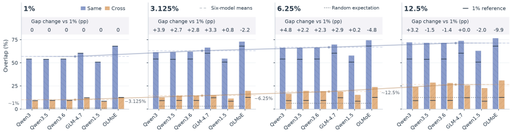
Figure 2 .Neuron-set overlap at four selection rates across six models. Blue and orange bars show same-domain and cross-domain overlap. Dashed lines and connected center points denote six-model means, while gray dotted lines mark random-set expectations. Dark ticks show each model’s overlap at 1% selection, and upper strips give the change in the same–cross gap relative to that setting, in percentage points.
원문 · CC BY 4.0 · Zhenhong Zhou, Mao Zheng, Mingyang Song, Qiankun Li, Kun Wang, Junfeng Fang · Understanding Mixture-of-Experts Language Models Beyond Expert Boundaries · 원문 그림 인용 · 원본 PDF 4쪽에서 그림 영역을 추출했습니다.중첩 결과의 적용 범위
저자들은 전문가 수준의 라우팅 선호와 뉴런 수준의 집합이 함께 나타난다는 점을 보고하지만, 이 결과가 모든 MoE 구조나 모든 도메인에서 같은 크기로 나타난다는 것은 보고하지 않습니다. 또한 뉴런 집합의 중첩 자체는 도메인 특화의 인과적 필요성을 증명하지 않으며, 이는 별도의 절제 실험에서 다룹니다.
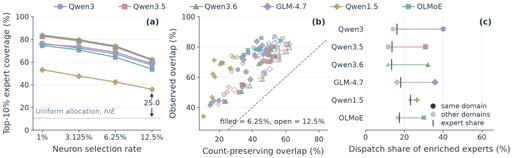
Figure 3 .(a) Share of each domain’s selected neurons held by the top ⌈0.1E⌉ experts, with the gray line marking uniform allocation and the arrow giving the gap in percentage points. (b) Observed overlap against the count-preserving expectation in Equation (5), with one marker per model, domain and selection rate, and the dashed line marking parity. (c) Validation dispatch share of each domain’s enriched experts, from the same domain in color and from other domains in gray, with black ticks marking their share of all experts.
원문 · CC BY 4.0 · Zhenhong Zhou, Mao Zheng, Mingyang Song, Qiankun Li, Kun Wang, Junfeng Fang · Understanding Mixture-of-Experts Language Models Beyond Expert Boundaries · 원문 그림 인용 · 원본 PDF 5쪽에서 그림 영역을 추출했습니다.RAMPr 가지치기의 성능 보존과 효율
RAMPr는 여러 도메인에서 계산한 RAMP 중요도를 결합해 레이어마다 하나의 공유 뉴런 집합을 고르는 가지치기 방법입니다. 75% 뉴런 유지 조건에서 RAMPr-L은 11개 과제 평균 성능의 91.12–97.63%를 유지합니다. 50% 유지 조건에서는 RAMPr가 메모리를 36–43% 줄이고 배치 prefill 처리량을 17–39% 향상시킵니다. 이 효율 수치는 측정 조건인 배치 32, 입력 2048 토큰, 고정 블록 폭 128에서 얻은 값입니다. 비교 기준인 REAP은 전문가 전체를 제거하므로 이 방식과 동일한 활성 파라미터 절감을 주지 않는다고 저자들은 설명합니다.
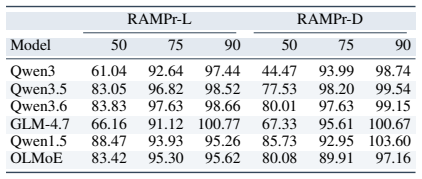
Table 2 .Mean performance retention (%) of RAMPr relative to the original model at 50%, 75% and 90% neuron retention.
원문 · CC BY 4.0 · Zhenhong Zhou, Mao Zheng, Mingyang Song, Qiankun Li, Kun Wang, Junfeng Fang · Understanding Mixture-of-Experts Language Models Beyond Expert Boundaries · 원문 그림 인용 · 원본 PDF 7쪽에서 그림 영역을 추출했습니다.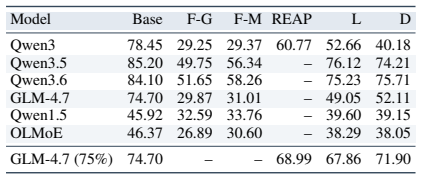
Table 3 .Raw-score 11-task macro-average against Fisher and REAP at 50% neuron retention, with GLM-4.7 also compared at 75%. F-G and F-M denote Fisher calibrated on GSM8K and MBPP, and REAP retains the same fraction of experts.
원문 · CC BY 4.0 · Zhenhong Zhou, Mao Zheng, Mingyang Song, Qiankun Li, Kun Wang, Junfeng Fang · Understanding Mixture-of-Experts Language Models Beyond Expert Boundaries · 원문 그림 인용 · 원본 PDF 7쪽에서 그림 영역을 추출했습니다.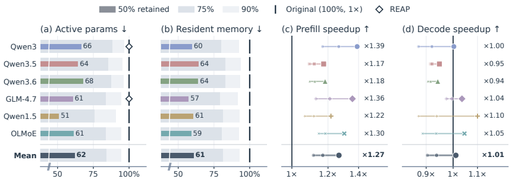
Figure 5 .RAMPr-L with fixed128 layout at batch 32 and 2048 input tokens, relative to the original model on the same GPU. The Mean row averages six models arithmetically in (a) and (b) and geometrically in (c) and (d). (a) Active parameters and (b) resident memory, with colored bars for 50% retention, gray bands for 75% and 90%, ticks at the original and diamonds for REAP. (c) Prefill and (d) decode speedups on log axes, with points from faint to solid for 90%, 75% and 50% retention and the original model at1×.
원문 · CC BY 4.0 · Zhenhong Zhou, Mao Zheng, Mingyang Song, Qiankun Li, Kun Wang, Junfeng Fang · Understanding Mixture-of-Experts Language Models Beyond Expert Boundaries · 원문 그림 인용 · 원본 PDF 8쪽에서 그림 영역을 추출했습니다.논문 정보
- 저자
- Zhenhong Zhou, Mao Zheng, Mingyang Song, Qiankun Li, Kun Wang, Junfeng Fang
- 학회·저널
- arXiv · 프리프린트
- 최초 공개일
- 2026년 11월 10일
- 등록일
- 2026년 11월 11일
- 수정일
- 2026년 11월 10일
- 버전
- v1
- arXiv
- 2611.13975
- 분류
- cs.AI · cs.CL
- 원문 이용 조건
- CC BY 4.0
- 제공 범위
- 논문 정보, 해설, 허용된 원문 그림
AI 해설은 논문 원문과 별개의 설명이며 오류가 있을 수 있습니다. 원문과 그림은 각 출처의 이용 조건과 따로 표시된 권리를 따릅니다.
초록
In Mixture-of-Experts (MoE) models, the nature of expert specialization remains controversial. Reports of domain-associated expert preferences contrast with analyses attributing routing primarily to token identity or syntactic patterns. To clarify these differing accounts, we look beyond expert-level routing to investigate the neuron-level organization of domain-specialized computation using Routing-Aware Magnitude Profiling (RAMP), a measure developed for this analysis. Using mixed-domain calibration data, we identify domain-specialized neuron sets with 58-74% overlap across multi-source samples of the same domain, compared with 15-24% across domains. To understand how this organization evolves during training, we trace neuron importance throughout pre-training and post-training across three fully open MoE families. Neuron importance continues to reorganize between pre-training checkpoints despite comparatively stable expert-level importance rankings, while post-training largely preserves neuron rankings. Building on these neuron-level perspectives, we further introduce RAMP-based Pruning (RAMPr) to select neurons across experts for balanced multi-domain capability preservation. At 75% neuron retention, RAMPr preserves average 91-98% of original full performance across six models. At 50% retention, our pruning method can reduce resident GPU memory by 36-43% and improves batched prefill throughput by 17-39% effectively. Our code is available at https://github.com/ydyjya/Neuron-Level-Specialization-in-MoE
원문 인용
Zhenhong Zhou, Mao Zheng, Mingyang Song, Qiankun Li, Kun Wang, Junfeng Fang (2026). Understanding Mixture-of-Experts Language Models Beyond Expert Boundaries. arXiv:2611.13975v1. https://arxiv.org/abs/2611.13975v1
BibTeX
@misc{zhou2026understanding,
  title = {{Understanding Mixture-of-Experts Language Models Beyond Expert Boundaries}},
  author = {Zhenhong Zhou and Mao Zheng and Mingyang Song and Qiankun Li and Kun Wang and Junfeng Fang},
  year = {2026},
  eprint = {2611.13975},
  archivePrefix = {arXiv},
  url = {https://arxiv.org/abs/2611.13975v1}
}