논문 해설
Reasoning Theater: Disentangling Model Beliefs from Chain-of-Thought
추론 연극: 모델의 믿음과 사고 연쇄 분리하기
- 연구 문제 추론 모델은 최종 답을 이미 확신한 뒤에도 추론 텍스트를 계속 생성할 수 있어, 텍스트 기반 CoT 모니터가 실제 내부 믿음을 놓칠 수 있습니다.
- 연구 방법 어텐션 프로브, 강제 응답, CoT 모니터의 세 방법으로 추론 접두부마다 최종 답을 해독하고 그 시점을 비교합니다.
- 주요 결과 MMLU에서는 답 정보가 추론 텍스트보다 일찍 나타나 수행적 추론 경향이 크며, GPQA-Diamond에서는 두 신호가 함께 증가합니다. 프로브 확신도 기반 조기 종료는 MMLU에서 토큰 68%를 절약하면서 원래 성능의 97%를 유지했습니다.
사고 흔적이 모델의 실제 믿음을 드러내는가
이 논문은 추론 모델이 최종 답을 이미 내부적으로 강하게 확신한 뒤에도 사고 연쇄(CoT) 토큰을 계속 생성하는 현상, 즉 수행적 추론(performative CoT)을 다룹니다. 이 경우 생성된 추론 텍스트는 모델의 실제 내부 믿음을 충실하게 드러내지 않습니다. 따라서 CoT 모니터가 추론 텍스트만 읽어서 안전성이나 해석 가능성을 판단하는 방식에는 한계가 생깁니다. 논문은 활성값 프로빙, 강제 응답, CoT 모니터라는 세 방법으로 같은 추론 흔적의 각 위치에서 답을 얼마나 일찍 해독할 수 있는지 비교합니다. 대상 모델은 DeepSeek-R1 671B와 GPT-OSS 120B이며, 평가 데이터는 MMLU-Redux 2.0과 GPQA-Diamond입니다.
모델, 데이터셋, 세 가지 해독 방법
DeepSeek-R1-0528 671B와 GPT-OSS 120B를 주된 분석 대상으로 삼았고, 증류된 DeepSeek-R1 Qwen2.5 모델(1.5B, 7B, 14B, 32B)을 모델 크기에 따른 비교에 추가했습니다. MMLU-Redux 2.0은 5700개 문항 중 오류 주석을 이용해 5280개 문항으로 걸러 사용했고, GPQA-Diamond는 198개 문항의 대학원 수준 과제입니다. 방법은 세 가지입니다. 어텐션 프로브는 추론 접두부의 활성값을 학습된 풀링으로 모아 답을 예측합니다. 강제 응답은 추론을 중간에서 자르고 같은 모델에게 답 선택지를 요구합니다. CoT 모니터는 Gemini-2.5-Flash가 부분 추론 흔적을 읽고 답을 예측하거나 N/A를 출력합니다.
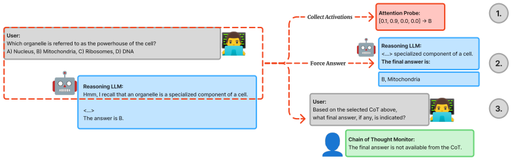
Figure 1 .Early decoding helps us identify performative reasoning, when an LLM knows what it will answer.We study whether a reasoning LLM’s final answer can be decoded given a prefix of its chain of thought up to an intermediate token x. We use this to identify performative reasoning, where a model internally knows its final answer early on but still generates text as if it does not. (1) Attention Probes: We train attention probes on varying-length activations of text to predict the model’s final answer. At test-time, we use activations up to x to studywhenthe model internalizes its final answer. (2) Forced Answering: At token x, we inject a forced answering prompt to obtain its final answer prediction at that point in reasoning. (3) Chain-of-thought Monitor: We provide the chain of thought up to x to another LLM, which determines whether the reasoning chain contains a potential final answer.
원문 · CC BY 4.0 · Siddharth Boppana, Annabel Ma, Max Loeffler, Raphael Sarfati, Eric Bigelow, Atticus Geiger, Owen Lewis, Jack Merullo · Reasoning Theater: Disentangling Model Beliefs from Chain-of-Thought · 원문 그림 인용 · 원본 PDF 2쪽에서 그림 영역을 추출했습니다.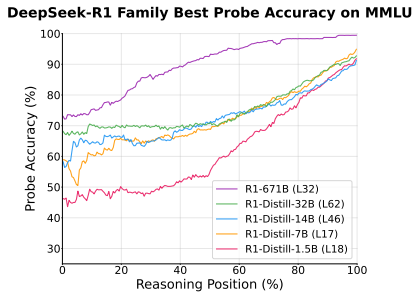
Figure 3 .Probe accuracy across DeepSeek-R1 model sizes on MMLU-Redux.Larger models achieve higher probe accuracy earlier in reasoning, likely reflecting greater in-weights knowledge. The 671B probe reaches high accuracy quickly and plateaus, the distilled models (7B–32B) remain flat before rising late in the sequence, and the 1.5B probe starts near chance and sharply in- creases only in the second half of reasoning.
원문 · CC BY 4.0 · Siddharth Boppana, Annabel Ma, Max Loeffler, Raphael Sarfati, Eric Bigelow, Atticus Geiger, Owen Lewis, Jack Merullo · Reasoning Theater: Disentangling Model Beliefs from Chain-of-Thought · 원문 그림 인용 · 원본 PDF 6쪽에서 그림 영역을 추출했습니다.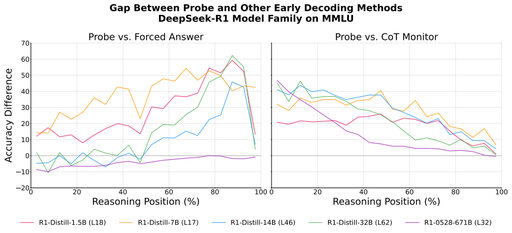
Figure 4 .Probe performance vs. other methods by model size.When comparing probes to forced answering, we see that the gap between them rises during reasoning for distilled models due to probe performance increasing while forced answering performance stays the same. In contrast, the gap between probes and the CoT monitor decreases over reasoning. We find that smaller models are less performative as the task is more difficult, requiring genuine reasoning.
원문 · CC BY 4.0 · Siddharth Boppana, Annabel Ma, Max Loeffler, Raphael Sarfati, Eric Bigelow, Atticus Geiger, Owen Lewis, Jack Merullo · Reasoning Theater: Disentangling Model Beliefs from Chain-of-Thought · 원문 그림 인용 · 원본 PDF 7쪽에서 그림 영역을 추출했습니다.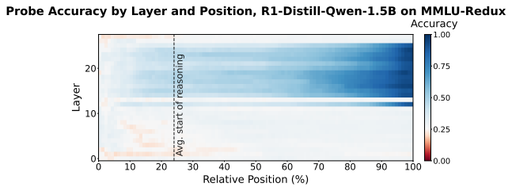
Figure 15 .Attention probe accuracy for DeepSeek-R1 Qwen2.5 1.5B Distill on MMLU.The 1.5B distilled model probes are able to decode final answer information gradually in the second half of layers, suggesting that test-time compute is needed for reasoning.
원문 · CC BY 4.0 · Siddharth Boppana, Annabel Ma, Max Loeffler, Raphael Sarfati, Eric Bigelow, Atticus Geiger, Owen Lewis, Jack Merullo · Reasoning Theater: Disentangling Model Beliefs from Chain-of-Thought · 원문 그림 인용 · 원본 PDF 19쪽에서 그림 영역을 추출했습니다.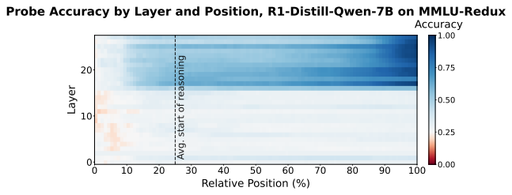
Figure 16 .Attention probe accuracy for DeepSeek-R1 Qwen2.5 7B Distill on MMLU.The 7B model’s results are similar but show signs of final answer information being decodable earlier in the sequence for successful probes. This indicates that the increase in model corresponds with less necessary computation in the rollout.
원문 · CC BY 4.0 · Siddharth Boppana, Annabel Ma, Max Loeffler, Raphael Sarfati, Eric Bigelow, Atticus Geiger, Owen Lewis, Jack Merullo · Reasoning Theater: Disentangling Model Beliefs from Chain-of-Thought · 원문 그림 인용 · 원본 PDF 19쪽에서 그림 영역을 추출했습니다.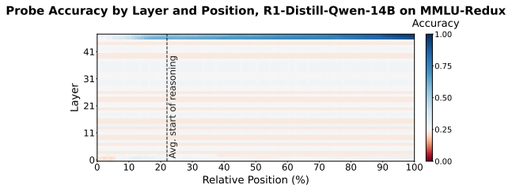
Figure 17 .Attention probe accuracy for DeepSeek-R1 Qwen2.5 14B Distill on MMLU.We find that successful probes trained on the 14B model’s activations are able to decode the final answer early in reasoning, but the vast majority of probe’s fail to decode it. This may be due to training instability, not a layerwise signal, and requires further study.
원문 · CC BY 4.0 · Siddharth Boppana, Annabel Ma, Max Loeffler, Raphael Sarfati, Eric Bigelow, Atticus Geiger, Owen Lewis, Jack Merullo · Reasoning Theater: Disentangling Model Beliefs from Chain-of-Thought · 원문 그림 인용 · 원본 PDF 20쪽에서 그림 영역을 추출했습니다.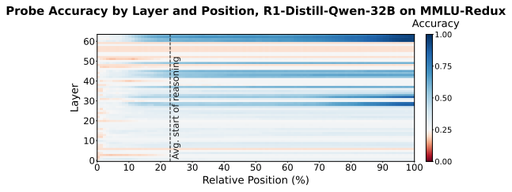
Figure 18 .Attention probe accuracy for DeepSeek-R1 Qwen2.5 32B Distill on MMLU.We again see layerwise instability for the 32B model’s probes, but generally find that final answer information can be decoded well before reasoning for successful probes.
원문 · CC BY 4.0 · Siddharth Boppana, Annabel Ma, Max Loeffler, Raphael Sarfati, Eric Bigelow, Atticus Geiger, Owen Lewis, Jack Merullo · Reasoning Theater: Disentangling Model Beliefs from Chain-of-Thought · 원문 그림 인용 · 원본 PDF 20쪽에서 그림 영역을 추출했습니다.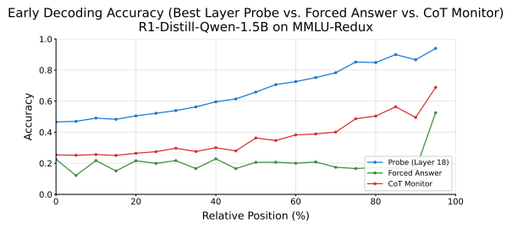
Figure 19 .Probe, forced answering, and CoT monitor accuracy by reasoning position for DeepSeek-R1-Distill-1.5B on MMLU. Probes significantly outperform both forced answering and CoT monitoring across the sequence. Smaller models likely struggle to do forced answering as we abruptly end thinking, resulting in off-policy generation.
원문 · CC BY 4.0 · Siddharth Boppana, Annabel Ma, Max Loeffler, Raphael Sarfati, Eric Bigelow, Atticus Geiger, Owen Lewis, Jack Merullo · Reasoning Theater: Disentangling Model Beliefs from Chain-of-Thought · 원문 그림 인용 · 원본 PDF 20쪽에서 그림 영역을 추출했습니다.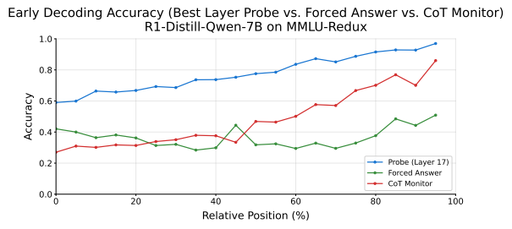
Figure 20 .Probe, forced answering, and CoT monitor accuracy by reasoning position for DeepSeek-R1-Distill-7B on MMLU.We observe a similar trend to the 1.5B model, with probe performance exceeding the other two methods.
원문 · CC BY 4.0 · Siddharth Boppana, Annabel Ma, Max Loeffler, Raphael Sarfati, Eric Bigelow, Atticus Geiger, Owen Lewis, Jack Merullo · Reasoning Theater: Disentangling Model Beliefs from Chain-of-Thought · 원문 그림 인용 · 원본 PDF 21쪽에서 그림 영역을 추출했습니다.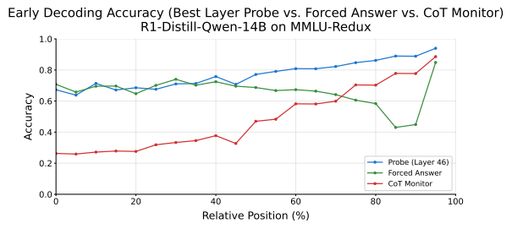
Figure 21 .Probe, forced answering, and CoT monitor accuracy by reasoning position for DeepSeek-R1-Distill-14B on MMLU. Forced answering and probe performance are similarly high in the first half of reasoning, but forced answering accuracy drops in the second half. This may be due to relying too heavily on the current computation within reasoning, creating a plausible answer than true belief like the probe is trained to predict.
원문 · CC BY 4.0 · Siddharth Boppana, Annabel Ma, Max Loeffler, Raphael Sarfati, Eric Bigelow, Atticus Geiger, Owen Lewis, Jack Merullo · Reasoning Theater: Disentangling Model Beliefs from Chain-of-Thought · 원문 그림 인용 · 원본 PDF 21쪽에서 그림 영역을 추출했습니다.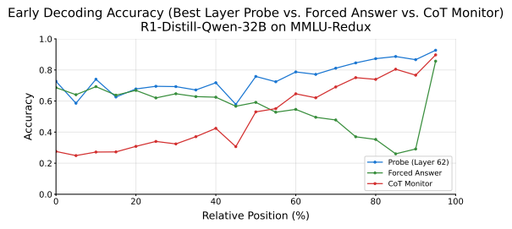
Figure 22 .Probe, forced answering, and CoT monitor accuracy by reasoning position for DeepSeek-R1-Distill-32B on MMLU.We see a similar trend to the 14B model, with forced answering accuracy dropping in the second half of reasoning. Both probe accuracy and forced answering accuracy remain the same at the start, implying that in-weights knowledge does not improve significantly between these model sizes.
원문 · CC BY 4.0 · Siddharth Boppana, Annabel Ma, Max Loeffler, Raphael Sarfati, Eric Bigelow, Atticus Geiger, Owen Lewis, Jack Merullo · Reasoning Theater: Disentangling Model Beliefs from Chain-of-Thought · 원문 그림 인용 · 원본 PDF 21쪽에서 그림 영역을 추출했습니다.어텐션 프로브의 학습과 적용
어텐션 프로브는 Kantamneni 등(2025)의 방식을 따르며, 트랜스포머 한 층의 은닉 상태에 학습된 풀링을 적용합니다. 학습할 때는 전체 시퀀스에서 무작위 접두부를 샘플링해, 답을 시퀀스 길이와 무관하게 해독하도록 유도합니다. 실행할 때는 모든 접두부 위치에서 프로브를 평가하여 답 선택지에 대한 확률 분포가 추론 중에 어떻게 변하는지 봅니다. 각 모델마다 층별로 프로브를 하나씩 학습하고, 가장 성능이 좋은 층의 결과를 보고합니다. 선형 프로브는 같은 설정에서 MMLU 정확도가 31.85%에 그쳐 어텐션 프로브(87.98%)보다 크게 낮았습니다. 이는 최종 답 정보가 모든 토큰에서 유지되지 않고 특정 토큰에서 갱신되며, 여러 위치를 가중 합산하는 풀링이 필요하다는 저자들의 해석과 맞닿아 있습니다.
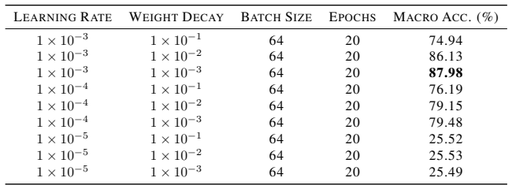
Table 3 .Attention Probe Hyperparameter Sweep (DeepSeek-R1, MMLU).We report the test macro accuracy of the best-performing layer for each hyperparameter setting.
원문 · CC BY 4.0 · Siddharth Boppana, Annabel Ma, Max Loeffler, Raphael Sarfati, Eric Bigelow, Atticus Geiger, Owen Lewis, Jack Merullo · Reasoning Theater: Disentangling Model Beliefs from Chain-of-Thought · 원문 그림 인용 · 원본 PDF 16쪽에서 그림 영역을 추출했습니다.
Table 4 .Attention Probe Results for Distilled DeepSeek-R1 Models (MMLU).All distilled models share the same hyperparameters. We report the test macro accuracy of the best-performing layer for each model.
원문 · CC BY 4.0 · Siddharth Boppana, Annabel Ma, Max Loeffler, Raphael Sarfati, Eric Bigelow, Atticus Geiger, Owen Lewis, Jack Merullo · Reasoning Theater: Disentangling Model Beliefs from Chain-of-Thought · 원문 그림 인용 · 원본 PDF 16쪽에서 그림 영역을 추출했습니다.
Table 5 .Attention Probe Performance Compared to Linear Probes and Probes Trained with Random Labels.
원문 · CC BY 4.0 · Siddharth Boppana, Annabel Ma, Max Loeffler, Raphael Sarfati, Eric Bigelow, Atticus Geiger, Owen Lewis, Jack Merullo · Reasoning Theater: Disentangling Model Beliefs from Chain-of-Thought · 원문 그림 인용 · 원본 PDF 16쪽에서 그림 영역을 추출했습니다.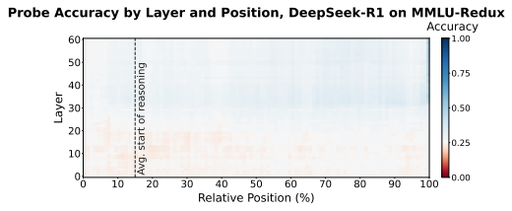
Figure 9 .Linear probe accuracy for DeepSeek-R1 on MMLU-Redux by layer and relative position.
원문 · CC BY 4.0 · Siddharth Boppana, Annabel Ma, Max Loeffler, Raphael Sarfati, Eric Bigelow, Atticus Geiger, Owen Lewis, Jack Merullo · Reasoning Theater: Disentangling Model Beliefs from Chain-of-Thought · 원문 그림 인용 · 원본 PDF 16쪽에서 그림 영역을 추출했습니다.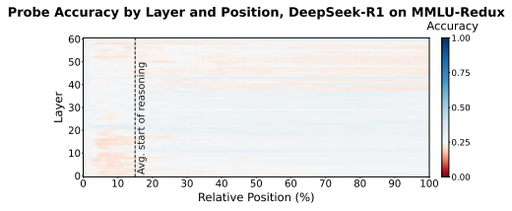
Figure 10 .Attention probe accuracy for DeepSeek-R1 on MMLU-Redux with random labels by layer and relative position.
원문 · CC BY 4.0 · Siddharth Boppana, Annabel Ma, Max Loeffler, Raphael Sarfati, Eric Bigelow, Atticus Geiger, Owen Lewis, Jack Merullo · Reasoning Theater: Disentangling Model Beliefs from Chain-of-Thought · 원문 그림 인용 · 원본 PDF 17쪽에서 그림 영역을 추출했습니다.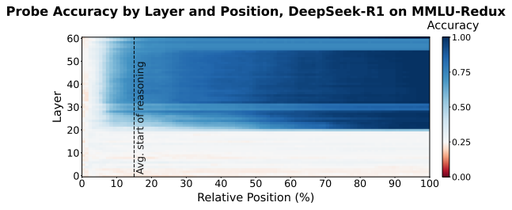
Figure 11 .Attention probe accuracy for DeepSeek-R1 on MMLU.Probes trained on DeepSeek-R1 activations are able to decode the final answer from layers 20 to 60. We see a sharp shift from earlier layers to these, suggesting that final answer information becomes linearly decodable at layer 20. Successful probes are able to identify the final answer significantly better than chance ( 28%) performance well before reasoning begins, as the question is being asked.
원문 · CC BY 4.0 · Siddharth Boppana, Annabel Ma, Max Loeffler, Raphael Sarfati, Eric Bigelow, Atticus Geiger, Owen Lewis, Jack Merullo · Reasoning Theater: Disentangling Model Beliefs from Chain-of-Thought · 원문 그림 인용 · 원본 PDF 18쪽에서 그림 영역을 추출했습니다.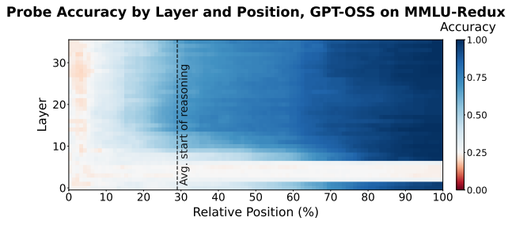
Figure 13 .Attention probe accuracy for GPT-OSS on MMLU.The latter two thirds of layers for GPT-OSS can also decode final answer information well before the start of reasoning like DeepSeek-R1. These reasoning traces are noticeably shorter, hence the later start of reasoning. We note that the first few layers can also decode the final answer with some success as well.
원문 · CC BY 4.0 · Siddharth Boppana, Annabel Ma, Max Loeffler, Raphael Sarfati, Eric Bigelow, Atticus Geiger, Owen Lewis, Jack Merullo · Reasoning Theater: Disentangling Model Beliefs from Chain-of-Thought · 원문 그림 인용 · 원본 PDF 18쪽에서 그림 영역을 추출했습니다.쉬운 회상 과제와 어려운 추론 과제의 차이
DeepSeek-R1에서 MMLU는 프로브와 강제 응답이 CoT 모니터보다 훨씬 일찍 높은 정확도를 보였고, 이는 답 정보가 추론 텍스트에 드러나기 전에 이미 내부에 존재함을 뜻합니다. 수행성 비율은 프로브 기준 MMLU가 0.417, GPQA-Diamond가 0.012로 보고되었고, 이 값은 5% 시간 구간마다 기울기 차이를 평균한 지표입니다. 값이 0에 가까울수록 추가 토큰이 프로브와 모니터 정확도를 비슷하게 올린다는 뜻입니다. GPQA-Diamond에서는 세 방법이 비슷한 낮은 정확도에서 출발해 함께 증가하여, 추론이 실제 정보 획득을 반영한다고 저자들은 해석합니다. 이 차이는 DeepSeek-R1과 GPT-OSS 모두에서 나타났습니다.
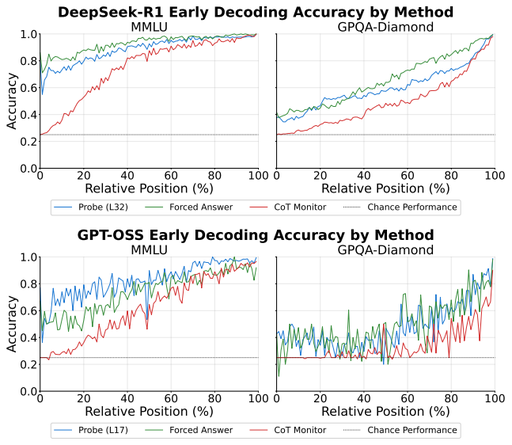
Figure 2 .Accuracy of three early decoding methods by position of DeepSeek-R1 and GPT-OSS on MMLU-Redux and GPQA- Diamond.MMLU (left):For both models, probing and forced answering predict the models’ predictions with much higher accuracy earlier than CoT Monitoring. The CoT monitor’s accuracy rapidly gains relative to the other two methods, indicating performative CoT that did not lead to the model’s internal accuracy improving.GPQA-D (right):All three methods begin with similar accuracy around chance performance, and generally increase at similar rates, indicating closer tracking between internal beliefs and CoT. This is genuine, as the CoT generated corresponds to gains in performance seen in probes and forced answering.
원문 · CC BY 4.0 · Siddharth Boppana, Annabel Ma, Max Loeffler, Raphael Sarfati, Eric Bigelow, Atticus Geiger, Owen Lewis, Jack Merullo · Reasoning Theater: Disentangling Model Beliefs from Chain-of-Thought · 원문 그림 인용 · 원본 PDF 4쪽에서 그림 영역을 추출했습니다.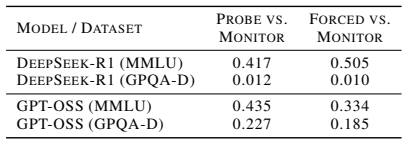
Table 1 .Comparison of the amount of information gained per step for the CoT Monitor vs. the Probe/Forced Answer.A large difference indicates that the LLM does not produce its answer based on the addition of information from the CoT while small dif- ferences indicate more genuine reasoning. This is measured as the change in slope of the average probe (or forced answer) accuracy minus CoT accuracy shown in Fig. 2:|∆Probe−∆Monitor|
원문 · CC BY 4.0 · Siddharth Boppana, Annabel Ma, Max Loeffler, Raphael Sarfati, Eric Bigelow, Atticus Geiger, Owen Lewis, Jack Merullo · Reasoning Theater: Disentangling Model Beliefs from Chain-of-Thought · 원문 그림 인용 · 원본 PDF 5쪽에서 그림 영역을 추출했습니다.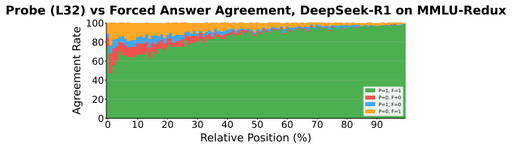
Figure 23 .Agreement of the best performing probe layer and forced answering for DeepSeek-R1 on MMLU at position bins of the sequenceAt the beginning of the sequence, forced answering is correct more often than probes when they disagree. This difference diminishes over reasoning.
원문 · CC BY 4.0 · Siddharth Boppana, Annabel Ma, Max Loeffler, Raphael Sarfati, Eric Bigelow, Atticus Geiger, Owen Lewis, Jack Merullo · Reasoning Theater: Disentangling Model Beliefs from Chain-of-Thought · 원문 그림 인용 · 원본 PDF 22쪽에서 그림 영역을 추출했습니다.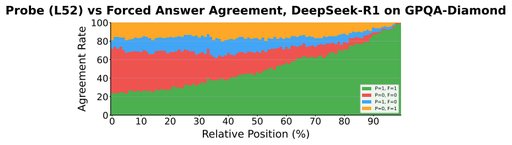
Figure 24 .Agreement of the best performing probe layer and forced answering for DeepSeek-R1 on GPQA-D at position bins of the sequence.In GPQA-D, both methods are incorrect 40% of the time at the beginning of reasoning. When they disagree, forced answering is correct slightly more often.
원문 · CC BY 4.0 · Siddharth Boppana, Annabel Ma, Max Loeffler, Raphael Sarfati, Eric Bigelow, Atticus Geiger, Owen Lewis, Jack Merullo · Reasoning Theater: Disentangling Model Beliefs from Chain-of-Thought · 원문 그림 인용 · 원본 PDF 22쪽에서 그림 영역을 추출했습니다.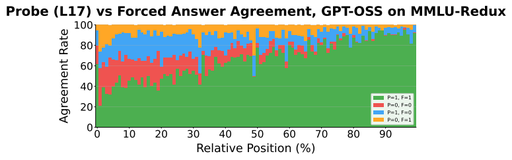
Figure 25 .Agreement of the best performing probe layer and forced answering for GPT-OSS on MMLU at position bins of the sequence.We see a less smooth trend for GPT-OSS as responses are shorter. Here, probes outperform forced answering when they disagree.
원문 · CC BY 4.0 · Siddharth Boppana, Annabel Ma, Max Loeffler, Raphael Sarfati, Eric Bigelow, Atticus Geiger, Owen Lewis, Jack Merullo · Reasoning Theater: Disentangling Model Beliefs from Chain-of-Thought · 원문 그림 인용 · 원본 PDF 22쪽에서 그림 영역을 추출했습니다.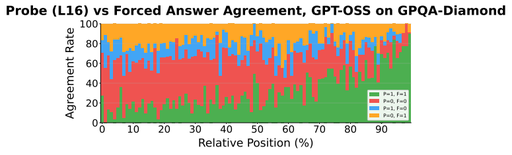
Figure 26 .Agreement of the best performing probe layer and forced answering for GPT-OSS on GPQA-D at position bins of the sequence.We see a similar trend to DeepSeek-R1, with both methods being incorrect more often than either is correct until the end of reasoning. Here, forced answering outperforms probing when they disagree, which could be a result of poor probe transfer from MMLU.
원문 · CC BY 4.0 · Siddharth Boppana, Annabel Ma, Max Loeffler, Raphael Sarfati, Eric Bigelow, Atticus Geiger, Owen Lewis, Jack Merullo · Reasoning Theater: Disentangling Model Beliefs from Chain-of-Thought · 원문 그림 인용 · 원본 PDF 23쪽에서 그림 영역을 추출했습니다.프로브 확신도 기반 조기 종료
프로브는 추론 중 확신도가 임계값에 도달하면 생성을 멈추고 프로브 예측을 최종 답으로 쓰는 조기 종료에 사용됩니다. 보정 곡선에서 프로브 확신도는 강제 응답 정확도를 잘 따라갔습니다. MMLU에서 95% 임계값을 쓰면 원래 성능의 97%를 유지하면서 토큰의 68%를 절약했습니다. GPQA-Diamond에서는 80% 임계값에서 97%의 성능을 유지하며 토큰의 50%를 절약했습니다. 이 결과는 DeepSeek-R1의 프로브에 대한 것이며, 이 조기 종료는 CoT 모니터 없이 프로브 예측만으로 수행됩니다.
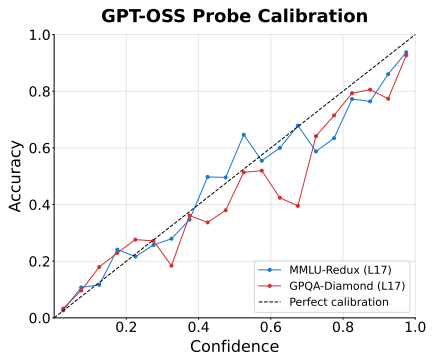
Figure 27 .Accuracy vs. confidence threshold.GPT-OSS probes for MMLU are well-calibrated, staying close to the perfect calibration line. We observe that when transferring to GPQA-D, probes are more overconfident, potentially due to direct transfer.
원문 · CC BY 4.0 · Siddharth Boppana, Annabel Ma, Max Loeffler, Raphael Sarfati, Eric Bigelow, Atticus Geiger, Owen Lewis, Jack Merullo · Reasoning Theater: Disentangling Model Beliefs from Chain-of-Thought · 원문 그림 인용 · 원본 PDF 23쪽에서 그림 영역을 추출했습니다.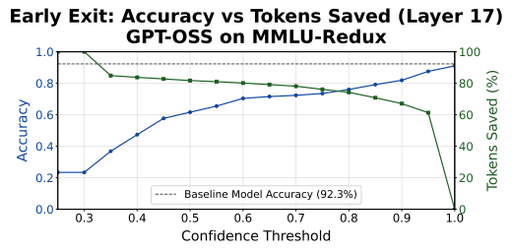
Figure 28 .Exit position vs. confidence threshold.We observe similar trends for GPT-OSS and DeepSeek-R1 on MMLU, where the majority of tokens can be saved by early exiting with 90% confidence while having a marginal drop in performance.
원문 · CC BY 4.0 · Siddharth Boppana, Annabel Ma, Max Loeffler, Raphael Sarfati, Eric Bigelow, Atticus Geiger, Owen Lewis, Jack Merullo · Reasoning Theater: Disentangling Model Beliefs from Chain-of-Thought · 원문 그림 인용 · 원본 PDF 24쪽에서 그림 영역을 추출했습니다.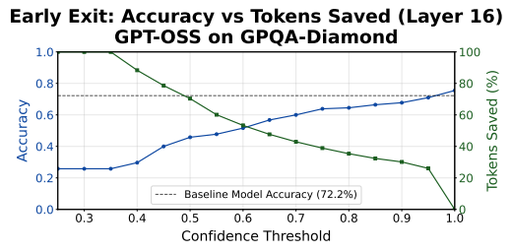
Figure 29 .Exit position vs. confidence threshold.We again see a similar trend to DeepSeek-R1, with less token saving per accuracy drop. Interestingly, our probe outperforms the original model’s accuracy at the end of reasoning.
원문 · CC BY 4.0 · Siddharth Boppana, Annabel Ma, Max Loeffler, Raphael Sarfati, Eric Bigelow, Atticus Geiger, Owen Lewis, Jack Merullo · Reasoning Theater: Disentangling Model Beliefs from Chain-of-Thought · 원문 그림 인용 · 원본 PDF 24쪽에서 그림 영역을 추출했습니다.변곡점은 내부 불확실성과 함께 나타나는가
저자들은 backtracking, realization, reconsideration 같은 변곡점을 CoT 모니터가 단계별로 식별하게 했습니다. DeepSeek-R1의 MMLU 흔적 중 프로브 확신도가 90% 이상으로 시작해 끝까지 떨어지지 않은 215/522개를 높은 확신 흔적으로 나누었습니다. 변곡점 비율은 높은 확신 흔적에서 0.020, 그 외 흔적에서 0.045로 나타나 약 두 배 차이가 있었습니다. 그러나 프로브 확신도 변화와 변곡점의 국소적 시간 관계는 일관되지 않았습니다. 예를 들어 DeepSeek-R1의 MMLU에서는 재고려 변곡점이 프로브 이동 뒤에 더 자주 나타났지만, GPQA-Diamond에서는 이 관계가 성립하지 않았습니다.
GPT-OSS에서는 방향이 달라졌고, 창 크기와 임계값에 따라 결과가 크게 바뀌었습니다.
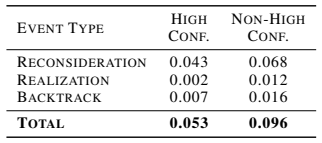
Table 7 .Inflection points by probe confidence level for GPT-OSS on MMLU (probe layer 35).The same pattern holds: high-confidence traces contain fewer inflections per step.
원문 · CC BY 4.0 · Siddharth Boppana, Annabel Ma, Max Loeffler, Raphael Sarfati, Eric Bigelow, Atticus Geiger, Owen Lewis, Jack Merullo · Reasoning Theater: Disentangling Model Beliefs from Chain-of-Thought · 원문 그림 인용 · 원본 PDF 24쪽에서 그림 영역을 추출했습니다.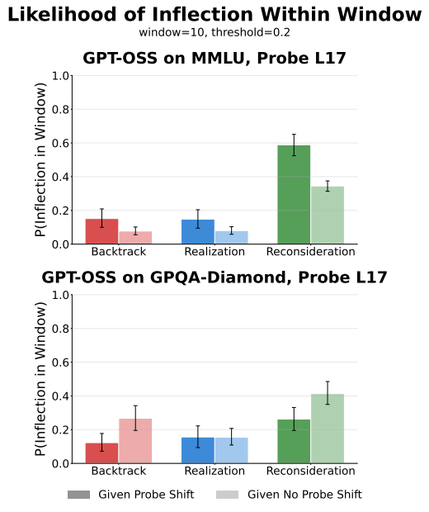
Figure 30 .Rate of inflection points occurring within windows beginning with probe shifts and windows containing no probe shifts. We observe that reconsideration points occur twice as often for 20% confidence shifts of the highest probability answer choice for MMLU with a window size of 10 steps ahead, but find no other significant trend for other answer types or for GPQA-D.
원문 · CC BY 4.0 · Siddharth Boppana, Annabel Ma, Max Loeffler, Raphael Sarfati, Eric Bigelow, Atticus Geiger, Owen Lewis, Jack Merullo · Reasoning Theater: Disentangling Model Beliefs from Chain-of-Thought · 원문 그림 인용 · 원본 PDF 25쪽에서 그림 영역을 추출했습니다.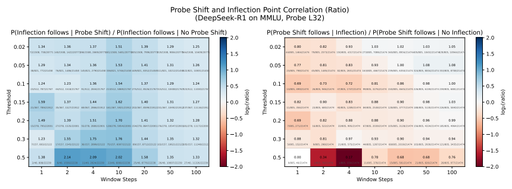
Figure 31 .Probe shift and inflection point correlation for DeepSeek-R1 on MMLU (probe layer 60).Left: inflection points are substantially more likely to follow probe confidence shifts, with the effect strongest at a high threshold (0.5) and moderate window sizes (2–10 steps), being twice as likely. Right: inflection points show either no correlation or a negative correlation depending on the window and threshold.
원문 · CC BY 4.0 · Siddharth Boppana, Annabel Ma, Max Loeffler, Raphael Sarfati, Eric Bigelow, Atticus Geiger, Owen Lewis, Jack Merullo · Reasoning Theater: Disentangling Model Beliefs from Chain-of-Thought · 원문 그림 인용 · 원본 PDF 26쪽에서 그림 영역을 추출했습니다.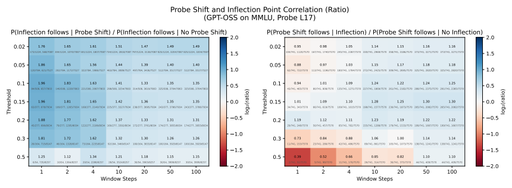
Figure 32 .Probe shift and inflection point correlation for GPT-OSS on MMLU (probe layer 35).We observe a different pattern of order here: probe shifts predict inflections (left), mainly with a window size of 1 while inflections also predict probe shifts for some window/threshold combinations. Howver, this trend is inconsistent, complicating analysis particularly in smaller window sizes.
원문 · CC BY 4.0 · Siddharth Boppana, Annabel Ma, Max Loeffler, Raphael Sarfati, Eric Bigelow, Atticus Geiger, Owen Lewis, Jack Merullo · Reasoning Theater: Disentangling Model Beliefs from Chain-of-Thought · 원문 그림 인용 · 원본 PDF 26쪽에서 그림 영역을 추출했습니다.전이와 적용 범위의 한계
GPQA-Diamond 결과는 MMLU에서 학습한 프로브 체크포인트를 추가 fine-tuning 없이 직접 전이해 얻었습니다. 저자들은 19개 학습 문항으로 fine-tuning을 시험했지만 직접 전이와 큰 차이가 없었다고 보고합니다. 따라서 GPQA-Diamond의 프로브 결과는 MMLU로 학습된 프로브가 다른 과제에 옮겨진 조건에서 해석해야 합니다. 프로브 확신도와 변곡점의 관계는 모델과 데이터셋, 창 크기에 따라 달라졌으므로 단순한 인과 패턴으로 결론짓지 않습니다. 또한 조기 종료의 절약 수치는 MMLU와 GPQA-Diamond의 해당 임계값에서 얻은 결과이며, 다른 과제에 일반화된 결과가 아닙니다.
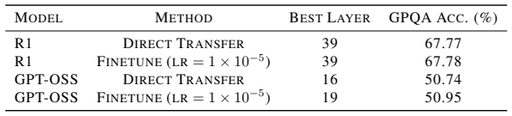
Table 6 .GPQA Transfer Results from MMLU-Redux.
원문 · CC BY 4.0 · Siddharth Boppana, Annabel Ma, Max Loeffler, Raphael Sarfati, Eric Bigelow, Atticus Geiger, Owen Lewis, Jack Merullo · Reasoning Theater: Disentangling Model Beliefs from Chain-of-Thought · 원문 그림 인용 · 원본 PDF 17쪽에서 그림 영역을 추출했습니다.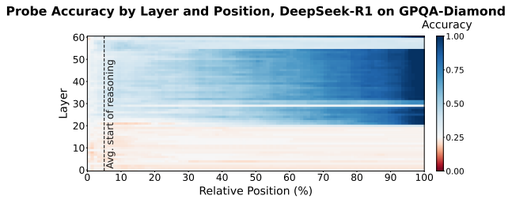
Figure 12 .Attention probe accuracy for DeepSeek-R1 on GPQA-D.Probes trained on MMLU activations are able to decode the final answer in the same layers, with worse performance generally across layers. Final answer information becomes decodable much more gradually for GPQA-D responses, implying that model computation is more genuine and requires test-time compute.
원문 · CC BY 4.0 · Siddharth Boppana, Annabel Ma, Max Loeffler, Raphael Sarfati, Eric Bigelow, Atticus Geiger, Owen Lewis, Jack Merullo · Reasoning Theater: Disentangling Model Beliefs from Chain-of-Thought · 원문 그림 인용 · 원본 PDF 18쪽에서 그림 영역을 추출했습니다.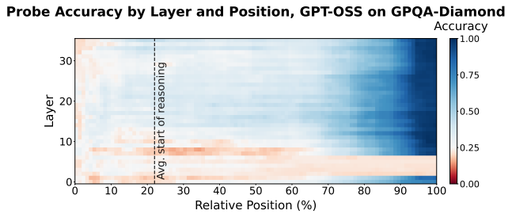
Figure 14 .Attention probe accuracy for GPT-OSS on GPQA-D.GPT-OSS MMLU probes transfer to GPQA-D as well, again showing a gradual trend over sequence length as opposed to MMLU.
원문 · CC BY 4.0 · Siddharth Boppana, Annabel Ma, Max Loeffler, Raphael Sarfati, Eric Bigelow, Atticus Geiger, Owen Lewis, Jack Merullo · Reasoning Theater: Disentangling Model Beliefs from Chain-of-Thought · 원문 그림 인용 · 원본 PDF 19쪽에서 그림 영역을 추출했습니다.논문 정보
- 저자
- Siddharth Boppana, Annabel Ma, Max Loeffler, Raphael Sarfati, Eric Bigelow, Atticus Geiger, Owen Lewis, Jack Merullo
- 학회·저널
- arXiv · 프리프린트
- 최초 공개일
- 2026년 3월 5일
- 등록일
- 2026년 11월 5일
- 수정일
- 2026년 5월 28일
- 버전
- v4
- arXiv
- 2603.05488
- 분류
- cs.CL · cs.AI · cs.LG
- 원문 이용 조건
- CC BY 4.0
- 제공 범위
- 논문 정보, 해설, 허용된 원문 그림
AI 해설은 논문 원문과 별개의 설명이며 오류가 있을 수 있습니다. 원문과 그림은 각 출처의 이용 조건과 따로 표시된 권리를 따릅니다.
초록
We provide evidence of performative chain-of-thought (CoT) in reasoning models, where a model becomes strongly confident in its final answer, but continues generating tokens without revealing its internal belief. Our analysis compares activation probing, early forced answering, and a CoT monitor across two large models (DeepSeek-R1 671B & GPT-OSS 120B) and find task difficulty-specific differences: The model's final answer is decodable from activations far earlier in CoT than a monitor is able to say, especially for easy recall-based MMLU questions. We contrast this with genuine reasoning in difficult multihop GPQA-Diamond questions. Despite this, inflection points (e.g., backtracking, 'aha' moments) occur almost exclusively in responses where probes show large belief shifts, suggesting these behaviors track genuine uncertainty rather than learned "reasoning theater." Finally, probe-guided early exit reduces tokens by up to 80% on MMLU and 30% on GPQA-Diamond with similar accuracy, positioning attention probing as an efficient tool for detecting performative reasoning and enabling adaptive computation.
원문 인용
Siddharth Boppana, Annabel Ma, Max Loeffler, Raphael Sarfati, Eric Bigelow, Atticus Geiger, Owen Lewis, Jack Merullo (2026). Reasoning Theater: Disentangling Model Beliefs from Chain-of-Thought. arXiv:2603.05488v4. https://arxiv.org/abs/2603.05488v4
BibTeX
@misc{boppana2026reasoning,
  title = {{Reasoning Theater: Disentangling Model Beliefs from Chain-of-Thought}},
  author = {Siddharth Boppana and Annabel Ma and Max Loeffler and Raphael Sarfati and Eric Bigelow and Atticus Geiger and Owen Lewis and Jack Merullo},
  year = {2026},
  eprint = {2603.05488},
  archivePrefix = {arXiv},
  url = {https://arxiv.org/abs/2603.05488v4}
}